The short answer
- Why is it empty?
- The federal database holds nothing before model year 1981. 1975 returns an empty list for every make we tested.
- Is my truck's number wrong?
- No. Fewer than seventeen characters is normal before 1981, when the standard format became required.
- So where do I look?
- The plate on the truck, the title, and marque-specific references. No federal system holds it.
1981
Earliest model year in the federal database
1975 returns nothing
4 of 154
Fields a pre-1981 number returns
Against 39 for a 1985 truck
4
Makes we ran the check on
Same result on all of them
The federal record starts at model year 1981
Most explanations of this stop at “old VINs are different.” True, and not useful. The specific reason a decoder gives you nothing is that the database it queries has an edge, and the edge is at a particular model year you can test for yourself.
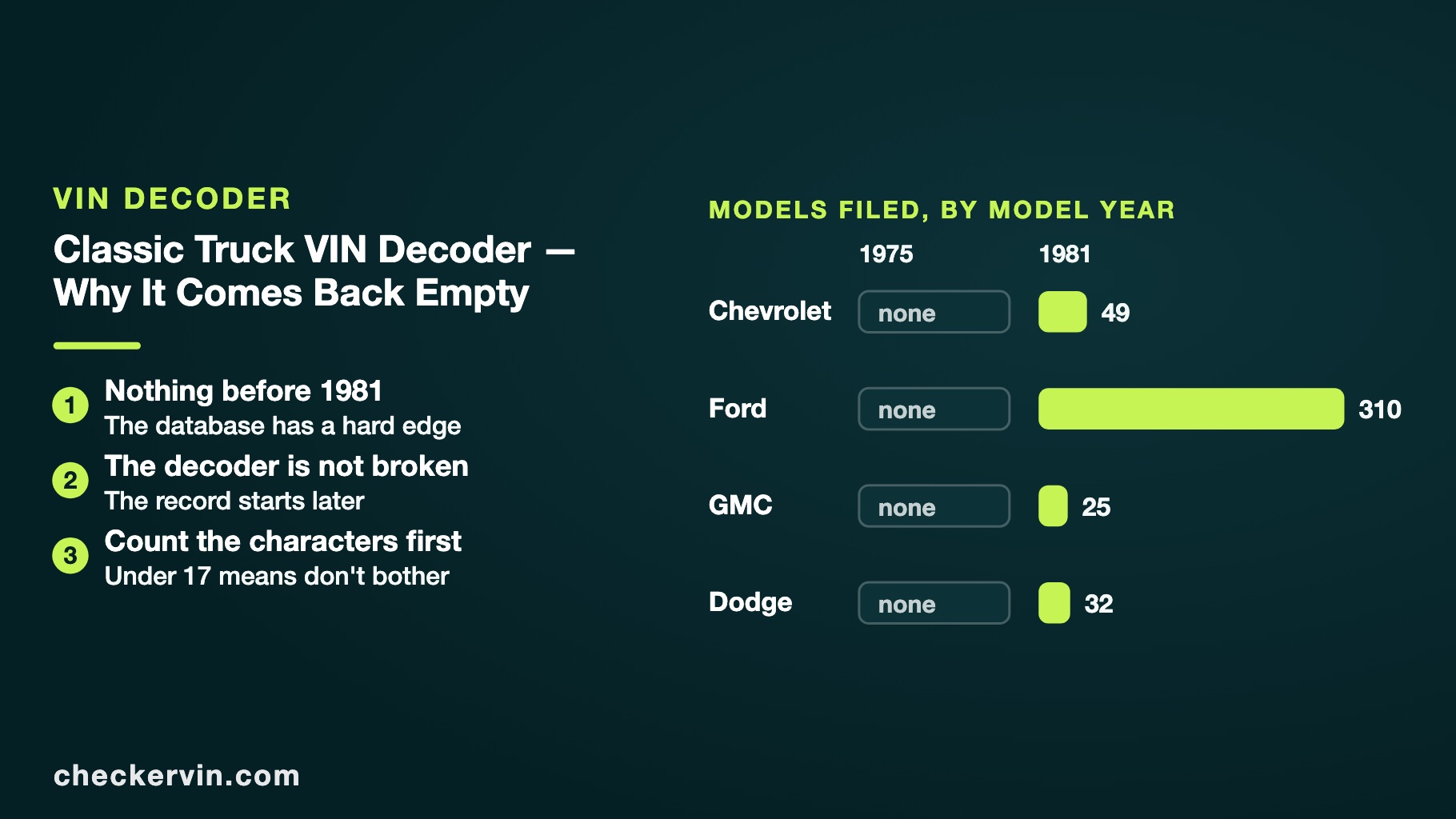
Asking the federal vehicle database which models a manufacturer filed in a given model year is a simple query. Run it on 1975 and on 1981 for the four makes that built most of the trucks people are asking about, and the difference is not subtle.
| Make | Models filed — 1975 vs 1981 |
|---|---|
| Chevrolet | 0 in 1975 · 49 in 1981 |
| Ford | 0 in 1975 · 310 in 1981 |
| GMC | 0 in 1975 · 25 in 1981 |
| Dodge | 0 in 1975 · 32 in 1981 |
Nothing at all in 1975. 416 models between them in 1981. That is the whole explanation for the empty decode, and it is why no amount of retyping the number will help.
How you know the gap is real and not a broken lookup
An empty answer from a database deserves suspicion, because a failed query and a genuine absence look identical from outside. Worth being careful here rather than asserting.
Two things settle it. First, the response comes back marked successfulwith an empty result set rather than as an error — the request was understood and the answer is that there is nothing. Second, and more convincingly, the 1981 column above is a known-positive control run through the identical query: same endpoint, same shape, one make at a time. It returns 416 rows.
Where the edge sits exactly, and where it frays
“Nothing before 1981” is close enough for most purposes, but it is worth testing rather than repeating, because the boundary is not perfectly clean and knowing where it frays saves a wasted search.
Running the same query across the boundary years, one make at a time:
| Make | 1979 · 1980 · 1981 |
|---|---|
| Chevrolet | 0 · 0 · 49 |
| Ford | 0 · 0 · 310 |
| GMC | 0 · 0 · 25 |
| Dodge | 0 · 3 · 32 |
Three of the four are empty in both 1979 and 1980 and populated in 1981. Dodge is the exception: it returns 3 models for 1980 — Ram Chassis Cab, Ram Van, Ram Wagon— all of them commercial body styles rather than pickups.
Two numbers, two very different answers
The same contrast shows up at the level of an individual decode. Run a thirteen-character number of the kind an older truck carries, then run an ordinary seventeen-character one from the mid-eighties.
| What was decoded | What came back |
|---|---|
| A 13-character pre-1981-style number | 4 of 154 fields populated, no make, no model, no year |
| A 17-character 1985 truck VIN | 39 of 154 fields, resolving to a make, a model line and a model year |
Nine times as much information from a number only four characters longer. The difference is not the length; it is that one of them is inside the system the decoder searches and the other is not.
Check any VIN free
Decoded from official manufacturer and NHTSA records
What the error message actually says
The short number does not fail silently. It returns a message, and the message is worth reading carefully because it is easy to misread as an accusation.
Read the second half slowly. It says the manufacturer identifier is not registered with the agency — which, for a truck built before the identifier system existed, is exactly what you would expect and says nothing about the vehicle. It is a statement about the database’s contents, not a finding about the truck in front of you.
This distinction matters in a sale. A seller who runs a decode, gets that message and concludes the truck has a problem has misread it; so has a buyer who takes it as a red flag. The same message on a modern vehicle would be worth stopping on, and our page on imported car VIN checks covers what it means there.
Why the number is shorter in the first place
The seventeen-character format is a federal requirement, and requirements have start dates. Before model year 1981each manufacturer used its own scheme — different lengths, different orders, different meanings for the same character position, and no obligation to make any of it consistent with anybody else.
That is why a generic decoder cannot help and why marque-specific references can. There is no single pre-1981 system to decode; there are dozens, and each one belongs to a manufacturer rather than to a standard. The structural half of this — what changed at 1981 and why — is covered on the classic car VIN decoder page, which takes the passenger-car side of the same divide.
What you can actually work from
The federal record being absent does not leave you with nothing. It leaves you with sources that are physical and documentary rather than queryable.
- The number stamped on the frame rail or the door post, read carefully
- The manufacturer's own data plate, where one is still attached
- Title and registration paperwork, which carries the number the state recorded
- Marque-specific reference works and owner registries, outside any federal system
We are not going to print per-marque code charts for pre-1981 trucks. Those decodings exist, but they live in enthusiast reference works and owner registries rather than in any source we can cite and re-check — and a chart we cannot verify is worth less than an honest pointer to the people who maintain them.
One thing to be careful about on an old truck specifically: several numbers may be stamped on it, and they are not all the vehicle’s identifying number. Establish what each number is before concluding that two of them disagree, and see where the VIN appears on a vehicle for the locations worth checking.
| A number stamped on | What it usually is |
|---|---|
| The frame rail, cowl or door post | A candidate for the vehicle's identifying number — compare it to the title |
| The engine block or head | An engine serial, which follows the engine rather than the truck |
| An axle housing or transmission case | A component serial, useful for matching-numbers claims and nothing else |
| A body or cab tag | Build information from the body plant, not an identifying number |
On a vehicle old enough to have had components replaced several times, a disagreement between the frame number and an engine stamping is the expected state of affairs rather than a warning. The comparison that matters is the one between the vehicle’s own number and the paperwork, and that is the subject of the next section.
An empty recall result is not a clean bill of health
The same edge governs the recall lookup, and this one is easier to misread because the answer looks reassuring. Enter a pre-1981 truck’s number into a recall check and it comes back with nothing, in exactly the way a clean modern vehicle does.
Those two results mean opposite things. On a modern vehicle, no open recalls means the agency holds campaign records for that VIN and none of them is outstanding. On a truck that predates the record, it means the search found no records of any kind — which is not a statement about the vehicle’s condition at all.
| Empty result on | What it actually means |
|---|---|
| A 2015 truck | The record was searched and holds nothing outstanding |
| A 1975 truck | There is no record to search — the absence is the database's, not the truck's |
It is the distinction between evidence of absence and absence of evidence, and it is the single most common way an old-vehicle lookup gets misread. Anything genuinely known about a defect on a truck of that age lives with the marque community rather than in a federal lookup.
Buying a classic truck without a decode to lean on
Everything a decode would normally do for you has to be done another way. The sequence below is what is left, in the order that costs least.
- 1Count the characters firstSeventeen means the federal database should hold it and you should run a decode. Fewer means you are working from the truck and its paperwork, and you can stop looking for an online answer.
- 2Match the number on the truck to the number on the titleCharacter for character, on the vehicle rather than from a photograph. With no database behind it, this comparison carries more weight than it does on a modern truck.
- 3Identify what each stamping isFrame, cowl, door post, engine, axle. A mismatch between the vehicle number and a component serial is not a mismatch at all.
- 4Take the paperwork chain seriouslyOlder vehicles change hands informally, and a missing link is harder to repair than on a newer one.
- 5Expect an empty recall result, and read it correctlyNo records is not the same as no problems. On a vehicle this old the absence tells you about the record rather than the truck.
The number the state recorded is the one that matters
With no federal database in the picture, the title becomes the primary document rather than a secondary one. What a state recorded when it last issued a title for the truck is, in practice, the authoritative statement of what the vehicle is.
That puts more weight on the document itself — whether it is genuine, whether it has been altered, whether the number on it matches the number on the frame. Those are checks you can run in a driveway, and we have written them up in detail on the car title check, including the security features federal rule requires on the document.
If the paperwork chain has a hole in it — a seller whose name is not on the title, or a title signed by somebody who never registered the truck — title jumping covers what that breaks and how to catch it before the money moves.
If the truck is 1981 or later, everything changes
The cliff cuts both ways. A truck from 1981 onward sits inside the federal record completely, and a free decode gives you a great deal.
| Question | Answered for a 1981+ truck? |
|---|---|
| What did the factory build? | Yes — make, model, year, body, engine, plant |
| Are there open safety recalls? | Yes, and the remedy is free |
| Has it been in a collision? | No — that is a history record |
| Is the title branded? | No |

Where this information comes from
- NHTSA vPIC — models filed by make and model yearReturns an empty result set; change 1975 to 1981 in the URL to see the control
- NHTSA vPIC — VIN decoding APISource of both decodes and of the error text quoted above
- 49 CFR Part 565 — Vehicle identification number requirementsThe rule that fixed the seventeen-character format and its content
- NHTSA recalls by VINThe recall lookup that returns nothing for the same reason a decode does
Frequently asked questions
Why does my classic truck VIN decoder return nothing?
Because the federal vehicle database does not hold anything before model year 1981. Ask it for Chevrolet models in 1975 and it returns an empty list — successfully, not as an error. Ask for 1981 and the same query returns forty-nine. The decoder is working; the record simply starts later than the truck does.
How many characters should a classic truck VIN have?
Fewer than seventeen, and how many fewer depends on the maker and the year. The seventeen-character format became the required standard for model year 1981, and before that manufacturers used their own schemes of varying length. A shorter number on an older truck is normal rather than a sign that something is missing or has been altered.
What does error 7 mean when I decode an old truck?
The federal decoder returns it when the manufacturer identifier in the number is not registered with NHTSA for sale in the United States. On a pre-1981 truck that is expected — the identifier system it would be checked against did not exist yet — so the message describes the database rather than the vehicle. It is not a statement that the truck is illegitimate.
Can I decode a 1972 Chevy truck VIN online?
Not through the federal database, which holds nothing for that model year. Marque-specific reference works and owner registries do decode those schemes, and they are the right place to go. What no such source can give you is a recall record or an official build confirmation, because neither exists in a federal system for a vehicle that predates the requirement.
Is a shorter VIN a problem when I go to register the truck?
It is normal, and states handle older vehicles routinely. What matters is that the number on the vehicle matches the number on the title, character for character. That comparison is the same one you would run on a modern truck, and on an older one it matters more because there is no federal database to fall back on if the two disagree.
Do classic trucks have recalls?
Any campaign issued for them would predate the record that a VIN lookup searches, so a modern recall check on a pre-1981 truck will come back empty for the same reason a decode does. That emptiness is not a clean bill of health — it is an absence of records, which is a different thing and worth being precise about.
Where is the VIN on an old truck?
It varies far more than on a modern vehicle — a plate on the door post, a tag on the cowl, a stamping on the frame rail, or several of those carrying different numbers for different components. Before you conclude that two numbers disagree, establish what each one is for, because an engine or axle stamping is not the vehicle's identifying number.
Keep reading
Decode a truck VIN free
Factory build, specifications and open safety recalls, for model year 1981 and later.
Run a free VIN check