The short answer
- What will a decode give me?
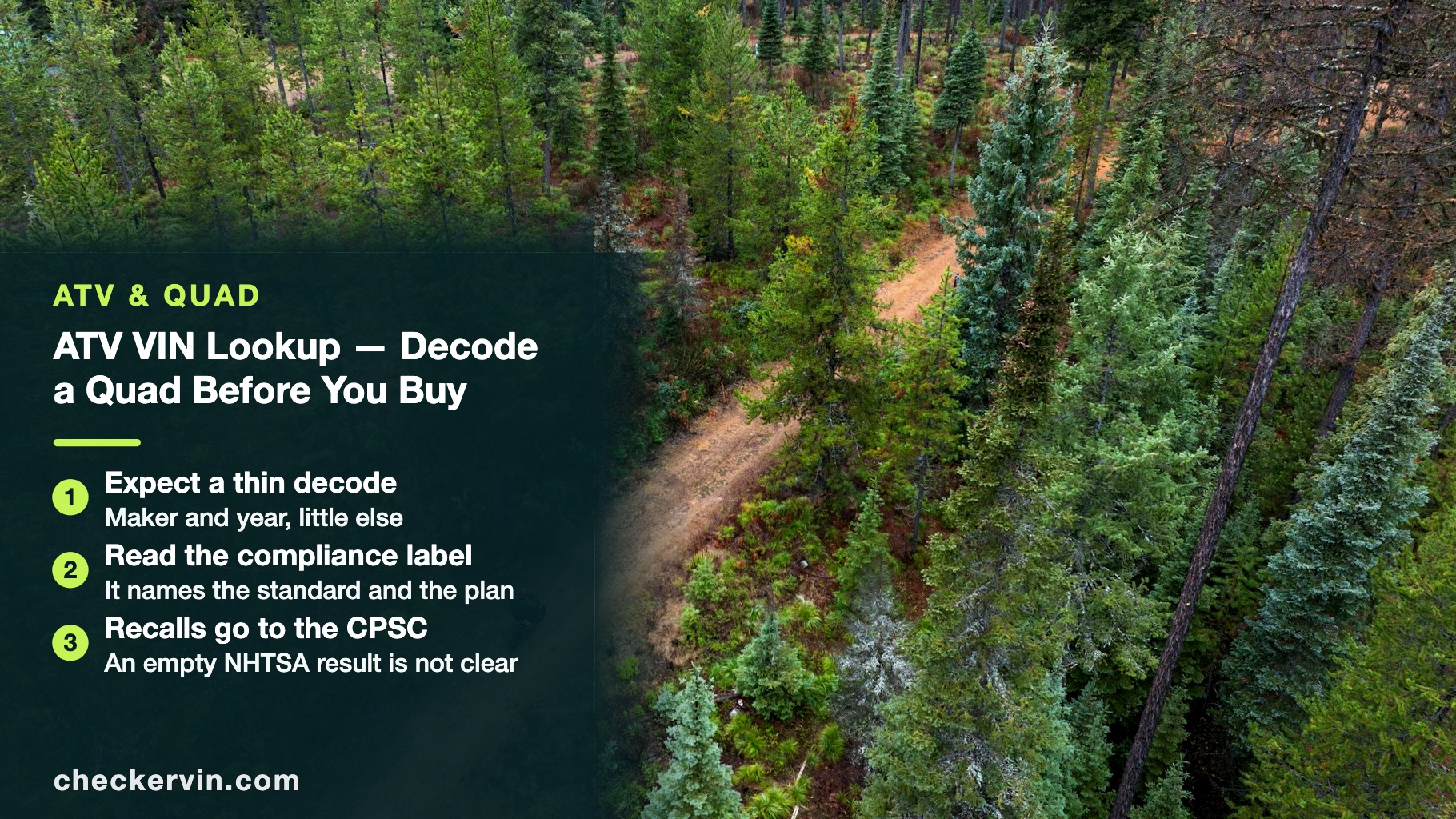
- Usually the manufacturer and the model year. The specification fields that fill for a car are mostly empty for a quad.
- Why so little?
- An ATV is a consumer product under the CPSC, not a motor vehicle under NHTSA, so the federal VIN scheme was never built around it.
- What should I check instead?
- The compliance label on the machine, the CPSC recall list, the free NICB theft screen, and your own state's titling rule.
3 or 4
Wheels, in the federal definition
Which is what excludes a dirt bike
CPSC
The agency that regulates it
Not NHTSA, which is why recalls differ
2025
New ANSI standard applies
Machines built on or after January 1
What the law actually calls an ATV
It is worth starting with the definition, because it is unusually precise and it settles several arguments at once. Under 16 CFR § 1420.2, an all-terrain vehicle is:
Three elements, and each one excludes something people often lump in with quads. Three or four wheels rules out a dirt bike. A straddle seat and handlebars rule out a side-by-side, which has a bench or bucket seat and a steering wheel. And “off-highway” is what keeps the whole category outside the road-vehicle system that governs cars.
| Machine | Inside the federal ATV definition? |
|---|---|
| Four-wheel quad with handlebars | Yes — the central case the standard was written for |
| Three-wheeler | Yes by the wheel count, though these have not been sold new in the US for decades |
| Dirt bike | No — two wheels |
| Side-by-side or UTV | No — steering wheel and a non-straddle seat |
| Golf cart | No — not off-highway in this sense, and no handlebars |
That matters when you are reading anything about ATVs, including safety data, recall notices and state law. A rule written for “ATVs” may simply not reach the side-by-side in the same barn. Our dirt bike guide covers the two-wheel side, and the Polaris guide works through one manufacturer’s numbering across all of its machine types.
The standard your quad was built to, and the 2025 line
Cars are built to Federal Motor Vehicle Safety Standards. ATVs are built to a voluntary industry standard that federal rule then makes mandatory, which is a different mechanism with a practical consequence for used buyers.
§ 1420.3 requires every new four-wheel ATV to comply with the American National Standard for Four-Wheel All-Terrain Vehicles. Which edition depends on when the machine was manufactured:
| Manufactured | Standard it must comply with |
|---|---|
| Before January 1, 2025 | ANSI/SVIA 1-2017, approved June 8, 2017 |
| On or after January 1, 2025 | ANSI/SVIA 1-2023, approved March 17, 2023 |
For a buyer the useful part is not memorizing edition numbers. It is knowing that the machine carries a compliance claim tied to a dated standard, and that the date is a manufacturing date rather than a model year. On a quad built close to the changeover, those two can differ, and the label on the machine is what settles it.
Two details in that rule are worth having, because both are the sort of thing that only shows up if somebody read it. The 2023 edition applies from the changeover with one carve-out: for Section 4.21, the owner’s manual, a machine continues to comply with the 2017 edition. And the standard itself is incorporated by reference rather than reprinted in the regulation, which means the document your quad was built to is published by the Specialty Vehicle Institute of America and is not free to read. You can confirm which edition applies from the rule; you cannot read what it requires without obtaining the standard.
The rule does not stop at construction. It also requires the machine to carry a label — one that certifies compliance, identifies the manufacturer, importer or private labeler, and identifies the ATV action plan to which it is subject. The manufacturer or distributor must then actually comply with that plan.
That last clause is what makes the label worth finding on a used machine. It is not simply a compliance sticker: it names the undertaking the maker gave about how these machines would be sold and supported, which is the subject of the next section.
The ATV action plan, and why age recommendations exist
There is a second obligation in the same part that most owners have never heard of, and it explains something visible on every dealer floor. The rule defines an ATV action plan as a written plan or letter of undertaking describing what a manufacturer or distributor will do to promote ATV safety.
- Rider training, and how it is offered to purchasers
- Dissemination of safety information
- Age recommendations for the machines being sold
- Other policies governing the marketing and sale of the ATVs
- Monitoring of those sales
Read the third item alongside the second-hand market. The age recommendations attached to ATVs are not marketing caution or a dealer’s own policy. They come out of an undertaking the manufacturer made about how its machines would be sold, and a youth model carries one for reasons that were written down.
When a used quad changes hands privately, the plan does not travel with it — there is no dealer in the transaction to run training or hand over safety material. That is a reasonable argument for treating the age recommendation on a used youth machine as information you should go and find, since nobody in a private sale is obliged to raise it.
Three-wheelers, and the rule that ended them
The federal definition covers machines on three or four wheels, which raises an obvious question: where are the three-wheelers? The answer is a single sentence of regulation, and it is more absolute than most people assume.
Read the structure of that. It is not a ban with an expiry date; it is a prohibition that lifts only if a mandatory standard for three-wheel machines is ever written. None has been. The practical effect is that new three-wheelers cannot lawfully be imported or distributed here, and have not been for a very long time.
For a buyer this matters in a narrow but real way. A three-wheeler you encounter is necessarily an old machine, which means parts supply, tire availability and any surviving documentation are all questions before condition is. It also means the whole four-wheel standard above — the ANSI edition, the compliance label, the action plan — describes a system that machine was never inside. Whatever labeling it carries predates the framework this page has been describing.
None of that makes owning one unlawful. The prohibition runs against importing and distributing new machines in commerce, not against a private sale of something that has been in the country for decades. But it does mean a three-wheeler sits outside every check on this page except the theft screen and your own eyes.
Why the decode comes back thin, and disagrees with itself
Run an ATV VIN through the federal decoder and the result is usually disappointing: a manufacturer, a model year, and a row of empty attribute fields where a car would return engine configuration, body class and restraint systems. The reason is structural rather than a fault in any particular tool.
NHTSA’s catalog holds what manufacturers submitted under rules written for road vehicles. Powersports makers registered manufacturer identifiers because they need them, but the attribute reporting that fills a car’s decode was never required of them. There is nothing to withhold and nothing a paid decoder can unlock.
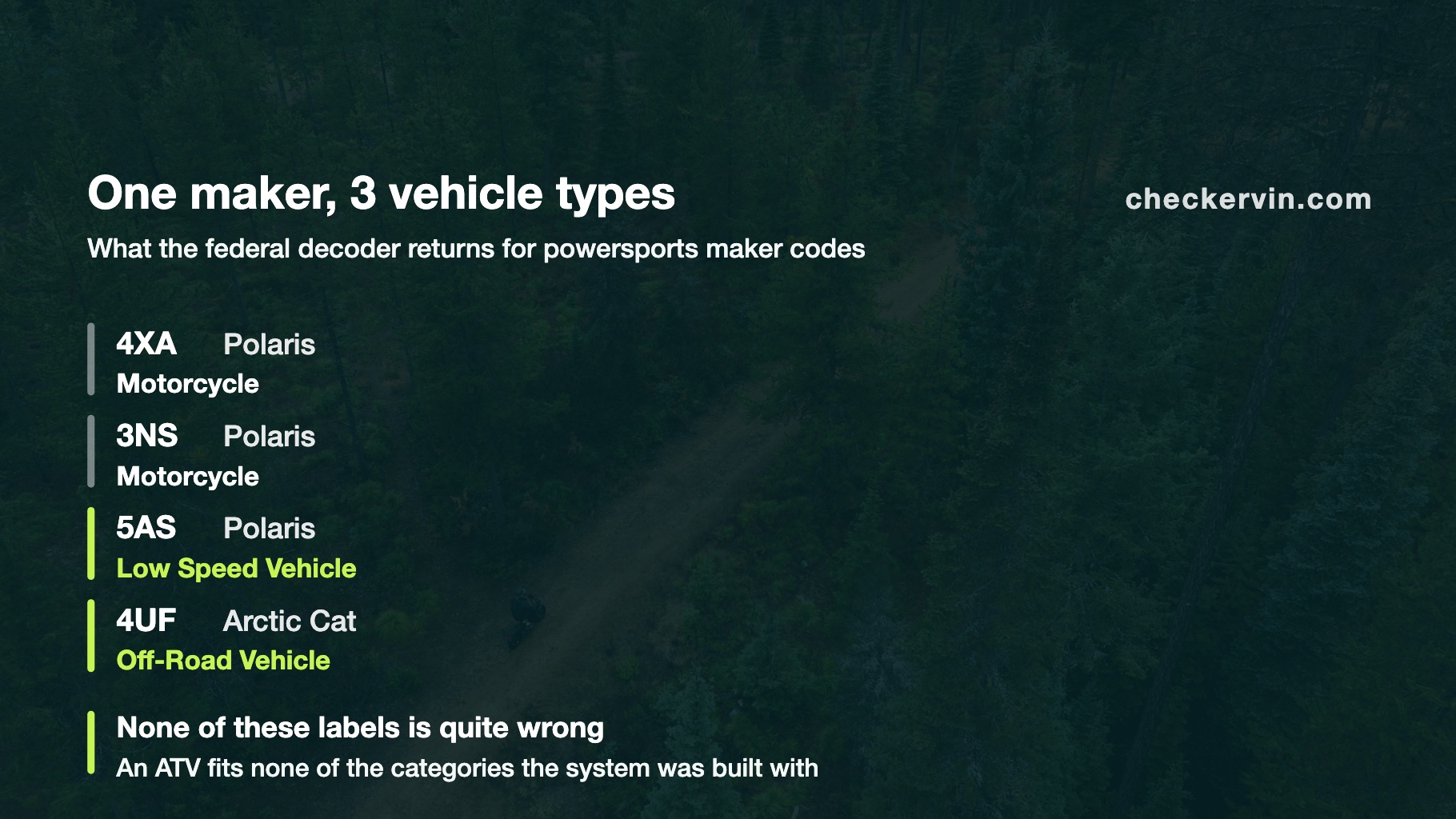
The inconsistency is easy to demonstrate. These are manufacturer identifiers as the federal decoder returns them today:
| Identifier | Maker, and the vehicle type the decoder reports |
|---|---|
| 4XA | Polaris — Motorcycle |
| 3NS | Polaris — Motorcycle |
| 5AS | Polaris — Low Speed Vehicle (LSV) |
| 4UF | Arctic Cat — Off-Road Vehicle |
One manufacturer, 3 different vehicle typesacross four identifiers. Polaris machines come back as motorcycles under two of its codes and as a low speed vehicle under a third, while Arctic Cat returns off-road vehicle. None of those labels is wrong exactly — they are the categories that existed when each identifier was registered, and an ATV does not fit any of them cleanly.
It is worth being fair to the decoder here. It is not broken and nobody has miscoded anything. A category that federal vehicle law does not regulate was fitted into a catalog built entirely out of the categories that law does regulate, and the seams show.
The lesson for a buyer is to stop expecting the decode to characterize the machine. Use it for what it does reliably: confirming the maker and the model year against what the seller told you. Everything else comes from the machine.
Youth machines, and the recommendation that does not travel
Youth ATVs deserve their own paragraph because the second-hand market handles them badly, and the reason connects directly to the action plan above.
Age recommendations on these machines are not a dealer’s house rule or a manufacturer being cautious in its marketing. They come out of a written undertaking about how the machines would be sold — the plan covers age recommendations, rider training and the monitoring of sales, and the manufacturer is obliged to comply with it. When you buy a youth quad new, that whole apparatus is in the room with you.
In a private resale, none of it is. There is no dealer to run training, nobody obliged to hand over safety material, and no monitoring of who the machine is sold to. The machine is identical; the framework around it has quietly gone.
- Find the age recommendation on the machine's own label rather than asking the seller
- Treat a youth model as sized for a rider, not merely as a smaller quad
- Ask whether the speed limiter is present and unmodified — removing one is common and undocumented
- Get the owner's manual if it still exists, since the standard requires one to have been supplied
That third item is worth pressing on. A limiter is trivial to defeat and leaves no record, so a used youth machine may be faster than the label on it implies. Nothing in the VIN, the decode or any database will tell you — it is a question for the seller and a thing to look at on the machine.
Where the numbers are on a quad
Unlike a car, where two locations settle it, an ATV can carry its identity in several places and the engine number is a separate thing entirely.
| What to look for | Where it usually is |
|---|---|
| Frame VIN | Stamped on the frame, commonly on the left rear or near the steering head |
| Compliance label | A durable label stating the standard complied with and the manufacturing date |
| Engine serial | Cast or stamped into the engine case — a different number, tracking a different history |
| Model and specification decal | Often under the seat or inside a fender well |
Two habits are worth building. Photograph the frame stamping and the compliance label before you talk price, because both are hard to dispute later. And record the engine serial separately, because an engine swap is common on used quads and is not a defect in itself — but a machine whose engine number does not match its paperwork is a different conversation from one where the seller volunteers the swap.
Recalls come from a different agency
A recall check on an ATV goes to the Consumer Product Safety Commission. Running the machine through NHTSA’s recall lookup — the one that works so well for cars — will usually return nothing at all.
That empty result is the single most misread thing in this category. It does not mean the machine has no open recalls. It means you asked an agency that does not regulate it. Our Polaris guide works through the two-stream problem in detail for machines that span both worlds, and the same logic applies to any quad.
Theft, and the free screen worth two minutes
Quads are stolen at a rate that surprises people coming from cars, for reasons that are not mysterious: they are stored outdoors or in unlocked outbuildings, they are light enough to lift into a truck, and a great many have never been titled anywhere.
The National Insurance Crime Bureau’s free VINCheck screen accepts powersports numbers. It reports theft and total-loss records filed by participating insurance carriers, so a clean result is meaningful rather than conclusive. Our guide to that screen covers how to read a hit and the daily search limit.
Titles, where they exist at all
The paperwork question is where ATV buyers most often get caught, because the honest answer is that it depends on the state to a degree that has no equivalent in the road-car world. Some states title quads much as they title cars. Some register them without issuing a title. Some do neither, and ownership travels on a bill of sale.
The practical consequence is that “it has no title” is a perfectly normal statement about a used ATV in some states and a serious problem in others, and only your own state’s rule tells you which. Settle it before you agree a price, because a machine you cannot register is worth materially less than one you can.
Our Polaris guide sets out how widely the titling rules vary and what to ask your state agency.
Buying a used quad: the sequence that catches most problems
None of the checks below costs anything except the last, and the order matters because each one can end the process before you spend on the next.
- 1Photograph the frame number and compliance labelBefore any negotiation. These are the two things a seller cannot revise afterward, and the label carries the manufacturing date.
- 2Decode the VIN for maker and yearExpect a thin result. What you are testing is whether the maker and year agree with the advertisement.
- 3Run the free NICB theft screenTwo minutes. On a category with this much outdoor storage and this little titling, it earns its place.
- 4Check CPSC recalls, not NHTSAAn empty NHTSA result means you asked the wrong agency, not that the machine is clear.
- 5Confirm your state's titling ruleBefore agreeing a price. Whether a title exists changes what the machine is worth to you specifically.
- 6Then inspect it, or pay someone who canFrame cracks at the welds, bent axles, water in the case, worn CV boots. No lookup at any price sees any of it.
Step two, free: decode the VIN
Decoded from official manufacturer and NHTSA records
Where this information comes from
- 16 CFR Part 1420 — safety standard for all-terrain vehiclesThe federal definition of an ATV, and the ANSI standard each machine must comply with
- CPSC — recallsThe agency that regulates ATVs, and therefore the one holding their recalls
- NICB VINCheckFree theft and total-loss screen, which accepts powersports numbers
- NHTSA vPIC — VIN decoderThe federal decoder, and the source of the manufacturer identifier results above
Keep reading
Frequently asked questions
Do ATVs have a 17-character VIN?
Most modern ones do, but not because federal VIN rules require it. An ATV is a consumer product regulated by the Consumer Product Safety Commission rather than a motor vehicle regulated by NHTSA, so the VIN standard that governs cars does not apply. Manufacturers use seventeen-character numbers anyway because dealers, insurers and state agencies expect them. Older and imported machines vary, and a shorter frame number is not automatically a problem.
Why does an ATV VIN decode return so little?
Because the federal decoder was built for road vehicles. It holds the manufacturer identifiers powersports makers registered, so it can usually name the maker and the model year, but the attribute fields it fills for cars are largely empty for quads. It is also inconsistent about what an ATV even is — the same manufacturer can appear under different vehicle types depending on which identifier you look up.
Where do I check ATV recalls?
The Consumer Product Safety Commission, not NHTSA. Running an ATV through a NHTSA recall lookup usually returns nothing at all, and that empty result is a fact about which agency regulates the machine rather than a clean bill of health for it.
Can I check whether an ATV is stolen?
The National Insurance Crime Bureau's free VINCheck screen accepts powersports numbers and is worth the two minutes on any machine you are serious about. It reports what participating insurance carriers filed, which means a clean result is meaningful without being a guarantee. Theft is a bigger risk on quads than on cars because many are stored outdoors and a great many were never titled.
Is a side-by-side the same as an ATV?
Not under the federal definition, and the distinction has consequences. 16 CFR 1420.2 defines an ATV as a machine with a straddle seat and handlebars, so a side-by-side — bench or bucket seats, a steering wheel, usually a roll cage — falls outside it. Rules, standards and recall notices written for ATVs may therefore not reach the side-by-side parked next to it, which is worth remembering when you are reading anything that says ATV and thinking about a UTV.
What if the frame number is unreadable?
Corrosion is normal on a machine stored outdoors and does not by itself mean anything. What matters is the pattern: uneven character spacing, grinding marks, filing, or a plate that looks newer than the metal around it are different from weathering. Photograph what is there, compare it against every piece of paperwork the seller has, and treat a number you cannot reconcile as a reason to walk away rather than a puzzle to solve after paying.
Does my ATV need a title?
It depends entirely on your state, and the variation is wider than for any road vehicle. Some states title ATVs like cars, some register them without issuing a title, and some do neither and rely on a bill of sale. That is why the paperwork question on a used quad has to be answered locally before you agree a price rather than after.
Decode any VIN free
Factory build, specifications and open safety recalls, from official manufacturer and NHTSA data. No account, no card.
Run a free VIN check