The short answer
- When were the MK names used?
- 2007 to 2020 in the federal filings — 14 model years, with none before or after.
- Why does it say Ford?
- Because Ford Motor Company is the manufacturer. Lincoln files no identifiers of its own.
- What is filed under Lincoln?
- One identifier, belonging to a trailer builder with the same name. Not the car company.
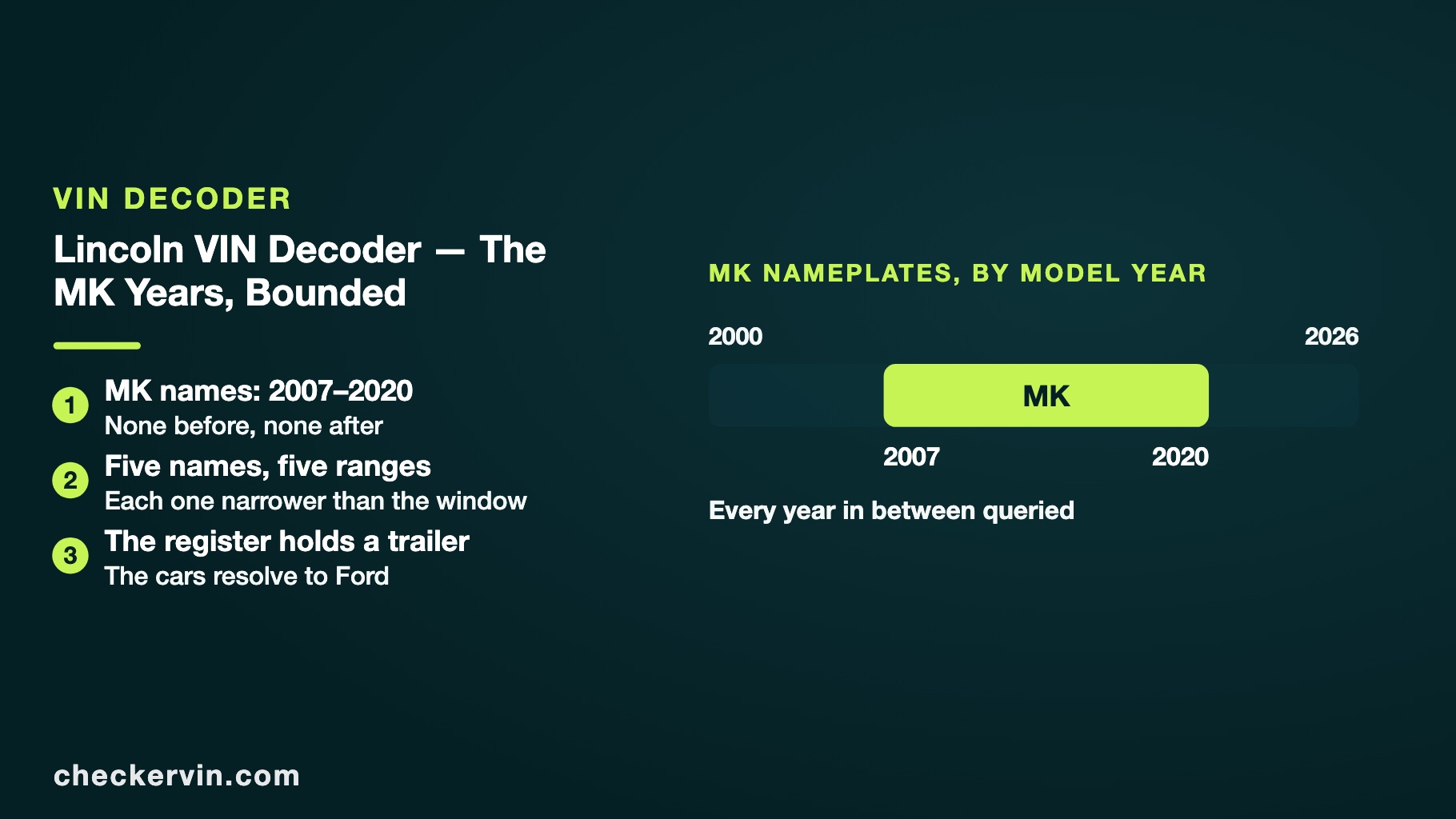
2007–2020
Model years with MK nameplates
14 years, none outside
5
Distinct MK names in the filings
MKC, MKS, MKT, MKX, MKZ
1
Identifiers filed under Lincoln
And it is a trailer builder
The MK nameplates have hard edges
Ask the federal database which models were filed under Lincoln in a given model year, walk it across two decades, and a clean rectangle appears.
Model year 2006contains no MK nameplate at all — the list reads LS, Mark LT, Navigator, Town Car and Zephyr. Model year 2007 is the first with any, and it arrives with two: MKX and MKZ. They accumulate from there. By 2020 only one is left, and model year 2021 contains none.
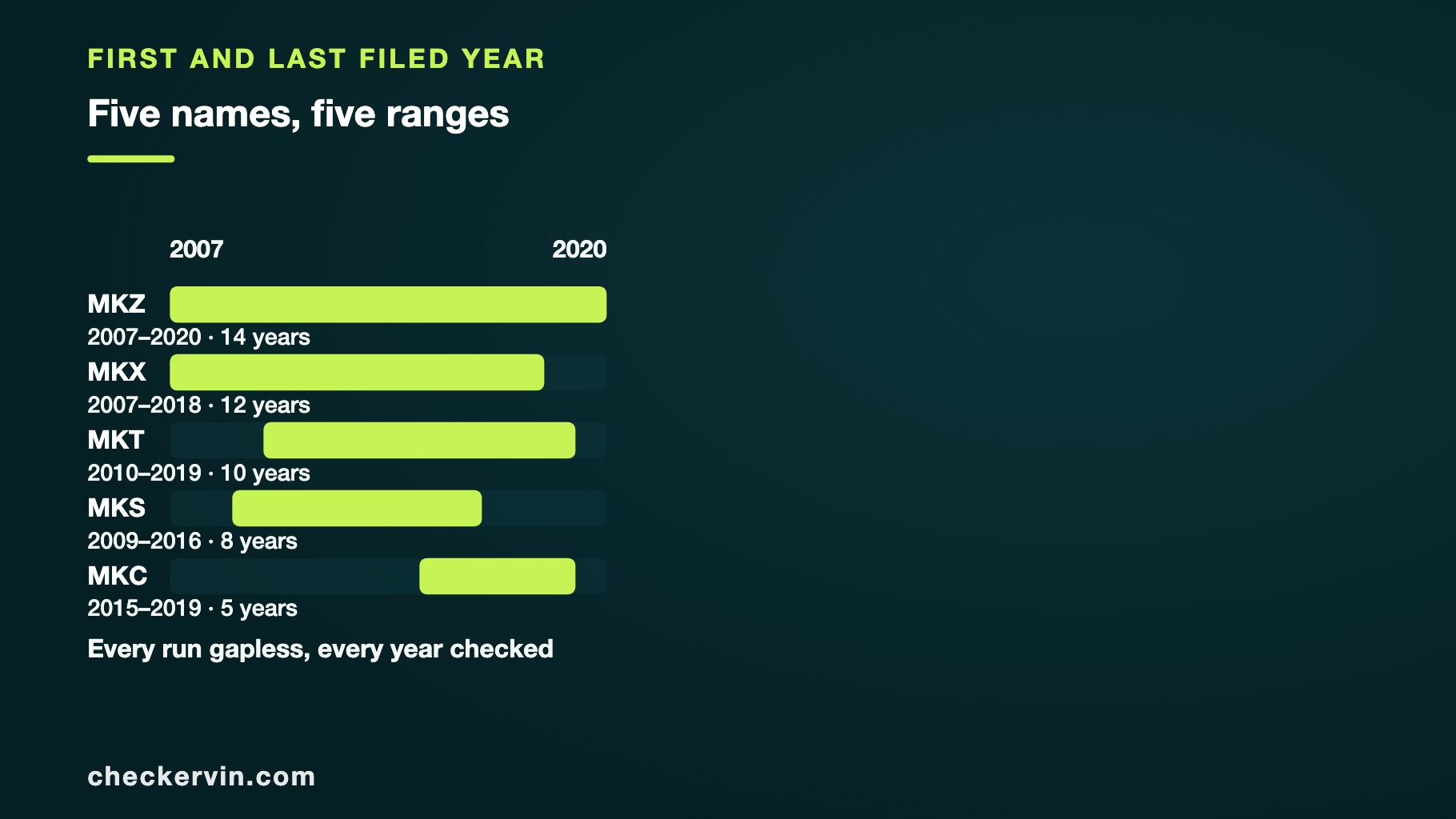
The 5 distinct MK names in the filings are MKC, MKS, MKT, MKX, MKZ. Each has its own narrower run inside the window — MKX and MKZ from the start, MKS and MKT arriving later, MKC later still.
Why a bounded window is worth knowing
A model name that only existed for a fixed span is a free consistency check, and it is the kind that catches the two most common listing problems without any effort.
| What you are looking at | What the window tells you |
|---|---|
| An MK name with a year outside the window | The year or the model is wrong — resolve it before anything else |
| An MK name with a year inside it | Consistent so far; check the name’s own run next, which is narrower |
| A current Lincoln name on an older car | Aviator, Corsair and Nautilus are filings from 2019 onward — check the year |
| A decode returning a name you did not expect | The filing, not a fault. Names moved twice on this marque |
None of that requires a paid report or a phone call. It requires the model year, which is encoded in the tenth character of the VIN, and a decode is free. If you want the mechanics of reading that character yourself, how to read a VIN covers all seventeen positions.
Check any VIN free
Decoded from official manufacturer and NHTSA records
Each MK name is its own, narrower date range
The 2007–2020window is the outer boundary. Inside it, each nameplate has its own run, and those are considerably tighter — which makes them a better check than the window itself.
We queried every model year from 2007 to 2020 rather than interpolating between samples, so these are the actual first and last filings for each name:
| Nameplate | Filed in model years |
|---|---|
| MKZ | 2007–2020 · 14 model years |
| MKX | 2007–2018 · 12 model years |
| MKT | 2010–2019 · 10 model years |
| MKS | 2009–2016 · 8 model years |
| MKC | 2015–2019 · 5 model years |
Every one of those runs is gapless— no name disappears for a year and returns. So the range is a genuine interval rather than a scattering, which is what makes it usable as a test.
It also explains why the window has soft-looking edges from the outside. MKZ alone spans the full 14 years, so it is the nameplate that defines both boundaries; the others start later, finish earlier, or both. Someone reasoning from a single model would get a different answer depending on which one they picked.
What was filed, model year by model year
The whole argument is visible in the lists themselves rather than in a summary of them.
| Model year | Models filed |
|---|---|
| 2000 | Continental, LS, Navigator, Town Car |
| 2006 | LS, Mark LT, Navigator, Town Car, Zephyr |
| 2007 | MKX, MKZ, Mark LT, Navigator, Town Car |
| 2010 | MKS, MKT, MKX, MKZ, Navigator, Town Car |
| 2015 | MKC, MKS, MKT, MKX, MKZ, Navigator |
| 2019 | Continental, MKC, MKT, MKZ, Nautilus, Navigator, Navigator L |
| 2020 | Aviator, Continental, Corsair, MKZ, Nautilus, Navigator, Navigator L |
| 2021 | Aviator, Corsair, Nautilus, Navigator, Navigator L |
Two transitions rather than one. Names give way to MK codes around 2007, and codes give way to names again at the other end — but the second changeover overlaps: in 2019 the list holds Continental, Nautilus and Navigator alongside MKC, MKT and MKZ. So there is a stretch where both conventions are live at once, which is exactly where a listing and a decode are most likely to disagree without either being wrong.
Notice also that Navigator runs straight through all of it. It is filed in every year in the table, on both sides of both transitions, which makes it the one Lincoln nameplate the window tells you nothing about — a year check against the name is useless there, and the decode has to do the work instead.
The other detail worth carrying into a listing is that Navigator L is filed as a separate model from Navigator rather than as a trim of it. So a decode returning one and an advertisement saying the other is a real difference in what was built, not a wording choice, and it is the kind of thing that changes what the vehicle is worth.
Search the register for Lincoln and you get a trailer company
Here is the second surprise, and it is a reminder that the register is organized by manufacturer rather than by badge.
One row, a six-character identifier of the kind issued to low-volume manufacturers, filed by a company that builds trailers and happens to share the name. Nothing in that result has anything to do with the cars.
That is because Lincoln is a division rather than a manufacturer, so it files nothing of its own — a shape we covered in detail on the Pontiac VIN decoder, where the same query returns nothing at all. The Lincoln version is stranger only because the name is not unique.
What the number actually resolves to
If the register does not hold the marque, the association has to come from the decode. It does, and it takes three characters to see it.
| Partial VIN | What comes back |
|---|---|
| 5LM* | LINCOLN · FORD MOTOR COMPANY · MPV |
| 1LN* | LINCOLN · FORD MOTOR COMPANY · Passenger car |
Both return the Lincoln make with Ford Motor Company as the manufacturer, separated by vehicle type rather than by badge. A decoder naming Ford on a Lincoln is reading the record correctly, and the field worth looking at instead is the model.
For the Ford-badged side of the same company, the Ford VIN decodercovers that marque’s own numbering.
A count from this endpoint is not a count of models
One caution if you run these queries yourself and compare your numbers to the table above. The raw responses contain duplicates.
Town Car is returned twice in 2006, 2007 and 2010. MKT is returned twice in 2019. The table on this page lists distinct names, which is why a raw row count will come out higher.
We have hit it on three marques now while building these pages. A 1995 response for one make returned thirteen rows covering seven names, with six of them doubled. Another returned the same nameplate twice inside a single model year. And here it is again on Town Car and MKT. Three sightings across unrelated makes is a property of the endpoint rather than a quirk of any one manufacturer’s filings.
The reason it matters beyond tidiness is that these counts get used as evidence. A chart of “models offered per year” built on raw rows would show a decline wherever duplication happened to fall away, and that decline would be entirely manufactured. Every figure on this page counts distinct names for exactly that reason, and the figures in the table can be reproduced from the source URLs at the bottom.
What the model year is, and what it is not
Everything above rests on the model year, so it is worth being precise about what that field means before leaning on it.
The model year is a designation the manufacturer assigns, encoded in the tenth character of the VIN. It is not the date the vehicle was built and it is not the date it was first sold. Production for a given model year commonly begins in the previous calendar year, so a car built in the autumn of one year is routinely a following-year model.
| What people mean by “year” | Where it comes from |
|---|---|
| Model year | Position ten of the VIN — the manufacturer's designation, and what these filings are indexed by |
| Build date | The certification label, not the VIN |
| First sold or registered | Title and registration records, not the vehicle |
For the checks on this page that distinction is helpful rather than a complication. The nameplate runs are indexed by model year and so is position ten, so the two are comparing like with like. Where it bites is in conversation with a seller: “it is a 2015” can mean any of the three, and only one of them is the one the filings answer.
What a decode returns, and what it does not
Worth being exact, because the same phrase covers two different products.
| Question | Answered by a decode? |
|---|---|
| What did the factory build? | Yes — make, model, year, body class, engine, plant |
| Which company is the manufacturer? | Yes — Ford Motor Company |
| Are there open safety recalls? | Yes, and the remedy is free |
| Which options were fitted? | Not reliably — those fields are inconsistently populated |
| Has it been in a collision? | No |
| Is the title branded? | No |
Buying a used Lincoln: the order that costs nothing
Arranged around what is specific to this marque rather than generic to used cars.
- 1Read the VIN off the car and decode itWindshield base and door-opening label, compared character by character. Expect Ford Motor Company as the manufacturer — that is correct.
- 2Check the model name against the windowAn MK name belongs to 2007–2020. Outside that, something in the listing is wrong.
- 3Treat the overlap years carefullyAround 2019 both naming conventions are live, so a name that looks anachronistic may simply be from the crossover.
- 4Run the recallsFree to check and free to fix. Do it before you discuss price rather than after.
- 5Do not treat the options fields as a build sheetWhat comes back is reliable; what is blank is unfilled data rather than a statement about the car.
- 6Then buy the historyThe build record says nothing about collisions, brands or mileage. That is a separate search and the one worth paying for.
Where this information comes from
- NHTSA vPIC — models filed by make and model yearSource of the census; change the year in the URL to reproduce it
- NHTSA vPIC — WMIs filed by manufacturerReturns the single trailer-builder row quoted above
- NHTSA vPIC — VIN decoding APIThe partial decodes that resolve 5LM and 1LN to Lincoln
- 49 CFR Part 565 — Vehicle identification number requirementsThe rule behind the seventeen positions and the manufacturer identifier
Frequently asked questions
What years did Lincoln use MK names?
In the federal model filings the MK nameplates run from 2007 to 2020 and nowhere else — 14 model years. 2006 has none, 2021 has none, and by 2020 only one is left. So any MK model has a bounded window it must sit inside, which is a fast check against a listing.
Why does my Lincoln VIN decode to Ford Motor Company?
Because that is the manufacturer. Lincoln is a division rather than a company that files identifiers of its own, so the decode names the parent. Partial decodes beginning 5LM and 1LN both return the Lincoln make with Ford Motor Company as the manufacturer, and that is the register being accurate rather than losing the marque.
What replaced the MKX and the MKZ?
The filings show names returning rather than codes. From 2021 the Lincoln list reads Aviator, Corsair, Nautilus, Navigator and Navigator L. Nautilus appears alongside MK names in 2019, so the changeover overlaps rather than switching cleanly at one model year.
Is a Lincoln VIN different from a Ford VIN?
It follows the same seventeen-character federal format, and the manufacturer it resolves to is the same company. What differs is the identifier itself and the model field. If you are decoding a Ford-badged vehicle, our Ford page covers that marque's own numbering.
How many identifiers are filed under Lincoln?
Exactly one, and it does not belong to the car company. The register returns a single six-character identifier filed by Lincoln Center Manufacturing, LLC for trailers. Everything wearing a Lincoln badge on the road is filed under Ford Motor Company, which is why searching the register by the marque name is the wrong query.
Can a VIN decode tell me a Lincoln's options?
It returns what the manufacturer filed — make, model, model year, body class, engine, plant, vehicle type. Trim and option packages are inconsistently populated in the federal data and should not be treated as a build sheet for the specific car. What is returned is reliable; what is missing is missing rather than absent from the vehicle.
Does a decode show recalls on a Lincoln?
Yes, and it is the most valuable free thing in the result. Campaigns are matched to the VIN and the remedy is performed at no charge regardless of the vehicle's age, its mileage or how many owners it has had. On an older Lincoln an open campaign is common enough to be worth checking before you discuss price.
Keep reading
Decode a Lincoln VIN free
Factory build, specifications and open safety recalls, read straight from the federal database.
Run a free VIN check