The short answer
- What happened to NADA values?
- The National Automobile Dealers Association sold its Used Car Guide to J.D. Power, and the product now runs as J.D. Power Values. The name people search for and the name on the service no longer match.
- Who is it built for?
- Dealers, lenders, insurers and government agencies. J.D. Power's valuation business serves loan origination and underwriting, floorplan valuation and portfolio management — professional decisions rather than consumer curiosity.
- Why does that matter to me?
- Because when you finance a car, the lender's book decides how much they will lend against it. That number can differ from the price on the windshield, and the gap is yours to cover.
J.D. Power
Who owns it now
Formerly NADA Used Car Guide
1933
When the guide was established
By NADA, sold to J.D. Power in 2015
20M+
Transactions analyzed a year
J.D. Power's own figure
Lenders
The primary audience
Not the retail shopper
NADA is now J.D. Power, and the search habit survived
The National Automobile Dealers Association established its used car guide in 1933. It sold that business to J.D. Power, which announced the acquisition in 2015, and the valuation product has operated under the J.D. Power name since.
Search behavior did not follow. People still type NADA because that is what the number was called for most of a century, and the old business web addresses route through to the J.D. Power valuation service. If you are looking for a NADA value, you are looking for a J.D. Power value and will end up there either way.
Who actually reads this book
This is the fact that reframes everything else. The valuation service is used by dealers, lenders, insurance companies and government agencies — organizations making repeatable financial decisions about vehicles they will never personally drive.
A consumer looking up their own car is a visitor in somebody else’s reference work. That is not a criticism of the book; it explains why its numbers behave the way they do.
Why a lender needs a book at all
A car loan is secured against the car. If the borrower stops paying, the lender’s recovery is whatever the vehicle fetches, so the institution needs a defensible, consistent estimate of that figure before it advances anything.
Consistency matters more to them than precision on any single vehicle. A book that is applied identically across thousands of loans produces a portfolio a lender can model, which is why J.D. Power describes services spanning loan origination and underwriting, floorplan valuation and portfolio management rather than one-off appraisals.
The loan-to-value moment, and where it bites
The point where this becomes your problem is specific. A lender will advance a percentage of the book value, not a percentage of the price you agreed.
If the seller’s price sits above the book figure, the shortfall is yours to cover in cash. Buyers routinely discover this after agreeing a price, and it is entirely avoidable by checking the book value before shaking hands rather than after.
Why it disagrees with the consumer books
People treat a gap between two valuation sources as evidence that one is wrong. It usually is not.
Different books draw on different transaction sets and are calibrated for different decisions. A guide built around wholesale and lending realities and a guide built around consumer retail expectations are describing different moments in the same car’s life, and they will not converge.
The useful move is to read the spread as a range rather than hunting for the true number. If two respected books differ, the honest answer is that the car is worth somewhere between them, depending on who is buying and how quickly you need to sell.
Which of its numbers applies to you
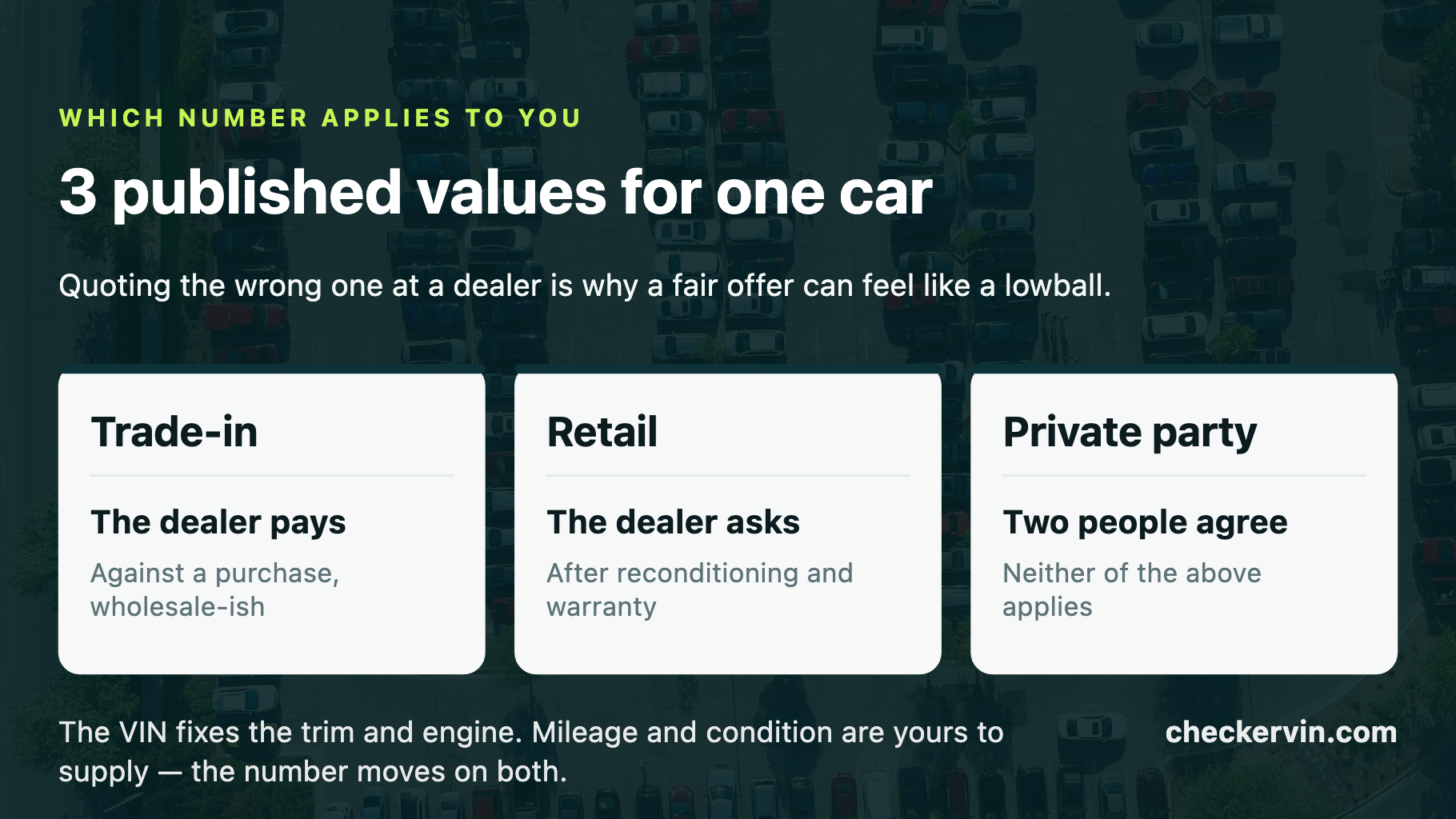
Any book publishes several values for one vehicle, and quoting the wrong one is the most common error in a negotiation.
| The number | When it is the right one |
|---|---|
| Trade-in | You are handing the car to a dealer against another purchase |
| Private party | You are selling directly to another individual |
| Retail | A dealer has reconditioned the car and is standing behind it |
| Loan value | A lender is deciding how much to advance against it |
RVs, boats and motorcycles
The valuation service covers recreational vehicles and motorcycles alongside cars and trucks, and that breadth is why it turns up so often outside ordinary car deals.
On vehicle types where consumer valuation coverage is thin, the lender’s book may be the only well-established reference in the room. If you are financing an RV or a motorcycle, expect the institution to be working from it.
Total loss settlements
Insurers sit in the same category of professional user. When a vehicle is declared a total loss, the settlement is built on the vehicle’s value at the moment of the loss, and book references feed that calculation.
If you believe a settlement is low, the productive argument is rarely that the book is wrong. It is that the specific vehicle was better than the assumed condition grade — and that argument is won with service records, photographs and receipts rather than opinion.
The same number decides whether it gets branded
The settlement check is not the only thing that value determines, and the second use is the one nobody mentions. Most states decide a salvage brand by comparing repair cost against a percentage of the vehicle’s value — 70, 75, 80 percent, sometimes more. That percentage is meaningless on its own. It needs a denominator, and several states name in law where the denominator comes from.
So a guide value is not merely descriptive here. It is doing statutory work: it is half of the test that decides whether a car carries a permanent brand for the rest of its life. States approach that differently, which is worth seeing side by side.
| State | How the value is fixed |
|---|---|
| North Carolina | Fair market retail values shall be as found in the NADA Pricing Guidebook, or other publications approved by the Commissioner |
| New Jersey | Retail value determined by the average of the official valuation manuals approved by the Commissioner of the Department of Banking and Insurance — no single book governs |
| Alabama | A current edition of a nationally recognized compilation of retail values, naming the NADA Used Car Guide Southeastern Edition and National Market Reports as examples, provided it fairly represents retail value within Alabama |
Three different philosophies sit in that table. North Carolina names a book and allows approved alternatives. New Jersey deliberately refuses to let one publisher decide, requiring an average across approved manuals. Alabama gives examples rather than a mandate but adds a condition the others do not — the figure has to represent the retail value within that state, on the reasoning that a national average is not a fact about the local market.
It also means the edition and the region matter, not just the book. If you are contesting a figure in a state that specifies a regional edition or an average across manuals, establishing which publication was used is a legitimate question before arguing about condition grade at all. Our salvage title VIN check covers what the threshold does once the denominator is settled, and the North Carolina and Alabamatitle guides work through each state’s version in full.
Using it well in a negotiation
Look the number up before the conversation, not during it, and be clear with yourself about which of the several figures you are quoting.
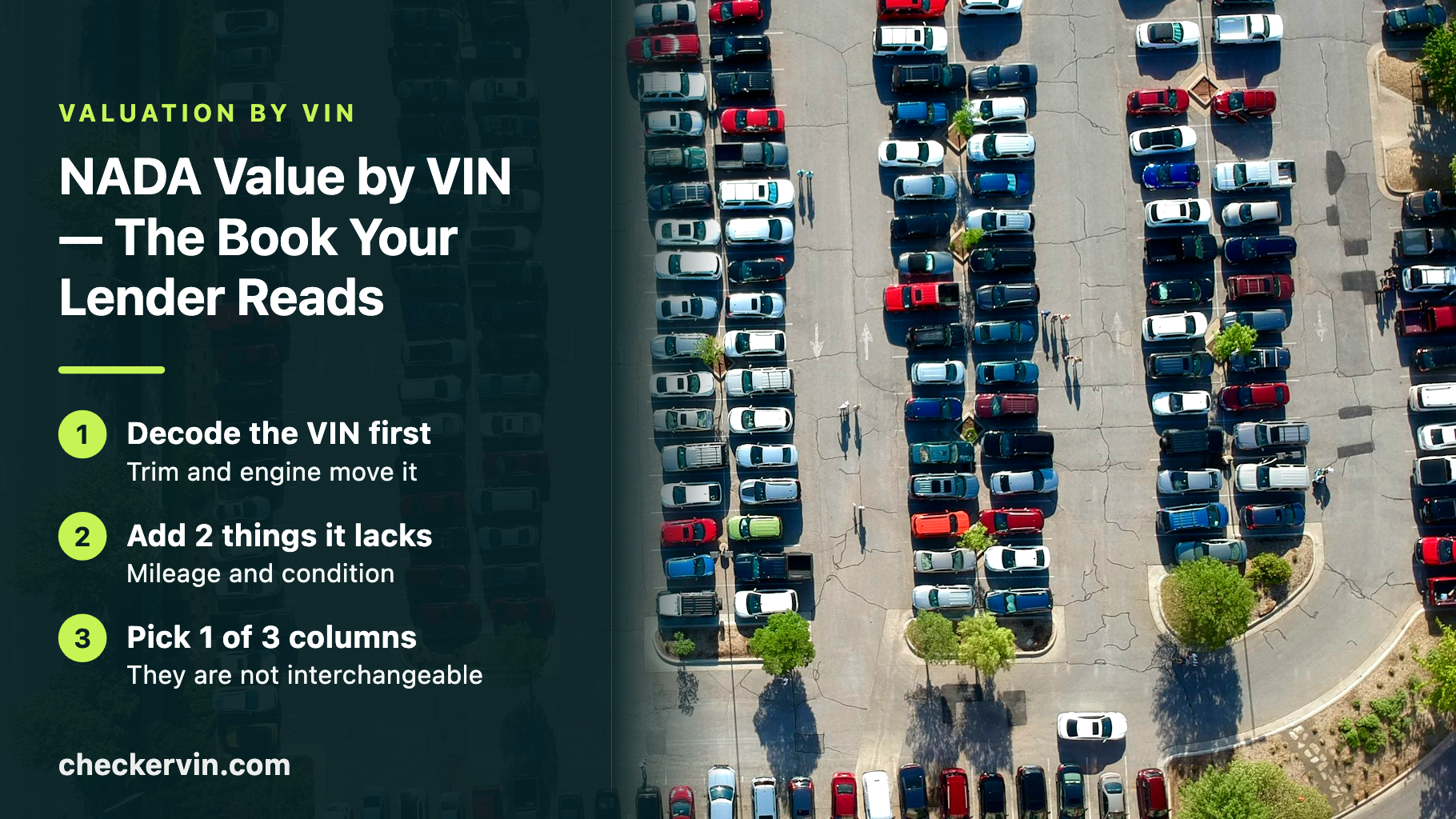
- Decode the VIN first so the trim and engine are certainly right
- Establish mileage from a record, not from the seller's recollection
- Grade condition as the person paying would grade it
- Quote the figure that matches the transaction actually happening
What the VIN settles, and what it cannot
A valuation starts with identification, and this is the half the VIN does perfectly. The seventeen characters fix the model year, the body, the engine and the trim the factory built — which matters more than people expect, because two cars wearing the same badge in the same year can sit thousands of dollars apart on engine and drivetrain alone. Guessing from the badge on the tailgate is how a valuation starts wrong before any condition question is asked.
What the VIN cannot supply is everything that happened afterwards. It does not encode mileage, and it never has. It does not know whether the car was garaged or left in salt, whether the timing service was done, whether a panel has been repainted, or whether the interior has been smoked in. Those are the inputs that move a guide number most, and every one of them has to be supplied by a human looking at the car.
- The VIN fixes: model year, body, engine, trim, plant and factory build
- The VIN does not carry: mileage, condition, service history or options fitted later
- Guide values assume a condition grade — read which grade the number you are quoting assumes
- A branded title sits outside the guide entirely and is priced separately
That last point is worth separating out. A guide value describes a clean-titled car. Once a vehicle carries a salvage, rebuilt or flood brand, the published number stops being the answer and becomes at best a starting point that a brand discount is taken from. Our guide to branded titles covers what each brand admits, and salvage title VIN check covers how to find one before you price anything.
So the honest sequence is short: decode the VIN free to establish exactly which car you are valuing, check the title status so you know whether a guide number applies at all, then supply mileage and an honest condition grade to whichever column matches your situation. Skipping the first two and going straight to a number is how people end up arguing about a figure that was never describing their vehicle.
Where the book stops
It is a model built from other people’s transactions. It has never seen your vehicle, and it cannot price what it has not seen.
It does not know about the title brand unless you tell it, the unrepaired recall, the service history that stops abruptly, or the corrosion underneath. Those are found by checking records and by inspecting the car.
Our own free check returns the factory build, the specifications and open recalls, and produces no valuation at all. What it does is make sure the vehicle you are valuing is the vehicle you think it is.
Where this information comes from
- NCDMV — form MVR-181North Carolina: fair market retail values as found in the NADA Pricing Guidebook or other publications approved by the Commissioner
- NJ MVC — salvage certificates of title regulations, N.J.A.C. 13:21-22New Jersey: fair market value as the average of official valuation manuals approved by the Commissioner of Banking and Insurance
- Alabama Administrative Code — Rule 810-5-75-.57Alabama: a current edition of a nationally recognized compilation of retail values, representative of retail value within the state
- NHTSA vPIC — public VIN decoderEstablishes the exact trim and engine any valuation has to start from
- NHTSA — odometer fraudThe mileage input every book depends on, and why it is worth corroborating
- FTC — buying a used carFederal consumer guidance covering dealer purchases and financing
Keep reading
Frequently asked questions
Is NADA still called NADA?
Not really. The National Automobile Dealers Association sold its Used Car Guide to J.D. Power, and the valuation product now runs as J.D. Power Values. People still say NADA out of habit, and the old web addresses route to the J.D. Power service.
Why does my lender use a different value than the dealer showed me?
Because lenders work from the book built for them. J.D. Power's valuation business is aimed at loan origination and underwriting, floorplan decisions and portfolio management, so the figure a lender applies is the one that governs how much they will advance.
Can I get a NADA value from just the VIN?
The VIN identifies the vehicle precisely, which matters because trim and engine differences move the number. But the valuation itself still needs mileage and condition, because the VIN encodes neither.
Does it cover anything other than cars?
Yes. The valuation service spans new and used cars, trucks, recreational vehicles and motorcycles, which is why it is often the reference used for lending on vehicle types the consumer books cover thinly.
Which value should I use when selling privately?
The private party figure, not the trade-in or retail one. Trade-in is what a dealer will pay against a purchase, retail is what a dealer asks after preparing the car, and neither describes two individuals meeting to do a deal.
Confirm the vehicle before you value it
Enter the VIN for the factory build, the specifications and any open safety recall on that exact vehicle. Free, and no account needed.
Run a free VIN check