The short answer
- Is there a free VIN accident check?
- Partly. NICB's free VINCheck flags insurer-reported total losses — the worst accidents. A full crash narrative is not free from anyone, and sites promising one are collecting your details.
- Do all accidents appear?
- No. A record exists only if a claim, police report, reporting repair shop or title event created one. Cash repairs create nothing.
- What catches the rest?
- Your eyes and a scan tool. Panel gaps, paint depth, weld quality, date codes and stored module faults find damage no database holds.
Claim
What usually creates a record
No claim, often no record
Free
NICB total-loss screen
The serious end of the scale
Gauge
The cheapest damage detector
Paint depth, panel by panel
Never
What any report shows about condition
That is the mechanic's job
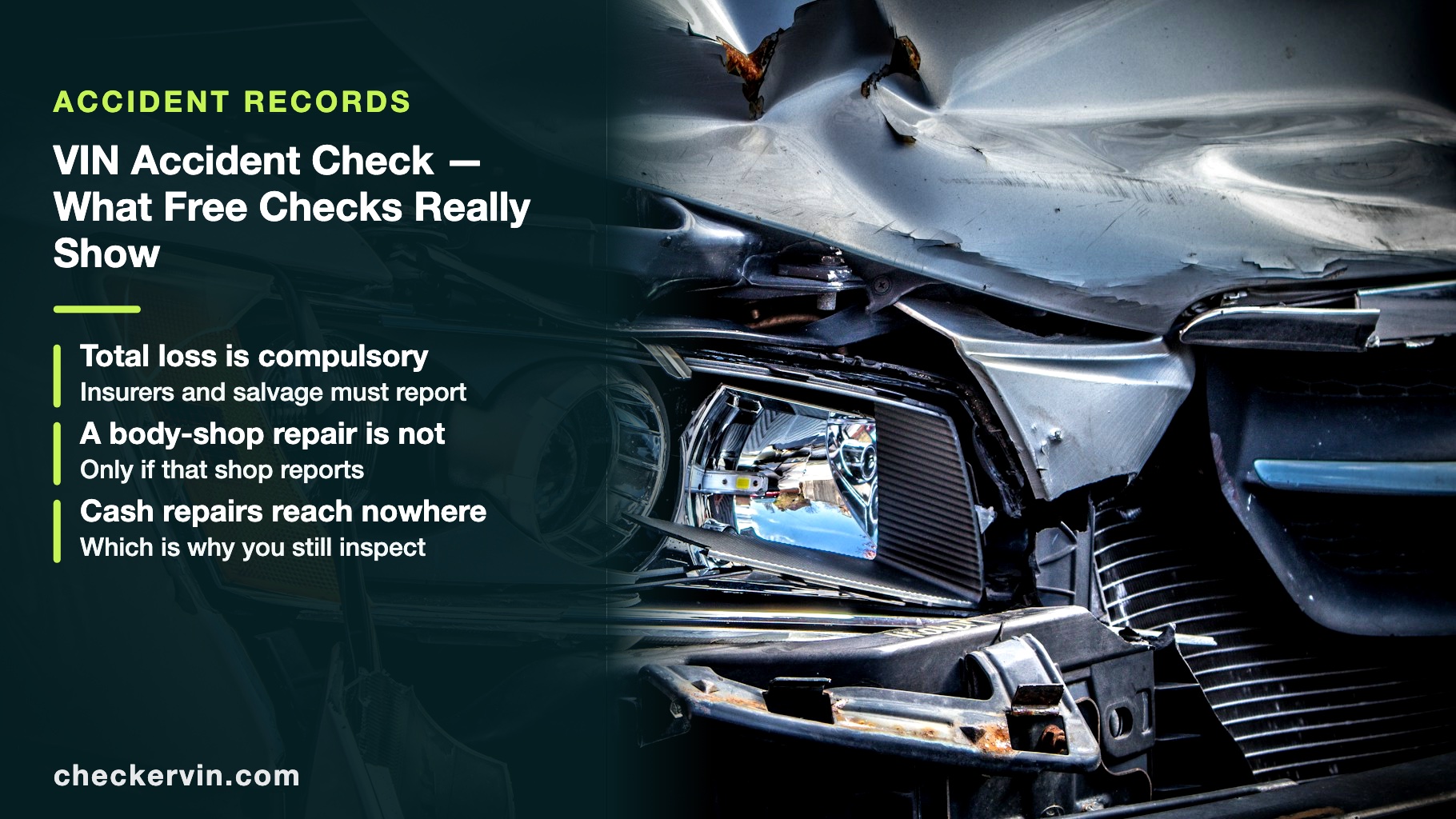
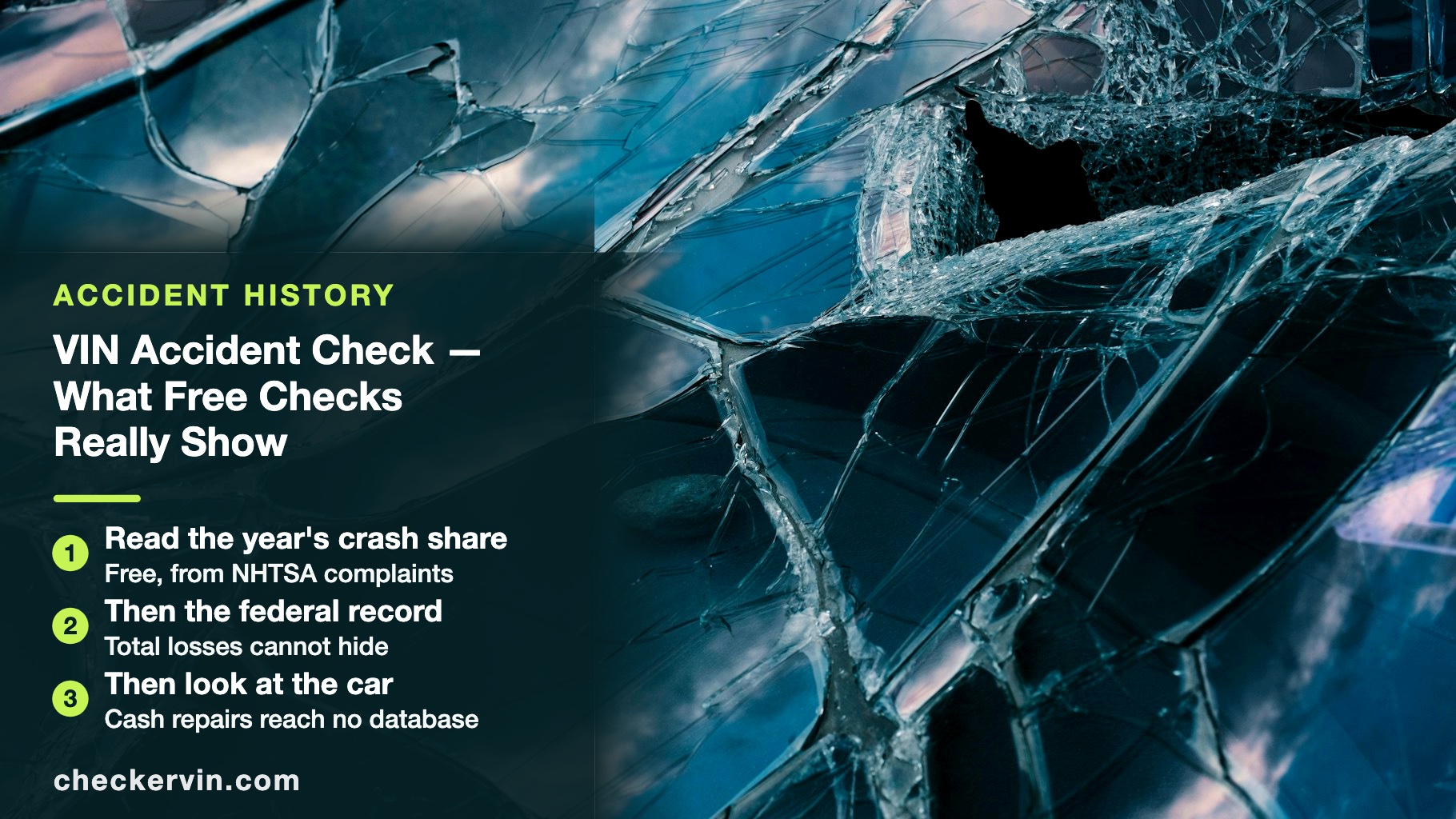
The honest answer first
Vehicle history reports do not contain accidents. They contain records of accidents — which is a different thing, and the gap between them is where used-car buyers lose money. If a crash produced an insurance claim, a police report, a repair at a shop that sells its data to a commercial network, or a title event, it can appear. If it produced none of those, no provider on earth can show it to you.
That is not a reason to skip the checks. It is a reason to run the free ones, buy the paid one when the car justifies it, and then treat the result as a starting point for an inspection rather than a verdict that ends one.
What actually creates an accident record
| Event | Where it can surface |
|---|---|
| Insurance claim paid | Commercial report networks; total losses also reach NICB and NMVTIS |
| Vehicle declared a total loss | NICB VINCheck and the federal NMVTIS record |
| Police report filed | Some commercial networks, depending on jurisdiction and partnerships |
| Repair at a reporting shop | Commercial networks only, and only if that shop reports |
| Airbag deployment recorded at a dealer | Sometimes the manufacturer's service history |
| Cash repair at an independent shop | Nowhere at all |
The free routes that genuinely work
- NICB VINCheck — free, and flags vehicles reported as total losses by participating insurers
- A free VIN decode — confirms the car is the trim and build the listing claims, which catches a different fraud
- NHTSA recall lookup — free, and unrepaired safety campaigns matter regardless of crash history
- State title tools where they exist, such as Florida's free FLHSMV check
- The seller's own paperwork — service invoices and insurance documents they may hand over without thinking
When paid reports earn their money
Commercial reports are worth buying when a car is expensive enough that a missed collision changes the deal materially. Their accident coverage comes from networks the providers built themselves, which is why coverage differs between them. Edmunds tested that directly by running both major products against one 2014 Porsche Boxster: the two came back with different service histories and even disagreed on how many owners the car had had, and neither was a superset of the other. Treat a single clean report as the absence of records rather than proof of an uneventful car. Our AutoCheck review and pricing guide cover which to reach for.
Separately and more cheaply, the federal NMVTIS record catches the most consequential accident outcome of all: the insurer write-off that became a title brand. At a few dollars, that check is worth running on any car you are serious about.
Which number the brand test runs on
“Was it in an accident, and what did the repair cost?” is the question almost everyone asks, and it quietly assumes that one number decides the outcome. Across states, at least three different numbers can — and a seller can answer one of them completely honestly while the other two would have told you something else entirely.
The three are: what a shop estimated, what was actually spent, and what an insurer paid. They are not interchangeable, and states do not agree on which one governs.
Wisconsin’s salvage test runs on the estimated or actual repair cost, whichever is greater — so a seller quoting whichever of the two came in lower has not answered the state’s question at all. North Carolina reaches its brand two independent ways: repair cost and making the vehicle safe for the road exceeding 75% of fair retail market value, or an insurance company having paid a claim exceeding 75% of that value. The second route needs no repair estimate to exist. New Jersey, for a vehicle outside its eight-model-year branch and above its value floor, treats the insurer settling a total loss claim as a trigger in its own right. Alabama ties its test to a settlement actually paid on damage at or above 75% of fair retail value.
It is also worth knowing that a payment does not have to be a write-off to matter. Wisconsin brands a vehicle under seven years old that was transferred to an insurer on a claim for damages of 30% through 70% of its value — damage far short of salvage, and a permanent mark on the title. Our Wisconsin title check covers that band in full.
So the questions worth asking a seller are narrower and more specific than the usual one:
- Was an insurance claim ever paid on this vehicle — and roughly how much?
- What did the repair estimate come to, and was there more than one estimate?
- What was actually spent, and is there an invoice or a shop that can confirm it?
- Did an insurer ever take ownership of the car, even briefly?
- Was any claim paid to you, or to an owner before you?
None of those answers settles the brand question by itself, and they are not meant to. They tell you which record to go looking for, and whether the seller’s account is consistent with what you find. A seller who genuinely cannot say whether a claim was ever paid has told you something useful: that the conversation is not the check, and the national record is.
The free record tells you what kind of failure this year produces
There is a column in the free federal data that almost nobody uses on this question. When an owner files a complaint with NHTSA, the record captures whether the failure involved a crash. That turns a pile of grievances into something an accident-minded buyer can actually read: not how many people complained, but what kind of thing went wrong.
Across the 777 model years in our data with enough complaints to measure, 4.3% of complaints involved a crash. That is the baseline. The useful part is that model years vary widely around it — 38 of them run at three times that rate or higher. A year sitting well above the line is not simply a noisy year. Its failures are the kind that end in a collision rather than an inconvenience.
That distinction is worth more than a raw complaint count. Two model years can carry identical complaint volumes while one is dominated by infotainment faults and the other by steering, braking or unintended acceleration. Only the second changes how carefully you want the car inspected, and only the second makes an unrecorded collision in its past more plausible.
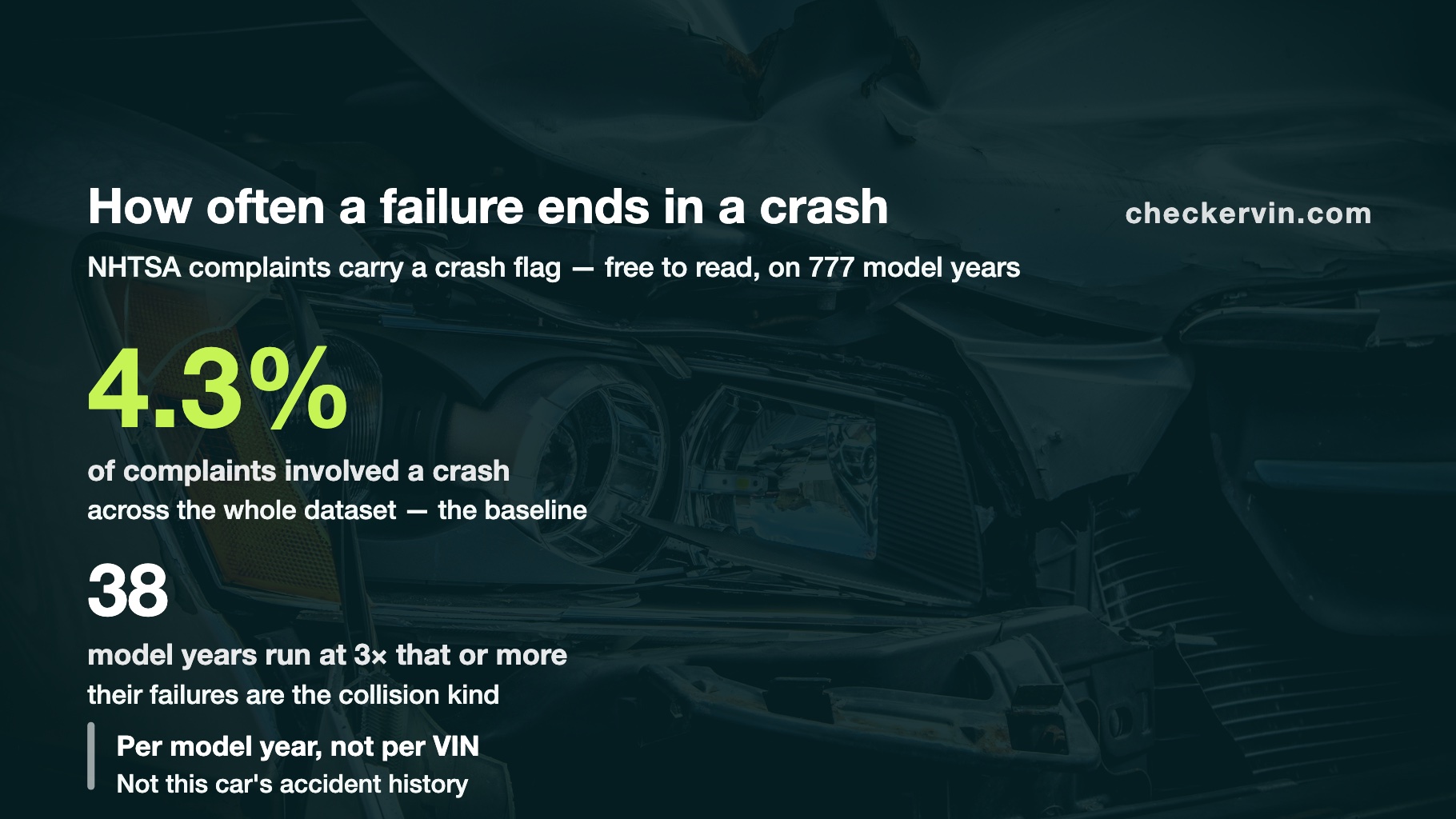
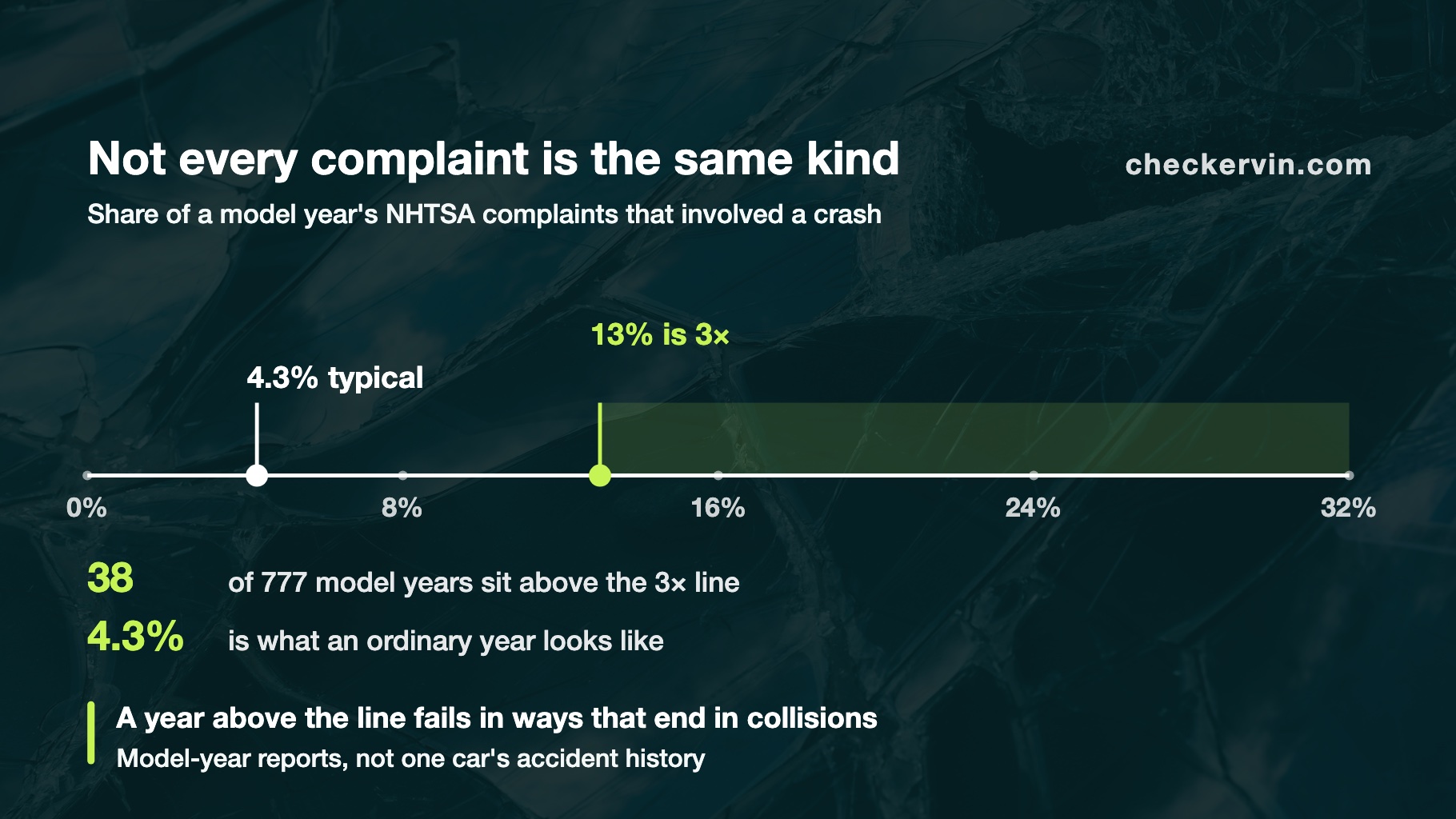
Used that way it changes the order of work. Pull the year’s record free, see whether its failures skew toward crash-involved systems, and let that set how much you spend on the paid checks and how long you keep the car on a lift. Our model-year problem pages break the same data down by nameplate and year.
Severe crashes are recorded by law; moderate ones by choice
The single most useful thing to understand about accident records is that they are not produced by one system with uniform coverage. They come from two, and the two have opposite guarantees.
When a crash is bad enough to total the car, reporting is compulsory. Federal rules oblige insurers and the salvage trade to report, and state titling agencies feed the same federal system, so a total loss struggles to stay invisible. When a crash is bad enough to need a body shop but not bad enough to total the car, reporting is voluntary. A commercial network learns about the repair only if that shop happens to be one that reports to it.
| Severity of the crash | How reliably it is recorded |
|---|---|
| Written off as a total loss | Compulsory reporting — hard to hide, reaches the federal record |
| Heavy repair, insurance claim paid | Usually recorded, because the insurer is in the chain |
| Moderate repair, claim paid | Depends whether the shop reports to that particular network |
| Moderate repair, paid in cash | Typically nowhere |
Read the consequence carefully, because it inverts the usual advice. A clean federal title record is strong evidence that this car was never written off. A clean commercial report is weak evidence that it was never in a moderate collision, because the absence may only mean nobody chose to file. The two clean results are not equally reassuring, and treating them as interchangeable is how people talk themselves past a repaired quarter panel.
The accidents nobody records
Picture the most common unreported crash: a driver with liability-only coverage backs into a pillar, gets an estimate, decides a claim would cost more in premium than the repair, and pays a body shop in cash. No insurer, no police, no title event, no reporting shop. The car is repaired, sold two years later, and every database on this page returns a clean result — accurately, because nothing was ever filed.
Multiply that by every driver with a high deductible and every fender-bender settled between two people at the roadside, and you have the reason a clean report and a good inspection are complementary rather than redundant.
Reading damage on the car itself
- Panel gaps — run a finger along each seam; consistent factory gaps become uneven after repair
- Paint depth — a gauge costs little and reads refinished panels as noticeably thicker than factory
- Low raking light — stand at the corner of the car and sight down the flank for texture and color shifts
- Overspray — check rubber seals, wheel arches, the fuel filler and under the hood edges
- Bolt heads — a paint-cracked or rounded fender bolt means that panel came off at some point
- Date codes — glass, headlights and the radiator support carry dates that should roughly match the build
Where a report already shows a damage reported entry, it tells you which corner of the car to start on — which is most of what that entry is actually good for, since the phrase itself carries no legal definition and no measurement.
The scan tool trick most buyers skip
Modern cars remember things their dashboards do not display. A scan across every module — not just the engine — can surface stored and historical fault codes, airbag-system status, and modules whose part numbers or programming dates sit oddly against the car’s age. A replaced airbag control unit on a car with no reported accident is a conversation worth having before money moves. Any decent independent shop does this as part of a pre-purchase inspection; it is the cheapest sophisticated check available.
The full sequence, in order
- 1Decode the VIN — freeConfirm the car matches the listing, and see the factory build and open recalls.
- 2Run NICB VINCheck — freeScreens theft and insurer-reported total losses in about a minute.
- 3Buy the NMVTIS record — a few dollarsCatches title brands and write-offs, including ones washed across state lines.
- 4Add a commercial report if the car is expensiveTheir accident networks hold records the federal system never sees.
- 5Inspect, gauge and scanThe step that finds the unrecorded repairs — and the only one that describes the car today.
Step one, free: decode the VIN
Decoded from official manufacturer and NHTSA records
Where this information comes from
- WisDOT — form MV2849, title application and notificationWisconsin: salvage on the estimated or actual repair cost whichever is greater, and Insurance Claim Paid at 30% through 70% of fair market value
- NCDMV — form MVR-181North Carolina: the repair-cost limb, and the independent limb for a vehicle on which an insurer has paid a claim exceeding 75%
- NJ MVC — salvage certificates of title regulations, N.J.A.C. 13:21-22New Jersey: the insurer settling a total loss claim as a trigger in its own right, for vehicles outside the eight-model-year branch
- Alabama Administrative Code — Rule 810-5-75-.57Alabama: the salvage application where an insurer has declared a total loss and paid compensation to the owner
- NICB VINCheckFree theft and total-loss screen from participating insurers
- NMVTIS — consumer informationThe federal title record and its approved providers
- NHTSA recall lookupFree open-recall check, independent of crash history
- FTC — buying a used carYour rights, and why a dealer's report is a dealer's document
- Edmunds — vehicle history reports tested on the same vehiclesThe Boxster comparison cited above — a named, hands-on test rather than an unattributed overlap statistic
Keep reading
Frequently asked questions
Can I check a VIN for accidents free?
Partly, and honesty here matters more than the sales pitch. NICB's free VINCheck flags vehicles reported as total losses by participating insurers — the most serious accidents. Free VIN decodes tell you how the car was built but nothing about damage. A complete accident narrative is not available free from anyone; sites promising one are collecting your email.
Do all accidents show up on a VIN check?
No, and this is the single most misunderstood thing about vehicle history. A record exists only if someone created one — an insurance claim, a police report, a repair shop that reports to a commercial network, or a title event. A crash repaired privately with cash generates none of those, so it appears in no report at any price.
What is the best way to check for accident damage?
Combine records with your own eyes. Run the free checks, buy a report if the car warrants it, then look at panel gaps, paint depth, weld quality and date codes — and have a mechanic scan every module for stored fault codes. The physical inspection catches what the databases structurally cannot.
Does a free VIN decoder show accident history?
No. A decoder reads the seventeen characters and returns build data — make, model, engine, plant, model year. Accident history lives in insurance, police and repair records, which are entirely separate systems. Any decoder claiming to return accidents free is describing something it does not have.
The free records show crashes — why isn't that this car's accident history?
Because the unit is different. NHTSA's complaint records are filed by owners about a failure, and they flag whether that incident involved a crash — so they aggregate to a model year, telling you whether this year of this model produces collision-type failures. Nothing in them is keyed to the car you are looking at. An accident recorded against a specific VIN comes from an insurance claim, a total-loss report or a shop that reports, which is a different set of systems entirely. Read the free data to decide how hard to inspect a year; never as a finding about one vehicle.
How do I know if a car has been repainted?
A paint depth gauge is the reliable answer and costs less than a tank of fuel. Factory paint is remarkably consistent panel to panel; refinished panels usually read thicker. Failing that, look along the body in low, raking light for texture changes, check for overspray on seals and inside the fuel filler, and compare the color in the door shuts against the outer skin.
Records first, then the walkaround
Decode any VIN free for the factory build, specifications and open safety recalls. No account, no card.
Run a free VIN check