The short answer
- What is the fastest free check?
- NICB's VINCheck. It is free, takes a minute, and screens theft and total-loss records reported by participating insurance companies.
- What actually catches a washed title?
- The NMVTIS record, a few dollars from an approved provider. It is the federal system states, insurers and salvage businesses must report into — built specifically to stop a brand disappearing across a state line.
- Can a salvage car pass every check?
- Yes, if it was totaled without an insurance claim. That is why the physical inspection below is part of the sequence, not an optional extra.
Free
NICB VINCheck
Theft and total-loss screen
A few $
The NMVTIS record
The federal title system
Mandatory
Who reports into NMVTIS
States, insurers, salvage yards
~50%
What a brand can cost in value
Which is why sellers stay quiet
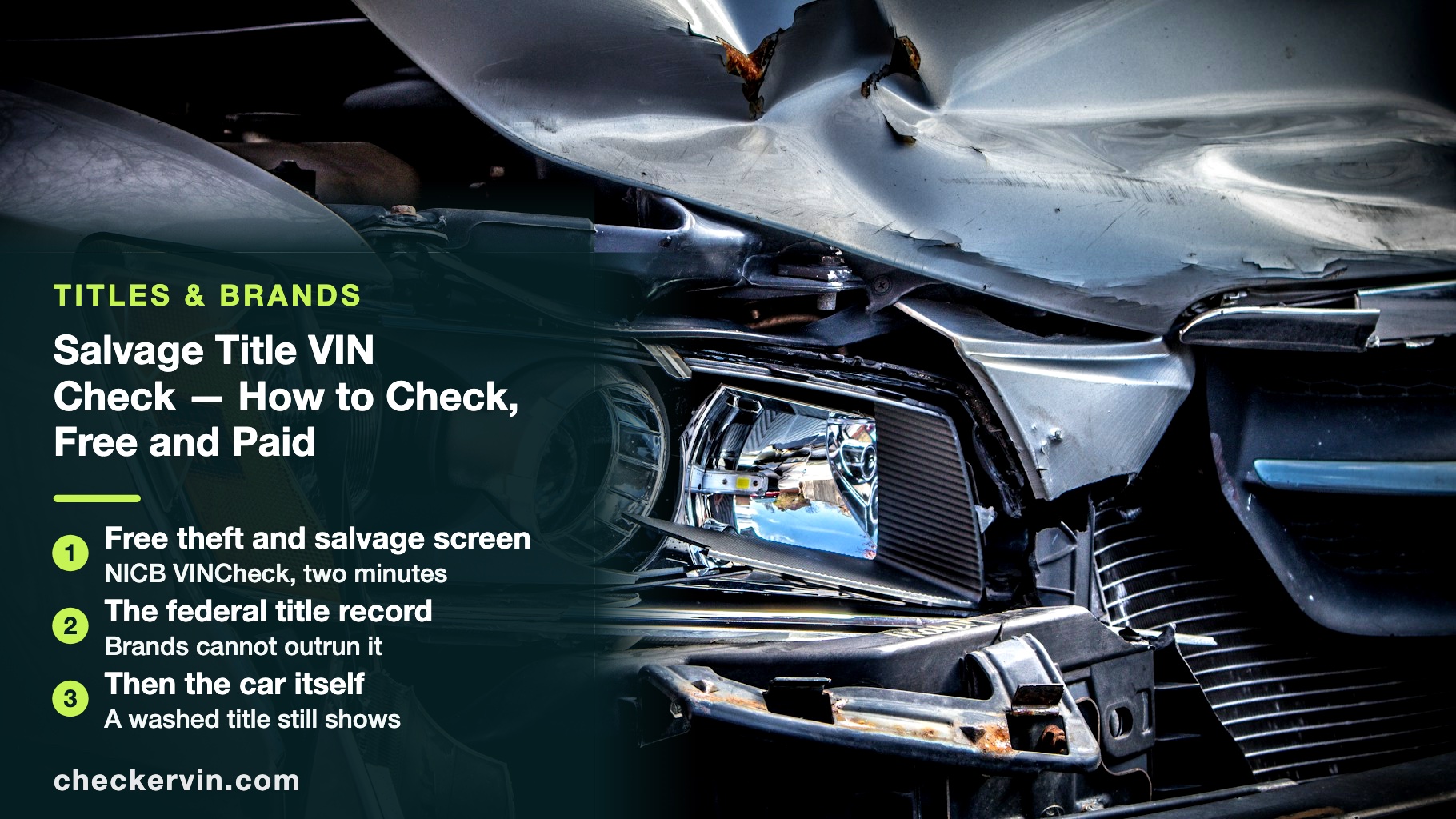
The fastest route, before the detail
If you have five minutes and a VIN: run NICB’s free VINCheck, then buy an NMVTIS report from an approved provider. Those two steps cost a few dollars combined and catch the overwhelming majority of branded vehicles, including the ones whose paperwork was laundered through a second state. Everything below is the detail behind why that order, and what to do when a result is ambiguous.
Step one: the free NICB screen
The National Insurance Crime Bureau publishes VINCheck free to the public. It draws on records contributed by participating insurance companies and returns two things worth knowing: whether the VIN has been reported stolen and not recovered, and whether it has been reported as a total loss by a participating insurer. There is a daily search limit and it does not cover every insurer, but it costs nothing and it ends plenty of conversations early. Our NICB guide walks the tool screen by screen.
Step two: the federal title record — the one that matters
NMVTIS is the National Motor Vehicle Title Information System, and its power comes from compulsion rather than commerce: state titling agencies, insurance carriers and junk and salvage businesses are required by federal law to report into it. That mandate is why a salvage brand issued in one state remains visible after the car is retitled in another — the exact maneuver the system exists to defeat.
Consumer access runs through approved providers, and the Department of Justice publishes exactly who those are. Reports cost single-digit dollars. Our NMVTIS guide explains what the record contains, and the pricing guide shows where it sits against the premium products.
What that mandate reports is defined federally, and the definition is not the one your state uses. 28 CFR § 25.52 makes an automobile a salvage automobilewhere its “fair salvage value plus the cost of repairing the automobile for legal operation on public streets, roads, and highways would be more than the fair market value of the automobile immediately before the event that caused the damage.” A junk automobileis defined separately: incapable of operating on public roads, and with “no value except as a source of parts or scrap.”
The federal test weighs salvage value plus repair cost against the car’s whole pre-damage value, where the state tests are percentages of it — 75% in several states, 80% in others, and none at all in California, which asks instead whether repair is uneconomical. But the definition does not stop at its own test, and the sentence that follows decides how the two relate:
So the two are not rival tests that disagree in both directions. A state total-loss determination is expressly swept into the federal definition, and so is an insurer’s own designation under its policy terms. The federal net is the wider one: it catches cars a state percentage would miss, while a state brand always reaches the federal record. If you were wondering whether a brand issued in one state might simply not appear federally — it does.
The tail of that clause closes a gap people assume exists. An insurer designation counts regardless of whether ownership transferred to the carrier, so the familiar owner-retained total loss — insurer writes the car off, owner keeps it and repairs it — is inside the definition rather than outside it. That is a different situation from the genuine no-claim case below, and only the second one leaves no record.
Step three: state tools, where they exist
| State tool | What it returns |
|---|---|
| Florida — FLHSMV Motor Vehicle Information Check | Free title status and brand flags by VIN |
| Wisconsin — DMV vehicle inquiry | Free registration status and expiration |
| Georgia — DOR DRIVES e-Services | Vehicle status tied to the state record |
| Ohio, Connecticut and others | Varying free status checks; coverage differs by state |
| Everywhere else | The registration card and title in the seller's hand |
These are worth the two minutes when the car has history in that state. Our registration lookup guide maps which states publish genuinely useful public tools and which do not.
The five things the federal record must establish, instantly
It is worth knowing what the system is required to be able to tell you, because the list is broader than “is it salvage” and two items on it are routinely overlooked.
Under 28 CFR 25.53, NMVTIS must permit a user to establish instantly and reliably all of the following.
| What you can establish | Why it is useful to a buyer |
|---|---|
| The validity and status of a document purporting to be a certificate of title | You can test the piece of paper in front of you, not just the car |
| Whether an automobile bearing a known VIN is titled in a particular state | A seller's claim about where the car is titled becomes checkable |
| Whether a vehicle titled in a state is or has been a junk or salvage automobile | The core salvage question, and note the words is OR HAS BEEN |
| The odometer mileage disclosure required under 49 U.S.C. 32705 at title issue, plus later mileage if the state noted it | Mileage is in the federal record by design, not as a bonus |
| Whether a VIN has been reported as junk or salvage under 49 U.S.C. 30504 | The reporting stream, separate from whether a state ever branded the title |
Item three carries a phrase worth reading twice: is or has been. The record is not only about the vehicle’s status today. And item five is separate again — a car can have been reported as salvage through the insurer or yard streams without a state having yet branded a title.
Who is allowed to ask, and what they may ask about
Access is not open to everyone equally, and the tiers are set out rather than left to the operator. Under 28 CFR 25.53 the operator must make information available to four groups, and the scope differs between them.
| Who | What they may ask about |
|---|---|
| A participating state, on its request | Any automobile |
| A government, state or local law enforcement official | A particular automobile — or a particular junk yard or salvage yard |
| A prospective purchaser, on request | That automobile |
| A prospective or current insurer, on request | That automobile |
Two things stand out. Law enforcement can query a yard rather than a car— which is how a pattern across many vehicles becomes visible, and is a capability no consumer product exposes. And a prospective purchaser is named in the regulation, so a buyer asking about a specific vehicle is exercising something the rule contemplates rather than requesting a favor.
Why one check is never enough
Title washing works because states set their own branding rules. A car totaled and branded in a strict state can be moved, retitled and — historically — emerge with cleaner paperwork somewhere with looser standards. NMVTIS closed most of that gap by making reporting mandatory and national, but the reason to run several checks rather than one is that each system holds records the others do not: NICB sees insurer total losses, NMVTIS sees title events and salvage-yard filings, state tools see that state’s own record. Different pipes, different leaks.
Thresholds are not the only variable — some states put a floor underneath them. South Carolinadoes not apply the salvage brand where the vehicle’s value falls under a stated figure, so a cheap car can be badly damaged and keep an unbranded title that then travels out of state.
Totaled is an accounting decision, not a damage assessment
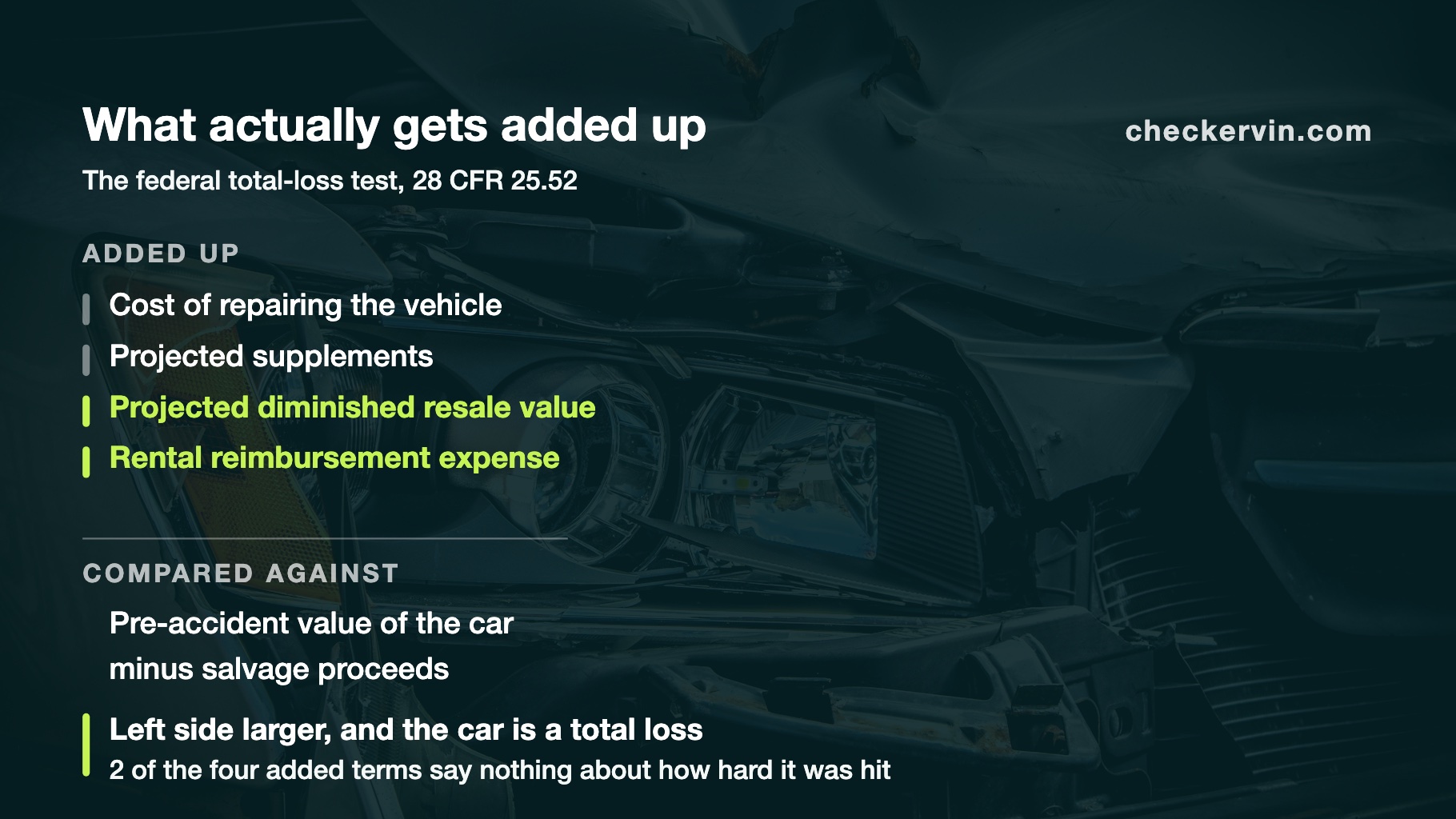
The same federal rule that defines a salvage automobile also defines what it means to total one, and that second definition is the one that explains cars people find inexplicable — the lightly creased sedan carrying a brand, the visibly wrecked one that never got a mark. 28 CFR § 25.52 puts it as an equation:
Read the four things on the left. Only the first is about the metal. Projected supplements are the additional damage a shop expects to find once the panel comes off. Diminished resale value is what the car is worth less after repair, purely because it was repaired. Rental reimbursementis what the insurer spends putting the owner in another car while the work waits — which scales with how long parts take to arrive, not with how hard the car was hit.
Then look at the right-hand side. The comparison is not against the repair bill alone; it is against the pre-accident value minus what the wreck can be sold for. A model with a strong salvage market makes the right side smaller, and a smaller right side totals more easily.
| What pushes a car toward a total loss | And it has nothing to do with impact severity |
|---|---|
| A long wait for parts | Rental reimbursement runs for every week the car sits |
| An expensive car | Diminished resale value is a percentage of a larger number |
| Hidden damage suspected | Projected supplements are counted before they are found |
| A strong market for its parts | Higher salvage proceeds lower the bar the repair has to clear |
The buyer’s conclusion is not that brands are meaningless. It is that a brand records a decision that was made, not how badly the car was hurt. Two cars with identical damage can end up on opposite sides of it depending on their value, their parts supply and their salvage market. So read the brand as a fact about the paperwork and go looking for the damage separately — which is what the inspection further down is for.
What a salvage yard is required to write down
The reporting duty behind all this is more specific than “yards report to the system,” and the specifics are useful to a buyer. Under 28 CFR § 25.56, anyone operating a junk or salvage yard must file a monthly inventory of every junk or salvage automobile obtained in the prior month, and the rule lists exactly what each entry carries.
- The name, address and contact details of the reporting yard
- The VIN
- The date the automobile was obtained
- The name of the individual or entity it was obtained from
- Whether it was crushed or disposed of, to whom it was transferred, and whether it is intended for export
The last item is the one to hold onto. A federal record can therefore show not merely that a car reached a salvage yard, but that the yard reported it as crushed or disposed of. A vehicle with that entry against its VIN, being offered to you as a running car, is not a paperwork puzzle to be solved by the seller’s explanation. It is the point at which you stop.
The dated, sourced quality of these entries also matters. Because each carries the date obtained and the party it came from, a salvage chapter in the record has a position in time you can test against the rest of the history — against when the title changed state, or when a mileage reading stopped making sense.
Two independent ways a car becomes salvage
The reporting duty on insurers describes two separate triggers, and a car only has to meet one of them. Under 28 CFR 25.55, a carrier must report any automobile it has determined to be a total loss under the law of the applicable jurisdiction, or designated as a total loss by the insurance company under the terms of its own policies.
| Trigger | What decides it |
|---|---|
| Total loss under state law | A state formula, which differs between states |
| Total loss under the insurer's own policy terms | The carrier's contract, which is not a public standard |
That second limb is why two identical cars, damaged identically, can end up in different places. One state’s threshold may not be met while a particular carrier’s policy terms are, or the reverse. The brand does not follow the severity of the damage; it follows whichever of these two tests fired first.
The same section fixes what the report must contain: the reporting carrier’s details, the VIN, the date the vehicle was obtained or designated junk or salvage, the name of the party it was obtained from and who possessed it at designation, and the name of the owner at the time of filing.
Crushed, sold, or exported: what a yard has to write down
The third reporting stream is the one buyers hear least about and it carries a field the others do not. Under 28 CFR 25.56, a junk yard, salvage yard or auto recycler must report monthly an inventory of all junk or salvage automobiles obtained in whole or in part in the prior month.
- The reporting entity's name, address and contact information
- The VIN
- The date the automobile was obtained
- The name of the individual or entity it was obtained from
- Whether the automobile was crushed or disposed of, for sale or other purposes
- To whom it was provided or transferred
- Whether the vehicle is intended for export out of the United States
“Obtained in whole or in part” means a yard that takes a portion of a vehicle is still reporting it. And the final two items are the interesting ones: the record is designed to follow the car out the other side of the yard, including out of the country.
There is also a supplemental duty. Where final disposition was not known at the time of the first report, a yard may be required to file an update. So a record can gain detail after the fact, which is one more reason a check run months apart is not always the same check.
When the test never reached the car
The value floor above is one instance of something wider, and it is the least understood reason a badly damaged vehicle carries clean paperwork. The record is not missing and nobody washed anything. The state’s branding test simply never applied to that car. It runs on two further axes beyond value. This is also why a car can show damage reported on a commercial report and still hold a clean title — the two are answering different questions.
The first is age. Several states only run the damage calculation on vehicles inside a defined window, and outside it that route to a brand is unavailable however severe the damage was.
| State | The window the test runs inside |
|---|---|
| Missouri | The damage test reaches a vehicle damaged no more than six years after the manufacturer's model year |
| New Jersey | One branch covers vehicles eight or fewer model years old; older ones engage only where pre-damage value clears a floor set by a five-year-old equivalent |
| Virginia | Built around late model vehicles: the current year plus five preceding model years, or any vehicle worth at least $10,000 before the damage |
| Michigan | The 75% and 91% tiers attach to late model vehicles, a defined term |
The second axis sits inside the calculation itself. Even where the test does apply, some of the most expensive repair lines are excluded from the figure that gets compared against the threshold. Missouri leaves out hail damage, safety restraint systems, tires, sound systems and sales tax. Virginia leaves out the cost of repairing the engine, transmission or drive axle assembly.
None of this is a loophole or a failure of the system — it is how the statutes are drafted, and the reasoning is usually that branding a low-value vehicle costs more than it protects. But it means the weight you put on a clean title should scale with the vehicle’s age and value, and the weight you put on an inspection should scale the other way. Our Missouri, Virginia and Michigantitle guides work through each state’s version in full.
What the databases never see
The hardest case is not the washed title; it is the car that was never branded at all. An owner without comprehensive coverage whose car is wrecked can repair it privately with no insurer, no claim, no total-loss declaration and therefore no record anywhere. That vehicle passes every check on this page. It is caught, if at all, by looking at it.
- Panel gaps that vary along a seam, or doors that need a shove to latch
- Paint texture and color depth changing between adjacent panels in low sun
- Overspray on rubber seals, wiring looms or inside the fuel filler
- Welds or seam sealer that look nothing like the factory's beads elsewhere on the car
- Mismatched date codes on glass, headlights or the radiator support
- Airbag warning behavior on startup — and modules that scan as replaced
Reading what comes back
- 1All clear on every checkEncouraging, not conclusive. It means no record exists — proceed to the inspection with normal caution.
- 2A total loss with no state brandThe washed-title shape. Price the car as branded, or walk; the insurer's write-off is the fact that matters.
- 3A brand in one state, clean title todayThe brand history is what follows the car forever. Read our rebuilt-title buying guide before going further.
- 4Salvage-yard or junk entriesParts-car territory. If it is being sold as roadworthy, the paperwork and the metal disagree.
If it comes back salvage
A salvage or rebuilt result is not automatically a walk-away — it is a repricing. What decides it is what was damaged, who repaired it, whether the documentation exists, and whether your insurer will write the coverage you want. Our guide to buying a car with a rebuilt title works through that decision, including the discount the market actually applies.
Decode the VIN free and start the sequence
Decoded from official manufacturer and NHTSA records
Where this information comes from
- eCFR — 28 CFR Part 25 subpart B, NMVTIS25.53 lists the five things the system must establish instantly and who may ask; 25.55 the insurer inventory and its two total-loss triggers; 25.56 the yard inventory, including crushed, transferred and intended for export
- Missouri Revised Statutes — Section 301.010, definitionsThe six-year window on the damage test, and the hail, restraint, tire, audio and sales tax exclusions
- Code of Virginia — § 46.2-1600, definitionsLate model as five model years or $10,000 of pre-damage value, and the engine, transmission and drive axle exclusion
- Michigan Vehicle Code — MCL 257.217cThe 75% and 91% tiers, and that they attach to late model vehicles
- NICB VINCheckThe free theft and total-loss screen — step one
- 28 CFR § 25.52 — NMVTIS definitionsThe federal salvage and junk definitions that govern what is reported into the national system — a whole-value test, not a state percentage
- NMVTIS — consumer information and approved providersThe federal title record and who may sell it
- FLHSMV — Motor Vehicle Information CheckFlorida's free state-level title status tool
- NHTSA recall lookupOpen recalls, free, which a rebuild never clears
Keep reading
Frequently asked questions
What can a salvage VIN check actually establish?
Under 28 CFR 25.53 the federal system must let a user establish, instantly and reliably, the validity and status of a document purporting to be a certificate of title, whether a VIN is titled in a particular state, whether a vehicle titled there is or has been a junk or salvage automobile, the odometer disclosure required at title issue, and whether the VIN has been reported as junk or salvage. Five separate questions, not one.
Why does a check say salvage but not say why?
Because the required report does not ask. 28 CFR 25.55 lists what an insurer's inventory must contain — the VIN, the date obtained or designated, who it came from, who possessed it, who owned it at filing — and nothing on that list is the cause of the damage. A fully compliant report of a total loss need never say whether the car was flooded, burned or hit.
Can a car be salvage without a state branding the title?
The record distinguishes them. One of the things NMVTIS must establish is whether a VIN has been reported as a junk or salvage automobile under 49 U.S.C. 30504, which is separate from whether a state has titled the vehicle with a brand. A car can appear in the reporting stream before, or without, a state brand following.
Does the record show if a salvage car was exported?
It is designed to. Under 28 CFR 25.56 a junk or salvage yard's monthly inventory must state whether the automobile was crushed or disposed of, to whom it was transferred, and whether the vehicle is intended for export out of the United States. Yards may also have to file a supplemental report when final disposition was unknown at first.
How do I check if a VIN has a salvage title?
Run three checks in order. NICB's VINCheck is free and screens theft and total-loss records reported by participating insurers. The NMVTIS record — a few dollars from an approved provider — is the federal title system that states, insurers and salvage yards must report into. Where the car has a state with a public tool, such as Florida, run that too. Any one of the three can surface a brand the others miss.
Can I check for a salvage title for free?
Partly. NICB's VINCheck is genuinely free and catches many total-loss and theft records, and some states publish free title-status tools. What is not free anywhere legitimate is the complete NMVTIS record — that costs a few dollars from an approved provider, which is the cheapest meaningful money in the entire car-buying process.
Will a salvage title always show up on a VIN check?
Not always, and that is the honest answer the industry avoids. Title washing — retitling a branded car in a state with looser rules — is precisely the fraud NMVTIS was built to defeat, which is why the federal record is the one to buy. But a car totaled by an owner who never filed an insurance claim may carry no brand at all, and no database can report a record that was never created.
What is the difference between salvage and rebuilt?
Salvage means an insurer declared the vehicle a total loss and it is not roadworthy as it stands. Rebuilt means someone repaired a salvage vehicle and a state inspected it well enough to allow registration again. A car advertised as rebuilt was salvage first — the brand history is the part that matters, not the current wording.
Does a free VIN decode show salvage history?
No, and any site implying otherwise is misleading you. A decode reads the seventeen characters and returns how the vehicle was built — make, model, engine, plant. Title brands live in title records, which is a completely separate system. Decode first to confirm the car is what the listing claims, then check the title record separately.
Start with the decode — it costs nothing
Decode any VIN free for the factory build, specifications and open safety recalls. No account, no card.
Run a free VIN check