The short answer
- What is the fastest check?
- Lift the carpet in a corner and look at the padding beneath, then pull a seat belt all the way out and inspect the webbing near the spool for a tide line or silt.
- Will the title say flood?
- Often not. A brand requires an insurer total loss recorded by a state — cars flooded while uninsured, or dried and sold fast, can carry clean paperwork.
- Why does it matter so much?
- Corrosion is progressive. The car drives fine at sale and develops untraceable electrical faults months or years later, long after the seller is gone.
Clean
What many flood titles look like
No claim means no brand
Padding
Where evidence survives detailing
Under the carpet, not on it
Salt
The version that is terminal
Wiring and connectors, permanently
Years
How long faults take to appear
Corrosion works slowly
Why flood damage is different from every other defect
Most used-car problems are mechanical and therefore diagnosable: a worn transmission announces itself, a tired engine shows compression numbers. Flood damage is neither localized nor immediate. Water enters a vehicle’s wiring looms, control modules, connector pins, seat-belt pretensioners and airbag components, and then corrosion proceeds slowly, in dozens of places at once, for years.
The result is the worst possible ownership pattern — a car that presents perfectly at sale and later develops intermittent electrical faults that defeat diagnosis because there is no single failure to find. Safety systems are part of that picture, which is why this is a walk-away rather than a haggling point.
Why so many flood cars carry clean titles
A flood brand exists only when an insurer declares the vehicle a total loss and a state records that decision. Two common situations produce no brand at all: the owner carried liability-only coverage, so no insurer was ever involved; or the car was dried, cleaned and sold quickly before any claim was made. In both cases every database returns clean — accurately, because nothing was ever filed.
This is the same structural limit our accident-check guide describes: reports contain records, not events. It is why the physical checks below are the primary tool for flood specifically, with the record checks as support rather than the other way round. Where a report does carry a damage reported entry, remember it is a vendor’s label rather than a finding — useful as a pointer, worthless as reassurance when absent.
Paperwork practice varies by state as well. Louisiana runs private sales through a notary, and the seller warrants the vehicle is free of encumbrances — a stronger document than most states produce, and still not a search of any damage record.
Where water leaves evidence
| Where to look | What you are looking for |
|---|---|
| Under the carpet padding | Damp, silt, or a stained tide line — detailing cleans carpet, not the foam beneath |
| Spare-wheel well | Standing water, silt in the corners, rust on the jack and its fittings |
| Seat rails and mounting bolts | Surface rust on bare metal that should be clean and dry |
| Seat belts, pulled fully out | A discolored tide line, grit, or a musty smell in the webbing |
| Behind kick panels and under the dash | Corroded connector pins and green oxidation on terminals |
| Interior fuse box and grounds | Rust, residue, or fresh replacement parts on an old car |
| Headlight and taillight housings | A visible water line inside the lens, or trapped moisture |
| Engine bay hardware | Mismatched corrosion — new-looking bolts beside heavily rusted ones |
The smell test, done properly
Almost everyone knows to smell for damp; almost nobody does it correctly. A car aired out with the windows down all morning, or freshly treated with deodorizer, will smell fine on a walk-up. The test that works: close all the doors and windows, leave the car sealed for at least fifteen minutes while you do the rest of the inspection, then open the driver’s door and put your head near the footwell before the air changes. Mustiness returns in a sealed cabin because the source is in the padding, not the air.
Be equally suspicious of the opposite signal: a strong air-freshener or shampoo smell on an otherwise ordinary used car is a question, not a courtesy.
The electrical timeline
Water damage rarely fails anything immediately. Corrosion needs time to work through connector pins and copper strands, which is why flood cars sell easily and fail later. Exercise every electrical item on the test drive — every window, the sunroof, seat motors and heaters, mirrors, wipers on all speeds, the infotainment, every light — and treat anything intermittent as significant rather than trivial. Then have a mechanic scan all modules: stored fault codes across unrelated systems is a pattern that points at wiring rather than components.
What the records can still tell you
- NICB VINCheck — free, and flags insurer-reported total losses including flood write-offs
- The NMVTIS record — the federal title system that carries flood brands across state lines
- State title tools where available, such as Florida's free FLHSMV check
- The title chain's geography — useful, but see the federal numbers below before you treat an inland title as clean
- Auction history in a commercial report — salvage-lane appearances are the strongest documentary hint
What the federal disaster record actually shows
Almost every flood-car guide tells you to be careful after a hurricane. That advice is not wrong, but it is incomplete in a way that matters when you are standing in front of a specific car. We checked it against the federal record rather than repeating it.
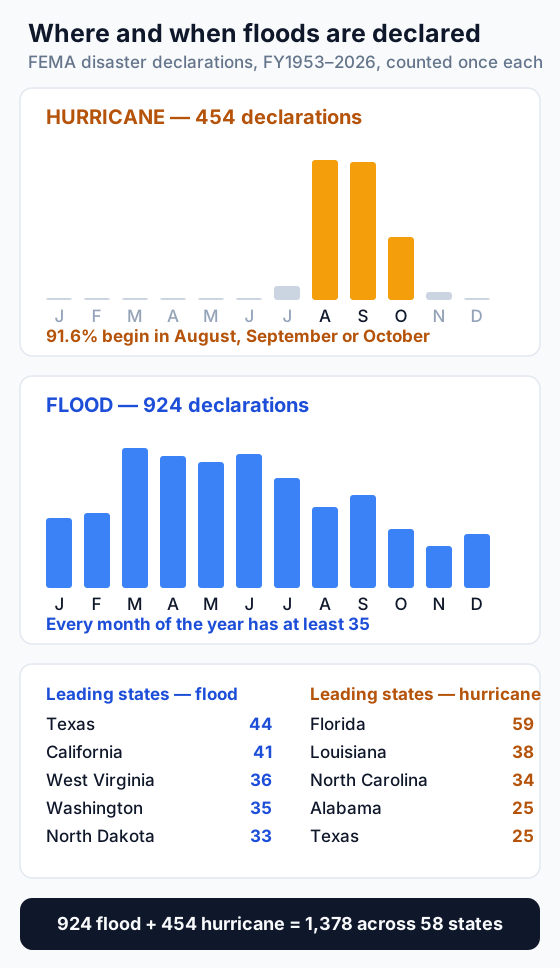
FEMA publishes every disaster declaration it has issued as an open data set, tagged by incident type, state and start date. Filtered to declarations whose incident type is Flood, and separately to those tagged Hurricane, the file covers fiscal years 1953 through 2026 and contains 924 distinct flood declarations against 454 hurricane declarations — flooding declared on its own roughly twice as often as hurricanes.
There is no safe month
Hurricanes are seasonal, and sharply so. Of the 454 hurricane declarations, 416 — 91.6% — began in August, September or October. August alone carries 37.7% of them. If hurricanes were the whole story, a car bought in March would be a materially safer car.
Plain flooding does not behave that way. Only 20.9% of flood declarations begin in those same three months. The busiest month for flood declarations is March, with 116 of them, and the quietest is November with 35 — a spread of barely three to one across the whole calendar, against a single hurricane month taking nearly four declarations in ten. Every month of the year has at least 35 flood declarations behind it.
So the season heuristic fails on exactly the vehicles it is supposed to catch. “It is spring, not hurricane season” tells you something real about hurricanes and nothing useful about whether the car in front of you has been under water.
There is no safe state either
The geography is the more useful surprise. Ranked by the number of distinct flood declarations touching them, the leading states are not the hurricane coast:
| Leading states by flood declarations | Leading states by hurricane declarations |
|---|---|
| Texas — 44 | Florida — 59 |
| California — 41 | Louisiana — 38 |
| West Virginia — 36 | North Carolina — 34 |
| Washington — 35 | Alabama — 25 |
| North Dakota — 33 | Texas — 25 |
| Minnesota — 31 | Mississippi — 24 |
| Iowa — 30 | South Carolina — 21 |
| Louisiana — 29 | Puerto Rico — 20 |
Seven of the ten states with the most flood declarations — California, West Virginia, Washington, North Dakota, Minnesota, Iowa and Kentucky — are not places a buyer associates with flood cars at all. Only Texas and Louisiana appear high on both lists. Across the whole file, 55 states and territories have at least one flood declaration, 42 of them have ten or more, and 10 have had a flood declaration and never a hurricane declaration.
That last group is worth naming, because it is the opposite of where buyers look. Eight US states have federal flood declarations on record and no hurricane declaration at all: Washington (35), North Dakota (33), South Dakota (21), Alaska (19), Oregon (16), Colorado (14), Utah (10) and Wyoming (7), along with two Pacific territories. Washington on its own has more flood declarations than Alabama, Mississippi or South Carolina have hurricane declarations — and a Washington or Colorado title chain is the kind that ends an inspection early rather than starting one.
This is the practical point of the whole page. A car with a North Dakota or West Virginia title chain reads as reassuring to most buyers and gets a shorter inspection than a Florida car — and the federal record gives no support at all for treating it that way. Distance from the coast is not the protection people take it for, and the title chain’s geography, which our salvage-title guide covers as a screening tool, is a weaker filter for flood than for almost any other kind of damage.
And the last five years ran the other way
The balance between the two is not fixed. Counting distinct declarations by the fiscal year they were declared:
| Fiscal year | Flood declarations vs hurricane declarations |
|---|---|
| 2021 | 8 flood, 32 hurricane — hurricane-led by four to one |
| 2022 | 10 flood, 10 hurricane — even |
| 2023 | 23 flood, 10 hurricane |
| 2024 | 21 flood, 8 hurricane |
| 2025 | 14 flood, 4 hurricane |
The three most recent complete years on the file each ran flood-led by roughly two or three to one, reversing 2021. We would not build a weather forecast on five data points, and declaration counts move with federal decisions as well as with rainfall, so treat this as a caution rather than a trend. But it points the same direction as everything above: the vehicles entering the used market from recent federal flood events are mostly not hurricane vehicles, and they are mostly not from the states buyers watch.
What that changes about your ten minutes
If you cannot screen by season and you cannot screen by state, the physical checks stop being a special procedure reserved for suspicious cars and become the baseline for every car you look at. That is a smaller change than it sounds. Lifting one corner of carpet, pulling a seat belt to its stop and sealing the cabin for a quarter of an hour costs ten minutes and no money, and it is the only step in the entire process that tests the car rather than the paperwork.
It is worth being clear about the division of labor, because the two halves of this job do not substitute for each other. The record checks are good at the cars that were insured, totaled and branded — the documented half — and they cost money and take minutes. The physical checks are the only thing that reaches the undocumented half, the cars dried out and sold before anyone filed anything, and they cost nothing. Skipping the cheap half because you paid for the expensive one is the mistake that puts flood cars on driveways.
- Run the checks on every candidate, not only cars from coastal or storm-year titles
- Treat an inland title chain as neutral information, not as a clean bill of health
- Do the sealed-cabin smell test on the quiet, sensible, one-owner car too
- Keep the record checks — they still catch the branded cars, which are the easy half
- Give the same ten minutes to a spring purchase as to one after a named storm
Timing: when flood cars reach the market
The movement itself is predictable even though the source is not. A flood event produces a batch of damaged cars; salvage auctions clear them over the following weeks; buyers transport them across state lines, clean them, and list them in markets with no connection to the water. Cars typically surface for retail sale several months later, which puts the peak risk well after the event and far from it — precisely when buyers have stopped thinking about it.
What the federal record adds is that the event feeding your local market was probably not a hurricane and probably did not happen where you would guess. The lag is real; the coastal, late-summer picture most guides attach to it is not the whole distribution.
Our state guides cover the local versions of this: Florida and Texas as the largest sources, and New Jersey and New York for the Sandy-era benchmark.
If you find evidence
- 1Walk away — this one is not a negotiationFlood damage is progressive and affects safety systems. A discount does not compensate for a fault that has not arrived yet.
- 2Tell the seller what you found, onceAn honest seller did not know; a dishonest one now knows you did. Either way you are finished.
- 3Report a mislabeled title if the paperwork is wrongYour state DMV and attorney general handle title-fraud complaints, and patterns are how rings get caught.
- 4Keep looking with the same checksAfter a storm year the next car deserves the same ten minutes — that is when the market is thickest with them.
Decode the VIN free before the drive out
Decoded from official manufacturer and NHTSA records
Where this information comes from
- FEMA — OpenFEMA disaster declarationsThe federal file behind every flood and hurricane figure on this page
- NICB — flood vehicle guidanceFree VINCheck plus post-disaster consumer alerts
- NMVTIS — national title recordFlood and salvage brands, across state lines
- FTC — flood-damaged car warningsFederal consumer guidance for used-car purchases
- NHTSA recall lookupOpen recalls, free — worth running on any candidate
Keep reading
Frequently asked questions
How can you tell if a car has flood damage?
Look where water settles and detailing does not reach: under the carpet padding, inside the spare well, along seat rails and seat-belt webbing pulled fully out, behind interior trim panels, and inside connectors under the dash. Silt, rust on bare metal fasteners, a tide line on upholstery, or a musty smell that returns after the car sits closed are the reliable signals.
Do flood cars always have a flood title?
No, and that is the central problem. A brand is issued when an insurer declares a total loss and the state records it. A car flooded while uninsured for comprehensive, or dried and sold quickly before any claim, can carry a completely clean title. Databases report records; a flood that produced no record produces no report.
Is it ever safe to buy a flood-damaged car?
Rarely, and never at a small discount. Salt water is effectively terminal for wiring and connectors. Fresh water above the floor pan reaches modules, seat-belt pretensioners and airbag components. The damage is progressive — corrosion continues for years after the car looks and drives fine — which is why the failures arrive long after the seller has gone.
How long after a flood do problems appear?
Often months to years. Corrosion migrates through connector pins and wiring looms slowly, so the classic pattern is a car that runs perfectly at sale and then develops intermittent electrical faults that no one can trace. That delay is exactly what makes flood cars attractive to sell and expensive to own.
Where do flood cars end up?
Far from the water. Damaged vehicles are bought at salvage auctions, transported across state lines, cleaned and resold where buyers are not thinking about floods. Distance from the event is not protection — it is the business model. And the event is often not a hurricane: FEMA has issued 924 flood declarations against 454 hurricane declarations since 1953, led by Texas, California, West Virginia, Washington and North Dakota.
Ten minutes and a flashlight beat any report
Decode any VIN free for the factory build, specifications and open safety recalls. No account, no card.
Run a free VIN check