The short answer
- Can the public buy at a car auction?
- Yes, at police impound auctions, government surplus sales, Treasury and U.S. Marshals seized-property sales and some credit union repo sales. Dealer-only wholesale auctions, and some salvage lots, are closed to the public.
- Do police auction cars come with a title?
- Often not directly. Many police auctions give you a sales receipt or bill of sale, which you take to the DMV or tax office to apply for a title. Some recommend applying for a salvage title.
- What should I check before bidding?
- Decode the VIN against the listing, look up open recalls, pull an NMVTIS title record from a Department of Justice listed provider, and ask what document you will leave with.
Fair market value
What government auction cars typically sell for
FTC, Operation Auction Guides, 1998
30 days
Treasury window to report a misdescribed lot
Written notice, counted from removal
90 days
Montgomery County, MD: title the car within
From the purchase, on an MVA sales receipt
12
DOJ-listed NMVTIS providers for the public
Department of Justice list, November 26, 2026
Can anyone buy at a public car auction? The short answer
Yes. A public car auction is any sale where you can register with a photo ID and bid without a dealer license, and the government runs most of them. Police departments sell impounded and abandoned cars nobody came back for. Federal agencies sell retired fleet vehicles and property seized in criminal cases. States sell their own surplus. Some credit unions sell repossessed cars directly to anyone who bids.
What these sales share is the bargain. Every seller on this page sells as-is, allows little or no driving before the sale, and expects payment and pickup within days. Where they differ is in who can bid on which lots, how you pay and, above all, what document you walk away with. A police auction receipt and a state certificate of title are not the same thing at the DMV counter.
The closed doors are worth knowing too. Wholesale auctions such as Manheim admit only licensed dealers, which our Manheim auction guide explains. Salvage auctions such as Copart and IAA open some lots to the public and restrict others.
Who sells cars at public auction, and why they have them
The seller explains most of what follows: how much it knows about the car, what paperwork it holds and how fast it needs the lot cleared.
| Seller | Where the cars come from |
|---|---|
| Federal agencies (GSA) | Retired fleet vehicles and surplus property no other agency or eligible donee wanted. |
| Treasury and U.S. Marshals | Vehicles seized by Justice Department and other federal agencies, and, per usa.gov, property forfeited for tax evasion or other violations of Treasury law. |
| City and county police | Unclaimed impounded and abandoned vehicles, and in some places seized ones, sold under state abandoned-vehicle law. |
| State surplus agencies | Cars and trucks a state department has retired from its own fleet. |
| Credit unions and banks | Repossessed collateral, sold to recover what the borrower still owed. |
A fleet car comes from an owner that usually kept service records. An impounded car comes from an owner who walked away from it, and a forfeited car from one who may have had good reason not to keep records at all. Bid accordingly.
Government car auctions: where federal vehicles are sold
usa.gov’s government vehicle auctions page, updated March 2, 2026, lists four federal routes: GSA Fleet vehicle sales, GSA Auctions, U.S. Marshals Service seized-asset auctions and U.S. Treasury auctions. It notes that the owning agency may run a sale itself or hire an auction company to do it, and that sales can be online, in person or by mail-in bid.
GSA’s purchase page sets out the federal surplus order: property is first offered for donation to state and public agencies and nonprofits, and what is left can be bought by the general public. GSA Auctions takes bids online. Card payments are capped per transaction, the government offers no financing, and removal is the buyer’s job, after payment and by the deadline set for each sale.
We cover the federal sale terms, the default fee schedule and the SF 97 title certificate in our GovDeals and GSA Auctions review, along with GovDeals, the marketplace many cities and counties use. We could not read gsaauctions.gov or usmarshals.gov, which both refused our requests, so lot-level rules on those sites are not described here.
Seized-car auctions: how Treasury forfeiture sales work
The Treasury’s general property auction page lists vehicle, vessel, aircraft, jewelry and nationwide sales, says all sales are open to the public, and links each sale to the outside platform running it. Its calendar on November 26, 2026 included a vehicle online auction and a separate salvage-dealer-only vehicle auction, both for November 2–9, 2026. So “open to the public” describes the program, not every lot.
The Government Terms of Sale linked from that page (revised January 4, 2021) govern the contract. The parts that matter to a car buyer:
| Term | What the Treasury terms say |
|---|---|
| Who may not bid | Among others, anyone under 18, the person the property was seized or forfeited from or anyone representing them, and bidders suspended for repeated defaults. |
| Registration | A bidder registration card and government-issued photo ID. Winning bidders' names, lots and prices are published on the Treasury auction website. |
| Inspection | Bidders are invited, urged and cautioned to inspect. Failing to inspect is no reason to cancel. |
| Condition | As is, where is, with all faults. Condition ranges from new to salvage. |
| Warranty of description | The only warranty. A claim needs written notice within 30 calendar days of removal, and recovery is limited to the price. |
| Reserve | Property sells with a minimum reserve unless the listing explicitly says otherwise. |
| Payment | Cash, cashier's check or credit card where accepted, with bank wires allowed for final payment. Cash payments of $10,000 or more are reported to the IRS on Form 8300. |
| Title | The contractor hands over the title and registration documents the government gave it, with no guarantee they are enough to get a title. |
| Default | Missing payment or pickup forfeits the money paid. Nonpayment brings a six-month suspension after a second default and a lifetime ban after that. |
The title clause is the one to plan around. A seized car may come from an owner who never had clean paperwork, and the government says plainly it is passing on what it has, not promising a registrable vehicle. Check the title record first, and ask your DMV what it wants with a forfeiture sale receipt.
Police auction cars: how impounded vehicles reach the block
Police and impound auctions sell cars that were towed and never reclaimed. State law sets the route. Minnesota’s shows the shape: under Minn. Stat. 168B.08, an abandoned or unauthorized vehicle that its owner does not reclaim may be sold at auction or sale. The government recovers its towing, storage and notice costs from the proceeds and holds any remainder for the owner or lienholder for 90 days. Our abandoned vehicle title guidecompares the notice clocks state by state, so here we stay on the buyer’s side of the sale.
Three real police auctions show how much the terms vary:
| Auction | Rules from its own page |
|---|---|
| Houston Police Department | Auctions run under Chapter 683 of the Texas Transportation Code, start daily at 8:00 a.m. at the storage lots reporting the vehicles, and are open to the public. Cash only, state ID required, visual inspection only, and salvage vehicles go to licensed salvage dealers. Anyone buying 5 or more vehicles in a calendar year needs a Texas MVD license. |
| Montgomery County, MD Police | A monthly auction of abandoned and seized vehicles, usually on the fourth Saturday. Register before 9:00 a.m. with a government photo ID showing a current address (passports not accepted). Pay by 1:00 p.m. in cash or by card, and remove the car by 2:30 p.m. or the next day. No guarantee that a car runs, can be repaired, has keys or comes with a title. |
| Minneapolis Impound Lot | Public auctions on the first Thursday of each month, run by an outside auction company, with separate dealer auctions for licensed parts, scrap and salvage dealers. Cars cannot be driven off the lot and must be towed. Salvaged or rebuilt vehicles need a state inspection before titling. |
The pattern is clear even across three cities: you see the car for a few minutes, you cannot drive it, you pay on the spot and you move it the same day or close to it. Houston leaves the pickup window to each storage lot’s own policy. Montgomery County treats a car still on its lot the following Friday as relinquished, with no refund.
Receipt, bill of sale or title: what you actually leave with
This is where public auctions differ most from buying from a dealer. A dealer signs over a title. Many government sellers hand you a document that lets you apply for one, and the application is your job.
| Seller | What the winning bidder receives |
|---|---|
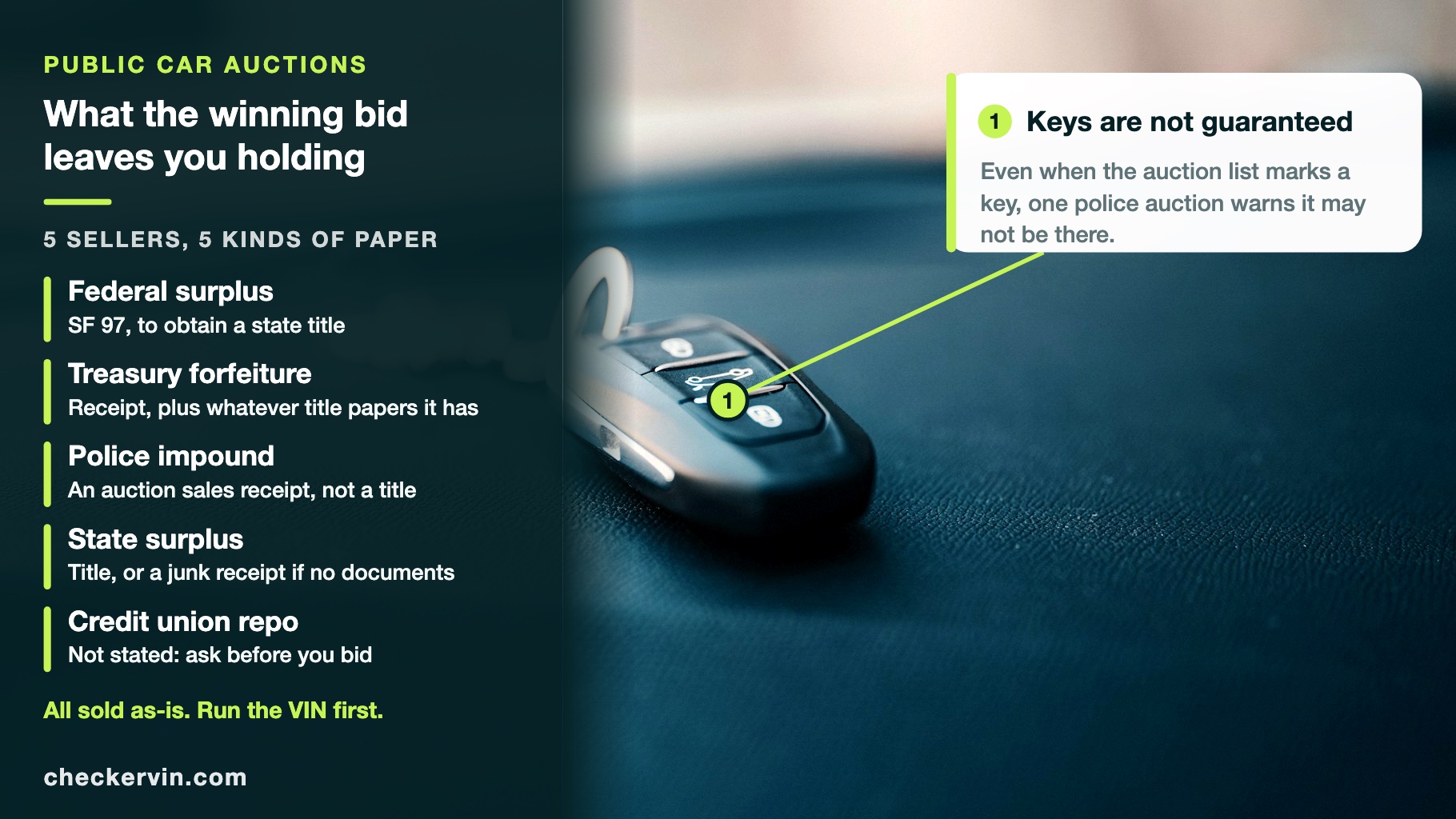
| Federal surplus (GSA) | An SF 97, a federal certificate you take to your DMV to obtain a state title. Our GovDeals review covers it in detail. |
| Treasury forfeiture sale | A sale receipt and release documents, plus whatever title papers the government holds. Its terms do not promise those papers are enough to title the car. |
| Houston police auction | An Auction Sales Receipt from the police department, taken to a county tax office to transfer the title. A lost receipt is not reissued. |
| Montgomery County, MD police auction | An MVA Auction Sales Receipt in the winning bidder's name. The car must be titled within 90 days, and the county recommends a Maryland salvage title. |
| Minneapolis impound lot | A receipt and a notarized bill of sale, with no plates. Under Minnesota law the receipt lets you title the car free of liens after a safety check. |
| California state surplus | A certificate of title if the car is sold with documents. Sold without documents, it leaves on a tow with a junk receipt and the DMV issues a salvaged title. |
| Credit union repossession | Not stated. Neither credit union page we read says what title paperwork the buyer receives, so ask before you bid. |
Three practical rules follow. Guard the receipt: Houston will not reissue a lost Auction Sales Receipt, and its page says a buyer who loses one needs a bonded title. Mind the clock, as Montgomery County sets 90 days to title the car. And if you live in another state, ask your own DMV first: Montgomery County warns that other states may not accept its receipt.
State surplus vehicle auctions
States sell their own retired vehicles through surplus agencies, mostly online now. These cars usually have titles, because the state owned them outright, which makes them the simplest public auction cars to register. Two examples:
- North Carolina State Surplus Property: open to the general public, bid online. Sold as is, where is, with all faults and no warranty. Its FAQ warns the vehicles may not pass a state inspection and may have problems not listed. You may start a car in place but not move it, and the title is issued only in the exact name on the winning bid, which must match your driver's license.
- California Department of General Services: vehicles are bid online through a contracted auctioneer, with in-person viewing at its yards two days before each monthly sale. Cars sold with documents come with a certificate of title; cars sold without documents leave on a tow, with a junk receipt, and the DMV issues a salvaged title. Pickups are scheduled the week after the sale, and items left beyond 5 business days can get the buyer locked out of GovDeals, where the state also lists.
California’s “with documents” and “without documents” split is worth looking for in any listing. Two identical-looking state cars can end up with very different titles, and the difference is printed in the lot description, not on the car.
Repo car auctions: where repossessions actually go
Searches for a repo car auction usually picture a public sale. Repossessions also move through wholesale channels the public cannot enter: Manheim’s contact page carries a dedicated repossession assistance line and status portal for lenders, and Manheim’s auctions are for licensed dealers only. The public routes are narrower, and the clearest are lenders selling their own cars.
- Coast Central Credit Union in California lists repossessed vehicles for sealed bid and says both members and non-members may bid. Cars are sold as-is, the credit union says it cannot warranty their condition, and it encourages bidders to have a mechanic inspect first.
- Goldenwest Credit Union takes repossession bids online, sells as-is without warranty, allows no test drives, and takes cashier's checks, certified funds or cash, not personal checks. Its page does not say whether non-members may bid, and it mentions credit union financing.
A repossession sale carries its own legal questions, such as which liens survive the sale and when the borrower can still redeem the car. Our guide to buying a repossessed car covers them, and they apply whether the lender sells by sealed bid, online or through an auction house.
Government auction scams: what the FTC has said
The oldest trick in this space is selling access to something that is free. In November 1998 the FTC announced Operation Auction Guides, suing companies that sold guides promising government-seized cars and homes for very little money. Its statement was blunt: cars and homes are sold at government auctions, but they typically sell for their fair market value, and information about the government’s sales programs is available free online.
The newer version is a fake seller. An FTC consumer alert from September 2026 describes scammers copying real dealer websites, sometimes with AI, to take upfront payment for cars that do not exist, and tells buyers to walk away from a seller who insists on wire transfer only. An earlier FTC alert on phony online car sales says a seller asking for payment in gift cards is running a scam, every time.
- Reach the auction from the agency's own .gov page, or from usa.gov's federal list, never from an ad or a text message.
- A real government sale tells you where the car is and when you can see it. A seller that will not allow an inspection is not running a government auction.
- Pay only by the methods printed in the official terms, to the payee they name. No real sale above asks for gift cards.
- Nobody sells a list of government auctions that the government does not already publish for free.
- Report a suspect listing at ReportFraud.ftc.gov.
A short inspection: what you can and cannot learn on the lot
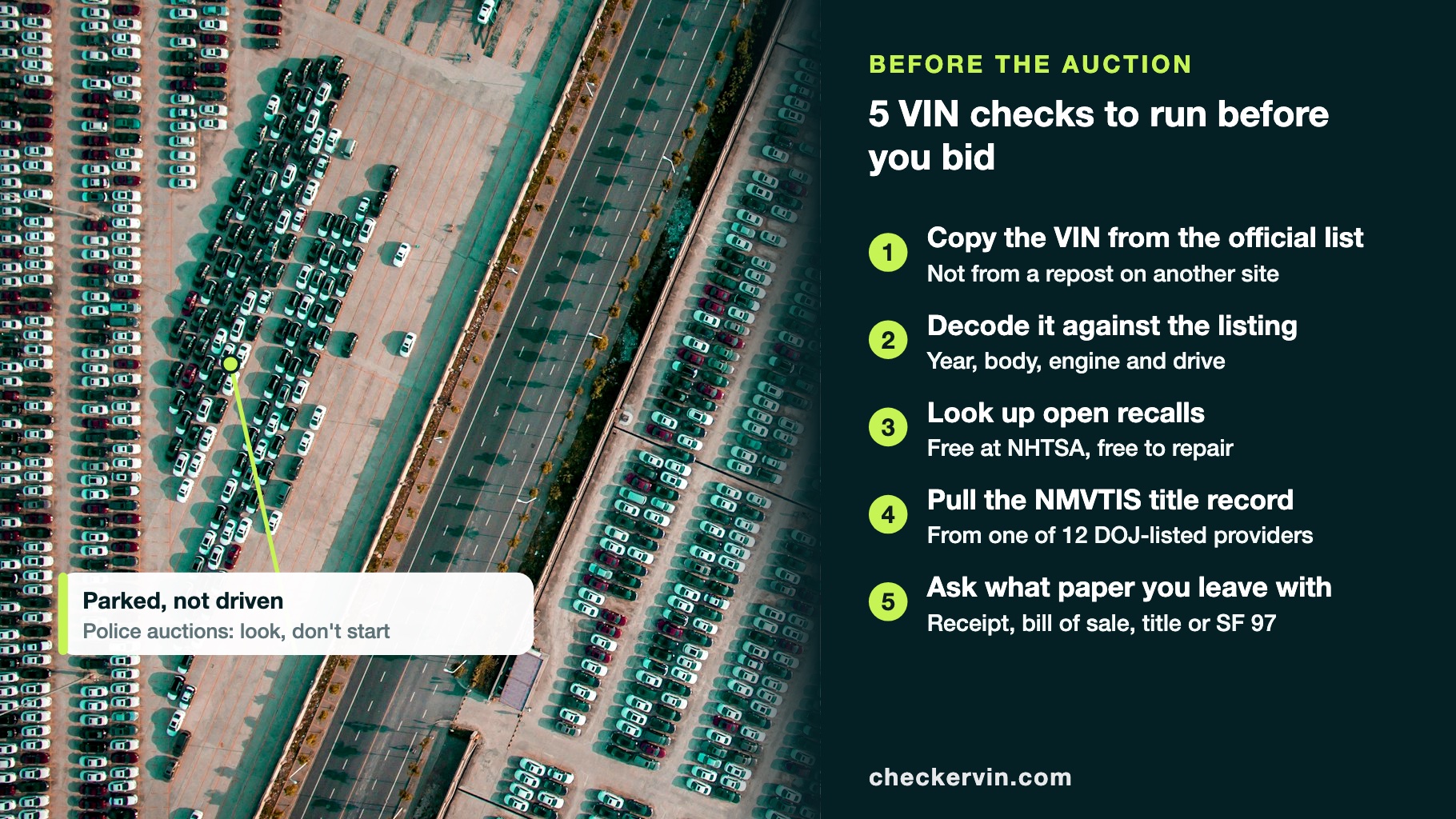
Every police auction above limits what you can do before bidding. Houston gives access only while officers are present and the sale is running, with a visual inspection only. Montgomery County does not let you start or move a car until the auction ends. Minneapolis does not let you drive one off the lot at all. Treasury terms let the government withdraw lots or add unlisted ones on the day, and day-of announcements override the catalog.
- Look for what sitting does: flat-spotted or cracked tires, rodent nests under the hood, a dead battery, mold in the cabin.
- Read the windshield and door-jamb VIN labels and make sure they match each other and the list.
- Note the odometer yourself if the display lights. Montgomery County makes recording it the buyer's job.
- Check for keys, and do not assume. Montgomery County warns a listed key may not be there.
- Budget the tow. Several of these sellers require the car to leave on a truck.
Our used car red flags list covers the rest of a visual inspection. If the car once passed through a salvage auction, auction history by VIN explains where its old photos may still be found.
Run the VIN and pull the title record before you bid
A public auction gives you almost no recourse after the hammer falls, so the checks have to come first. Treasury’s terms warrant only the description; the police auctions above warrant nothing. Here is the order that saves the most time:
- 1Get the VIN from the official listPolice and government auctions publish a vehicle list or catalog before sale day. Copy the 17-character VIN from it, or from the windshield during the preview, rather than from a repost on a third-party site.
- 2Decode it against the descriptionYear, body, engine and drive should match the listing. Impound and forfeiture lists are typed by staff who never drove the car, so a mismatch is a reason to look harder, not a typo to ignore.
- 3Look up open recallsAn impounded car may have sat for weeks, and a seized one may have missed recall notices for years. NHTSA's lookup is free, and a recall repair at a franchised dealer is free too.
- 4Pull the NMVTIS title recordBuy a report from a provider on the Department of Justice list and read the brand history, total-loss and salvage records and odometer readings before you decide what to bid.
- 5Ask what paper you will leave withReceipt, bill of sale, certificate of title or SF 97. Then ask your own DMV what it needs with that paper, especially if you live in another state.
Decode an auction car's VIN free, no card
Decoded from official manufacturer and NHTSA records
The NMVTIS program says repair histories are not meant to be part of its reports, so a clean title record is not proof of a sound car. It does tell you whether the paper you are about to receive will title as clean, salvage or junk, which on a forfeited or impounded car is often the biggest unknown. Our NMVTIS report guide explains who reports what to the federal system.
Where this information comes from
- USAGov — Government vehicle auctionsThe four federal routes and how agencies run sales (updated March 2, 2026)
- GSA — How to purchase surplus propertyDonation first, then public sale; GSA Auctions, payment, no financing, removal (updated Nov 2, 2026)
- GSA — SF 97-1, The United States Government Certificate to Obtain Title to a VehicleThe federal certificate a buyer takes to the DMV (rev. 04/2012)
- U.S. Department of the Treasury — General Property AuctionsOpen-to-the-public sales and the auction calendar, including a salvage-dealer-only vehicle sale
- Treasury — Sale of Government Property: General Sale Terms and Conditions (rev. 1/4/21)Eligibility, registration, inspection, as-is, warranty of description, payment, title documents and defaults; linked from the Treasury page
- Houston Police Department — Vehicle AuctionDaily public auctions under Texas Transportation Code chapter 683, cash only, visual inspection, Auction Sales Receipt
- Montgomery County (MD) Police — Vehicle AuctionRegistration, ID, payment and removal deadlines, MVA Auction Sales Receipt, 90-day titling, salvage title advice
- City of Minneapolis — Impound Lot auctionsPublic and dealer auctions, towing required, receipt and notarized bill of sale, no plates
- Minnesota Statutes § 168B.08Sale of unclaimed impounded vehicles, the buyer's receipt and lien-free title, and proceeds held 90 days
- North Carolina State Surplus Property — Vehicle FAQsOpen to the public, as-is terms, inspection warning, keys and titling in the bidder's name
- California DGS — Public Vehicle AuctionsOnline bidding, viewing days, with and without documents, removal
- Coast Central Credit Union — Hot DealsRepossessed vehicles by sealed bid, open to members and non-members, sold as-is
- Goldenwest Credit Union — Repo Sales, AboutOnline bids, as-is, no test drives, payment methods
- Manheim — Contact usRepossession assistance line and status portal
- FTC — FTC Charges Companies with Making Fraudulent Claims about Government Auctions for Cars, Homes or Jobs (Nov 20, 1998)Operation Auction Guides; government auction cars typically sell at fair market value; sales information is free
- FTC — Scammers are spoofing car dealership websites (Sept 1, 2026)Cloned dealer sites, wire-transfer-only demands, ReportFraud.ftc.gov
- FTC — Put the brakes on phony online car salesFake listings and gift-card payment demands
- NMVTIS — approved data providersThe Department of Justice list; no auction seller on this page appears on it
- NMVTIS — Understanding a Vehicle History ReportRepair histories are not meant to be included
- NHTSA — Recalls lookupFree open-recall check by VIN
- How we made this pageWritten by the CarCheckerVIN editorial team with AI assistance from public records: usa.gov, gsa.gov, Treasury auction pages and terms, police and city auction pages, a Minnesota statute, state surplus pages, credit union pages, Manheim's contact page, FTC releases and alerts, and the Department of Justice NMVTIS pages; facts checked November 2026. usmarshals.gov and gsaauctions.gov could not be read, and no fee or car price is printed.
Keep reading
Frequently asked questions
Can anyone go to a public car auction?
Most police, government and state surplus auctions are open to the general public, typically with government-issued photo ID; Treasury and Montgomery County, Maryland require bidders to be 18 or older. Some lots are not: Houston sells salvage vehicles only to licensed salvage dealers, Minneapolis runs separate dealer auctions for parts, scrap and salvage dealers, and Treasury's calendar includes salvage-dealer-only vehicle sales.
Are police auction cars cheap?
Some are, many are not. The FTC has said that cars sold at government auctions typically sell for their fair market value, and it sued companies whose ads promised luxury cars for a few hundred dollars. The cheap ones are usually cheap for a reason: no keys, no title, or damage you can only see from the outside.
Do you get a title when you buy a car at a police impound auction?
Usually not on the day. Police auctions commonly hand over a sales receipt or bill of sale, which you take to the DMV or county tax office to apply for a title. Houston issues an Auction Sales Receipt, Montgomery County, Maryland issues an MVA Auction Sales Receipt, and Minneapolis issues a receipt and a notarized bill of sale.
Can the public buy at a repo car auction?
At dealer-only wholesale auctions, no. Public repossession sales do exist, mostly run by credit unions that sell their own repossessed cars by sealed or online bid. Coast Central Credit Union in California, for example, says both members and non-members may bid. Read our guide to buying a repossessed car for the lien questions.
How do government car auctions work?
The agency, or an auction company working for it, lists the vehicle, allows a short inspection, takes bids online, in person or by mail, and expects payment and removal within days. Federal surplus goes through GSA, seized property through the Treasury and U.S. Marshals programs, and state and local cars through each government's own surplus or police auction.
Can I test drive a car at a police or government auction?
Generally no. Houston limits bidders to a visual inspection and says the vehicles may not be operated. Montgomery County forbids starting or moving a car until the auction is over. North Carolina's state surplus lets you start a vehicle in place but not move it.
Should I pay for a list of government car auctions?
No. The FTC said in 1998 that information about the government's sales programs is available free on the internet, while suing sellers of paid auction guides. Start from the agency's own .gov page: usa.gov links the federal programs, and your city, county or state lists its own sales.
Check the VIN before the auction starts
Decode any police, government or repo auction car's VIN free for the factory build, specifications and open safety recalls. No account, no card. Full vehicle history reports are launching soon.
Run a free VIN check