The short answer
- Can the public buy at a Manheim auction?
- No. Every Manheim buyer needs an AuctionACCESS ID, and AuctionACCESS restricts membership to licensed, credentialed vehicle dealers and their authorized representatives.
- How do dealer auction cars reach retail lots?
- Dealers buy at Manheim, recondition and resell. What the seller announced in the lane, such as structural damage or True Miles Unknown, was said to the buying dealer, not to you.
- What should a retail buyer do about it?
- Ask where the car came from, decode the VIN, check open recalls, pull an NMVTIS title record from a Department of Justice listed provider, and get an independent inspection.
81
Manheim physical auction locations
Cox Automotive's Manheim page
3.9 million+
Vehicles Manheim inspects a year
Cox Automotive's Manheim page
Dealers only
Who AuctionACCESS admits
Licensed dealers and their representatives
206.8
Manheim index, mid-November 2026
Cox Automotive, Nov. 18, 2026
Can the public buy at a Manheim auction? The short answer
No. Manheim’s own sign-up page starts with an AuctionACCESS ID, which it describes as coming from “a dealer authentication service that confirms you are an authorized dealer.” AuctionACCESS’s FAQ is plainer still: membership is restricted to licensed, credentialed vehicle dealers and their authorized representatives. Without that credential the Manheim auction is closed to you, whether you are in the lane or bidding online.
That answers the usual question, but most people searching “Manheim auction” are really asking something closer to home. If dealers buy there, how much of what a used-car lot sells came through a dealer auction, and what did the auction know about the car that the lot does not mention? Manheim and the trade association whose rules it follows publish a great deal about that, and almost none of it is written for consumers. This page reads it from the retail buyer’s side.
What Manheim is, by Cox Automotive's own numbers
Manheim belongs to Cox Automotive, which describes it as the largest wholesale network in the country. Its brand page gives 81 physical auction locations, 80,000+ active dealers in the Manheim marketplace and 3.9 million+ vehicles inspected a year. Cox also owns Kelley Blue Book, a connection our Kelley Blue Book value by VIN guide covers, so we will not repeat it here.
A dealer auction is a wholesale market. Sellers are dealers and other businesses with cars to move; buyers are dealers restocking their lots. Manheim’s seller pages describe the tools on that side: listing a unit on OVE.com with a Manheim-approved condition report, following a car through a live Simulcast sale and accepting or countering offers in real time. Nobody in that exchange is buying a car to drive home. Both sides are pricing it for resale, and the rules are written for two professionals.
AuctionACCESS: the dealer credential behind every Manheim bid
AuctionACCESS calls its membership “a dealer’s gateway into the wholesale auction industry” and says one credential works at over 400 marketplaces in the US and Canada. Its FAQ sets out what that credential involves:
| AuctionACCESS FAQ says | What it means for you |
|---|---|
| Membership is restricted to licensed, credentialed vehicle dealers and their authorized representatives | A consumer cannot join. There is no individual or public tier. |
| Representatives are bona fide employees or contractors of a licensed dealership | Borrowing a friend's dealer number is not what the membership allows. |
| A valid photo ID is required | State driver's licenses, other government IDs and passports are among the accepted forms. |
| The annual fee is $107 per individual, plus applicable sales tax | Charged to the individual, not the dealership. Read November 2026; it can change. |
| Membership does not register you at all auctions | Each auction is separate. Manheim needs its own sign-up after AuctionACCESS approves you. |
Manheim’s side asks for the AuctionACCESS ID and the last four digits of a Social Security number or government ID. Its location registration page adds that a picture ID may be needed at the auction and that some sites ask for extra auction-specific forms. Buying at Manheim therefore takes two approvals, and the first one depends on a state dealer license.
What a dealer license takes: California and Texas as examples
Searchers often ask whether they can get a dealer license just to buy one car at a dealer auction. Look at what a state actually asks for and the answer becomes obvious. Two examples, read from the agencies’ own pages:
| California DMV, vehicle dealer license | Requirement |
|---|---|
| Dealer education | Used and wholesale-only dealer applicants submit a Certificate of Completion from the Dealer Education Program. |
| DMV test | Proof of passing the used dealer test. Applicants get 3 attempts; a failed attempt costs $16 and a week's wait, and a third failure sends you back to the education program. |
| Fingerprints | Live scan fingerprints for each person listed under ownership. |
| Place of business | Established so that its construction is not temporary, transitory or mobile, and actually occupied by the dealer. |
| Wholesale-only | A separate dealer-wholesale only path uses the used dealer forms packet. |
Texas works through a general distinguishing number. The Texas DMV describes its Independent GDN as the “basic dealer license” that allows a holder to buy, sell or exchange the type of used vehicle it is issued for. Either way, a license is a business with premises, testing and background checks. It is not a pass to one sale.
Dealer auction vs public auction vs salvage auction
“Car auction” covers three different markets, and confusing them is how buyers end up on the wrong website. The table sets the dealer auction against the two kinds you can use without a dealer license.
| Auction type | Who can buy, and what is sold |
|---|---|
| Dealer auction (Manheim and similar) | Licensed dealers with an AuctionACCESS credential. Used cars moving between dealers and other wholesale sellers. |
| Government surplus (GovDeals, GSA Auctions) | Mostly open to the public. Retired fleet and agency vehicles, sold as-is. |
| Salvage auction (Copart, IAA) | Some lots open to the public, others need a license or a broker. Insurance total losses and other damaged vehicles, many on salvage titles. |
Each of the public routes has its own page here: our GovDeals review covers government sales and the SF 97, the Copart review covers which lots need a license, and IAAI feescovers IAA’s public-buyer schedule. A dealer auction is different in kind. You will not find a public lane at Manheim, and the cars do not come to you until a dealer has bought them.
How a Manheim sale runs: the lane, Simulcast and OVE
Manheim sells in a physical lane and online, and the same rules on announcements apply in both. Its buyer and seller pages describe the channels:
| Channel | How it works, per Manheim and NAAA pages |
|---|---|
| In-lane | A live auction at a Manheim location, with the auctioneer, the sale lights and announcements made in the lane. |
| Simulcast | Real-time online bidding in a live lane. The first dealer to click wins the displayed bid, and a proxy bid can bid up to a set maximum. |
| OVE.com | A round-the-clock online marketplace with Bid and Buy Now listings, which can carry a Manheim-approved condition report. |
The Simulcast buyer’s guide notes two things a dealer needs before the first click: an AuctionACCESS registration and a sign-up for each specific sale on Manheim.com. It also warns that clicking Bid does not guarantee the auctioneer will accept it. For a consumer, the relevant point is that a car bought on a screen hundreds of miles away is described to the buying dealer almost entirely by the condition report and the announcements.
The sale lights, and what each one promises the dealer
Wholesale auctions describe each car with a light. Manheim follows the National Auto Auction Association’s Arbitration Guidelines, effective June 1, 2026, which define them this way:
| Light | What the NAAA guidelines say it means |
|---|---|
| Green: Ride & Drive | The seller guarantees the vehicle under the guidelines. Anything requiring disclosure has to be announced. |
| Yellow: Limited Guarantee | The seller has made announcements that qualify the vehicle's condition and limit arbitration to what was not announced. |
| Red: Limited As-Is | Not guaranteed. Arbitration only in narrow cases. Local auction policy can push vehicles into red automatically by price, model year or mileage. |
| Blue: Title Attached / Absent | The title is not present at the time of sale. The buyer waits for it under the auction's own deadline. |
Two more defaults matter. Vehicles more than 20model years old sell as-is unless the seller says otherwise. And Manheim’s arbitration page says OVE.com cars are treated as Ride & Drive unless specifically labeled as-is. The light protects the buying dealer for a short window. None of that protection passes to the person who later buys the car from that dealer.
Manheim condition reports and grades: what they cover
A Manheim condition report is the written description most online buyers rely on. Manheim says reports come from its Mobile Inspection service or from an Insight report completed by a certified partner, and lists these elements:
- Vehicle description
- Frame damage report
- Prior paint information
- Tire information
- Description of options
- Images
- Visual damage summary
- Mechanical damage summary
The frame damage line is the one worth remembering. A wholesale buyer reads a structural finding in the condition report and prices the car accordingly. Whether that finding follows the car to retail depends entirely on the dealer.
Grades are a different matter. The NAAA guidelines state that the auction and seller are not bound by vehicle grades or other scoring systems, and that a buyer may arbitrate only for undisclosed damage or defects present at the time of sale. A grade is a summary of the report, not a guarantee, and dealers treat it that way.
Manheim adds one protection for digital buyers. Its Digital Buyer Protection covers vehicles bought through Simulcast Live and Timed sales and related OVE.com purchases, where Manheim or an approved vendor did the inspection. It extends to visible frame or critical structural issues the inspection report did not disclose. Under $50,000, a claim must total at least $800, and cars sold as-is, through TRA, inoperable, significantly modified or exotic are excluded. Damage after the sale or in transport is excluded too.
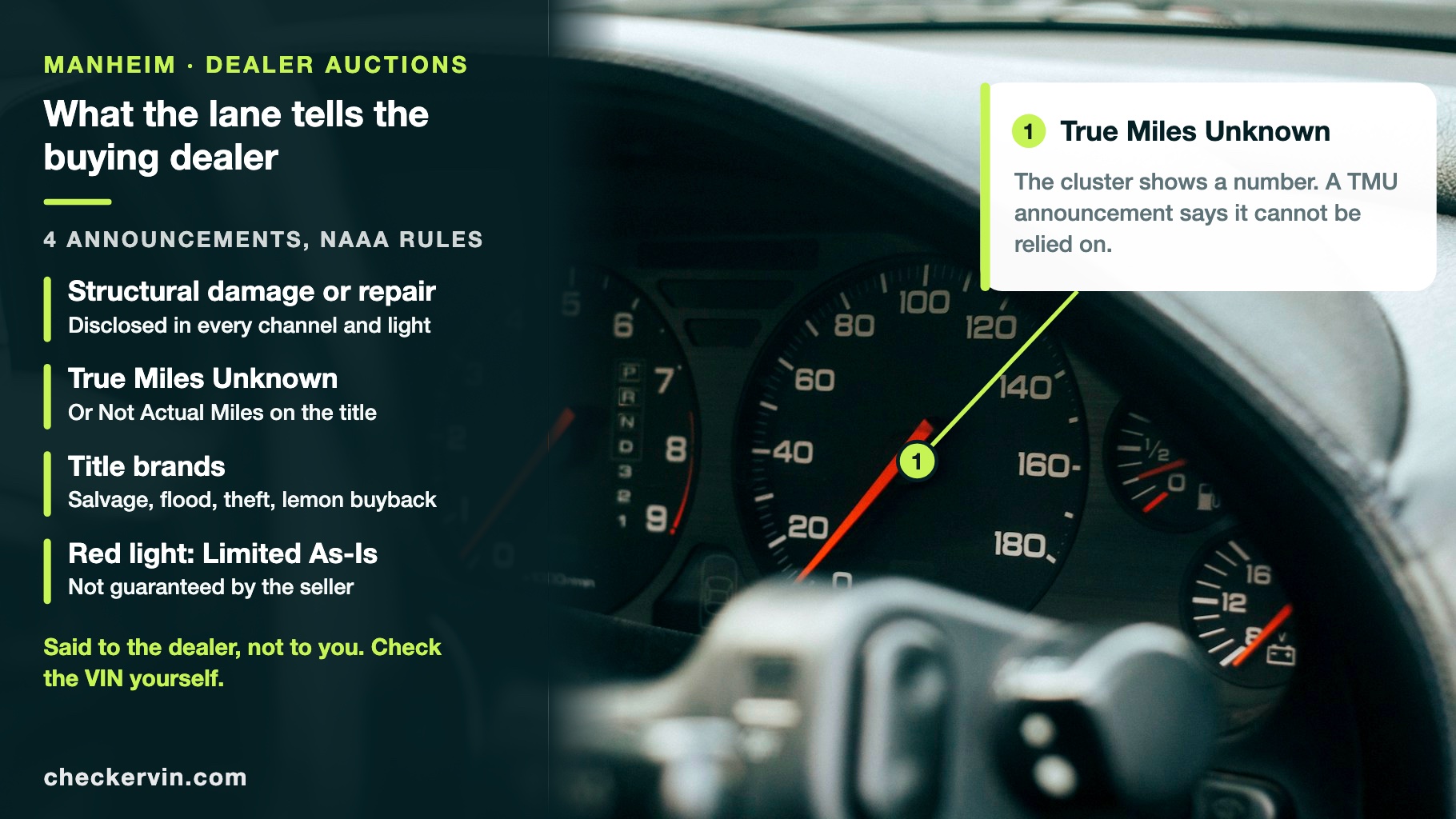
The announcements that matter: structural, TMU and title brands
An announcement is the seller’s formal disclosure, made verbally in the lane and in the written listing. The NAAA guidelines say title discrepancies must be announced, naming:
- Not actual miles
- Salvage
- Theft recovery
- Stolen vehicle
- Flood damage
- Lemon Law buybacks
Structural disclosures go further. Sellers must disclose permanent structural damage, structural alterations, and structural repairs or replacements, certified or not, regardless of sales channel or light. The list runs from kinked or broken structure and repairs not meeting OEM guidelines to corrosion that changes a component’s shape and tie-down tears more than an inch long. The guidelines also ban vague dodges: a seller may not announce “No Arb for [defect]” to avoid arbitration, and must name the defect or sell the car red light.
Then there is the as-is tier. Manheim’s Limited Arbitration Rights Policy, effective April 1, 2026, covers Total Resource Auctions sales, every vehicle sold for $3,000or less, and cars announced “As-Is, No Arbitration.” Those cars can be arbitrated only for:
- Inoperative odometer, True Miles Unknown or Not Actual Miles
- Title branding, discrepancies or encumbrances
- Requirements required by law
- Other written or verbal representations by the seller
The policy states that no other defect qualifies and that there are no mechanical or structural guarantees. So the cheapest dealer-auction cars sell with less protection for the dealer than any other tier. Some of them end up on a retail lot anyway, where you have none of that protection at all. What True Miles Unknown means for the odometer itself is covered in our odometer rollback guide.
Arbitration: a remedy between two dealers, on a short clock
Arbitration is how a buying dealer unwinds or reprices a car that was not as announced. It is fast and narrow, and the clocks below show why a problem has to surface within days:
| Rule | What the NAAA guidelines or Manheim say |
|---|---|
| Mechanical defects | Arbitrable if a single undisclosed defect costs $800 or more to repair on a car under $50,000, or 2% of the price at $50,000 and above. One claim per purchase. |
| Time period by channel | "A" In-lane: sale day only; "B" In-lane: 7 calendar days only; "C" Online: minimum industry standard of 7 calendar days. Sale day counts as day 1. |
| Manheim digital purchases | Manheim gives 10 calendar days of arbitration coverage, and wants documents and the car back within 5 calendar days of a claim specialist's request. |
| History issues | Total loss, salvage, Not Actual Miles, True Miles Unknown and lemon buybacks: 30 days, with later claims handled under the title rules. |
| Structural measurement | The auction can have the car measured. It passes if it is within ±8 mm of published specification and 6 mm side to side. Visual evidence overrides any measurement. |
| Title guarantee | The seller guarantees marketable title for 4 years, capped at the sale price and reduced by 2% a month. |
The guidelines are explicit about whose contract this is. The auction is not a party to the sale; the contract is between seller and buyer only, and the auction’s decision binds both. The retail customer is in neither role. If you buy the car three weeks after the auction, the dealer’s arbitration window may already have closed, and in any case it was never yours to use.
Why the auction will not take a history report as proof
One clause in the NAAA guidelines should change how a retail buyer reads a history report. A buyer cannot file an arbitration claim based solely on a vehicle history report, and the auction and seller are not bound by what one says. The guidelines name AutoCheck, Carfax and NMVTIS as examples. Manheim’s buyer arbitration guide says the same in its own words: it does not use electronic vehicle histories for verification, though they may point to other sources.
For a title claim, the guidelines list the evidence an auction does accept:
- Official government motor vehicle reporting, such as DMV records
- Insurance declarations
- NICB reporting
- Law enforcement reports
- Prior auction history and sale announcements
The professionals treat a history report as a lead, then go to the primary record: the state’s title, the insurer’s file, the police report, the earlier auction’s announcement. You can do the same. A clean report on a car that came through a dealer auction is worth having, but it is not the auction’s record, and the auction itself would not accept it as one. Our guide to auction history by VIN explains which earlier auction listings can still be found and which never were public.
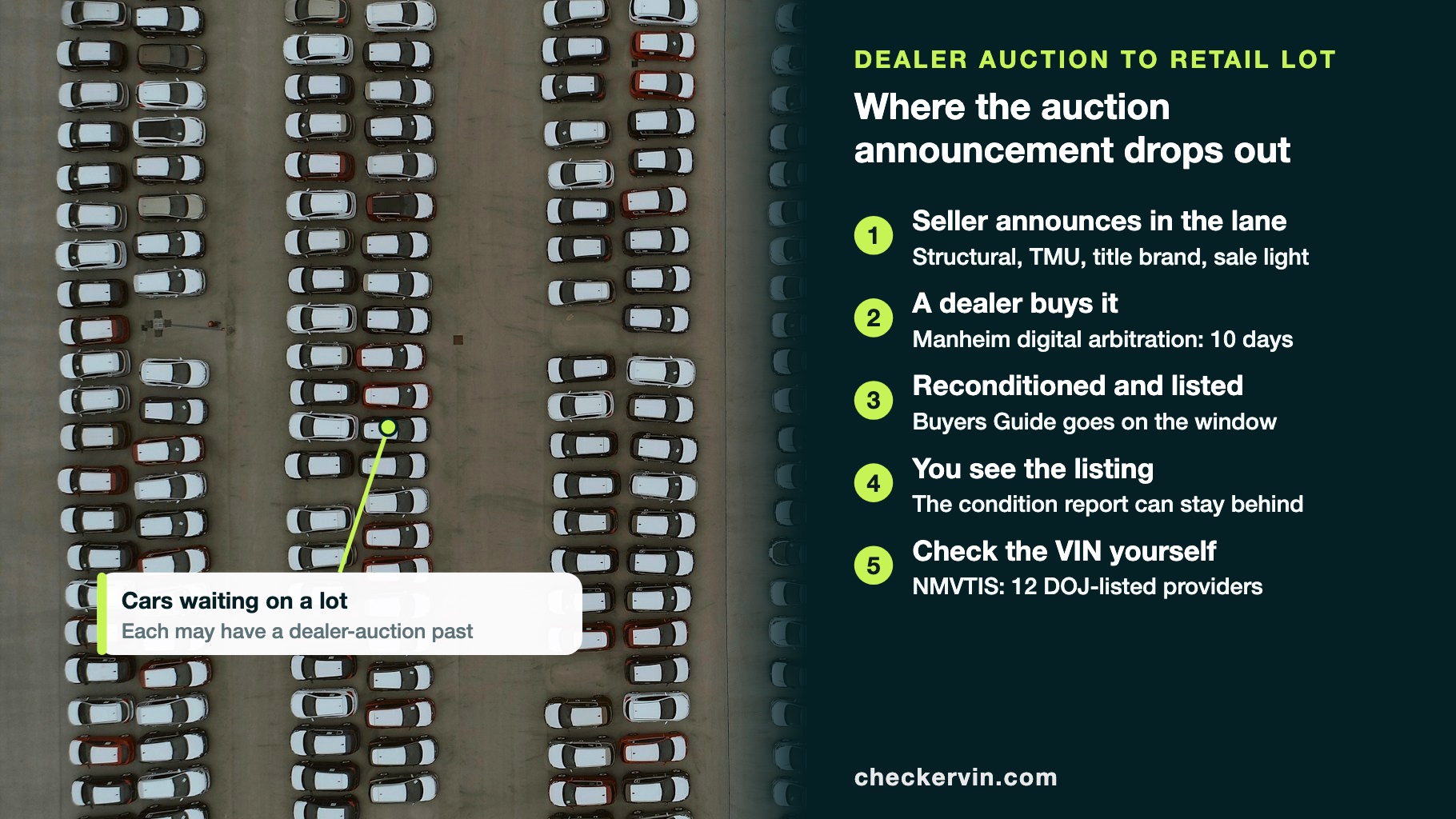
From the auction lane to the retail lot: what does not travel
Take a hypothetical car. A lease return or a trade-in the first dealer does not want runs at Manheim under a yellow light, announced with prior structural repair. A second dealer buys it knowing that, at a price that reflects it, and keeps the condition report in a deal file. The car is detailed and listed for retail sale.
What you see on the lot is the FTC Buyers Guide on the window. The FTC explains that it shows whether the car is sold as is or with a warranty, and that “As Is - No Dealer Warranty” means the dealer will not pay for later repairs. It is not a copy of the auction’s condition report, and it does not repeat the lane announcement. A state’s own disclosure laws may require more in some cases. The only document certain to hold the announcement is the auction paperwork, and you have to ask for it.
| Stays with the dealer | What reaches you |
|---|---|
| The lane announcement and sale light | The Buyers Guide's as-is or warranty box |
| The Manheim condition report and frame damage line | The dealer's own listing and photos |
| The arbitration window and title guarantee | Whatever warranty or return policy the dealer offers |
| The auction bill of sale | A title in the dealer's name, assigned to you |
None of this makes a dealer-auction car a bad buy, and an announced repair is not a hidden one. The point is narrower. The person who knew the most about the car’s past was the buying dealer, and the FTC tells shoppers that a history report “is not a substitute for an independent vehicle inspection.” Our frame damage check explains how a structural repair is found and measured.
The Manheim Used Vehicle Value Index, read from Cox's releases
The other reason Manheim makes the news is its index. Cox Automotive publishes the Manheim Used Vehicle Value Index as a benchmark of US wholesale used-vehicle prices, adjusted for mix, mileage and seasonality, on a base of January 1997 = 100.
| Release | What Cox Automotive reported |
|---|---|
| October 2026 (released Nov. 6, 2026) | Index at 206.8, up 0.5% from September and 2% above October 2025. |
| Mid-November 2026 (released Nov. 18, 2026) | Unchanged at 206.8 in the first 15 days of November, and 0.7% above November 2025. |
For a shopper, the index is context, not a price. It tells you whether dealers are paying more or less for used inventory than they were a year ago, and that eventually feeds into what lots ask. It cannot value one car with one history: a lane announcement about structural repair or True Miles Unknown is exactly the kind of detail a market-wide average leaves out. When a dealer quotes you a trade-in figure, the index is a fair reminder that they price against wholesale.
Checking a dealer-auction car's VIN yourself
You cannot use the dealer’s arbitration rights, but you can rebuild most of what the auction knew before you sign. Work through these in order, cheapest first:
- 1Ask where the dealer got the carAsk whether it came from a wholesale auction, and if so whether the dealer kept the auction's condition report and bill of sale. The announcement, if there was one, is printed there. The FTC's Buyers Guide on the window is not that paperwork, so you have to ask for it.
- 2Decode the VIN, freeConfirm year, body, engine and drive against the retail listing. A wholesale car can be re-described at retail by someone who never saw the auction paperwork, and the decode is the cheapest way to catch a wrong trim or powertrain.
- 3Look up open recallsA car that cycled through dealer auctions after a lease or a rental term may have moved between owners before a remedy was done. Check the VIN against NHTSA's recall data before you sign.
- 4Pull the NMVTIS title recordBuy a report from a provider on the Department of Justice list and look for title brands, total-loss records and odometer readings. These are the same kinds of record the NAAA guidelines tell an auction to accept as evidence.
- 5Pay for an independent inspectionAsk the inspector to look specifically for structural repair, because that is the announcement most likely to have stayed at the auction. If the dealer will not allow it, the FTC suggests going to another dealer.
Decode a dealer-auction car's VIN free, no card
Decoded from official manufacturer and NHTSA records
If the title record shows a brand, a total loss or an odometer flag the dealer did not mention, put it to them in writing before you go further. Our used car red flags list covers the inspection itself, and the NMVTIS report guide explains who reports what to the federal system.
Where this information comes from
- Manheim — New dealer registration FAQAuctionACCESS as a dealer authentication service; Manheim sign-up with the AuctionACCESS ID and last four digits of an SSN or government ID
- Manheim — New dealer tutorialsAuctionACCESS registration does not register you with Manheim; documents uploaded at AuctionACCESS
- Manheim — Location registrationEnrollment through AuctionACCESS, picture ID and auction-specific forms at a location
- AuctionACCESS — Frequently Asked QuestionsMembership restricted to licensed dealers and authorized representatives; photo ID; annual fee; membership does not register you at auctions
- AuctionACCESS — HomeOne credential across more than 400 marketplaces in the US and Canada
- Cox Automotive — ManheimPhysical locations, active dealers and vehicles inspected a year
- Manheim — Simulcast buyer's guideReal-time online bidding, proxy bids, and the AuctionACCESS and sale registrations needed first
- Manheim — SellOVE.com, Simulcast and Manheim-approved condition reports from the seller's side
- Manheim — Condition reportingWhat a condition report lists, including the frame damage report; Mobile Inspection and Insight reports
- NAAA Arbitration Guidelines, effective June 1, 2026 (via Manheim's NAAA arbitration page)Sale lights, required announcements, structural guidelines and measurement tolerances, arbitration time periods, history reports and title evidence
- Manheim — Limited Arbitration Rights PolicyTRA, $3,000-and-under and As-Is, No Arbitration sales: what remains arbitrable (effective April 1, 2026)
- Manheim — Digital Buyer ProtectionCoverage for undisclosed visible frame or structural issues on digital purchases, minimum claim and exclusions
- Manheim — Buyer Arbitration GuideDigital arbitration coverage period, return deadlines, and no use of electronic vehicle histories for verification
- Manheim — Assurance and arbitrationClaims filed within NAAA Appendix I periods; OVE.com cars treated as Ride & Drive unless labeled as-is
- Cox Automotive — Manheim Used Vehicle Value Index, October 2026Index level and changes, released Nov. 6, 2026
- Cox Automotive — Manheim Used Vehicle Value Index, mid-November 2026Mid-month reading, adjustment method and base year, released Nov. 18, 2026
- California DMV — Vehicle dealer licenseDealer education, the DMV test and retest fee, live scan fingerprints, place of business, wholesale-only forms
- Texas DMV — Dealer licensingThe Independent GDN as the basic used-vehicle dealer license
- FTC — Buying a used car from a dealerWhat the Buyers Guide shows, history reports versus inspections, and independent mechanic inspections
- NMVTIS — approved data providersThe Department of Justice list; Manheim, Cox Automotive and AuctionACCESS do not appear on it
- NHTSA — Recalls lookupFree open-recall check by VIN
- How we made this pageWritten by the CarCheckerVIN editorial team with AI assistance from public records: Manheim's own help and policy pages, the NAAA Arbitration Guidelines, AuctionACCESS's pages, Cox Automotive's Manheim page and index releases, California and Texas DMV pages, the FTC and the Department of Justice NMVTIS list; facts checked November 2026. No Manheim buyer fee is reproduced, because we found no published schedule.
Keep reading
Frequently asked questions
Can the public buy at a Manheim auction?
No, not directly. Buying at Manheim requires an AuctionACCESS ID, and AuctionACCESS says its membership is restricted to licensed, credentialed vehicle dealers and their authorized representatives, meaning bona fide employees or contractors of a licensed dealership. A consumer reaches Manheim cars later, when a dealer resells them at retail.
Do you need a dealer license to buy at a dealer auction?
At Manheim, yes, through the AuctionACCESS credential. Getting a license is a business application, not a buyer's pass: California, for example, asks used and wholesale-only dealer applicants for a dealer education certificate, a passed DMV test, live scan fingerprints and an established place of business. Public alternatives exist, such as government surplus sales and the no-license lots at some salvage auctions.
What is AuctionACCESS and how much does it cost?
AuctionACCESS is the dealer credential service used across wholesale auctions; it says one membership works at over 400 marketplaces in the US and Canada. Its FAQ gives the annual fee as $107 per individual, plus applicable sales tax, read in November 2026. Membership does not register you at any auction; each one, including Manheim, needs its own sign-up.
What does TMU mean at a car auction?
True Miles Unknown. It sits with Not Actual Miles in the auction rules: the odometer reading cannot be relied on. Manheim's Limited Arbitration Rights Policy keeps TMU and Not Actual Miles arbitrable even on as-is sales, which tells you how seriously the trade treats it. The label lives on the auction paperwork, so a retail buyer has to look for it in the title record.
What does a red light mean at Manheim?
Limited As-Is. Under the NAAA guidelines Manheim follows, a red-light vehicle is not guaranteed and qualifies for arbitration only in narrow cases. Manheim's own policy adds that vehicles announced As-Is, No Arbitration, and every vehicle sold for $3,000 or less, can be arbitrated only for odometer, title, legal and seller-representation issues, with no mechanical or structural guarantee.
Is the Manheim index the value of my car?
No. The Manheim Used Vehicle Value Index tracks wholesale used-vehicle prices across the US market, adjusted for mix, mileage and seasonality. Cox Automotive put it at 206.8 in its mid-November 2026 reading. It shows the direction of dealer-to-dealer prices, not what one car with one history is worth.
How do dealer auction cars end up on retail lots?
A dealer buys the car at a wholesale auction such as Manheim, may recondition it, then lists it for retail sale. Any announcement made in the auction lane, such as structural damage or True Miles Unknown, was a statement to the buying dealer. The FTC's Buyers Guide on the window covers warranty terms, not the auction paperwork, so run your own VIN checks and inspection.
Check the VIN the dealer bought at auction
Decode any used car's VIN free for the factory build, specifications, warranty and open safety recalls. No account, no card. Full vehicle history reports are launching soon.
Run a free VIN check