The short answer
- Is GovDeals legit?
- Yes. It is run by Liquidity Services, a Nasdaq-listed company, and the sellers are mostly government agencies. Its User Agreement sells every vehicle as-is, where-is and with all faults, so legit does not mean inspected.
- How do GSA Auctions cars work?
- GSA Auctions sells surplus federal property online to the public. You bid, pay by wire, government check or card, then remove the vehicle by the deadline. The title paperwork is an SF 97 you take to your DMV.
- What should I check before bidding on a government surplus car?
- Decode the VIN, look up open recalls, pull an NMVTIS title record from a Department of Justice listed provider, and inspect the car on the listed inspection days.
$952.3 million
GovDeals segment sales volume
Liquidity Services 10-K, year to September 30, 2026
30,000+
GSA Fleet vehicles sold a year
GSA, Sales of GSA Fleet vehicles
10 days
Default GovDeals removal window
Business days, unless the listing differs
Neither listed
GovDeals or GSA on the NMVTIS list
They sell vehicles, not title reports
The short verdict: is GovDeals legit?
Yes. GovDeals is the government surplus marketplace of Liquidity Services, which trades on Nasdaq as LQDT and reports GovDeals as one of its three business segments in its annual report for the fiscal year ended September 30, 2026. GovDeals’ own About page claims more than 15,000 sellers, more than 1 million registered buyers and more than $4 billionin completed sales. The “is GovDeals legit” question has a plain answer.
The harder question is whether a particular car is worth buying, and GovDeals’ terms make that the buyer’s problem in writing. The selling agency writes the listing, sets payment and pickup terms and decides whether to accept your bid. GovDeals’ help center says it manages the website and software while the transaction itself happens between buyer and seller. And the User Agreement says that by bidding you accept the vehicle as-is, where-is and with all faults.
Read the listing, run the VIN checks below, inspect if you can, and budget for getting the car home. This GovDeals review walks through each, and then does the same for GSA Auctions vehicles, which follow federal rules of their own.
Who operates GovDeals, from its own terms and SEC filing
The User Agreement, effective September 17, 2026, names the operator as Liquidity Services Operations LLC, a Delaware limited liability company, together with its parent, affiliates and subsidiaries. It lists GovDeals alongside AllSurplus and Liquidation.com as marketplace sites Liquidity Services operates. The parent, Liquidity Services, Inc., is based in Bethesda, Maryland, and filed its latest 10-K with the SEC on November 19, 2026.
| What the 10-K says | Why a car buyer should care |
|---|---|
| The GovDeals segment serves city, county, state and federal agencies in the U.S. and Canada, plus related businesses | Your seller is usually a public body, and each agency writes its own listing terms and handles its own paperwork. |
| Vehicles are a substantial portion of GovDeals' gross merchandise volume | Cars and trucks are central to the site, not a side category. |
| GovDeals segment gross merchandise volume was $952.3 million in fiscal 2026 | A large, active market, which also means competition from dealers who buy here for a living. |
| Vehicle supply depends on agency fleet replacement cycles, budgets and leasing | Ex-fleet cars arrive when an agency retires them, so the same model can come up several times at once. |
| Eligible GovDeals listings may also appear on the AllSurplus marketplace | The same car can show up on two sites run by the same company. It is one auction, not two sellers. |
The 10-K also explains how the company is paid. In consignment sales it acts as the seller’s agent and charges the seller a commission, and buyers pay a separate transaction fee it calls a buyer premium. Both matter to you: the agency’s terms govern the car, and Liquidity Services’ terms govern the platform and the fees.
Buying a car on GovDeals, step by step
The mechanics are simpler than at a salvage auction. There is no license gate on most listings, and the help center says most items are offered to the general public. The catches are in the timing, which runs on agency schedules, and in the pickup.
- 1Register, and expect probationRegistration is free and asks for no card or bank details. Every new account starts on probation, which caps card payments at $1,000 until you complete enough purchases or post a deposit.
- 2Read the listing, not just the photosEach asset page carries the seller's own payment terms, removal method and full terms and conditions. The seller is the agency, and its terms differ from one listing to the next.
- 3Ask questions and inspectGovDeals' general rules invite you to ask as many questions as you like or inspect before bidding. Inspection may need an appointment or fall on set viewing times.
- 4Bid, usually with AutobidAutobid is ticked by default and bids for you up to your limit. On lots with auto extension, a bid in the final 3 minutes adds another 3 minutes. A reserve, if any, stays hidden.
- 5Wait for seller confirmation, where it appliesOn "subject to seller confirmation" lots the agency can take up to 10 business days to accept or reject the high bid. The payment and removal clock starts only when it accepts.
- 6Pay, then collect the Buyer's CertificateSome agencies take payment directly and others through GovDeals' checkout. Once you have paid in full, GovDeals emails a Buyer's Certificate, which is what the seller asks to see at pickup.
- 7Remove the vehicle on timeUnless the listing says otherwise, removal is due within 10 business days of that certificate. You do the loading, towing or driving, and you need insurance to do it.
A few listings are restricted. GovDeals’ help center lists restrictions for fire and law enforcement agencies, gun dealers, and licensed auto dealers or salvors, among others, each needing documents emailed to its customer service team. A restricted listing shows a red banner below the photos, and if you do not qualify, the bid box will tell you so.
GovDeals buyer's premium, payment limits and default fees
The User Agreement defines the buyer’s premium as the service fee Liquidity Services charges a buyer “as expressly stated in a Seller’s Listing.” It adds that a premium is generally required and is typically a percentage of the sale price. We could not find a single GovDeals fee page that sets one rate for every vehicle, so we print no figure here. Look for the premium on the listing itself before you bid.
| Cost or limit | What GovDeals' own pages say |
|---|---|
| Buyer's premium | Usually a percentage of the sale price, stated per listing, paid to Liquidity Services on top of the winning bid. |
| Sales tax | The buyer owes it unless a valid exemption certificate is on file. Tax refund requests have a deadline counted from the auction's end. |
| Card processing fee | Charged on card payments, shown at checkout, and not refundable. |
| Card limit on probation | $1,000 per transaction, rising to $5,000 once probation ends. |
| Larger invoices | $5,000 or more needs certified funds, such as a wire transfer. Western Union is not accepted. |
| Late payment | Liquidity Services may charge interest on overdue amounts, plus collection costs. |
Defaults cost money. The User Agreement lets Liquidity Services charge a default administration fee, set as the greater of a percentage of the purchase price or a flat minimum, if you fail to pay or fail to remove, and lock the account until it is paid. If you have paid and then miss the pickup, it may also keep the buyer’s premium and refund the rest. GovDeals’ help pages quote different default figures from the agreement, so treat the User Agreement in force when you bid as the version that counts.
Sold as-is, where-is: what a GovDeals bid gives up
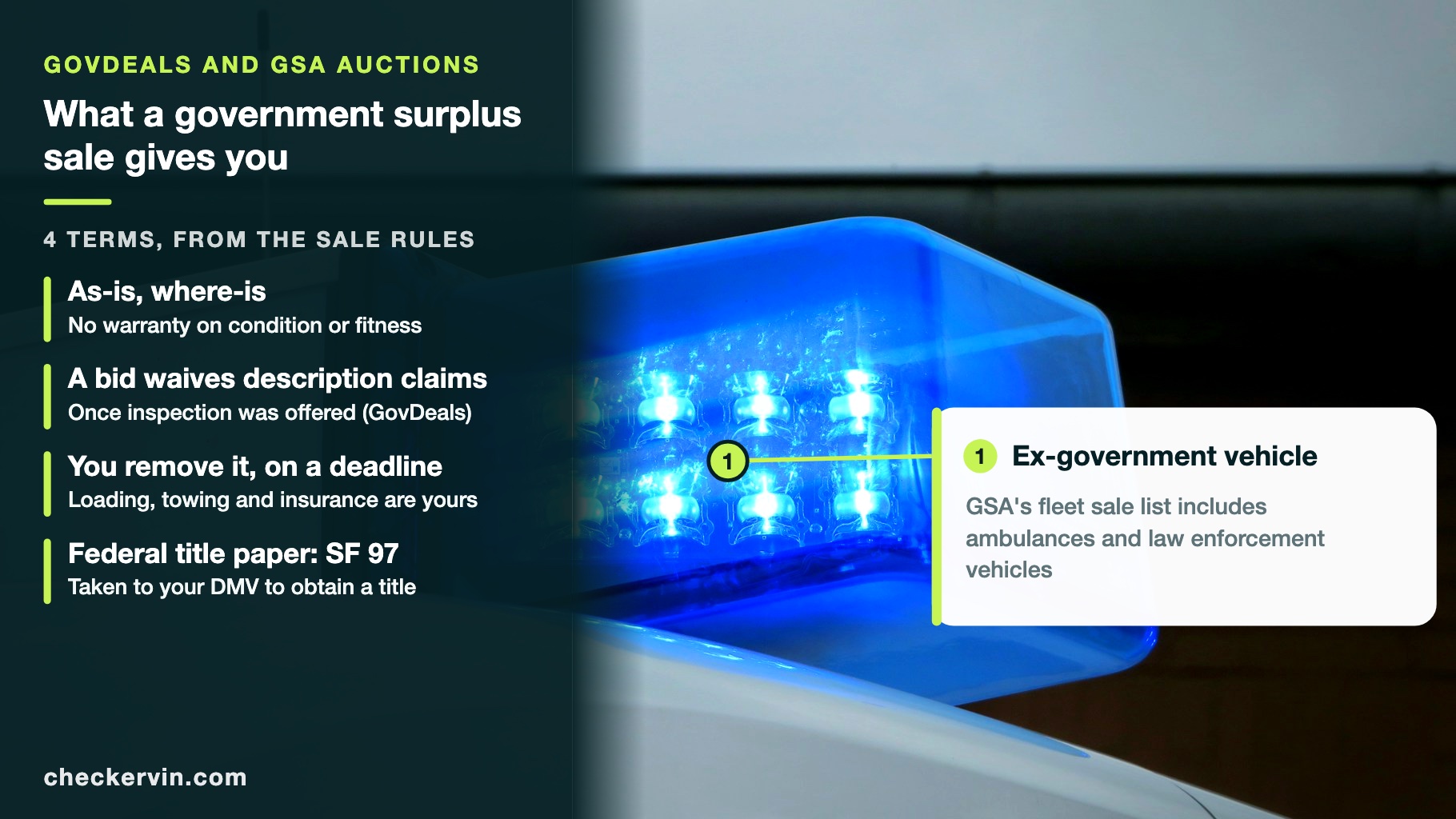
The User Agreement gives the buyer one small protection and then explains how it disappears. Each seller makes a limited warranty that the vehicle matches its listing description. But where the asset was made available for inspection, a buyer waives that warranty at the moment of bidding, and the agreement adds that the waiver applies even if the buyer never took up the chance to inspect. Except for narrow exceptions, all sales are final.
| Situation | What the User Agreement says happens |
|---|---|
| Inspection was offered before bidding | Your bid waives the seller's warranty of description, whether or not you inspected. |
| Inspection allowed only at pickup | The warranty is waived when you start removing the vehicle. No dispute is processed after that. |
| Everything else | You accept the vehicle as-is, where-is and with all faults, unless the listing contract says otherwise in writing. |
| Seller changes its mind before the sale completes | The seller may revoke acceptance; you get the price and buyer's premium back, and nothing more. |
Practically, that makes the inspection window the most valuable part of a listing. Some agencies offer viewing by appointment or on set days; the agreement notes that inspection may require exactly that. If you cannot attend, the checks further down this page are what you have instead, and they are worth more than the listing photos.
GovDeals removal deadlines, loading and insurance
Pickup is where government surplus buyers get caught out. The default in the User Agreement is removal within 10business days of the emailed Buyer’s Certificate, unless the listing sets a different date or you agree another one with the seller in writing. Time is “of the essence”, and you may need to book an appointment.
- You are responsible for loading, transport and any towing. Most sellers do not ship.
- You and anyone collecting for you need adequate auto and general liability insurance, and must show proof if asked.
- Someone else can collect for you with an Authorization of Release form given to the seller's contact.
- Unless the listing says otherwise, the sale is Ex Works at the vehicle's location: risk of loss passes to you once you have paid in full and start removal.
- Storage fees may apply to assets left at a Liquidity Services facility after the removal period.
- Exporting the vehicle is your responsibility, including duties and customs.
Budget for the drive or the tow before you bid. A cheap car four states away, sold by an agency that releases vehicles only on weekday mornings, can cost more to collect than it saved. Late pickup is a buyer default, with the fees described above.
Titles on GovDeals vehicles
The User Agreement says the seller will hand over the certificate of title or ownership at removal for any vehicle that has one. Titles may carry restrictions noted in the listing. It also says some vehicles are sold without a title, as salvage. In that case no title transfers, caveat emptor applies, and whether you can get a title from your state is for you to establish.
Two other clauses are worth knowing. Title passes when the transaction is complete, meaning you have paid in full and started removal. And the seller warrants it will deliver good and marketable title, free of liens. That is a stronger starting point than a repossession sale, where an older lien can survive. It still promises nothing about the car’s past brands or mileage. Federal vehicles sold through GovDeals are a special case: see the SF 97 section below.
GSA Auctions vehicles: how the federal program works
GSA Auctions is the General Services Administration’s online sale site for surplus federal personal property, from office furniture to vessels and vehicles. GSA’s own page explains the order: surplus property is first offered for donation to state and public agencies and nonprofits, and what is not donated can be bought by the general public. Registered participants bid electronically on single items or lots within set time frames.
GSA Auctions cars are only part of the federal picture. GSA Fleet leases vehicles to other federal agencies, and when one meets replacement criteria GSA offers it to the public. Its page says 30,000+ vehicles are sold at auction every year, through a separate GSA Fleet vehicle sales site. Inventory varies by sale and can include:
- Sedans
- Station wagons
- Sport utility vehicles
- Vans
- Pickup trucks
- Buses
- Ambulances
- Medium and heavy duty trucks
- Law enforcement vehicles
- Specialty equipment (trailers)
GSA also sells offline, and the method decides how much time you get to inspect. Its “Methods of sales” page describes 7 formats:
| Sale method | How GSA describes it |
|---|---|
| Online (GSA Auctions) | Browse, bid and pay online for single items or lots within set time frames. |
| Live auction | Used when many items sit in one place. Bidders get a catalog and a chance to inspect before or on sale day. |
| Drop-by sale | Inspect and bid at the same visit; bid cards go in a secured box and the high bid wins. |
| Fixed-price sale | Prices posted on the property, first come, first served. |
| Negotiated sale | Usually specialized equipment, priced through a sales contracting officer. |
| Sealed bid sale | Bids are mailed, never submitted electronically, and opened publicly. Late bids are refused. |
| Spot bid sale | A silent auction with written bids, item by item, awarded the same day. |
One eligibility rule: a GSA employee, or a GSA employee’s spouse or minor child, may not bid on federal personal property. Employees of other agencies may, unless their own agency’s rules forbid it. We could not read gsaauctions.gov itself, which refused our requests, so lot-level rules on that site are described here only as gsa.gov states them.
Paying for and removing a GSA Auctions vehicle
GSA sells used personal property under Standard Form 114C, “General Sale Terms and Conditions”, plus whatever the invitation for bid adds. The form invites, urges and cautions bidders to inspect first, and says property is sold “as is” and “where is”, with no warranty as to kind, quality, description or fitness for any purpose. In practice it is the same bargain as GovDeals, written by the government.
| Step | What gsa.gov says |
|---|---|
| Payment methods | Wire transfer (Fedwire or ACH), U.S. federal, state or local government checks, or a major credit card, capped at $24,999.99 and one card per transaction. |
| Not accepted | Personal checks, bank drafts and debit cards with dollar limits or PIN requirements. |
| Financing | None. The government does not provide any. |
| Removal | Only after payment, and within the time set for each sale. Removal is the buyer's job. |
| Missed payment or pickup | The government can collect damages. |
GSA’s purchase page follows that last line with a fee schedule tied to the award amount. Because it is a government charge, we reproduce it as GSA publishes it:
| Award amount | Fee |
|---|---|
| Less than $325 | Equal to the award amount |
| $325 to $100,000 | $325 |
| More than $100,000 | 5% of the award amount |
The 2001 form itself sets out a 15-day written notice of default and liquidated damages before the buyer loses the property, and lets the contracting officer extend a removal deadline when the delay was beyond the buyer’s control. Read the invitation for bid on the specific lot: it can change any of these terms.
The SF 97: the federal paper you take to the DMV
Buy a federal vehicle and you will not get a state title from the government. You get Standard Form 97, The United States Government Certificate to Obtain Title to a Vehicle (the current printed version is the SF 97-1, revised April 2012). The rule is in federal regulations: 41 CFR 102-38.285 says that for vehicles, the selling agency must issue the purchaser an SF 97. Standard Form 114C says the same for every vehicle that needs a state license, unless the invitation for bid provides otherwise.
| Question | Answer |
|---|---|
| Is the SF 97 a title? | No. As its name says, it is a certificate to obtain one. Your state motor vehicle agency issues the title. |
| When does ownership pass? | Under SF 114C, title vests in the buyer when removal is completed, unless the invitation says otherwise. |
| Does it carry history? | No. It shows the government transferred the vehicle to you, not where it has been or what happened to it. |
| What does the DMV want? | Requirements are set by each state. Ask your DMV what it needs alongside the SF 97 before you bid. |
The SF 97 confirms the sale. It says nothing about whether the car was ever in a crash or written off. A fleet vehicle can spend years with one agency and still have been damaged, repaired and returned to service, which is why the title record and the inspection still matter.
GovDeals vs GSA Auctions at a glance
The two are often searched together and easily confused. GovDeals is a private company’s marketplace used by many public agencies. GSA Auctions is the federal government’s own site. Federal agencies sell on GovDeals too, and a federal vehicle comes with an SF 97 whichever site it is sold on.
| GovDeals | GSA Auctions |
|---|---|
| Run by: Liquidity Services, a Nasdaq-listed company | Run by: the General Services Administration |
| Sellers: City, county, state and federal agencies, plus related businesses | Sellers: Federal agencies' surplus property |
| Terms: GovDeals User Agreement plus each agency's listing terms | Terms: SF 114C plus the invitation for bid |
| Buyer fee: Buyer's premium, stated per listing | Buyer fee: No buyer's premium mentioned on GSA's purchase page |
| Condition: As-is, where-is, with all faults | Condition: As is and where is, no warranty |
| Removal: 10 business days unless the listing differs | Removal: Within the time set for each sale |
| Title paperwork: The agency's certificate of title, or none for salvage | Title paperwork: SF 97, taken to your state DMV |
Fleet maintenance records are not a vehicle history report
One genuine advantage of government surplus cars is that many were maintained on a schedule by an organization that kept records. GSA’s own pages show the shape of it: drivers of GSA Fleet leased vehicles must get pre-approval from a Maintenance Control Center for repairs, tires and batteries, and accidents are reported and repaired through an Accident Management Center. Some agencies attach service records to a listing, and asking for them is reasonable.
Those records are not a history report, for three reasons.
- They cover one owner's time with the car. A vehicle that moved between agencies, or was bought used, can have a past the records do not mention.
- They record what was serviced, not how the state titled the car. Title brands, total-loss records and salvage history live in state records reported to NMVTIS.
- Nobody has to hand them over. Neither GovDeals' terms nor GSA's sale terms promise them, so a listing without them is normal, not suspicious.
Recalls are a separate gap. GSA says it runs a recall management program and still tells anyone interested in acquiring a GSA vehicle to check open recalls at nhtsa.gov/recalls. A retired fleet car may have left service before a remedy was done.
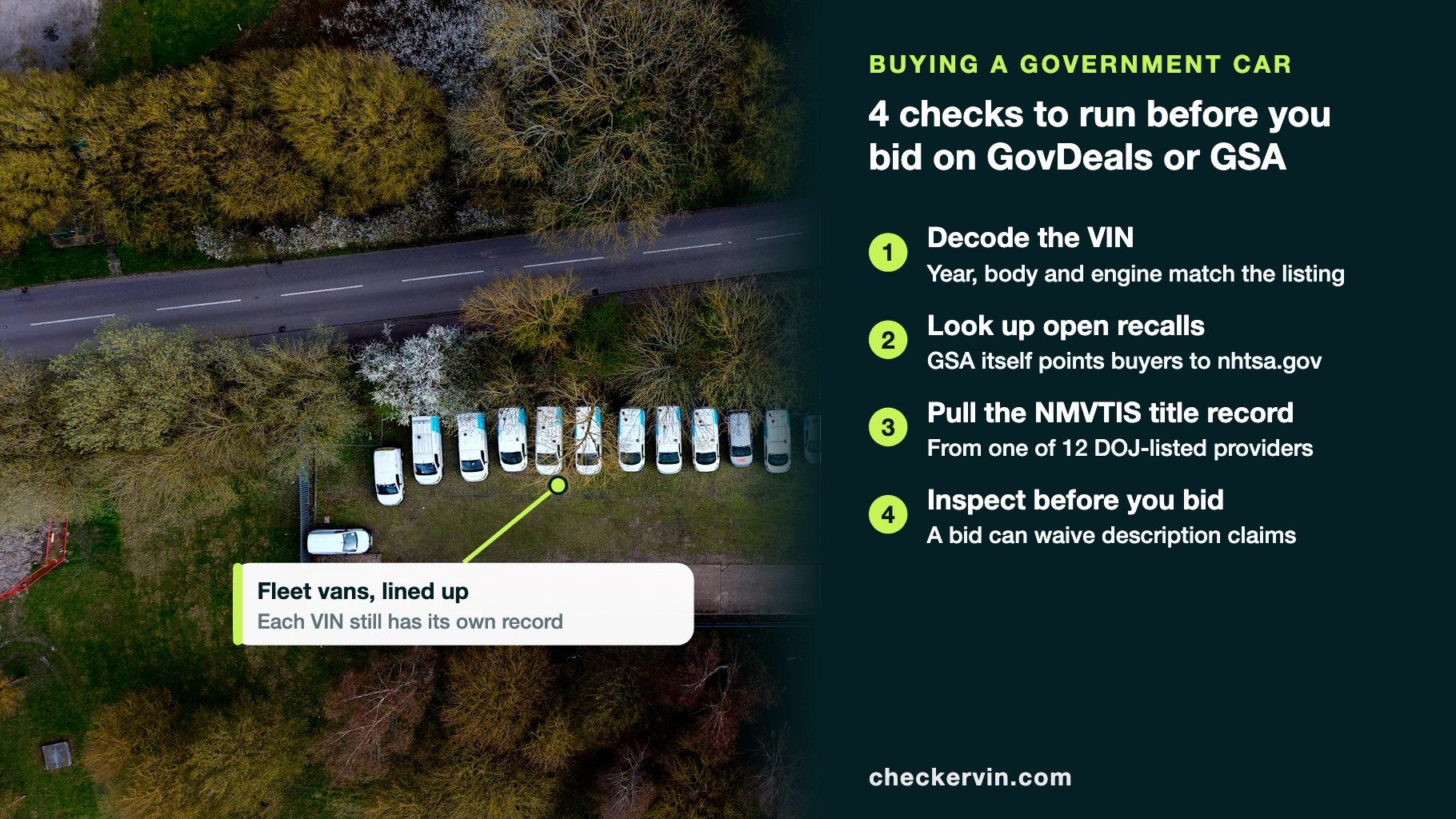
The buyer's checks before bidding on a government car
None of the sale terms above leaves you a remedy after the fact, so the checks have to come first. Do the free ones before you spend money on a report, and the report before you drive to an inspection.
- 1Decode the VIN, freeCopy the 17-character VIN from the listing and decode it. Year, body, engine and drive should match the description. Fleet buyers often order unusual configurations, so a mismatch is worth a question to the agency before you bid.
- 2Check open recalls, freeGSA's own recall page tells anyone acquiring a GSA vehicle to look it up at nhtsa.gov/recalls. Do the same for a city or county car. An open recall is a dealer visit you will make after pickup.
- 3Pull the NMVTIS title recordBuy a report from a provider on the Department of Justice list and line it up against what the listing says about title, odometer and damage.
- 4Inspect before you bidUse the inspection window the listing offers. GovDeals' terms treat a bid as waiving the seller's warranty of description once inspection was available, whether or not you went.
Decode a government surplus VIN free, no card
Decoded from official manufacturer and NHTSA records
Our list of used car red flagscovers what to look for at the inspection itself. For a fleet car, add the things fleet duty leaves behind: holes where equipment was mounted, a worn driver’s seat against a low odometer reading, and idle hours if the vehicle records them.
Matching a government listing against the NMVTIS title record
An NMVTIS report is built on 5 indicators: current state of title and last title date; brand history; odometer reading; total loss history; salvage history. Neither GovDeals, Liquidity Services nor GSA appears on the Department of Justice list of approved NMVTIS data providers, which is expected: they sell vehicles, not title reports. Put the listing and the report side by side.
| On the listing | Check it against |
|---|---|
| Title type, or 'sold without title' | The NMVTIS current title state and brand history. A salvage or junk brand changes what you can register. |
| Stated mileage | The NMVTIS odometer readings. A lower figure than an earlier report needs an explanation from the agency. |
| Damage described, or none mentioned | Total-loss and salvage history. A total-loss record the listing does not mention is exactly the gap to look for. |
| Federal seller, SF 97 promised | Whatever the report holds. If it shows very little, that is not proof of a clean past; ask the agency for its own records. |
| Seized or forfeited vehicle | Ownership and title history. The agency did not buy the car new, so it may know little about its earlier life. |
The program itself says repair histories are not meant to be part of an NMVTIS report, so the last step is always the inspection. If the car went through a salvage auction before the agency bought it, our guide to auction history by VIN explains where those earlier listings can still be found, and the NMVTIS report guide explains who reports what to the federal system.
Where this information comes from
- GovDeals — About UsA Liquidity Services marketplace; sellers, registered buyers and completed sales as GovDeals states them
- GovDeals — User Agreement (effective September 17, 2026)Operator, buyer's premium definition, as-is terms, warranty of description, removal period, titles, defaults and storage
- GovDeals — Frequently Asked QuestionsGeneral rules, auto extension, seller confirmation, payment methods and limits, probation, restricted auctions, shipping and title name
- Liquidity Services, Inc. — Form 10-K for the fiscal year ended September 30, 2026 (SEC EDGAR)GovDeals segment, its sellers, vehicles as a substantial share of its volume, fiscal 2026 GMV and the fee model; filed November 19, 2026
- GSA — How to purchase surplus propertyGSA Auctions, payment methods, card limit, removal and the fee schedule (last updated Nov 2, 2026)
- GSA — Methods of salesOnline, live, drop-by, fixed-price, negotiated, sealed bid and spot bid sales; who may not bid
- GSA — Sales of GSA Fleet vehiclesReplacement vehicles sold to the public, annual volume and vehicle types (last updated Mar 10, 2025)
- GSA — Standard Form 114C, Sale of Government Property: General Sale Terms and ConditionsInspection, as is and where is, title on removal, SF 97 for licensed vehicles, removal and default (rev. 04/2001)
- GSA — SF 97-1, The United States Government Certificate to Obtain Title to a VehicleThe form a federal vehicle buyer receives (rev. 04/2012)
- eCFR — 41 CFR 102-38.285How title passes from the government to the buyer; for vehicles, the agency must issue an SF 97
- GSA — GOV RecallsGSA's recall program, and its pointer to nhtsa.gov/recalls for anyone acquiring a GSA vehicle (last updated Aug 21, 2025)
- GSA — Accidents and maintenance for fleet vehiclesMaintenance Control Center pre-approval and the Accident Management Center for GSA Fleet leased vehicles
- NMVTIS — approved data providersThe Department of Justice list; GovDeals, Liquidity Services and GSA do not appear on it
- NMVTIS — Understanding a Vehicle History ReportThe five indicators, and that repair histories are not meant to be included
- NHTSA — Recalls lookupFree open-recall check by VIN
- How we made this pageWritten by the CarCheckerVIN editorial team with AI assistance from public records: GovDeals' own published pages and User Agreement, Liquidity Services' SEC filing, gsa.gov pages and forms, the eCFR and the Department of Justice NMVTIS pages; facts checked November 2026. gsaauctions.gov and the GSA Fleet sales site could not be read, and no GovDeals buyer's premium rate is reproduced.
Keep reading
Frequently asked questions
Is GovDeals legit?
Yes. GovDeals is a marketplace operated by Liquidity Services, a Nasdaq-listed company (ticker LQDT) that reports GovDeals as its own business segment in its SEC filings. The sellers are mostly government agencies. Being legitimate does not make a car a safe buy: GovDeals' User Agreement sells everything as-is, where-is and with all faults.
Who owns GovDeals?
Liquidity Services. GovDeals' About page calls it a Liquidity Services marketplace, and the User Agreement names Liquidity Services Operations LLC, a Delaware company, and its parent and affiliates as the operator. The cars belong to the selling agencies; GovDeals runs the auction and, in most cases, collects payment.
Does GovDeals charge a buyer's premium?
Generally, yes. The User Agreement says a buyer's premium is generally required, is typically a percentage of the sale price, and is stated in each seller's listing. Read the listing before you bid, because the premium, any card processing fee and sales tax all sit on top of the winning bid.
Can the public buy cars from GSA Auctions?
Yes. GSA says surplus federal property that is not donated can be bought by the general public, and GSA Auctions lets registered bidders bid online. GSA employees and their spouses or minor children may not bid. Fleet vehicles GSA leased to agencies are sold through a separate GSA Fleet vehicle sales site.
What is an SF 97 when you buy a government vehicle?
Standard Form 97, The United States Government Certificate to Obtain Title to a Vehicle. Federal rules require the selling agency to issue one to the buyer of a vehicle, and you take it to your state's motor vehicle agency to get a state title. It is not itself a state title.
How long do I have to pick up a car from GovDeals?
Unless the listing sets a different deadline, GovDeals' User Agreement gives 10 business days from the emailed Buyer's Certificate. Missing it is a buyer default: GovDeals may keep the buyer's premium and charge a default administration fee.
Do government fleet cars come with a history report?
No. Some agencies keep maintenance records, and GSA Fleet pre-approves repairs through its own maintenance center, but neither is a title record. For title brands, total-loss and odometer history, use a provider on the Department of Justice NMVTIS list.
Check the VIN before the auction closes
Decode any government surplus vehicle's VIN free for the factory build, specifications and open safety recalls. No account, no card. Full vehicle history reports are launching soon.
Run a free VIN check