The short answer
- Is IAA legit?
- Yes. It is owned by RB Global, an NYSE- and TSX-listed company that bought it on March 20, 2023 for approximately $6.6 billion. Every lot is sold as is, where is, so "legit" does not mean "safe to buy unseen."
- What is mostly for sale?
- Insurance write-offs. On November 26, 2026, 81% of lots with a loss type listed were collisions, and 61% of lots with a sale document listed were salvage.
- What should I check first?
- Get the full VIN, decode it against the listing, check open recalls and pull an NMVTIS title record. Then book a preview or an inspection.
379,610
Lots in IAA's search
Logged-out count, November 26, 2026
67%
Coded Run & Drive
Share of lots with a start code
6%
Open to public buyers
Who Can Buy: Available to the public
Not listed
IAA on the NMVTIS provider list
It sells cars, not title reports
The short verdict: is Insurance Auto Auctions legit?
IAA is a large, established auction business, and buying on iaai.com is a real transaction with a real company. Its parent, RB Global, files with the SEC; its annual report for 2025 names IAA as a marketplace brand alongside Ritchie Bros., and reports no material legal proceedings pending. A web search of FTC and state attorney general announcements turned up no enforcement action against Insurance Auto Auctions.
The real question is whether a particular lot is worth bidding on, and IAA is clear that the answer is yours to find. Its Auction Rules sell every vehicle as is, where is, with no warranty, expressed or implied. They say the photos are not meant to show the full condition, that IAA is not responsible for odometer discrepancies, and that a clear-title car may have a salvage history. Read IAA’s labels as narrowly as IAA defines them, and the surprises shrink.
What Insurance Auto Auctions is, from RB Global's 10-K
IAA was the salvage auction business of KAR Auction Services until KAR spun it off as a separate public company on June 28, 2019. RB Global completed its purchase of IAA on March 20, 2023 for approximately $6.6 billion. RB Global is headquartered in Westchester, Illinois, and its 10-K, filed on February 25, 2026, describes IAA as a leading global digital marketplace connecting vehicle buyers and sellers.
| What the 10-K says | What it means for a buyer |
|---|---|
| Sellers include insurers, used-vehicle dealers, rental and fleet lease companies, auto lenders and charities | Most lots are insurance settlements, but not all. The lot page's sale document tells you which kind you are looking at. |
| IAA's buyers include body shops, rebuilders, used car dealers, automotive wholesalers, exporters, dismantlers, recyclers, brokers, the general public | You bid against professionals who price a car for parts, repair or export, not for a commute. |
| Vehicles bought outright under purchase agreements were about 2.7% of IAA's sales in fiscal 2025 | IAA owns only a small share of what it sells. On most lots it acts for the seller, which is why a seller can turn down a bid that misses its reserve. |
| IAA does not usually release a vehicle until it has full payment | No pay, no pickup. The car stays in the yard, and storage starts counting. |
| Some state rules limit who can buy total-loss vehicles and whether they can be sold as rebuildable or only for parts or scrap | Two identical cars can be open to you in one state and closed in another. |
For scale, the 10-K counts RB Global’s automotive lots across all its brands, not IAA alone: about 2.4 million in 2025. It names Copart, Inc. as the main competitor in salvage. Our Copart review covers that auction in its own terms.
What IAA is selling: a snapshot of its own search page
IAA’s search page shows counts beside every filter, which makes it possible to see the shape of the inventory without logging in. We read those counts on November 26, 2026. They move by the hour, so treat the figures as one day’s picture, not a constant.
| Loss type (IAA filter) | Lots on November 26, 2026 |
|---|---|
| Collision | 277,194 (81%) |
| Other | 45,980 (13%) |
| Water | 7,388 (2%) |
| Theft | 6,915 (2%) |
| Fire | 4,579 (1%) |
Collision dominated, at 81% of lots with a loss type. Water and fire losses are small shares but large numbers in absolute terms: 7,388 and 4,579 cars that day. Airbags were listed as deployed on 31% of lots with an airbag status.
Only 76,312 lots had a sale date; 303,298did not. IAA’s glossary explains why: unassigned vehicles are waiting for saleable title documents from the seller or the state DMV. A car you like may sit for weeks before it runs.
IAA start codes: Run & Drive, Starts and Stationary
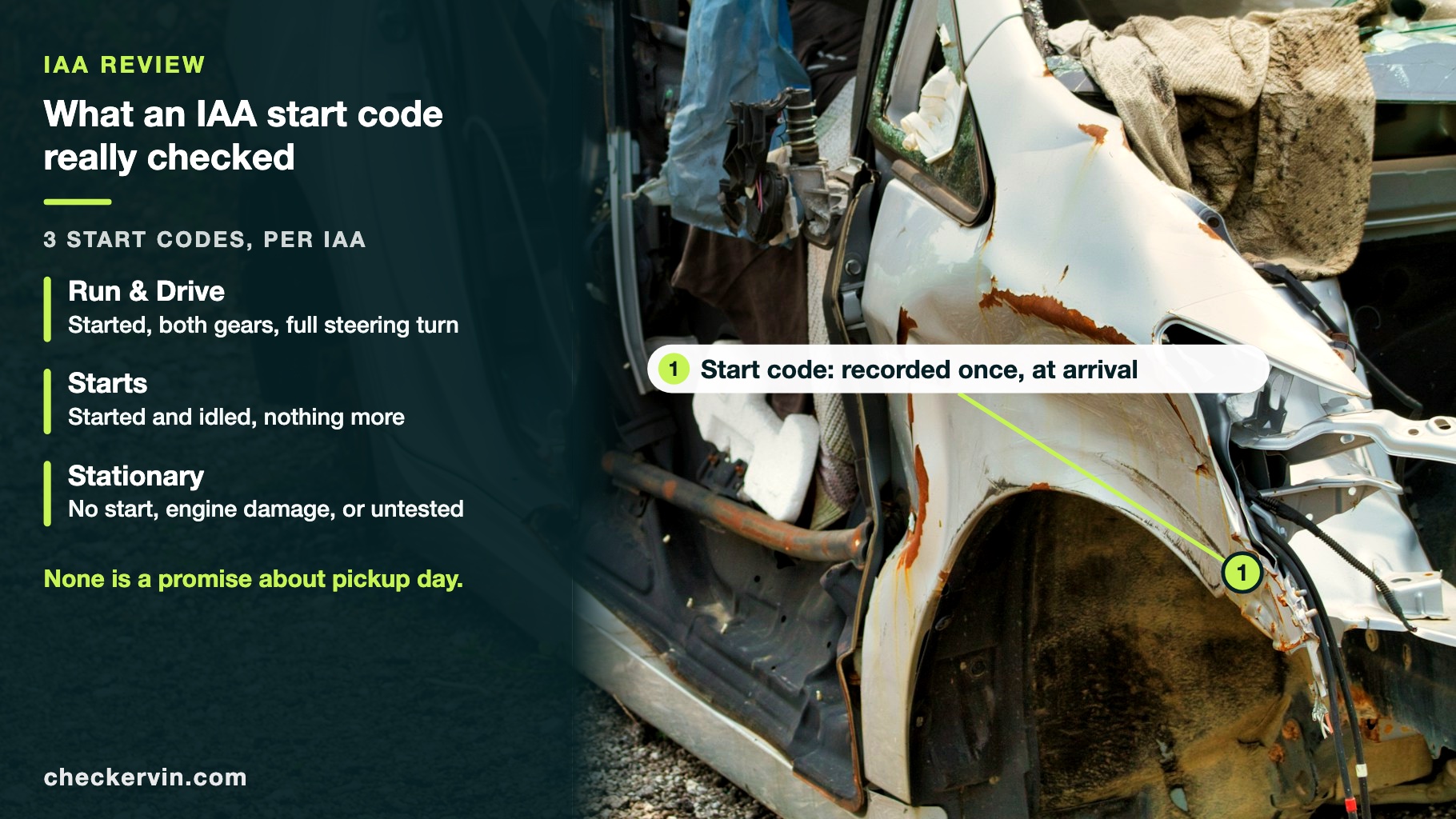
Every IAA lot carries a start code, and IAA’s help center defines three. All of them describe the car on the day it reached the yard.
| Start code | What IAA says was checked |
|---|---|
| Run & Drive | On arrival the motor started, with or without a jump, and idled; forward and reverse both engaged; and the steering wheel turned one full rotation each way. Not guaranteed at pickup, and the vehicle may not be roadworthy. |
| Starts | The motor started, with or without a jump, and idled when it reached the yard. It may not start, drive or move forward at pickup. |
| Stationary | The vehicle would not start, has engine damage, or was not tested on arrival. |
On November 26, 2026, 67% of lots with a start code were Run & Drive and 29%were Stationary. IAA’s search also showed a fourth value, Can’t Test, on 7 lots; the glossary does not define it.
IAA’s Run & Drive page adds the limits buyers miss. The code says nothing about tires or wheel hubs. Batteries run down and fluids leak after check-in. Some state and local rules bar driving a car off the lot at all. And the Auction Rules say IAA is not required to provide an engine video even for a Run & Drive car.
IAA title and sale document types
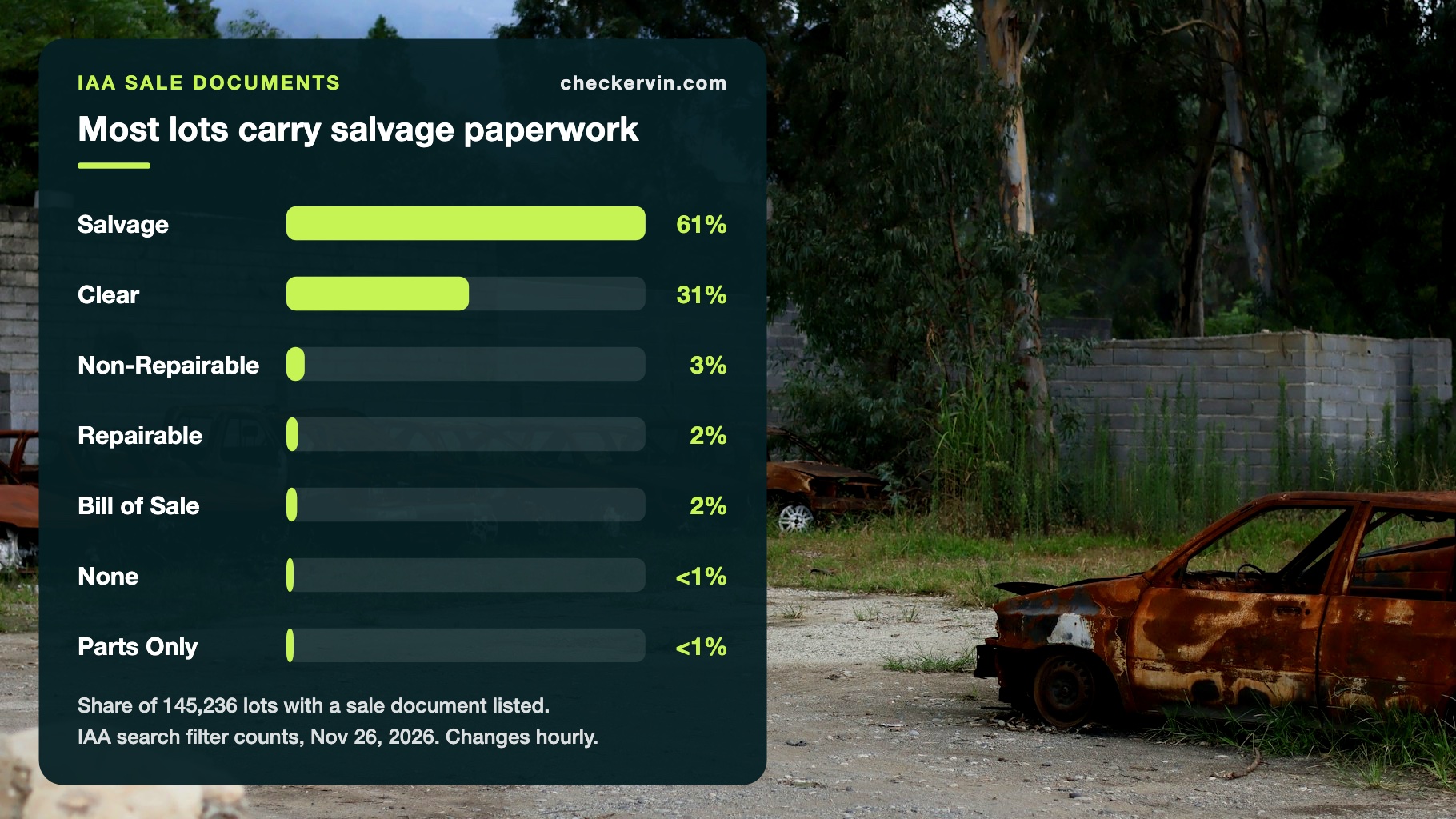
IAA files every lot under a Title/Sale Doc. The search filter groups them into a handful of types, while the lot page prints the issuing state’s own wording, such as a salvage certificate from California. Here is how the types split on November 26, 2026, among lots with a document listed:
| Sale document (IAA filter) | Lots, and what it usually means |
|---|---|
| Salvage | 88,513 (61%). A total-loss brand. IAA's title explainer says salvage cars often sell for less and may be hard to finance; the state decides how one is rebuilt and re-titled. |
| Clear | 44,998 (31%). IAA's explainer says a clear title has never been declared a total loss by an insurer. Its Auction Rules add that a clear-title car may still have a salvage history elsewhere. |
| Non-Repairable | 4,516. Usually a parts-or-scrap brand; the wording and the rules come from the issuing state. |
| Parts Only | 463. Sold for parts. IAA's Florida title guide, for example, describes the state's Certificate of Destruction as parts only. |
| Repairable | 2,875. A state brand. What repair and inspection it requires depends on the issuing state. |
| Bill of Sale | 2,636. A sale document rather than a title. Ask what your state will accept before you bid. |
| None | 1,235. No document listed. Ask the branch before you bid. |
Two rules from IAA’s Auction Rules belong next to this table. A state or country may change a car’s title or brand classification after you buy it, and a clear-title car may show up as junk or salvage in later NMVTIS reports. That is why the rules tell buyers to verify the title type and brand before making any repairs. Our salvage title VIN check explains how brands follow a car between states.
Reading an IAA lot page, field by field
We opened IAA vehicle pages logged out on November 26, 2026. Most fields are visible to anyone, and a few carry caveats IAA states elsewhere.
| Lot-page field | What to know |
|---|---|
| VIN (Status) | Shown with the last six characters masked when logged out. You need the full VIN for every check below. |
| Loss and Primary Damage | Loss is why the car was written off (collision, water, theft). Primary damage is the main damage IAA recorded, such as front end or hail. A theft recovery can have little visible damage. |
| Start Code, Key, Airbags | All recorded at intake. See the start-code limits above. |
| Odometer | Printed with a status such as Actual. IAA's rules say it is not responsible for mileage or odometer discrepancies. |
| Actual Cash Value | IAA's glossary says the seller supplies this pre-damage estimate and IAA does not represent its accuracy. |
| Seller and Seller Type | Masked when logged out. |
| IAA Vehicle Score | A 0 to 50 damage-level score for paid subscribers. IAA's own scale uses hedged words such as "likely stationary." |
| Vehicle Location | Some lots sit offsite. IAA's lot pages say offsite vehicles are generally unavailable for inspection. |
IAA’s imaging tools include HD photos, a 360-degree walkaround and a short Engine Starts video. They help, but the Auction Rules say the images are not meant to show the full current condition, and they warn of hidden damage to the undercarriage, suspension and electrics.
How buying works: live auctions, Timed Auctions, If Bids and Buy Now
IAA runs four ways to buy, and the rules differ in ways that matter once you have bid. On November 26, 2026 the search counted 76,312 lots in live auctions, 4,266 in Timed Auctions and 30,179 on Buy Now.
| Format | How IAA says it works |
|---|---|
| Live (AuctionNow) | IAA's digital bidding platform. Auto Bid bids for you up to your limit while the car is on the block; Jump Bid skips ahead in preset steps. |
| Timed Auctions | Online only, typically for about 24 hours, at least two days before any live sale. Each car has its own closing time, a reserve and a starting bid. A maximum bid is final. |
| If Bid (Sale Pending) | The top bid missed the reserve. The seller accepts, declines or counters through Manage Offers. With no deal, the car may go to Buy Now or a later auction. |
| Buy Now | A set price between auctions. Confirming it invoices the car to you at once, and all standard buyer fees apply. |
The format that surprises people is the If Bid. Winning the bidding does not mean you have bought the car; the seller still decides. IAA’s Timed Auctions FAQ also answers the buyback question bluntly: Timed Auction cars fall under the same Auction Rules as every other purchase. How Buy Now is priced and what it costs on top is covered in our IAAI fees guide.
Who can bid at IAA: public, licensed and broker buyers
A free guest account lets you watch live sales and build a watch list but not bid. Bidding needs a paid account, and which lots you may bid on depends on your license and the state where the car sits. Every lot lists who can buy it. On November 26, 2026, 22,480 lots, about 6% of the total, were marked Available to the public.
For a lot closed to you, IAA’s glossary describes the broker route: a broker is a registered buyer who purchases on your behalf, charges a fee and has its own terms, and you get a Broker Bidder login under the broker’s account. On IAA’s books the broker is the buyer. We review two broker routes, SalvageBid (which our review found on IAA’s broker list) and SalvageReseller. IAA’s public buyer table by state and its membership fee are on our IAAI fees page, so we do not repeat them here.
Previews and inspections before you bid
IAA’s help center says registered buyers can inspect cars on site before the auction, with preview dates and times on each branch’s information page. Its Timed Auctions FAQ adds that preview depends on branch staff availability, and lot pages tell you to contact the branch first.
If you cannot get there, IAA recommends a third-party inspection by CarInspector.US, which it calls its exclusive nationwide vendor. IAA’s inspection page lists what the inspector looks at: the VIN and equipment, under the hood, the interior and airbag state, body panels and visible frame, tires, startup behavior, steering and air conditioning where possible. It is visual only, and IAA says it does not endorse or warrant the inspector’s work.
Paying and pickup: methods, cash limits and a deadline to confirm
IAA’s help center lists these payment methods:
- Cash, with a daily cap per branch
- Cashier's checks and certified checks
- Wire transfer
- I-Pay
- Credit and debit cards
- Account credit
- PayPal
- Financing
Its cash policy caps cash at $500 per day per branch and allows no partial cash payments. Wire transfers land as account credit, have no daily limit, and are accepted only from the registered business, the account owner or an additional bidder on a licensed account; IAA will not accept wires from third parties.
Check the payment deadline on your invoice, because IAA’s pages give two figures. The Auction Rules put payment due within 3 business days of the award, while its public-buyer page says 2business days after the award for U.S. buyers. Plan on the shorter one. Risk of loss passes to you when the car is awarded, pickup happens only during yard hours, and daily storage starts when the branch’s window closes. Our Bidcars reviewsets out IAA’s late, renege and cancellation rules.
Sold as is: arbitration, deadlines and what you give up
IAA’s Auction Rules are a buyer agreement, and three clauses are worth reading before you register, not after a dispute.
| Clause | What the Auction Rules say |
|---|---|
| As is, where is | No warranty, expressed or implied. IAA is not responsible for missing parts. |
| Arbitration | Disputes go to final, binding arbitration rather than court, small claims excepted, after 30 days' written notice to IAA. |
| Opt-out | You may opt out of arbitration by written notice within 30 days of registering. |
| Time limit | Claims must be filed within 1 year of arising, or are barred. |
The opt-out window is the one clause you can act on, and only at the start. If keeping the right to go to court matters to you, send the notice when you sign up.
Check the VIN yourself before you bid at IAA
IAA’s Auction Rules make it the buyer’s sole responsibility to research and inspect a vehicle before bidding. These checks fit between finding a lot and placing a bid, cheapest first:
- 1Get the full VIN, then decode itLogged out, IAA hid the last six characters of the VIN when we looked. Get the full 17 characters from the lot page or the branch, decode it, and compare year, engine, drive and body with the listing.
- 2Check open recallsAn open safety recall is not on the IAA lot page. NHTSA's lookup, or our free check, shows it by VIN.
- 3Pull the NMVTIS title recordIAA's Auction Rules warn that a clear-title car may have a salvage history. A report from a DOJ-listed provider shows the brand history across states.
- 4Search earlier auction salesThe same VIN at an earlier Copart or IAA sale means it has been through the salvage cycle before. Compare the old photos with the new ones.
- 5Book an inspection or previewPhotos, start codes and Vehicle Score are all taken at intake. Only a person at the car sees what changed since.
- Factory build and specifications decoded from the VIN
- Factory warranty terms
- Open NHTSA safety recalls
- Photos filed against the VIN
- Market and listing prices
Decode an IAA lot's VIN free
Decoded from official manufacturer and NHTSA records
An NMVTIS report covers 5 indicators: current state of title and last title date; brand history; odometer reading; total loss history; salvage history. IAA itself is not on the DOJ’s list of approved providers, which is expected; it sells cars, not title reports. The consumer-tier providers, as listed on November 26, 2026:
- Bumper.com
- Carsforsale.com
- Carvertical.com
- Checkthatvin.com
- Clearvin.com
- EpicVin.com
- GoodCar.com
- Titlecheck.us
- Vinaudit.com
- Vindata.com
- VinReport
- Vinsmart.com
The department says the list is alphabetical and implies no preference. Repair histories are outside NMVTIS, which is why the inspection stays on the list. For earlier sales of the same VIN, see our auction history guide, and for the federal record itself, the NMVTIS report guide.
Where this information comes from
- RB Global, Inc. — Form 10-K for the year ended December 31, 2025 (SEC EDGAR)IAA acquisition, KAR spin-off, sellers, buyers, purchase-agreement share, product names, state regulation, automotive lots, legal proceedings; filed February 25, 2026
- IAA — Auction Rules and Buyer AgreementAs is, start codes, airbags, title reclassification, NMVTIS note, payment methods and deadline, pickup, arbitration and opt-out
- IAA Help Center — Glossary of TermsStart codes, ACV, brokers, guest accounts, inspection services, Timed Auctions, unassigned vehicles (last published 10/3/2022)
- IAA — Run & Drive: Vehicle Start Code ClassificationThe three checks, and what the code does not cover
- IAA — Vehicle search (filter counts)Loss type, start code, sale document, airbag, auction type and Who Can Buy counts, read logged out on November 26, 2026
- IAA — U.S. Vehicle Titles: Clear and SalvageClear and salvage titles explained (October 26, 2023)
- IAA — Florida Title Reference Guide for Catastrophic EventsCertificate of Destruction described as parts only
- IAA Help Center — Types of AuctionsAuctionNow, Timed Auctions, Buy Now, Rec Rides and Specialty (last published 8/23/2024)
- IAA Help Center — IAA Timed Auctions FAQsFinal bids, timing before live sales, previews and the same Auction Rules (11/15/2024)
- IAA Help Center — What is an If Bid or Sale Pending bid?Reserve not met; accept, decline or counter through Manage Offers
- IAA Help Center — Can I inspect vehicles before the auction?On-site inspection for registered buyers (8/22/2024)
- IAA — Inspections from CarInspector.USWhat the third-party inspection covers and its limits
- IAA — IAA Vehicle ScoreThe 0 to 50 damage-level scale for subscribers
- IAA Help Center — What payment options are available?Payment methods (6/13/2025)
- IAA Help Center — IAA's Cash Handling PolicyDaily cash cap per branch, no partial cash payments (6/13/2025)
- IAA Help Center — Wire Transfer InformationWires land as account credit; no third-party wires (9/10/2026)
- IAA — Auto Auctions Open to Public BuyersPayment due two business days after award for U.S. buyers; the Available to Public filter
- NMVTIS — approved data providersDepartment of Justice list, consumer tier read November 26, 2026; IAA does not appear on it
- NMVTIS — Understanding a Vehicle History ReportThe five indicators, and that repair histories are not meant to be included
- How we made this pageWritten by the CarCheckerVIN editorial team with AI assistance from RB Global's SEC filing, IAA's published pages and the Department of Justice NMVTIS pages; facts checked November 2026. Inventory shares are computed from the filter counts on IAA's search page on November 26, 2026. Fee amounts are intentionally not reproduced.
Keep reading
Frequently asked questions
Is Insurance Auto Auctions legit?
Yes. IAA is a real auction company, owned since March 20, 2023 by RB Global, which trades on the NYSE and TSX and files annual reports with the SEC. Its 2025 10-K reports no material legal proceedings pending. Being real does not make a lot a good buy: IAA's Auction Rules sell every vehicle as is, where is, with no warranty.
What is an insurance auto auction?
An auction where insurers sell cars they have settled as total losses or recovered after theft, along with dealer, rental, lender and charity vehicles. RB Global's 10-K says it has long-term relationships with virtually all of the major automobile insurance companies. Most cars arrive damaged, and many carry salvage paperwork.
What do Run & Drive, Starts and Stationary mean at IAA?
They are IAA's three start codes, recorded when the car arrives. Run & Drive: it started, went into forward and reverse, and the wheel turned fully both ways. Starts: it started and idled. Stationary: it would not start, has engine damage or was not tested. None is a promise about pickup day.
Can I buy from IAA without a dealer license?
On lots marked Available to the public, yes, with a paid account. When we looked on November 26, 2026, 22,480 of 379,610 lots carried that label. For the rest, IAA points you to a broker. The state-by-state rules and the membership fee are on our IAA fees page.
What is a Non-Repairable or Parts Only sale document at IAA?
Paperwork that limits the car to parts or scrap rather than a return to the road. The exact term comes from the state that issued it. IAA's 10-K notes that some state regulations decide whether a total-loss vehicle can be sold as rebuildable or must be sold for parts or scrap only.
Can I cancel a bid at IAA?
In Timed Auctions, no. IAA's Timed Auctions FAQ says a maximum bid is final and the winner must pay and collect. A Buy Now purchase is also final once confirmed. On an If Bid, the seller decides afterward whether to accept, decline or counter.
Does IAA let you inspect cars before the auction?
Yes, usually. IAA says registered buyers can inspect on site before the auction, with preview times on each branch page, and it recommends a paid third-party inspection by CarInspector.US. Lot pages note that offsite vehicles are generally unavailable for inspection.
Check the VIN before you bid at IAA
Decode any IAA lot's VIN free for the factory build, specifications, warranty and open safety recalls. No account, no card. Full vehicle history reports are launching soon.
Run a free VIN check