The short answer
- Is Copart legit?
- Yes. Copart, Inc. is listed on Nasdaq, files a 10-K with the SEC and reports 286 operating facilities worldwide. Its own terms sell every lot as-is, where-is, so "legit" is not the same as "safe to buy blind."
- Can I buy without a dealer license?
- On No License Required lots, yes. Otherwise state law decides, and Copart points unlicensed buyers to a registered broker.
- What do Run and Drive, Pure Sale and Enhanced mean?
- Run and Drive: started, went into gear and moved forward at intake. Pure Sale: no reserve. Enhanced: a service may have been done. None of them is a warranty.
286
Copart operating facilities
Form 10-K, fiscal 2026
79%
Vehicles from insurance sellers
Share of units processed, fiscal 2026
11
Countries Copart operates in
As listed in the 10-K
Not listed
Copart on the NMVTIS provider list
It sells cars, not title reports
The short verdict: is Copart legit?
Copart is a large, regulated, publicly traded business, and buying through copart.com is a real transaction with a real company. Its annual report for the fiscal year ended July 31, 2026 describes 286 operating facilities, approximately 1 million registered members and revenue of $4.7 billion. That is the “is it a scam” question answered.
The harder question is whether a given lot is a good buy, and Copart is plain that this is your problem. Every vehicle is sold as-is, where-is. Its damage codes come with an express disclaimer. Its most reassuring label, Run and Drive, describes a few seconds in the yard on the day the car arrived. Most of what disappoints people about Copart is written down in Copart’s own help pages before they bid.
So read the labels literally, decode the VIN, and get the title record from somewhere other than the listing. The rest of this page goes through each of those in turn.
What Copart is, from its own annual report
Copart’s 10-K, filed with the SEC on September 29, 2026, sets out the business in its own words. The company was incorporated in California in 1982, went public in 1994 and reincorporated in Delaware in 2012. Its headquarters are in Dallas, Texas, and its stock trades on Nasdaq under the symbol CPRT. It reports operations in 11 countries and owns or leases facilities in every U.S. state.
| What the 10-K says | Why a buyer should care |
|---|---|
| Insurance companies supplied 79% of vehicles processed in fiscal 2026 | Most cars arrive because an insurer settled a claim on them. Expect damage, not trade-ins. |
| Most insurer vehicles are total losses, not economically repairable, or recovered thefts | A theft recovery can look clean in photos and still carry a total-loss record. |
| Other sellers include dealers, individuals, charities, rental companies, banks and fleets | Not every lot is salvage. The title type on the lot page tells you which kind you are looking at. |
| Buyers are mainly dismantlers, rebuilders, repair licensees, dealers, exporters and the public | You are bidding against professionals who price a car for parts or export. |
| International members bought 38.2% of U.S. vehicles sold in fiscal 2026, by units | Copart says its online platform widens the pool of bidders, which it believes raises what buyers are willing to pay. |
In the U.S., Copart says it sells primarily as an agent for the seller and earns its money from fees, rather than owning the cars. Bidding runs on its VB3 platform in two steps: an open preliminary round where members set a maximum, then a live internet-only auction where the system bids for the top preliminary bidder until bidding stops. It employs approximately 11,900 people.
Who can buy at Copart, and when you need a broker
Anyone can open a free Guest account to search inventory, watch auctions and set alerts. Bidding needs a paid membership, a government-issued ID and, for many lots, a license. The 10-K says every member must provide current photo ID before buying, and business members also supply licenses such as dismantler, dealer, resale, repair or export licenses.
Copart’s licensing page puts the rule in one line: what you can buy is decided by the laws of the place where the vehicle is located, not where you live. After you choose a membership, Copart asks what and where you want to buy, then lists the documents you need. Its review of uploaded documents usually takes one business day, and expired documents are one of the most common reasons for a rejection.
| If the lot says | What it means for a public buyer |
|---|---|
| No License Required | Anyone with a verified account can bid and buy, subject to deposits and limits. |
| Broker Required | You lack a credential that state law requires. A registered broker can bid for you, for a fee. |
| Eligibility Status (lot page) | Copart's own field showing whether your account can bid on that lot, or needs a broker. |
Copart lists brokers on its own site, and the glossary explains that brokers charge their own registration fees, transaction fees and a security deposit. We have reviewed three Copart brokers: AutoBidMaster, A Better Bid and SalvageReseller. On fees in general: Copart’s own buyer fees sit on top of the winning bid and depend on whether you have a business license on file and how you pay, and Copart publishes the schedule on its site.
Copart title types, in Copart's own words
The lot page shows a title type for every vehicle, and Copart’s help center defines the main ones. It also notes that most states require a license to buy vehicles of each title type, which is why the same car can be open to you in one state and broker-only in another.
| Title type | Copart's description |
|---|---|
| Salvage | Damaged to the point it cannot be safely driven, registered or insured. Usually issued after an insurer declares a total loss. Many places allow repair and re-titling after an inspection. |
| Clean | Operable, or can be made so with some repairs. Can be sold privately or at a dealership, registered and insured. |
| Rebuilt | Previously issued a salvage title, then repaired and taken through the state's process to get a new title. Can be registered and insured. |
| Title Pending | Copart has not yet received the title but is in the process of acquiring it. |
| Expected Future Date | Title paperwork has been submitted to the state and the car is waiting on DMV processing before it is assigned to a sale. |
Two cautions. First, Copart says states label salvage differently, and some issue a general title to a repaired car rather than a rebuilt brand, so the words on a lot page reflect one state’s paperwork at one moment. Second, a clean title at auction is not the same as a clean history: a car can have been totaled, branded and re-titled elsewhere. Our salvage title VIN check explains how brands follow, and sometimes fail to follow, a car across state lines.
Copart Pure Sale, On Approval and Minimum Bid
Every lot carries a sale status, and it decides whether winning the auction means you have bought the car. Copart’s glossary defines three:
| Sale status | What happens when bidding ends |
|---|---|
| Pure Sale | No minimum bid or reserve. The vehicle goes to the highest bidder at the close of the virtual auction. |
| On Approval | The seller may approve or reject the high bid, and has until 7:45 p.m. PST one business day after the sale to decide. If the seller accepts, the high bidder must buy. |
| Minimum Bid | The seller set a minimum price. If bidding does not reach it, the seller has the same deadline to accept or reject, and can rerun the car later. |
The detail that catches people is in the glossary’s entry on counter bids. On an On Approval or Minimum Bid lot the seller may come back to negotiate, but your high bid stays open to acceptance until the next business day’s deadline regardless of any counter offers. You cannot treat a counteroffer as a sign the deal is off and bid on a different car with the same money.
A Pure Sale lot is the only one where the hammer price is final at the close. If you win and then fail to pay within 8 calendar days, counting the day of the sale, Copart says the car is relisted and you are charged a relisting fee. That is also why the same VIN can appear in more than one sale record, a point our Bidfax review covers from the archive side.
Copart Buy It Now and Make An Offer
Buy It Now lets you skip the auction. Copart describes it as buying the vehicle immediately at a price set by the seller, available only on certain lots. If you think the price is too high, the Make An Offer tool sends the seller a counteroffer and the two of you negotiate. Copart’s FAQ lists Buy It Now and Make An Offer as the ways to buy a vehicle before its auction date.
Buy It Now changes how you buy, not what you buy. The car is still sold as-is, the same labels and disclaimers apply, and the speed of the purchase is the main risk: there is no auction countdown to give you time to run a VIN check. Do the checks before you click.
Two other bidding tools are worth knowing, because both are hard to undo. A Max Bid lets the system bid for you up to a limit you set. A Monster Bid jumps the current bid straight to your number, and Copart says it cannot be undone once placed.
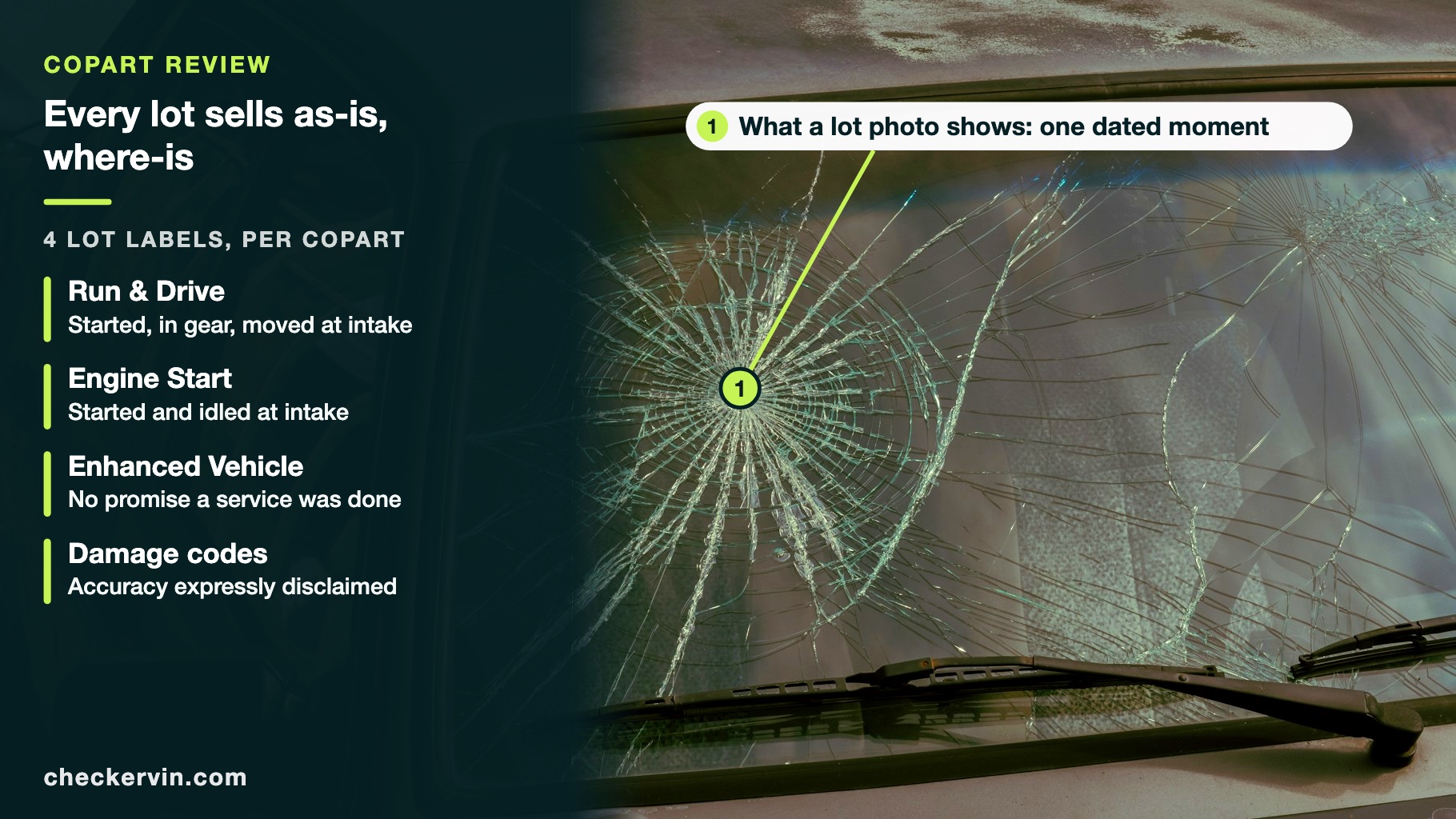
Copart Run and Drive and Engine Start: what was checked, and when
Copart’s own misconceptions page calls Run and Drive the most misunderstood Copart term. Its Vehicle Icons page defines it precisely: at the time of inventory, the vehicle
- Started under its own power or with an external jump box
- Was put into gear
- Moved forward
That is all 3conditions, and they describe arrival day. Copart adds that the label is not a guarantee, representation or warranty that the vehicle is roadworthy, or that it will start, go into gear or move forward at the time of sale or pickup. The misconceptions page goes further and says there is no promise the car can be driven lawfully on any state’s highways.
| Label | What Copart verified, and when |
|---|---|
| Run & Drive | Started (a jump box counts), went into gear and moved forward, at intake. |
| Engine Start Program | Started and ran at idle, at intake. Nothing about gears or moving. |
| Neither label | No statement either way. Does not mean the car does not run. |
Time passes between intake and pickup, and nothing in the label covers it. Batteries go flat and a car that started on arrival may not start when you collect it. Read Run and Drive as “it moved once, under its own power or with a jump, on the day it arrived,” and budget as if you will need to tow it.
Copart Enhanced Vehicles, Seller Certified and the other icons
Lot icons flag how a car is being sold. Copart’s Vehicle Icons page defines each, and several carry more conditions than the badge suggests.
| Icon | What Copart says it means |
|---|---|
| Enhanced Vehicle | The seller authorized an enhancement such as a wash, vacuum or protective covering, or the car is in a program that lets Copart use them. Copart says the label does not guarantee any service was done; checking is the member's job. |
| Seller Certified | If you are not satisfied on inspection, you may decline the purchase before the car leaves Copart's premises. After that, you accept it as-is. |
| Copart GO | Listed by a business or individual through Copart's app, with a yes/no condition report the seller fills in. Copart says it has not inspected the car or reviewed that report and is not responsible for its accuracy. |
| Wholesale (green, yellow, red) | Graded by Copart's multi-point inspection. Green and yellow lights fall under Copart's arbitration policy; red light vehicles are sold as-is under its Member Protection Pledge. |
| VIX | Repossessed or total-loss vehicles not in Copart's possession, inspectable only through photos. Live bids only, and the final price needs seller approval. |
| Flood Reconditioned | Recovered from a storm event and treated to extract water and help prevent mold and odors. |
The Enhanced label is the one that drifts furthest from its name. It reads like an upgrade but describes, at most, cleaning and covers, and Copart does not promise even that much was done. Flood Reconditioned is the opposite case: an honest label for a car that was in water. Treatment for mold and odor is not a repair of the wiring and modules a flood reaches.
Sold as-is, where-is: what Copart's terms leave you
Copart’s glossary states that all Copart vehicles are sold as-is, where-is, and are not represented as roadworthy, mechanically sound or maintained to any guaranteed level of quality. The same document disclaims most of the data on a lot page.
| Lot-page field | Copart's own caveat |
|---|---|
| Primary and secondary damage | Known or reported damage only. Copart expressly disclaims their accuracy and says they may not be relied on for bidding. Both codes count equally. The glossary lists 26 codes, including water/flood, frame damage reported and replaced VIN. |
| Estimated retail value | Submitted by the seller, the pre-damage value if the car is damaged, informational only, with no representation of accuracy. |
| Odometer | One of 4 descriptions: actual, exempt, not actual, exceeds mechanical limits. "Not actual" means the reading is wrong or cannot be known; "exempt" means federal law requires no odometer code. |
| Engine | The specification the VIN denotes. Copart encourages inspection to verify the original equipment is still there. |
| Photos | 10 images taken when the car was processed for sale. |
The engine row is worth a second look. Copart’s engine field is decoded from the VIN, which tells you what the factory installed, not what is under the hood today. A parts car can arrive with the engine already gone.
What Copart reviews usually come down to
People searching for Copart reviews tend to find the same few complaints, and Copart has published its own answer to them. Its “common misconceptions” page names three myths, and each maps to something on this page.
| The complaint | What Copart's own page says |
|---|---|
| Hidden fees | Fees exist but are published. They depend on whether you are a business member (a business license on file) or a consumer member, and on how you pay. |
| The car was not what I expected | Copart is not a new or used car dealership, most of its vehicles carry salvage titles, and every lot is advertised as-is. It encourages in-person previews or a third-party inspector. |
| Misleading terms | Copart concedes its terminology can confuse buyers and points to its glossary, singling out Run and Drive. |
We do not reprint star ratings from review sites; they mix buyers, sellers and people who never bid, and they move every week. What can be checked is that Copart’s terms say, in advance and in writing, most of what disappointed reviewers later discover.
Official Copart channels vs lookalike sellers
Copart publishes an “Avoiding Scams and Fraud” page, and its first line is the most useful advice on it: the best way to avoid scams is to buy via copart.com. The page is aimed at third parties on sites such as Craigslist or eBay who claim to be selling Copart vehicles, and it lists warning signs:
- A request to wire funds through a service such as Western Union
- An offer to send you a cashier's check or money order and have you wire money back, which Copart calls always a scam in its experience
- A seller who is traveling or relocating and needs money sent abroad
- A deal that seems too good to be true, or a price that is too low
- A seller who will only communicate by text or email
- Any claim that a third party guarantees the transaction
The same page tells U.S. buyers to report fraud attempts to the FBI’s Internet Crime Complaint Center and the FTC. Note what the warning covers: Copart does accept wire transfers as a way to pay Copart itself, and documents them in its help center. The danger is wiring money to someone who is not Copart.
| Official channel | How to confirm it |
|---|---|
| copart.com | The U.S. site named in Copart's 10-K. Type it yourself rather than following a link. |
| Copart's country sites | Copart names 8 for its subsidiaries: copart.ca, copart.co.uk, copart.ie, copart.com.br, copart.de, copart.fi, copartmea.com, copart.es. |
| Brokers | Reach a broker from the list on copart.com, not from an ad or a message. |
| Copart phone line | The help center lists (972) 391-5400. The 10-K gives the Dallas headquarters number as (972) 391-5000. |
The buyer's checks: VIN, title record and auction archives
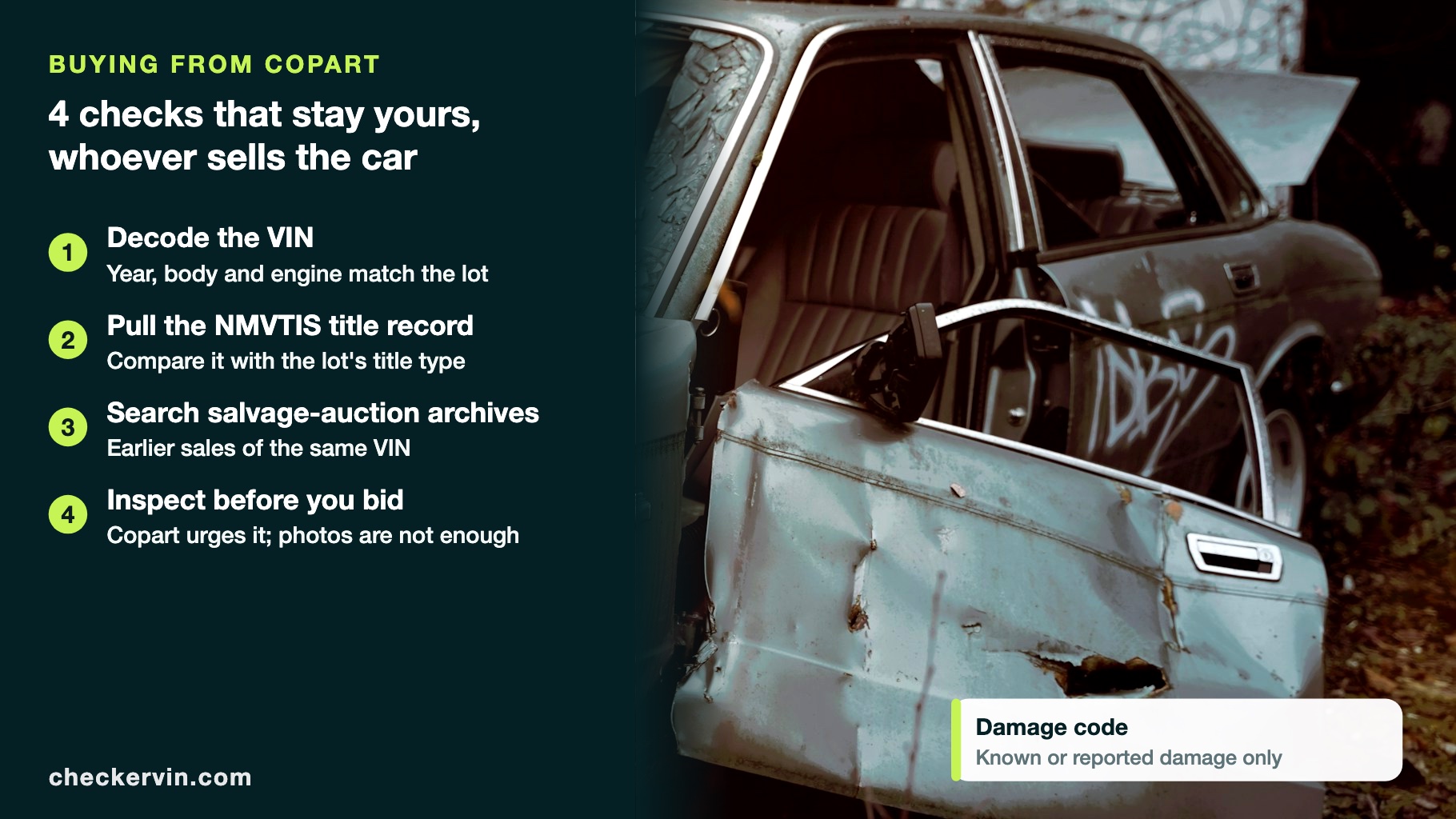
None of Copart’s labels replaces checks you run yourself, and all of them can be done from the lot page before you bid. The order matters: the free ones first, so you only pay for a title report on a car that survives them.
- 1Decode the VIN, freeCopy the 17-character VIN from the lot page and decode it. The year, body, engine and drive should match what the listing says. A mismatch is a question for Copart before you bid, not after.
- 2Check open recalls, freeNHTSA's recall lookup shows open safety campaigns on that VIN. Knowing them before you bid tells you what still needs a dealer visit once the car is yours.
- 3Pull the NMVTIS title recordBuy a report from a provider on the Department of Justice list and line it up against the lot's title type, odometer and damage codes. Differences are the point of the exercise.
- 4Search salvage-auction archives by VINAn earlier sale of the same VIN, at Copart or IAA, shows how the car looked before and whether it has been through the salvage cycle more than once.
- 5Inspect, or send someone who willCopart recommends a thorough inspection before purchase and publishes a list of approved third-party inspectors. Nothing above sees the car itself.
Decode a Copart VIN free, no card
Decoded from official manufacturer and NHTSA records
Comparing a Copart lot page with the title record
An NMVTIS report is built on 5 indicators: current state of title and last title date; brand history; odometer reading; total loss history; salvage history. Copart is not on the Department of Justice’s list of approved NMVTIS data providers, which is expected: it sells cars, not title reports. Put the two side by side and the gaps show.
| On the Copart lot page | Check it against |
|---|---|
| Title type | The NMVTIS current title state and brand history. A clean lot title with an older salvage brand elsewhere is the classic washed title. |
| Odometer and its description | The NMVTIS odometer readings. A lower figure than an earlier report, or a 'not actual' description, needs an explanation. |
| Seller is an insurer | The NMVTIS total-loss and salvage history. An insurer-sold car with nothing there deserves a second look. |
| Damage codes | Earlier auction listings for the same VIN. A second salvage sale points to a repaired car that was wrecked again. |
| Replaced or altered VIN code | Stop. Compare the VIN plate, door label and title before anything else. |
The title record has its own limit: the program says repair histories are not meant to be in it. That is why the last step is always an inspection. For the archive side, our guide to auction history by VIN explains where earlier Copart and IAA listings can still be found, and the NMVTIS report guide explains who reports what to the federal system.
Where this information comes from
- Copart, Inc. — Form 10-K for the fiscal year ended July 31, 2026 (SEC EDGAR)Corporate history, countries, facilities, sellers, buyers, members and the VB3 process; filed September 29, 2026
- Copart — Glossary of Common Terms Used at CopartPure Sale, On Approval, Minimum Bid, counter bids, damage codes, odometer types and the as-is statement (updated 2025-11-25)
- Copart — Vehicle IconsRun & Drive, Engine Start, Enhanced Vehicle, Seller Certified, Copart GO, VIX and Flood Reconditioned (updated 2025-11-21)
- Copart — Title TypesSalvage, clean and rebuilt definitions (updated 2024-11-08)
- Copart — Ways To Bid & BuyBuy It Now, Make An Offer, Max Bid and Monster Bid (updated 2024-11-11)
- Copart — Bidding & Buying FAQEligibility status, buying before auction, and relisting after non-payment (updated 2024-12-30)
- Copart — Licensing & Documentation RequirementsState law decides what you can buy; ID, document review, brokers and No License Required lots (updated 2025-01-07)
- Copart — Choosing a MembershipFree Guest accounts and Copart's own country sites (updated 2025-02-18)
- Copart — Understanding the Lot Details PageThe fields a lot page carries, including title type (updated 2024-11-07)
- Copart — Common MisconceptionsFees, salvage inventory, and Run and Drive as the most misunderstood term
- Copart — Avoiding Scams and FraudWarning signs for third parties claiming to sell Copart vehicles
- NMVTIS — approved data providersThe Department of Justice list; Copart does not appear on it
- NMVTIS — Understanding a Vehicle History ReportThe five indicators, and that repair histories are not meant to be included
- NHTSA — Recalls lookupFree open-recall check by VIN
- NHTSA — vPIC VIN decoderFree federal VIN decode to match a lot against its VIN
- How we made this pageWritten by the CarCheckerVIN editorial team with AI assistance from NHTSA vPIC and other public records, including Copart's SEC filing, Copart's published help pages and the Department of Justice NMVTIS pages; facts checked November 2026. Fee amounts are intentionally not reproduced.
Keep reading
Frequently asked questions
Is Copart legit?
Yes, in the sense that matters first: Copart, Inc. is a Nasdaq-listed company that files annual reports with the SEC, and its fiscal 2026 10-K reports 286 operating facilities and approximately 1 million registered members. Being a real auction does not make every lot a good buy. Copart sells every vehicle as-is, where-is, and most of its inventory carries a salvage title.
Can the public buy cars from Copart without a dealer license?
Sometimes. Copart says the vehicles you can buy depend on the laws of the state where each vehicle sits. Lots marked No License Required are open to anyone with a verified account; for the rest, Copart points buyers without the right license to a registered broker who bids on their behalf for a fee.
What does Run and Drive mean on Copart?
At the time of inventory the vehicle started under its own power or with an external jump box, was put into gear, moved forward. Copart says the label is no guarantee the car is roadworthy, or that it will start, go into gear or move when you collect it. Copart's own misconceptions page calls it the most misunderstood term on the site.
What is a Pure Sale on Copart?
A lot with no minimum bid and no reserve price. Copart's glossary says it is awarded to the highest bidder at the close of bidding. On Approval and Minimum Bid lots work differently: the seller can accept or reject the high bid afterward.
How does Copart Buy It Now work?
On certain lots, the seller sets a price at which you can buy the vehicle immediately instead of waiting for the auction. If the price is too high, Copart's Make An Offer tool lets you send a counteroffer and negotiate. The vehicle is still sold as-is.
What does Enhanced Vehicle mean at Copart?
The seller authorized Copart to perform an enhancement service such as a wash, vacuum or protective covering, or the vehicle is in a program that lets Copart use such services. Copart says the label does not guarantee that any service was actually done.
What title types does Copart sell?
Copart's help center describes clean, salvage and rebuilt titles, and its misconceptions page says most vehicles at Copart carry a salvage title. The exact title wording comes from the issuing state, and most states require a license to buy at least some of these types.
Check the VIN before you place a bid
Decode any Copart lot's VIN free for the factory build, specifications and open safety recalls. No account, no card. Full vehicle history reports are launching soon.
Run a free VIN check