The short answer
- Do I end up with a title?
- Usually not. Of the 14 states we read, only Virginia and Pennsylvania put the certificate in the applicant's own name. In the other 12 it goes to the tow yard, to a buyer at auction, or to the town.
- Who has to find the owner?
- The fork nobody names. 6 states run the record search for you, 5 make you do it, 2 force you to pay a licensed vendor, and California decides by the value of the car.
- How fast is this?
- Weeks at the fastest and months where a court is involved. Every clock on this page is a notice period, and it is there so the owner can appear. Shortening it is what voids the outcome.
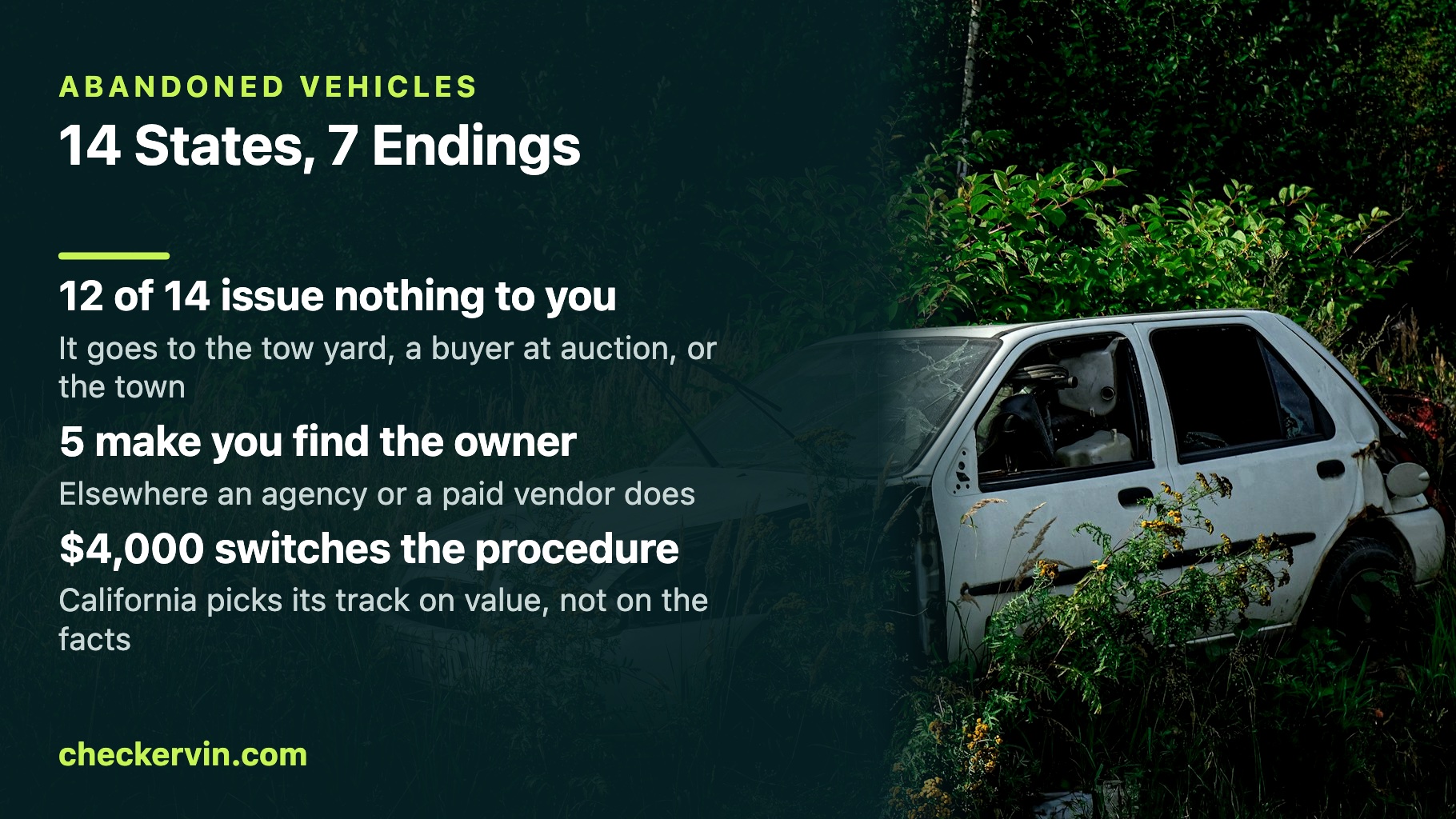
12 of 14
States where the certificate does not end up in your name
It goes to the tow yard, to a buyer at auction, or to the town
7
Distinct endings across the states read end to end
A sale is the most common, in 7 of them
24h to 7d
The spread on how long a car must sit on private property first
Pennsylvania at the short end, the Carolinas at the long one
4 of 14
States using a website rather than print for the public notice
2 require it, 2 post only when the mail fails
The procedure usually does not end in a title
Search for this and the results will tell you how to get a title for an abandoned vehicle. Read the state pages behind those results and the promise quietly disappears. Of the 14 states we read from statute to form, only 2 — Virginia and Pennsylvania— put a certificate of title in the applicant’s own name. The other 12 finish somewhere else, and the somewhere is usually a business.
The trap is a phrase that appears in statute after statute: ownership passes to the person in possession. It reads like a description of you, standing in your own yard next to a car nobody has moved in a year. It is not. In Arizona and Missourithat person is the tow yard or storage firm that took custody after a removal, and you can tell from the surrounding text — Missouri’s free-of-liens transfer is one clause of the notice a storage facility sends, in the same list as the facility’s address and its claim of a possessory lien for towing and storage. Arizona’s transfer section is captioned, in the statute book, with the words towing companies.
This is not a technicality. It changes what the whole exercise is worth to you. If the ending is a sale, the car is going to auction and the title issues to the buyer — who may well be you, bidding on your own procedure, but who is a buyer and not an heir to the paperwork. If the ending is authority to destroy, the vehicle is not going to be registered by anybody ever again, which is fine if you wanted it gone and useless if you wanted to drive it. If the ending is a bill of sale, you have finished one procedure and are standing at the start of a second. And in 4 states the honest answer is that you are not the person who gets to run the procedure at all.
One law firm page in the ranking set for this query says outright that there is no direct method to title an abandoned vehicle. That sits at odds with the rest of the results, which promise exactly that, and nobody reconciles the two. The reconciliation is the table further down: both statements are true in different states, and the word abandoned is doing different work in each of them. If you take one thing from this page, take the habit of asking not what the procedure issues but who it issues to.
What this procedure is actually for
Before any of the mechanics, the thing worth being honest about. Every route on this page is a notice procedure with a waiting period attached, and the waiting period is not bureaucratic friction to be minimized. It is the whole point. Somewhere in a state database there is a registered owner, and possibly a lienholder, and the clock exists so that they can be told and can turn up.
Read that way, the steps stop looking arbitrary. The record search exists so the owner can be identified. The certified letter exists so they can be told at their last known address. The publication exists to catch the case where the address is stale. The waiting period exists so they have time to act on either. A procedure that skipped all four would be a way of taking a car from somebody who was on holiday.
It follows that the most common real answer here is disappointing and correct: if the car has value and the owner is findable, the fastest route is usually to find them and ask for a signature. The statutory procedure is the route for when that has already failed.
What abandoned means, and what it does not
The everyday sense of the word — it has been there for ages, nobody has touched it — is not the legal sense in any state we read. The statutory definitions turn on some combination of where the vehicle is, how it got there, how long it has been there and whether anyone with a right to it has responded to notice. Time alone is rarely enough on its own, and in Missouri the clock does not even begin until you have told law enforcement the car is there.
The practical consequence is that a car in your driveway that a friend left there, or a car a tenant left behind, or a car that came in for repair and was never collected, may each fall under a different chapter of the same state’s code, with different forms and different clocks. Virginia, for instance, excludes vehicles subject to a mechanic’s or storage lien from its abandoned vehicle program and publishes a separate page for them. Landing in the wrong chapter costs you the whole waiting period, because you find out at the end.
| The situation | Usually not the abandoned vehicle chapter |
|---|---|
| A car left by a tenant in a rented space | Often landlord or self-storage law, with its own notice rules |
| A car that came in for repair and was never collected | A mechanic's or repairman's lien, a separate and generally faster route |
| A car you bought but the seller never signed over | There is a transaction here, so this is the bonded or court-order route |
| A car with a name on the title who is deceased | An estate transfer, which is a different form in every state |
| A car that is genuinely a shell, past use | Junk, derelict or dismantler routes, which end in a non-repairable document |
The third and fourth rows are the two that trip people most often. If you handed over money and the seller vanished before signing, there was a transaction and you are on the bonded title route, not this one. If the registered owner has died, that is an estate matter. Only the case where no transaction ever happened — the car simply arrived, or came in and was never claimed — is the case this page describes.
14 states, 7 different endings
Here is the whole page in one table. The column that matters is the second, and it is written to name the recipient rather than just the document, because that is the part that decides whether the procedure is worth your time. It is also the column that no page ranking for this query prints, because reaching it requires reading each state’s procedure to the end rather than summarizing its opening paragraph.
| State | What is issued, and to whom |
|---|---|
| Arizona | Ownership free of all liens, to the tow yard holding the vehicle |
| Missouri | Title free of all prior liens, to the storage firm in possession |
| Virginia | Form VSA 40, on which you elect to title, auction or demolish |
| California | Authority to sell; the title issues to whoever buys |
| Georgia | A court-ordered public sale; the title issues to the purchaser |
| South Carolina | A magistrate's order of sale; the purchaser takes title free and clear |
| North Carolina | A sale, and the state says bonds are not accepted on abandoned vehicles |
| Tennessee | An auction, which a private individual is not permitted to run |
| Mississippi | A public auction that removes the claims against the vehicle |
| Florida | After the public sale, a title or a certificate of destruction |
| Texas | Authority to destroy. Not a title, and not a right to drive it |
| Alabama | An abandoned vehicle bill of sale, then a separate title application |
| New York | Ownership vests in the local authority, not in the landowner |
| Pennsylvania | A Common Pleas judgment, accepted in place of a certificate of title |
14 states, 7 distinct endings, and in 12 of them the paper ends up with somebody other than the person who found the car. A sale is the modal answer, in 7 of them, which is itself the finding: the standard American solution to an abandoned car is not to give it to the person it was dumped on but to sell it under supervision and let the money settle the claims. Any page that gives you a single national answer to what happens at the end is generalizing from whichever state its author read.
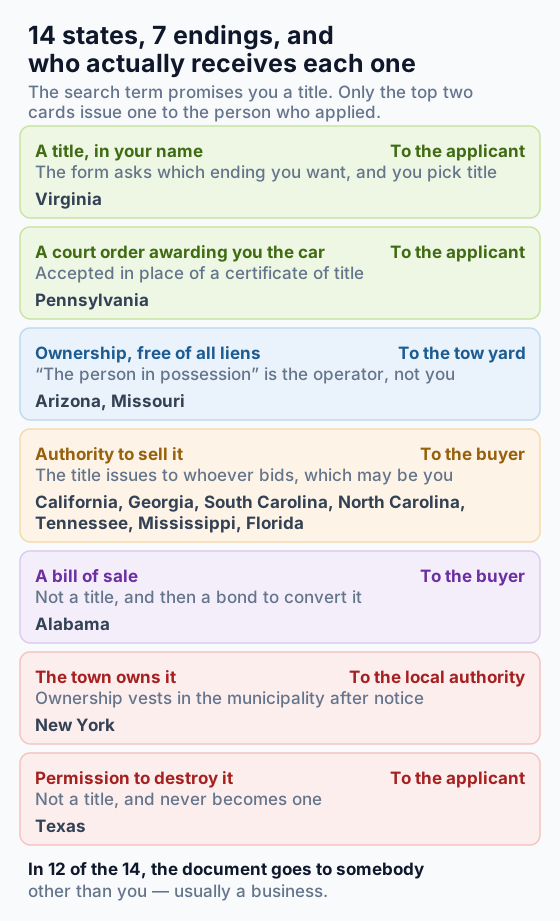
The two routes that reach a title in your name
If your goal is the certificate itself and not simply removal, this set contains two answers, and they are worth naming together because they are the exception rather than the rule.
The first is election. Virginia asks the applicant, on Form VSA 40, what they want to happen — title it, auction it, or demolish it. Tick the first box and the vehicle qualifies, and the certificate is issued to you. Virginia is also unusually plain about the rest of the procedure, which is why it appears so often on this page: the DMV states the reclaim period, the posting period and the absence of a newspaper requirement in plain sentences rather than by statutory cross-reference.
The second is a court order, and it is the route people assume does not exist because it does not look like a form. In Pennsylvania a landowner may file in the Court of Common Pleas for an order that awards ownership of the vehicle to them and extinguishes everybody else’s interest in it. PennDOT accepts that order as evidence of ownership in place of a certificate of title, and its fact sheet prints a sample order for the court to sign. That is slower and costs more than a form, and it is the only route in this set designed around the landowner rather than around a business.
A third answer is not on this list at all, and is the one most people actually end up using: buy the car at the sale you initiated. California documents this as a specific contingency rather than a strategy — where nobody places a qualifying bid at the lien sale, the lienholder completes the REG 168A as both the seller and the buyer. It works, it is documented, and the record will show a sale rather than a transfer, which matters later, because the next buyer running a history report will see one.
The real fork: who hunts for the owner
Every one of these procedures requires that the registered owner and any lienholder be identified and notified. What varies, dramatically, is who does the identifying. It is the single biggest difference in effort between states and it is almost never mentioned.
In Arizona, Missouri, Virginia, Tennessee, Texas and New Yorkthe state or the local authority runs the record check itself. Missouri is explicit about the timetable: within five working days of receiving the inspection report the director of revenue searches the department’s records, or opens an inquiry with another state. Your job is to file correctly and wait.
In Georgia, South Carolina, North Carolina, Alabama and Pennsylvaniait is on you. Georgia has a specific form for it — MV-603, the notice of abandoned vehicle and request for information — and Alabama expects the applicant to establish owners and lienholders, including through a national title-history query, before notice goes out. South Carolina makes the applicant apply to the titling facility for the owner and lienholder details, though the sheriff must supply the state of title at no cost.
And in Mississippi and Florida there is a third answer that did not exist a few years ago: you must pay a licensed third-party vendor to do it. Florida requires a tow company to use an approved service provider to mail the notice of lien to owners, lienholders and insurers. Mississippi moves to the same model, with an approved vendor handling certified mail. The work has been outsourced, standardized and priced.
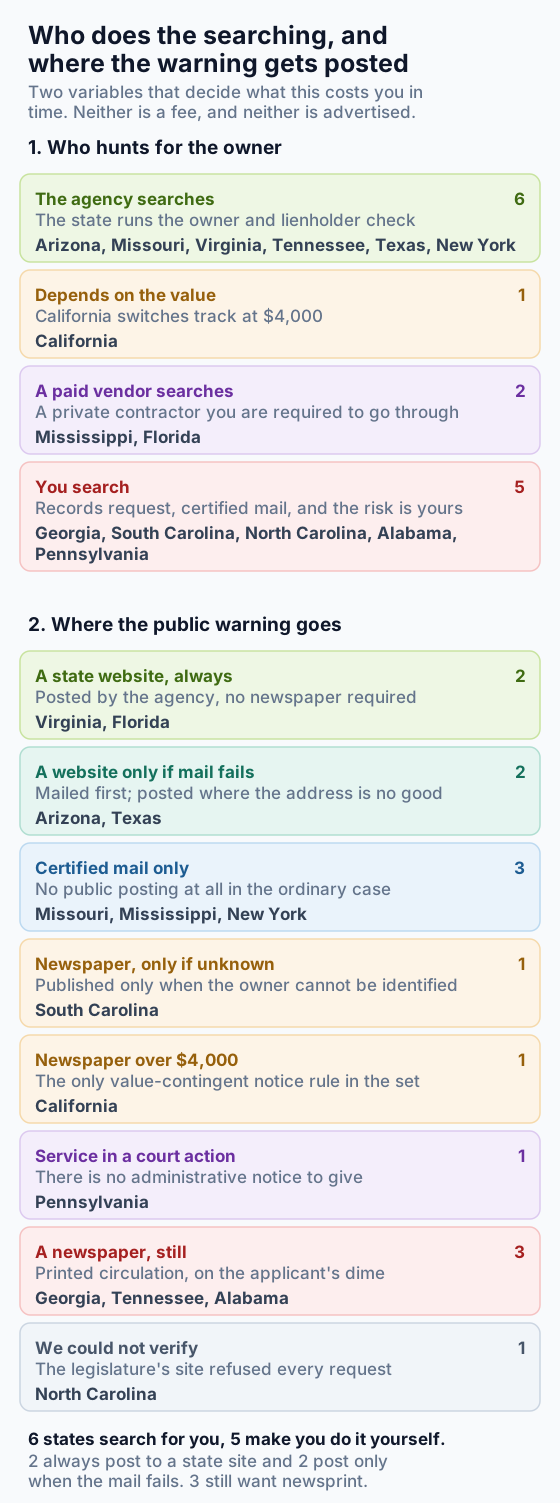
If you are estimating what this will cost you before you begin, this is the variable to look up first — ahead of the fees, ahead of the forms and ahead of the waiting period. An agency-run search costs you a filing. An applicant-run search costs you a records request, a certified mailing and the risk of getting the address wrong. A vendor-run search costs money but removes the risk, which for a tow operator handling volume is the better trade and is presumably why the model is spreading.
Publication did not die, it moved
Older guides to this topic spend a long time on newspaper notices, classified sections and the number of consecutive days. That advice has aged unevenly. In Virginia and Florida the notice goes on a state agency or approved website as the ordinary course, and Virginia DMV answers the question in as many words: you are not required to post intent to auction in other public places, including newspapers.
Two more states use a website without requiring one. Arizona and Texasboth mail first, and publish only where the mail cannot do the job. Arizona’s statute posts the notice on the department’s website where the records do not disclose a name and address, or where the notice comes back marked unclaimed. Texas mails by first class and posts on its own webpage where it cannot locate a vehicle record. That is a meaningful distinction if you are trying to work out whether anyone will ever see the notice: in those two states, a successful mailing means nothing is published at all.
Florida is the clearest single data point, because it changed inside living memory of the guides still describing the old rule. Until mid-2024 the advertisement of a public sale had to run in a general-circulation newspaper that had been in business at least two years. From 1 July 2024 it must instead be posted on a publicly available website maintained by an approved third-party service, twenty days before the sale. Anything you read about Florida newspaper advertising is describing a rule that no longer exists.
Newsprint has not vanished. Georgia, Tennessee and Alabamastill require it. Alabama’s is the most demanding we found: once a week for two successive weeks in a newspaper of general circulation in the county where the sale is held, with the first publication at least 30 days before the sale — and where the county has no newspaper, a posting at the courthouse instead. California requires publication only above $4,000. South Carolina requires it only where the last registered owner cannot be identified, one publication being sufficient in that case.
A third group — Missouri, Mississippi and New York— leans on certified mail instead of publication. Missouri requires notice to the owner and lienholder within ten business days by certified mail, return receipt requested, and asks for the returned envelope marked undeliverable as part of the file.
| Where the notice goes | States |
|---|---|
| A state agency or approved website, always | Virginia and Florida |
| A website, but only if the mail fails | Arizona and Texas |
| A newspaper, for a defined run | Georgia, Tennessee and Alabama |
| Certified mail rather than publication | Missouri, Mississippi and New York |
| A newspaper only above $4,000 in value | California |
| A newspaper only if the owner cannot be identified | South Carolina |
| Service in a court action instead | Pennsylvania |
For you this is mostly good news, because a website posting is free and a legal notice in a newspaper is not. It also means the step is easy to overlook: nothing physically arrives, and the notice period runs whether you are watching or not. Note the date the listing goes live, because that is the date the clock actually started, and it is frequently later than the date you filed.
Who is actually allowed to start this
The assumption running underneath most writing on this subject is that a landowner with a car on their property can begin an abandoned vehicle procedure. In 4 of the 14 states here that assumption is simply false, and the states are Georgia, Tennessee, South Carolina and Mississippi.
Tennessee says it in a sentence that leaves no room: private individuals are not allowed to go through the procedure for abandoned, immobile or unattended vehicles. Georgia’s Department of Revenue authorizes only towing and storage firms to remove vehicles from public and private property in the first place, so a homeowner never reaches the paperwork. South Carolina gives the right to have the vehicle sold at public auction to the proprietor, owner or operator of the towing company, storage facility, garage or repair shop. Mississippi frames its whole procedure around vehicles left with auto dealers, towing companies and repair shops.
That single restriction reorganizes the advice for a large share of readers. If you are a homeowner in one of those four, the practical route is to have the vehicle towed by a licensed operator, at which point the operator is in the class that can run the procedure, and the car becomes their problem and their asset rather than yours. You get the driveway back. You do not get the car.
Pennsylvania is the deliberate counter-example and the reason this page does not simply say landowners are shut out everywhere. PennDOT’s fact sheet is written for the landowner and gives three options: ask a police department to declare the vehicle abandoned and require a salvor to take it, remove it to storage yourself and sue before a District Justice for the costs, or file in the Court of Common Pleas for an order awarding you ownership outright. Only the third ends with you holding the car, and PennDOT notes pointedly that a landowner cannot hold a vehicle against storage costs unless they happen to be a bona fide warehouseman.
It is worth checking this before anything else in your own state, because it is a threshold question rather than a procedural one, and it is usually stated once near the top of the state’s page in language that reads like preamble.
Arizona hands the car to the tow yard
Arizona is the state most often cited as proof that this works, and its statute is worth reading closely for exactly that reason. Once the vehicle remains unclaimed past the statutory date, the director makes an inquiry to establish that it is not a stolen vehicle, and on receiving notice that it has not been reported stolen may transfer ownership of the vehicle free and clear of all liens or encumbrances to the person in possession of the vehicle.
Three things in that sentence are doing real work. The stolen-vehicle check runs first and is not optional, which is the state protecting itself and, incidentally, protecting whoever ends up with the car. The transfer is free and clear of all liens or encumbrances — a phrase most states do not use. And the recipient is the person in possession rather than a purchaser at auction, which is what makes this a true ownership ending rather than a sale.
The application itself is a certified statement with two assertions: that as of the date of application no person has presented proof of ownership and financial responsibility for the release of the vehicle, and that the applicant is currently in possession of it. The statute also lists exactly what counts as proof of ownership if somebody does come forward — a valid certificate of title, current registration, a repossession affidavit, an insurance company release, a certified motor vehicle record, or proof of a security interest existing at the time of the tow.
Missouri: your 96 hours only buys a tow
Missouri reaches the same ending as Arizona and gets there by a structure worth understanding, because it is the clearest example of a clock that does not start when the car arrives. On private property the statute requires that the owner or lawful possessor of the real property has notified the appropriate law enforcement agency and that ninety-six hours have elapsed since that notification. The car can have been sitting there for a year; the four days begin when you make the call.
Read the next clause, though, because it is the one that decides whether any of this is for you. What those ninety-six hours unlock is the right to authorize a towing company to removethe vehicle. That is the landowner’s power in Missouri, and it is the whole of it. You complete an abandoned property report, which the statute treats as a legal declaration carrying criminal penalties for a false one, and the car leaves.
From there the state does the work. Within five working days of receiving the crime inquiry and inspection report, the director of revenue searches the department’s records or opens an inquiry with another state. Notice then goes to the owner and any lienholder within ten business days by certified mail, return receipt requested. There is no newspaper advertisement.
And the ending is the strong one, for somebody. If the property remains unclaimed for thirty days from the date the notice was mailed, title transfers to the person or firm in possession, free of all prior liens. The file is an affidavit of possession together with the certified mail receipt and, where the letter came back, the envelope showing it was undeliverable — the paper trail doing exactly the job described at the top of this page.
Virginia lets you pick the ending
Virginia is the most user-friendly procedure in the set and also the one whose paperwork most needs reading twice. The state runs the owner search, sends the notice, and posts the vehicle on the DMV website. The intent to auction must remain posted for 21 days before auctioning, titling or demolishing the vehicle, and you are not asked to advertise anywhere else.
Count both periods, because the 21 days people quote is the second one. DMV notifies the owner by certified letter that the vehicle must be reclaimed within 15 days. Only if it is not reclaimed does the additional 21-day posting run. Budget five weeks from the letter, not three.
What makes Virginia unusual is visible in that same sentence: auctioning, titling or demolishing. The application does not assume a single outcome. It presents a choice among endings, and the Vehicle Removal Certificate, Form VSA 40, is the document that records it. That is a real convenience — you say what you want to happen — and it is also where people go wrong, because it is easy to tick the option that sounds best rather than the one the statute supports for your situation.
Texas gives permission to destroy
Texas is the clearest example of the gap between what people search for and what the state issues. A vehicle reported abandoned goes onto a list the department maintains for 20 days, and can be released on the twenty-first. What is released is authority to destroy the vehicle. The filing is nominal and it does what its name says.
It is not a title. It does not become a title, and there is no waiting period after which it converts into one. If your plan was to fix the car up and drive it, this route does not reach that outcome and no amount of correct filing will make it. Texas has other routes for a vehicle you actually want — the bonded route among them, which our bonded title page covers state by state and registering a car without a title walks through at the counter.
Read the other way round, though, Texas is offering the cleanest possible answer to the most common version of this problem. A large share of the people searching this term do not want the car. They want the car gone, lawfully, without inheriting whatever is attached to it. Authority to destroy is precisely that, in three weeks.
California: $4,000 changes who does the work
California runs a lien-sale structure rather than a titling procedure, and it splits by the value of the vehicle. Above $4,000 the process carries the heavier notice burden, newspaper publication included. At or below it, a lighter track applies. What you get at the end of either is authority to conduct a sale; the certificate of title then issues to the purchaser.
The wrinkle that catches people is that you can be the purchaser. California’s paperwork contemplates the applicant appearing as both the seller and the buyer at the same sale, which is how a possessor ends up with the title in practice. It is legitimate and it is documented, but it is a sale, and the record will show a sale.
There is a third track below the second threshold. At or under $500the vehicle goes to a licensed dismantler, and nobody gets a title at all — not you, not a buyer. The vehicle leaves the road permanently. If the car is a shell, that is the route it is on whether or not that was your intention, so establish the value early.
Georgia routes it through a judge
Georgia is the most demanding of the fourteen and the most explicit about why. The authorized business files the notice of abandoned vehicle and request for information, runs the owner and lienholder identification itself, publishes in a newspaper, and then the matter goes to a court. What comes out is a court order for a public sale, and the certificate of title issues to whoever buys the vehicle at that sale. The second person is deliberately absent from that sentence: as the previous section set out, Georgia authorizes only towing and storage firms to remove the vehicle in the first place, so a homeowner is not the one filing any of it.
The reason Georgia stacks the requirements this high is visible in what it forbids elsewhere. Georgia’s Department of Revenue states that a certificate of title cannot be obtained for an abandoned vehicle on the basis of a surety bond. In a state that otherwise runs a well-known bonded title program, the abandonment procedure is affirmatively walled off from it. There is one road, it goes past a judge, and the bond cannot be used to go around.
South Carolina next door reaches a similar destination with less ceremony: the sale is held under a magistrate’s order, and the statute is unusually generous to the buyer, who takes title free and clear of all liens and claims of ownership and is entitled to register the vehicle. Proceeds are held for ninety days before they go to the general fund of the county or municipality. Both states are protecting the same thing — the absent owner’s money, if not their car.
Alabama issues a bill of sale, not a title
Alabama’s procedure ends in an abandoned vehicle bill of sale. That document is not a certificate of title, and the state does not present it as one. It is the evidence you then take into a separate title application — and where the vehicle is not being sold by a bonded agent, § 32-13-3 requires the notice of sale to state that the purchaser must post a surety bond under § 32-8-36 in order to obtain title, for any sale on or after 1 January 2020. Read the condition: it is the sale run by somebody who is not already bonded that pushes the bond onto the buyer.
Set that next to Georgia and North Carolina and you have the sharpest contradiction on this page. Georgia: a title cannot be obtained for an abandoned vehicle on the basis of a surety bond. North Carolina: bonds are not acceptable on abandoned vehicles. Alabama: in the ordinary case the purchaser posts a surety bond in order to obtain title. Same instrument, same fact pattern, opposite rules, three states in the same region. This is the clearest possible demonstration that there is no national answer here and that carrying advice across a state line is how people lose months.
Alabama also runs its clock in two stages. A vehicle becomes unclaimed at one point and only becomes abandoned a further period after notice. Anyone counting from the day the car appeared will file too early, be rejected, and start again. Count from notice.
Pennsylvania: the one route built for landowners
Pennsylvania has the shortest trigger we found and the longest road afterwards. A vehicle left on private property without the consent of the person in control of it for more than 24 hours already meets the definition. What follows is not a form, and it is also not the dead end it is often written up as.
PennDOT publishes a fact sheet addressed to landowners, and it sets out three methods. The first is to ask a police department to declare the vehicle abandoned and require a salvor to take possession of it — that is removal, and it ends your involvement without giving you anything. The second is to remove the vehicle to storage yourself and bring an action before a District Justice to recover the removal and storage costs; once judgment is entered and the owner has had reasonable notice, the vehicle can be sold at a sheriff’s sale in execution of that judgment. That is a sale, and the title goes to whoever buys.
The third is the one worth knowing about, because it is the only procedure in this entire set that is designed to put the certificate in the landowner’s own name. You file suit in the Court of Common Pleas asking for an order that awards ownership of the vehicle to you and extinguishes the right, title and interest of any other person in it. PennDOT accepts that order as evidence of ownership in place of a certificate of title, and it prints a sample order in the fact sheet for the court to work from. You bring a certified copy together with the standard application and the taxes and fees, plus proof that reasonable notice went to the owner and to anybody whose lien is recorded against the title.
Two consequences follow that are easy to miss. There is no fixed end date, because a court schedule is not a statutory clock. And a landowner cannot hold the car hostage against storage costs in the meantime unless they are a bona fide warehouseman, which almost no homeowner is. For a low-value car in Pennsylvania the arithmetic usually favors having it towed by an operator who has a procedure available to them.
New York gives the car to the town
New York is the ending nobody expects, and it is worth stating plainly because it changes what the whole exercise is for. A vehicle left more than ninety-six hours on the property of another without permission is abandoned. The local authority takes custody, inquires of the jurisdiction that issued the plates — or of the Department of Motor Vehicles where there are none — and notifies the last known owner that the vehicle has been recovered and will be sold at public auction if unclaimed.
Then: ownership of such abandoned vehicles, if unclaimed, vests in the local authority ten days from the date the notice is given. Not in you. The statute is written for the municipality that has to deal with the car, and the landowner’s interest in it ends when the town takes it away. The roadside clocks in the same section are shorter still — six hours for an unplated vehicle, twenty-four in a no-parking area, forty-eight once the parking has become illegal.
If you are in New York and you want the car, this procedure is not the way to it. If you want the car gone, it is efficient, free and fast by the standards of everything else on this page.
Where the bonded route is shut off
People arrive at this page having already read about surety bonded titles, and reasonably ask whether the bond is a faster way around the notice period. The answer is that the bond and the abandonment procedure answer different questions, and the states here say so in opposite directions.
A surety bond exists for the case where there was a transaction and the paperwork failed: you bought the car, the seller cannot be produced to sign, and the bond stands as financial protection against their later return. It presumes a chain of ownership with a gap in it. An abandonment procedure presumes no chain at all — the car arrived and nobody has ever purported to convey it to you. That is why Georgia and North Carolina close the bond route here: the bond would be securing a transaction that never took place.
Alabama’s answer is the opposite because it puts the bond at a different point in the sequence. There, the sale itself is the event that establishes the transfer, and the bond attaches to the purchaser’s subsequent title application, securing that purchase rather than a phantom original sale. Both positions are internally consistent. Neither survives being moved to the other state.
If your state does offer the bonded route and you are trying to work out the multiple, what it is a multiple of, how long it stands and which office holds it, that is a fifty-state question and it has its own page: bonded title, state by state.
What happens to the loan on the car
A car nobody has collected has a fair chance of having a lienholder in the file, and the lienholder is the party most likely to appear and least likely to be sentimental about it. What the procedure does to their interest is the difference between a result that holds and one that unravels.
Arizona and Missouri both say it plainly: ownership or title transfers free and clear of prior liens. Those are strong outcomes and they are written into the statutes — and in both they run to the person in possession, which after a tow is the operator. The lien gets cleared; it is just not cleared for you. South Carolina extends the same protection but to the purchaser at the magistrate’s sale, who takes free and clear of all liens and claims of ownership, which helps you only if you are the one buying. This is the pattern worth internalizing: the statutes that speak most confidently about wiping liens are the ones written for the business at the end of the chain. Elsewhere the lienholder is simply a party entitled to notice, and if they receive it and act, they generally prevail: their interest is recorded, yours is possession, and a recorded interest wins that contest almost every time.
This is the strongest practical argument for running the VIN before you spend anything on the procedure. A history check will tell you whether there is a lienholder in the record, and knowing that on day one is worth more than knowing it at the sale. Our vehicle lien check page explains what does and does not show up, and the possessory lien section covers the case where a shop or yard has a competing claim of its own.
Reading your state's clock correctly
Almost every mistake with timing on these procedures is the same mistake: counting from when the car showed up. Statutory clocks in this area generally start when notice is given or published, and sometimes at a moment stranger than that. Missouri’s ninety-six hours run from the day you notify law enforcement. Florida’s run from the tow and are set by the age of the vehicle, not by where it is. Alabama and North Carolina both run two periods in sequence.
| State | What the clock is actually measuring |
|---|---|
| Arizona | Held 10 days after an officer-ordered removal, then reported within 5 |
| Missouri | 96 hours from the day you notify police, then 30 days from notice |
| Virginia | 15 days to reclaim after DMV’s letter, then 21 days posted online |
| California | Runs from the lien-sale notice, and the track depends on value |
| Georgia | Notice, then a court order, then an advertised public sale |
| South Carolina | 7 days on private property, then 30 days to reclaim after notice |
| North Carolina | 7 days before it can be towed, 30 more before it counts as abandoned |
| Tennessee | File within 3 business days of taking custody; storage capped at 60 days |
| Mississippi | Notice within 7 days of receiving it, then 30 days to claim |
| Florida | 35 days after the tow if the car is over 3 years old, 57 days if newer |
| Texas | 20 days to claim, and the authority issues on the 21st day |
| Alabama | Two stages: unclaimed first, abandoned some days later after notice |
| New York | 96 hours on another's property; ownership vests 10 days after notice |
| Pennsylvania | 24 hours on private property, and then a court action with no fixed end |
The spread on private property alone runs from 24 hours in Pennsylvania to 96 hours in Missouri to seven days in South Carolina and North Carolina. That is not a rounding difference; it is the difference between a procedure you can start this week and one you cannot.
Two practical habits follow. Write down the date the notice was published or mailed, because that date is the anchor for everything after it and nobody will remind you of it. And check whether your state’s period is in days or business days — Tennessee gives an applicant three business days from taking custody to file, and missing it costs you most of the storage you could otherwise bill.
This is a moving target
This is an area of law that has been changing quickly, in one consistent direction: away from the individual doing the work and toward an agency, a website or a licensed vendor doing it. Florida replaced newspaper advertising with an approved website posting in July 2024. Mississippi has required towing companies and repair shops to use an approved third-party vendor for owner and lienholder notification since 1 July 2026, which is recent enough that most of what is written about Mississippi predates it. Alabama’s bond requirement is itself dated, attaching only to sales on or after January 2020.
The practical reading of that trend is that any guide to this subject decays fast, this one included. If a page you are reading spends its time on classified advertisements and does not mention a state website listing or an approved vendor, check its date before you rely on it. And check your own state’s page on the day you file rather than trusting a figure you read a month ago.
What we could not verify
Four limits on what is above, stated rather than papered over. Michigan and Ohio are absent from this page because we could not read either at a primary source. Michigan blocked every attempt at the legislature and the secretary of state, and the same block answered on the bare domains, so it is a general refusal rather than anything about the subject. Ohio’s code server did not answer at all and its motor vehicle bureau returned the same rejection page on every path, including its homepage. Neither absence is a statement about Michigan or Ohio law.
North Carolina’s publication requirement is unverified. The state’s DMV page gave us the two-stage clock and the bond exclusion, but the publication rule sits in the general statutes, which we could not reach, so this page prints no North Carolina publication figure at all.
Arizona’s statutory text above is quoted from the state legislature’s own site, which we read directly. The Arizona transportation department’s pages — where the current form numbers and fees live — blocked every fetch we attempted, including the homepage, so we have described what Arizona law provides and deliberately not named a form number or a fee for it. Alabama’s code is mid-migration between hosts; the quotations here come from the legislature’s current data service, which is what the sources list points at.
The rule we hold to on this site is that a page we could not reach is a fact about our tools, not about the law. Where that happened, this page says less rather than guessing, and your own state’s titling agency is the authority in every case.
What to do, in order
- 1Establish which chapter you are actually inTenant leaves a car, repair shop holds a car, a private sale that never completed and a car that simply appeared are four different procedures. Landing in the wrong one costs you the entire waiting period, because you find out at the end.
- 2Check whether you are allowed to file at allTennessee bars private individuals outright; Georgia, South Carolina and Mississippi build the procedure around towing, storage and repair operators. In those four a landowner's realistic move is to authorize a tow and stop there. This is a threshold question and it is usually answered in one line near the top of the state's page.
- 3Run the VIN before you spend anythingYou want to know about a stolen record, a lienholder and any existing brand on day one. Each of those changes whether the procedure is worth starting, and none of them gets cheaper to discover later.
- 4Find out what starts your clockIt is rarely the day the car appeared. Missouri counts from the moment you notify police. Florida counts from the tow and sets the length by the age of the car. Several states run two periods in sequence.
- 5Find out who is required to search for the ownerIf the agency runs it, your job is to file correctly and wait. If it is on you, budget for a records request and a certified mailing. In Florida and Mississippi you must pay an approved vendor to do it.
- 6Give notice exactly as written and record the dateCertified mail to the last known address, publication where required, and a note of the date it went live. That date, not the day the car appeared, is what the waiting period counts from.
- 7Wait out the full period without shortening itThe period exists so the owner can appear. It is also the part anybody reviewing the outcome later will check first, because it is the part with a paper trail.
- 8Find out what your state issues at the end, and to whomOwnership, an elected outcome, a sale, permission to destroy, a bill of sale, ownership to the town, or a court judgment — and then ask who receives it. In Arizona and Missouri the statute transfers ownership to the person in possession, and after a tow that is the operator. If the ending is a bill of sale you have a second application to make, and if it is authority to destroy the car is never being registered again by anyone.
Where this information comes from
- Ariz. Rev. Stat. § 28-4842 — unclaimed vehicle; transfer of ownershipThe director may transfer ownership free and clear of all liens or encumbrances to the person in possession, after a stolen-vehicle inquiry
- Ariz. Rev. Stat. § 28-4834 — abandoned vehicle reportingThe reporting step that precedes the transfer of ownership, and the private property owner’s authorization form the tow operator relies on
- Ariz. Rev. Stat. § 28-4838 — removal and storage of abandoned vehiclesReaches only vehicles seized pursuant to law or removed by order of an officer, which is why the possessor at the end of it is the towing company
- Mo. Rev. Stat. § 304.157 — abandoned property on private landThe ninety-six hours run from the moment the landowner notifies law enforcement, not from when the vehicle appeared
- Mo. Rev. Stat. § 304.156 — the record search, the notice and the transferTitle transfers to the person or firm in possession free of all prior liens after thirty days from the mailing of the notice
- Virginia DMV — Abandoned Vehicle Program, questions and answersYou are not required to post intent to auction in other public places, including newspapers; the posting runs 21 days before auctioning, titling or demolishing
- Virginia DMV — the mechanic's and storage lien routeThe separate path for vehicles excluded from the abandoned vehicle program
- Va. Code § 46.2-1200 — abandoned vehicles, definitions and scope
- Va. Code § 46.2-1202.2 — the abandoned vehicle procedure
- Tex. Transp. Code ch. 683 — abandoned motor vehiclesThe chapter behind the department's list and the authority that issues at the end of it
- TxDMV — abandoned vehiclesThe 20-day listing and the authority to destroy that follows it
- TxDMV — the abandoned vehicle list itselfWhere the notice is published, in place of a newspaper
- California DMV — lien sales for vehicles valued at $4,000 or lessCarries the no-bid contingency: where no qualifying bid is received, the lienholder completes the REG 168A as both seller and buyer
- California DMV — vehicles valued over $4,000 or from a self-storage facilityThe heavier notice track, including newspaper publication
- Cal. Civ. Code § 3072 — lien sale procedureThe low-value track, and the point below which a dismantler takes the vehicle
- Georgia DOR — abandoned vehiclesStates that a certificate of title cannot be obtained for an abandoned vehicle on the basis of a surety bond
- Georgia DOR — the abandonment process after a court orderThe public sale, and the title issuing to the purchaser rather than the applicant
- Georgia DOR — Form MV-603, notice of abandoned vehicle and request for informationThe applicant-run owner search that Georgia requires
- S.C. Code tit. 56 ch. 5 — abandoned vehicles and the magistrate's order of sale§ 56-5-5810 sets the clocks; § 56-5-5640 gives the purchaser title free and clear; publication only where the owner cannot be identified
- NCDMV — special title cases, including abandoned vehiclesSeven days before it can be towed, thirty more before it counts as abandoned; bonds are not acceptable on abandoned vehicles
- Tennessee Department of Revenue — abandoned, immobile or unattended vehiclesPrivate individuals are not allowed to go through the procedure
- Tennessee Department of Revenue — the procedure itselfThree business days to file, a 60-day storage cap, and the advertisement before auction
- Mississippi DOR — abandoned vehiclesNotice within seven days, thirty days to claim, and an approved third-party notification vendor since 1 July 2026
- FLHSMV procedure TL-26 — sale of abandoned or derelict vehicles35 or 57 days depending on the age of the vehicle, and the July 2024 move from newspaper advertising to an approved website posting
- New York Vehicle and Traffic Law § 1224 — abandoned vehiclesOwnership vests in the local authority ten days from the date notice is given
- PennDOT — disposition of abandoned vehicles, landowner fact sheet24 hours on private property, and a Court of Common Pleas order accepted in lieu of a certificate of title
- Alabama Legislature — Code of Alabama, Title 32 ch. 13§ 32-13-3 carries the two-week publication with first publication 30 days before sale, and the surety bond for any sale on or after 1 January 2020. Match on displayId; the page index can drift
- Alabama MVTRIP — unclaimed and abandoned vehicle portalThe two-stage clock and the abandoned vehicle bill of sale that ends the process
- NMVTIS — national title history, consumer pageThe national record several states require an applicant to query before notice goes out
Keep reading
Frequently asked questions
Can I get the title to a car abandoned on my property?
Rarely, and in far fewer states than the phrase suggests. Of the 14 we read end to end, 2 put the certificate in the applicant's own name: Virginia and Pennsylvania. Virginia does it on Form VSA 40, where you elect to title rather than auction or demolish. Pennsylvania does it through a Court of Common Pleas order awarding you ownership, which PennDOT accepts in lieu of a title. Everywhere else the paper lands with somebody else. In Arizona and Missouri the statute transfers ownership to "the person in possession" and that person is the tow yard or storage firm, not you — Missouri's transfer sits inside the notice the storage facility itself sends. In the 7 sale states the title issues to whoever buys at auction, which can be you, but as a purchaser. Texas issues authority to destroy and nothing more. Alabama issues a bill of sale you then have to convert. New York vests ownership in the local authority. Read your own state's procedure for the ending, not the beginning: the first paragraph is nearly identical everywhere and the last one is not.
How long does an abandoned vehicle have to sit before I can claim it?
There is no national clock and usually more than one clock. On private property alone the spread runs from 24 hours in Pennsylvania to 96 hours in Missouri — and Missouri's 96 hours starts when you notify law enforcement, not when the car appeared — to seven days in South Carolina and North Carolina. Florida ignores location entirely and clocks off the age of the vehicle: 35 days after the tow if it is more than three years old, 57 days if it is newer. Then a second period runs from notice. Alabama and North Carolina both run two stages in sequence. The number you want is the one that starts when notice is given, not when the car turned up.
Do I have to publish a notice in the newspaper?
Less often than the older guides say, but read the trigger carefully. Virginia and Florida require a website posting outright, and Virginia DMV answers the question directly: you are not required to post intent to auction in other public places, including newspapers. Florida switched from newspapers to a posting on an approved third-party website in July 2024. Arizona and Texas use a website too, but only as a fallback — both mail first, and post publicly when the mail comes back or no record can be found. Missouri, Mississippi and New York rely on certified mail rather than publication. Georgia, Tennessee and Alabama still require a newspaper run — Alabama's is once a week for two successive weeks, with the first publication at least 30 days before the sale. California requires it only above $4,000, and South Carolina only where the last registered owner cannot be identified.
Can I use a bonded title for an abandoned vehicle?
That depends on the state and the answers are flatly opposite. Georgia's Department of Revenue says a certificate of title cannot be obtained for an abandoned vehicle on the basis of a surety bond, and North Carolina's DMV lists abandoned vehicles among the cases where bonds are not acceptable. In both, the bond route is affirmatively closed. Alabama points the other way: where the vehicle is not being sold by a bonded agent, § 32-13-3 requires the purchaser at an abandoned vehicle sale to post a surety bond under § 32-8-36 in order to obtain title, for any sale on or after 1 January 2020 — so there the bond is not an alternative to the procedure but the last step of it. Do not carry an answer across a state line. If your state does offer the bonded route, the multiple, the term and the office that holds it are all set out on our bonded title page.
Does an abandoned vehicle title clear the lien or the loan?
Only where the statute says so, most do not, and note who the clearing benefits. Arizona and Missouri are unusually explicit — Arizona transfers ownership free and clear of all liens or encumbrances, Missouri transfers title free of all prior liens — but in both the recipient is the person or firm in possession, which on these facts is the tow yard or storage firm rather than the landowner. South Carolina says the purchaser at the magistrate's sale takes free and clear of all liens and claims of ownership, but that is the purchaser, not the applicant. Elsewhere the lienholder is simply a party who must be notified, and a finance company that receives the notice and appears will generally beat you, because their interest is recorded and yours is possession. That is exactly why the notice step exists and why skipping it destroys the outcome you were trying to build. Run the VIN first, so you learn whether there is a lienholder in the file at the start rather than at the sale.