The short answer
- Is the loan wiped out?
- The one the sale was made under is, and anything junior to it. A senior lien survives and would follow the car to you.
- Can the old owner reclaim it?
- Not if you bought in good faith. Their complaint about a botched repossession runs against the lender, not against your title.
- What is the real risk?
- Condition, and an undischarged senior lien. Neither is addressed anywhere in the law that governs the sale.
9-617(a)
Discharges junior liens
And the lender's own
Senior
The lien that survives
Not on the discharge list
Good faith
What protects your title
9-617(b)
Borrower
Who the duties are owed to
Not the buyer
What a repossession sale actually transfers
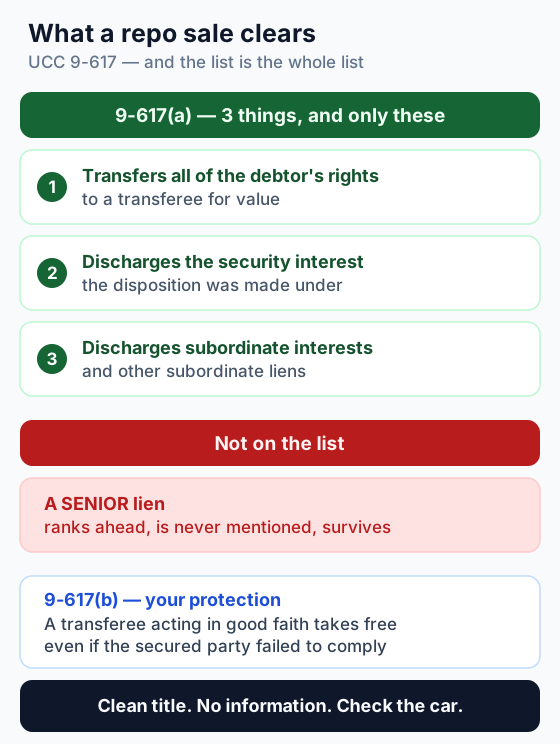
When a lender repossesses a car and sells it, the sale is governed by Article 9 of the Uniform Commercial Code, adopted in every state. The section that decides what you receive is 9-617, and it is unusually readable for a statute. A disposition of collateral after default does three things:
| UCC 9-617(a) says the sale — | What that means to you |
|---|---|
| Transfers to a transferee for value all of the debtor's rights in the collateral | You step into whatever ownership the borrower had. Not more, and not less |
| Discharges the security interest under which the disposition is made | The loan that caused the repossession is gone from the car |
| Discharges any subordinate security interest or other subordinate lien | Anything that attached after that loan — a second lienholder — is gone too |
Read as a buyer, that is a strong package. The debt that produced the repossession cannot follow the car to you, and neither can anything that ranked behind it. It is also a complete list, and completeness is what makes the next section matter.
The lien that survives the sale
Look again at the third item. It discharges any subordinate security interest or other subordinate lien. The word is doing real work. A lien that ranks ahead of the one the sale was made under is not discharged, is not mentioned, and is not affected by the disposition at all.
That is not a hypothetical. It arises whenever a car carries an earlier registered interest than the loan the repossessing lender holds — a first lienholder where the repossessing party is second, or a statutory lien with priority, such as one a repair shop or a taxing authority may hold in some states. If a senior interest exists, it survives, and the holder can look to the car.
Good faith is what protects your title
The second half of the section is the buyer’s protection, and it is broader than most people expect. Under 9-617(b), a transferee that acts in good faith takes free of the rights and interests described above even if the secured party fails to comply with this division or the requirements of any judicial proceeding.
Read that carefully, because it settles the question buyers worry about most. If the lender repossessed badly — insufficient notice, a sale that was not commercially reasonable, a procedural failure of almost any kind — your title is still good, provided you acted in good faith. The borrower is not left without a remedy; their remedy runs against the lender. It does not run against the car in your driveway.
Good faith is the condition, and it is not a formality. A buyer who knows the sale is irregular, or who is party to an arrangement designed to strip the borrower, is not acting in good faith. For an ordinary purchaser at an ordinary auction it is not a difficult standard to meet.
The protections in the statute are not yours
This is the most consistently misread part of buying a repossessed car, and getting it right changes how you approach the sale.
UCC 9-610(b) requires that every aspect of a disposition of collateral — the method, manner, time, place and other terms — be commercially reasonable. UCC 9-611 requires the secured party to send a reasonable signed notification of disposition to the debtor and any secondary obligor before selling. These sound like consumer protections attached to the sale, and in a sense they are. They are simply not owed to you.
| The duty | Who it is owed to |
|---|---|
| Commercially reasonable disposition — 9-610(b) | The debtor and other parties with an interest in the collateral |
| Signed notification before the sale — 9-611 | The debtor and any secondary obligor |
| Correct application of the proceeds — 9-615(a) | The debtor, and junior claimants who have made a demand |
| Clean title despite the lender's failures — 9-617(b) | You, the good-faith transferee |
The practical consequence is simple. You cannot complain that the auction was badly run or that the price was low, because those duties protect the borrower against a lender who dumps collateral cheaply. What you get instead is the last row: your purchase stands even when those duties were breached. It is a good trade, but it means every question about the car — as opposed to the sale — is entirely yours to answer.
Where the money goes, and why a buyer should care
UCC 9-615(a)sets the order in which the cash proceeds are applied: first the reasonable expenses of retaking, holding, preparing for disposition, processing and disposing — including reasonable attorney’s fees where the agreement provides for them — and then the obligation secured by the interest the disposition was made under.
That ordering explains the pricing you see. The lender is not trying to achieve market value; it is trying to extinguish a debt while covering its costs, and once those two are met, further price achieves nothing for it. A borrower usually remains liable for any shortfall, which is why these cars are priced to move rather than priced to compete.
There is a second half to that section which explains the seller’s incentives exactly. Under 9-615(d), once the expenses and the secured obligation are paid, the secured party shall account to and pay the debtor for any surplus, and the obligor is liable for any deficiency. So every dollar above the payoff figure goes to the borrower, and every dollar below it stays a debt the borrower owes.
For a buyer that is unusually clarifying. The lender has no financial interest in achieving more than the payoff plus its costs, because the excess is not theirs to keep. It has a strong interest in not falling short, because a deficiency has to be chased. The number the seller is actually working toward is a payoff figure you cannot see — which is why offers near it are accepted quickly and offers below it stall for reasons that have nothing to do with the car.
The buyer’s conclusion is not that the car is a bargain. It is that the discount is structural rather than informational — it exists because of how the sale is required to work, not because the seller knows something bad about the car. That is genuinely different from a cheap private sale, where a low price usually is information.
The borrower can take the car back — right up to a specific moment
There is a step between repossession and sale that buyers are rarely told about, and it can remove a car you thought you had bought. Until the lender disposes of the vehicle, the borrower has a statutory right to get it back.
UCC 9-623 gives a debtor, any secondary obligor, and any other secured party or lienholder the right to redeem the collateral. Redemption is not a matter of catching up the missed payments. The person redeeming has to tender both fulfillment of all obligations secured by the collateral and the reasonable expenses and attorney’s fees the lender is entitled to under 9-615(a)(1) — the whole debt, plus the cost of taking and storing the car. That is why redemption is uncommon, and it is also why it is not impossible: a borrower who has been waiting on a refinance, an insurance payout or a family loan can suddenly clear it.
The part that concerns you is the deadline. Under 9-623(c), redemption may occur at any time before the secured party has collected the collateral, disposed of it, or entered into a contract for its disposition, or accepted it in satisfaction of the obligation. That third item is the one that protects a buyer: the right to redeem is cut off when the contract for sale is made, not when you collect the car or when the title is transferred.
| Stage | Can the borrower still redeem? |
|---|---|
| Car repossessed, not yet listed | Yes — the whole debt plus expenses |
| Listed, viewings happening, no contract | Yes, and your interest in it changes nothing |
| Contract for disposition entered into | No — 9-623(c)(2) cuts the right off here |
| Delivery and payment completed | No, and 9-617(b) protects your title besides |
Condition: the part no statute helps with
Nothing in Article 9 says anything about whether the car runs. A repossession is a financial event, so the fact of it tells you nothing mechanical — which is the honest version of the reassurance often given on this subject. The dishonest version is that repossessed cars are therefore just normal used cars.
The realistic middle is this: a car goes through a period of ownership under financial pressure before it is taken, and deferred maintenance is the first economy most people make. Add a storage period, often outdoors, and frequently no opportunity to test drive. None of that is disclosed to you, and none of it is a defect in the sale.
- Assume deferred servicing rather than abuse — the pattern is neglect, not damage
- Budget for fluids, filters, belts, brakes and a battery as a baseline, not as a surprise
- Treat a car that has stood outside for months as needing tires and brakes inspected before highway use
- Check for a title brand separately, because repossession and a brand are unrelated events that can both be true
- Where a test drive is not offered, price the unknown rather than assuming the best
Where repossessed cars are actually sold
- 1Credit union and bank salesOften the most transparent route, because the seller holds the paperwork and is not a reseller. The vehicle is usually still titled to the lender, and the story of the lien is easy to establish.
- 2Public auto auctionsMixed inventory, with repossessions alongside fleet and trade-in cars. Inspection time is short and terms are as is, so the record checks matter more than usual.
- 3Dealer lots that buy repossession inventoryCheapest to buy from in effort and most expensive in margin. The dealer has already done the checks you are about to do and priced accordingly.
- 4Government and municipal disposalsA different animal — usually seizure or fleet disposal rather than a secured party's disposition — so the Article 9 analysis above may not apply at all. Read the terms rather than assuming.
The checks worth running before you bid
Because the statute hands you a clean title and no information, the useful work is all on the vehicle side. In order of what they rule out per minute spent:
- An independent lien check — the senior lien is the one legal risk the sale does not remove
- Open safety recalls, which are free to check and free to fix at a franchised dealer
- A title brand check, since salvage, flood or odometer brands are unaffected by a repossession
- The federal title record, for the ownership and brand history the seller cannot summarize for you
- A physical inspection focused on standing damage — tires, brakes, fluids, battery, rodent damage
Our free decode covers the factory build, specifications and open safety recalls for any VIN, which settles the recall question before you travel. It does not include title, lien or ownership history, and full vehicle history reports are launching soon — for the lien question today, the routes on our lien check guide are what to use.
Run the VIN before the auction
Decoded from official manufacturer and NHTSA records
When to walk away
Most of these are not judgment calls. A repossession sale hands you a title the statute protects and no information whatsoever about the vehicle, so the walk-away triggers are the ones where information is missing and cannot be obtained before you commit money.
- A senior lien you cannot get a clear answer about — this is the one that survives the sale
- A seller who cannot say which party held the security interest the sale was made under
- A title brand the listing did not mention, whatever the explanation offered
- A price that is not actually a discount once the deferred maintenance is priced in
- Any pressure to complete before you have run checks that take ten minutes and cost nothing
- A car you cannot start, on a lot that will not let you start one — a stood engine is the single most common expensive surprise here
Where this information comes from
- UCC 9-617 — rights of transferee (California Commercial Code 9617)What a disposition transfers and discharges, and the good-faith transferee protection
- UCC 9-610 — disposition of collateral after defaultThe commercially reasonable requirement, in every aspect of the disposition
- UCC 9-611 — notification before dispositionWho the secured party must notify, and who is absent from that list
- UCC 9-623 — right to redeem collateralWho may redeem, what they must tender, and the moment the right is cut off
- UCC 9-615 — application of proceedsExpenses first, then the secured obligation — the reason these cars are priced to move
Keep reading
Frequently asked questions
Does buying a repossessed car clear the loan on it?
It clears the loan the sale was made under, and any lien junior to it. UCC 9-617(a) says a disposition after default transfers all of the debtor's rights, discharges the security interest the disposition is made under, and discharges subordinate security interests and liens. A senior lien is not on that list and is not discharged.
Can the previous owner get the car back from me?
Not ordinarily. Under UCC 9-617(b) a transferee who acts in good faith takes free of the discharged interests even if the secured party failed to comply with the rules for the sale. The borrower's remedy for a botched repossession is against the lender, not against your title.
Do I get any protection from the commercially reasonable requirement?
No, and this is the most misread part. UCC 9-610(b) requires every aspect of the disposition to be commercially reasonable, and 9-611 requires notification to the debtor and any secondary obligor. Those duties are owed to the borrower. A buyer is not among the persons entitled to notification, and a low price is not a defect you can complain about.
Are repossessed cars sold as is?
Almost always. Repossession says nothing about mechanical condition — the car was taken for missed payments, not for a fault — but it does mean a period with an owner under financial pressure, when maintenance is usually the first thing deferred. Nothing in the law gives you a warranty, so an inspection matters more here, not less.
How do I check a repossessed car before buying it?
Run the VIN for open safety recalls and the factory build, check for a title brand, and check for a lien independently rather than relying on the seller's paperwork. The lien check is the one that matters most here, because a senior lien survives the sale and would follow the car to you.
Two free checks before the bidding starts
Decode any VIN free for the factory build, specifications and open safety recalls. No account, no card. Full vehicle history reports are launching soon.
Run a free VIN check