The short answer
- What does a Kelley Blue Book VIN lookup actually do?
- It resolves which vehicle you have — trim, engine and drivetrain — so the valuation starts from the right car. It cannot supply mileage, condition or location, which is why the form asks for all three next.
- Who owns Kelley Blue Book?
- Cox Automotive, part of Cox Enterprises. The same parent owns Autotrader, Dealertrack, vAuto and Manheim, the world's largest wholesale vehicle marketplace.
- What does no blue book value include?
- Whether that specific VIN has an unrepaired safety recall. Recalls attach to the vehicle, not the model, and no valuation tool asks the question.
Cox
Who owns KBB
Cox Automotive, part of Cox Enterprises
Manheim
Same owner
Largest wholesale marketplace
Trim
What the VIN settles
Before mileage and condition
6
Quarters of recall reporting
49 CFR 573.7, then it ends
What the book actually is
Kelley Blue Book publishes estimated values for vehicles based on observed transactions, adjusted for mileage, condition, options and geography. It is the consumer-facing reference in American car buying, to the point where people say “blue book value” as a generic term the way they say a brand name for a tissue.
That familiarity is worth pausing on, because a name people treat as a neutral standard is in fact a commercial product published by a company with substantial interests elsewhere in the car business.
What a Kelley Blue Book VIN lookup actually does
Most people arrive at a blue book value by VIN expecting the seventeen characters to produce a price. They do not, and it is worth being precise about where the number actually comes from, because the distinction changes how much weight the output deserves.
A KBB VIN lookup performs one job well: it identifies the vehicle. The VIN is a factory identifier, and decoding it resolves the make, the model year, the body style, the engine and, on most vehicles, the trim and drivetrain. That is the part of the valuation you can get exactly right, and it is the part sellers most often get wrong from memory.
Everything that follows is supplied by you. The mileage is typed in. The condition is chosen from a menu. The location is a ZIP code. None of those three are encoded anywhere in the VIN, and all three move the output more than the trim does. So the honest way to describe a blue book VIN lookup is that it removes one source of error — the wrong car — and leaves the other three sources entirely in your hands.
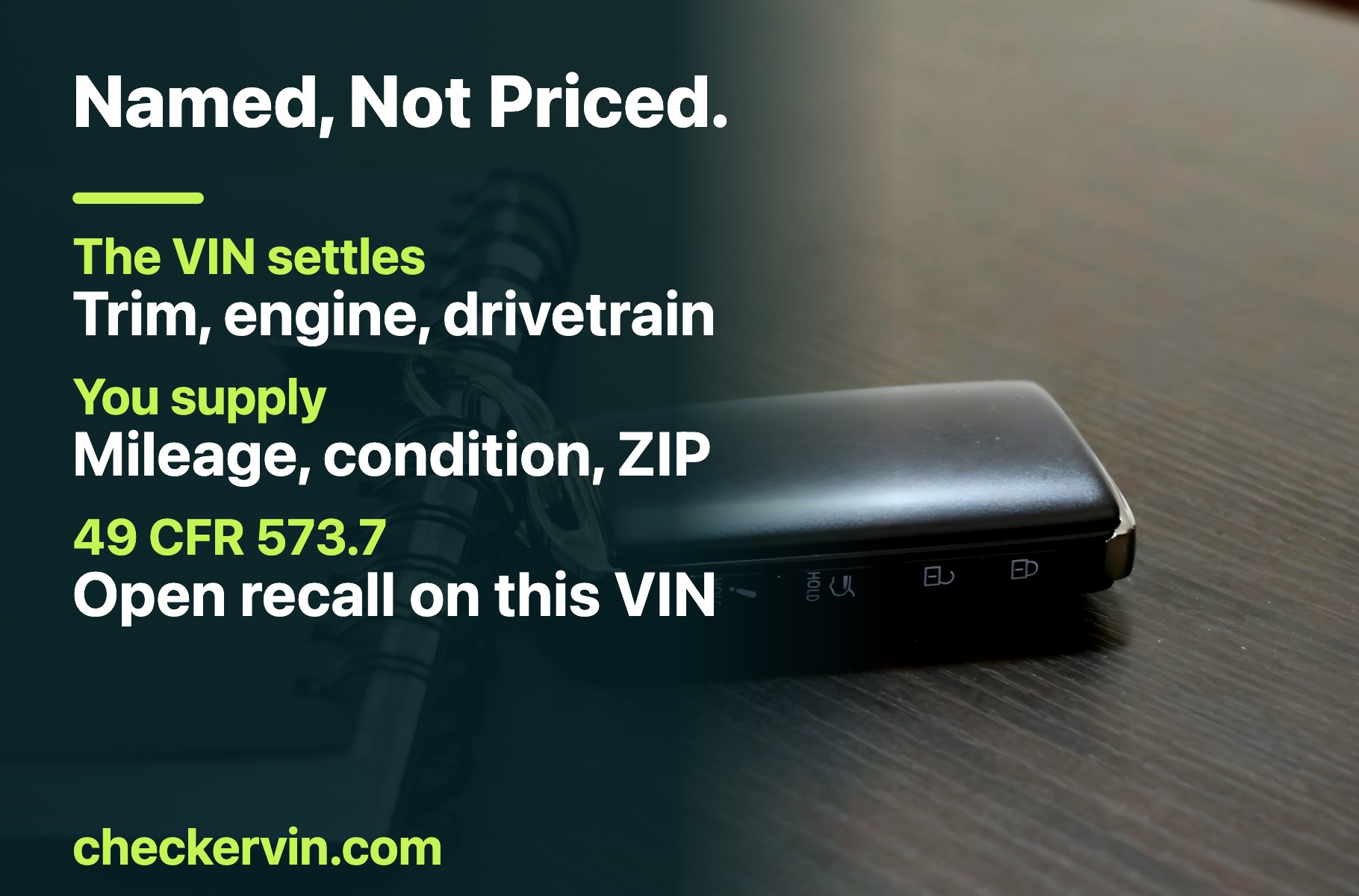
This also explains a common frustration. Two people run the same VIN, get different numbers, and assume one of the tools is broken. Neither is. They graded the condition differently, or they are in different markets, and the VIN they share was never the part of the calculation that disagreed.
Who owns it
Cox Automotive owns Kelley Blue Book. Cox Automotive is a subsidiary of Cox Enterprises, a privately held company based in Atlanta.
The same group holds Autotrader, Dealertrack, vAuto, NextGear Capital and Manheim. That is a listings marketplace, dealer software, inventory management, floorplan financing and wholesale auctions — most of the machinery a dealership touches, under one roof.
The book and the auction have one owner
Manheim is the largest wholesale vehicle marketplace in the world. It is where dealers buy and sell cars between themselves, and it is where a very large share of the real price discovery in the used car market happens.
So the reference a private seller consults and the marketplace that sets wholesale prices are parts of the same business. Neither fact is hidden; both are simply absent from the conversation when somebody says they checked the blue book.
Why it matters when you are the one selling
A private seller and a dealer come to the same number from opposite directions. You are asking what your car is worth. The dealer is asking what it will make at wholesale after reconditioning, and they have far better information about that than you do.
Knowing that the consumer book sits inside the group that runs the wholesale market reframes the negotiation honestly: you are not two parties consulting a neutral referee. You are one party with a published estimate and one party with operational visibility of the actual market.
What the VIN contributes, and what it does not
Entering a VIN removes ambiguity about the vehicle itself. Within a single model line, engine, drivetrain and trim differences produce genuinely different values, and a seller describing the car from memory will not always get those right.
What the VIN does not carry is everything that happened after the factory. Mileage, condition, service history and location all have to be supplied separately, which is why the tool asks for them the moment the number is entered.
The condition grades, and the honest one
Condition selection moves the output more than most people expect, and almost everybody over-grades their own vehicle. The definitions are published; the discipline is in applying them to a car you are fond of.
- Read the written definition rather than picking by instinct
- Grade as the buyer would after a thorough walk around
- Assume anything you would mention as a flaw is one
- If two grades feel arguable, model both and take the range
The open recall no valuation asks about
There is one fact about a specific vehicle that changes what it is worth, is free to establish, and is absent from every valuation form in the country: whether the car has a safety recall that was never repaired.
Recalls attach to the vehicle, not to the model. Two cars built the same week can differ, because a campaign covers a production range and because one owner responded to the notice and the other did not. That is precisely the kind of vehicle-specific fact a VIN can answer and a model-level average cannot.
The federal system is unusually well documented here. Under 49 CFR 573.6, a manufacturer must report a safety defect to NHTSA within five working days of determining that one exists. From there, 49 CFR 573.7 requires quarterly reports on how the repair campaign is going — how many vehicles were involved, how many were inspected and repaired, and how many were inspected and found not to need repair. Those figures are cumulative totals, and they are due on April 30, July 30, October 30 and January 30.
The reason this matters to a valuation is simple. The car being priced is somewhere in those counts. It is either in the repaired column or it is not, and the blue book number is identical either way.
One detail in the rule is easy to skim past and worth keeping. Section 573.7(b)(4) asks for two separate figures, not one: the number of vehicles inspected and repaired, and the number inspected and determined not to need repair. A campaign can therefore close with a high completion figure partly because a lot of the vehicles turned out not to need the remedy, which is a good outcome and a different one from a fleet that was fixed. Section 573.7(c) then requires both figures to be reported as cumulative totals rather than as activity during the quarter.
For a buyer, the useful consequence of all that machinery is narrow but real. The remedy is performed at no charge to the owner, so an open recall on a car you are considering is not a repair bill. It is an appointment, and a reason to ask why the previous owner never made it.
Six quarters, and then the counting stops
The part of the rule worth reading closely is the duration. Section 573.7(a) requires the quarterly report for six consecutive quarters, beginning with the quarter in which the campaign started, or until corrective action has been completed on every affected vehicle, whichever comes first.
Six quarters is eighteen months. After that, the reporting obligation ends. The defect does not end, and neither does the recall — the remedy remains available and the vehicle remains unrepaired — but the quarterly accounting that told the public how many cars were still outstanding is no longer required.
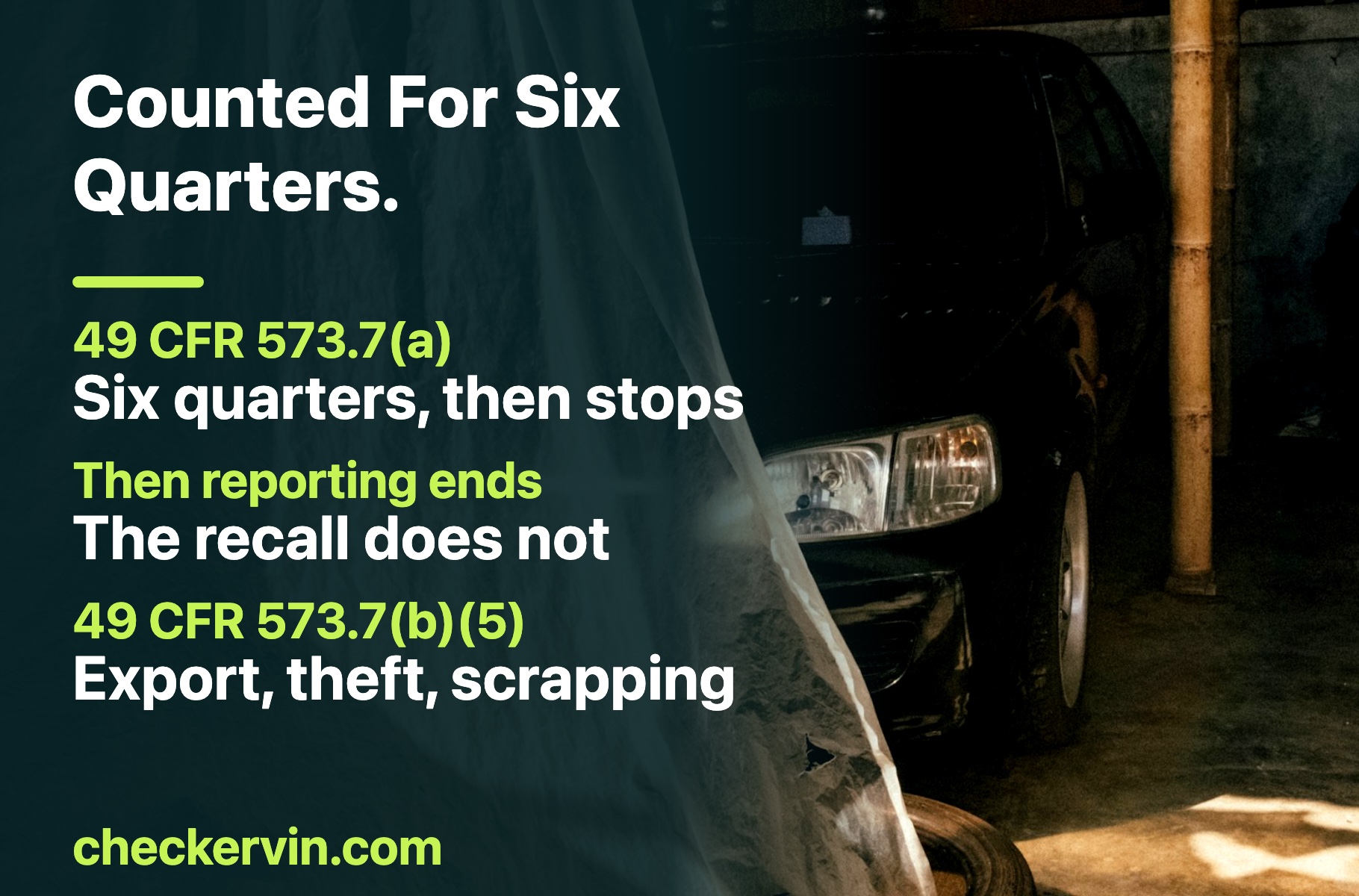
There is a second category in the same rule that says something plainer still. Section 573.7(b)(5) requires the manufacturer to report the number of vehicles “determined to be unreachable for inspection,” and it names the reasons: export, theft, scrapping, failure to receive notification, or other reasons, with the count broken out by category.
Read that as a used car buyer rather than as a regulator. The federal recall system has a formal, required line item for vehicles it cannot find, including cars whose owners never got the letter. A car in that line item is on the road, is for sale, and looks exactly like a car that was repaired. It will also return exactly the same blue book value.
The practical version is short. A recall lookup takes a VIN and returns whether anything is outstanding on that specific vehicle right now, independently of what quarter the campaign started in or whether the manufacturer is still filing reports on it. Run it before you agree a price rather than after, because an unrepaired campaign is a fact about the car you are buying and not a fact about the model you are researching.
None of this is a criticism of the valuation. A book estimates a market; it was never built to audit an individual vehicle. It is an argument for doing the vehicle-level check separately, because the two questions are genuinely different and only one of them is about your car.
What 73 model years actually carry
To give the point a size rather than a feeling, we counted the recall campaigns in the vehicle records we publish. Across 73 model years spanning 2008 to 2022, those records carry 613 separate recall campaigns, and every single one of the 73 has at least one.
The median vehicle carries seven campaigns. The spread is what should interest anyone pricing a car: the lightest record in the set is a 2013 Ford Edge with two campaigns, and the heaviest is a 2019 Ram 1500 with thirty. Both are ordinary, high-volume vehicles sold in the same decade, and a fifteen-fold difference in recall history sits entirely outside anything a year-make-model valuation can express.
The components those campaigns land on are not evenly spread either. Sorted by how many campaigns name them, the concentration is heavily weighted toward systems that only matter in a crash or a fire.
| Component named | Campaigns |
|---|---|
| Air bags | 89 |
| Electrical system | 84 |
| Power train | 56 |
| Seat belts | 38 |
| Fuel system, gasoline | 38 |
| Service brakes, hydraulic | 38 |
Air bags and seat belts together account for 127 of the 613 campaigns in the set. Those are the parts of a car a test drive cannot evaluate, a photograph cannot show and a condition grade does not cover. A vehicle can present as excellent on every axis a valuation measures while carrying an unrepaired restraint-system campaign.
A campaign count is not a quality score and should not be read as one. A vehicle with thirty campaigns whose owner completed all thirty is in better condition than one with two that were both ignored. That is exactly the point: the number that matters is not how many recalls the model had, but how many are still open on the VIN in front of you.
Against the lender's book
The other major reference in American vehicle valuation is the guide that carried the NADA name and now runs under J.D. Power. It is built for lenders, dealers, insurers and government agencies rather than consumers.
| Reference | Who it is built for |
|---|---|
| Kelley Blue Book | Consumers, published by Cox Automotive |
| J.D. Power, formerly NADA | Lenders, dealers, insurers and agencies |
| Auction results | The trade, and the closest thing to observed truth |
| A dealer's written offer | You, specifically, and it is binding on them |
When the two published books disagree, neither is malfunctioning. They were calibrated for different decisions.
Reading a range rather than a price
Every published value is a point estimate drawn from a distribution. Cars of the same year, model, mileage and nominal condition sell for materially different amounts depending on timing, presentation, location and who happened to be looking that week.
Treating the figure as a range rather than a price makes you a better negotiator in both directions. A seller who insists on the exact published number is arguing with a statistic, and a buyer who quotes the bottom of the range as though it were the value is doing the same thing in reverse.
Using it well
The sequence costs nothing and takes about ten minutes.
- 1Decode the VIN firstEstablish the exact trim and engine so the valuation starts from the right vehicle rather than an assumed one.
- 2Check for open recalls on that VINIt is free, it is vehicle-specific, and no valuation tool will ask you the question.
- 3Verify the mileage independentlyCheck the reading against recorded figures rather than accepting what a listing or a memory says.
- 4Grade the condition against the written definitionsThen grade it once more as though you were the buyer, and use the lower of the two.
- 5Read a second book before you decideThe spread between a consumer book and a lender's book is your realistic range.
Where the book stops
No published valuation has seen your car. It cannot know about the title brand, the unrepaired recall, the corrosion underneath or the service history that stops abruptly four years ago.
Those are found by checking records and by inspecting the vehicle, and on any specific car they will move the price further than the difference between one book and another.
Our own free check returns the factory build, the specifications and open recalls, and publishes no valuation of any kind. What it does is confirm the vehicle you are pricing is the vehicle you think it is — the assumption every valuation tool silently makes.
Where this information comes from
- 49 CFR 573.7 — quarterly reportsSix consecutive quarters, and the required count of vehicles unreachable for inspection
- 49 CFR 573.6 — defect and noncompliance information reportThe five-working-day deadline that starts a recall campaign
- NHTSA vPIC — public VIN decoderEstablishes the exact trim and engine any valuation has to start from
- NHTSA — odometer fraudWhy the mileage figure underneath a valuation deserves corroboration
- FTC — buying a used carFederal consumer guidance covering dealer purchases and the Buyers Guide
Keep reading
Frequently asked questions
Who owns Kelley Blue Book?
Cox Automotive, which is part of Cox Enterprises. The same parent owns Autotrader, Dealertrack, vAuto and Manheim — the largest wholesale vehicle marketplace in the world.
Can I get a Kelley Blue Book value from the VIN alone?
No. A KBB VIN lookup pins down the exact trim and engine, which matters because closely related versions of one model can be worth noticeably different amounts. The valuation still needs mileage, condition and your location, because the VIN encodes none of them.
Does a blue book value account for open recalls?
No published valuation asks whether the car has an unrepaired safety recall, and the recall is attached to the specific VIN rather than to the model. Manufacturers report repair progress to NHTSA quarterly under 49 CFR 573.7, but that reporting is required for six quarters, not indefinitely.
Why is the KBB number different from what a dealer offers?
A published value is an estimate of a market. A dealer's offer is a commitment by one business that has looked at your specific car and has to resell it. The gap between them is reconditioning, risk and margin, and it is normal rather than a sign of a bad offer.
Which valuation should I trust?
Read at least two and treat the spread as your range. A consumer book and a lender's book are calibrated for different decisions and different transaction sets, so agreement between them would be more surprising than disagreement.
Confirm the vehicle before you price it
Enter the VIN for the factory build, the specifications and any open safety recall on that exact vehicle. Free, and no account needed.
Run a free VIN check