The short answer
- What fees does IAAI charge a buyer?
- A buyer fee that rises with the sale price, a live online or proxy bid fee if you win online, a $105 service fee and a $20 title-handling fee, plus storage, an EH&S and fuel surcharge and payment-method fees where they apply.
- How much on a typical car?
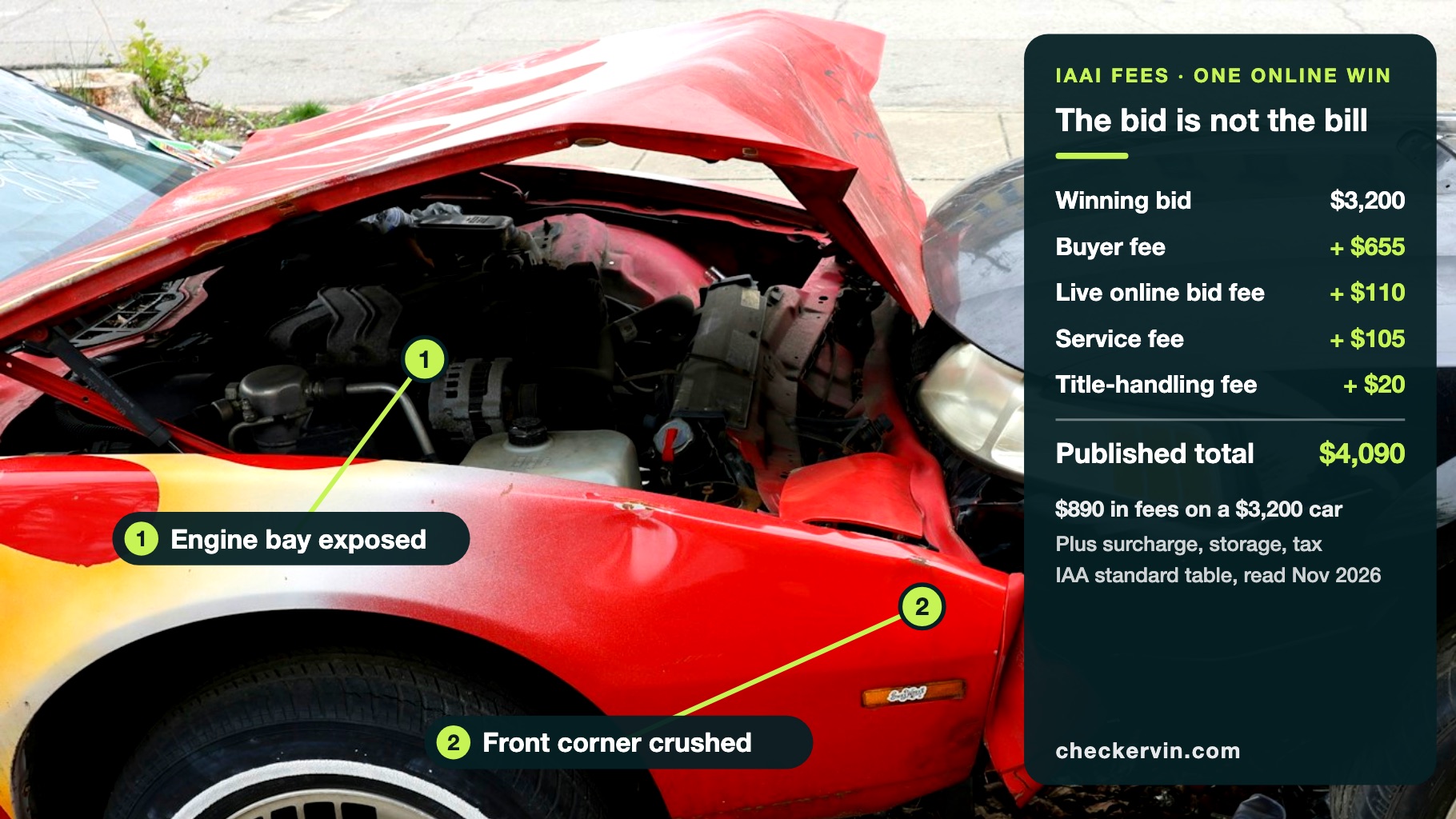
- On IAA's standard table, a $3,200 live online win carries $890 in published fees, 28% of the bid. Cheaper cars carry a far larger share.
- What does membership cost?
- $225 a year for a Public or Licensed Business account, per IAA's help center (read November 25, 2026). It is non-refundable.
$655
Buyer fee on a $3,200 car
IAA standard and non-licensed table
7.5%
Buyer fee from $15,000 up
A flat fee per band below that
$225
Yearly membership
Public or Licensed Business account
$125
Service plus title handling
Per vehicle, effective October 1, 2026
The short answer
IAA charges a buyer fee on every vehicle it sells. On its standard schedule the fee is a flat amount set by sale-price band, from $25 on the cheapest lots to $1,000 on cars between $10,000 and $14,999.99, and 7.5% of the sale price from $15,000 up. Win online and a second fee is added; since October 1, 2026 every purchase also carries a $105 service fee and a $20 title-handling fee.
The fees are regressive. On a $500 parts car the published fees come to 79% of the bid; on a $16,000 car, 9%. That is the single most useful thing to know before setting a maximum bid, and the reason this page works the numbers out rather than just listing them.
Every fee line on an IAA invoice, explained
IAA’s help center lists four fee schedules (licensed, non-licensed, heavy vehicle and Rec Rides) and says a buyer fee is charged for each vehicle sold, with other fees such as internet and service fees on top. Its Auction Rules add the rest. Here is what each line is for, in the order it lands on the bill:
| Fee line | What IAA says it is |
|---|---|
| Buyer fee | Charged on each vehicle sold, by sale-price band; may vary by facility |
| Live online bid fee or proxy bid fee | Applies when the vehicle is awarded on a successful internet bid; the Auction Rules call it an Online Bidding Fee on vehicles bought online from a live auction |
| Service fee | $105 per unit for handling: imaging, pull-out and/or loading, as IAA decides |
| Title-handling fee | $20 on all purchases |
| Premium imagery set fee | $10 per unit, only on eligible vehicles with a Premium Imagery Set |
| EH&S and fuel surcharge | Helps cover energy, fuel, utility, waste and fluid-handling costs; IAA says it is not a government tax. No amount is printed on the fee page |
| Storage | Per day, per vehicle, once the branch's pickup window passes; rates are set by branch |
| Payment-method fees | A convenience fee may apply to credit cards and some electronic payments; returned checks carry an NSF fee |
| Registration (membership) fee | $225 a year, per account, not per car |
Heavy vehicles (a gross vehicle weight rating of 10,001 lbs. and up) and Rec Rides have their own schedules, which this page does not cover. Everything below is the standard schedule for cars, SUVs and light trucks.
The IAA buyer fee schedule, band by band
This is IAA’s standard buyer fee table, effective November 4, 2024 and read on November 25, 2026. It is the table IAA publishes for non-licensed (public) buyers, and on that date it matched the standard-volume table for licensed buyers row for row. The sale price is the winning bid; the fee is added on top.
| Sale price | Buyer fee |
|---|---|
| $0 to $49.99 | $25 |
| $50 to $99.99 | $45 |
| $100 to $199.99 | $80 |
| $200 to $299.99 | $130 |
| $300 to $349.99 | $137.50 |
| $350 to $399.99 | $145 |
| $400 to $449.99 | $175 |
| $450 to $499.99 | $185 |
| $500 to $549.99 | $205 |
| $550 to $599.99 | $210 |
| $600 to $699.99 | $240 |
| $700 to $799.99 | $270 |
| $800 to $899.99 | $295 |
| $900 to $999.99 | $320 |
| $1,000 to $1,199.99 | $375 |
| $1,200 to $1,299.99 | $395 |
| $1,300 to $1,399.99 | $410 |
| $1,400 to $1,499.99 | $430 |
| $1,500 to $1,599.99 | $445 |
| $1,600 to $1,699.99 | $465 |
| $1,700 to $1,799.99 | $485 |
| $1,800 to $1,999.99 | $510 |
| $2,000 to $2,399.99 | $535 |
| $2,400 to $2,499.99 | $570 |
| $2,500 to $2,999.99 | $610 |
| $3,000 to $3,499.99 | $655 |
| $3,500 to $3,999.99 | $705 |
| $4,000 to $4,499.99 | $725 |
| $4,500 to $4,999.99 | $750 |
| $5,000 to $5,499.99 | $775 |
| $5,500 to $5,999.99 | $800 |
| $6,000 to $6,499.99 | $825 |
| $6,500 to $6,999.99 | $845 |
| $7,000 to $7,499.99 | $880 |
| $7,500 to $7,999.99 | $900 |
| $8,000 to $8,499.99 | $925 |
| $8,500 to $9,999.99 | $945 |
| $10,000 to $14,999.99 | $1,000 |
| $15,000 and up | 7.5% of the sale price |
Two things in the shape of that table matter when you bid. The bands are narrow at the low end, $50 wide at first, and a bid that crosses a band edge by a dollar pays the higher fee: a car at $999 carries a $320 buyer fee, and one at $1,000 carries $375. And the $10,000 band runs all the way to $14,999.99, so the fee is flat there before switching to a percentage. If your ceiling sits just over a band edge, bidding one increment lower can save more than the increment.
Live online bid fee vs proxy bid fee
Most buyers who are not standing in the lane win online, and IAA charges for that. Its table splits the internet fee in two: a proxy bid fee when your pre-set maximum wins, and a live online bid fee when you win by bidding in real time. Both are effective November 4, 2024; the same figures appear for licensed and non-licensed buyers.
| Sale price | Internet fee |
|---|---|
| $0 to $99.99 | Proxy bid $0 · Live online bid $0 |
| $100 to $499.99 | Proxy bid $40 · Live online bid $50 |
| $500 to $999.99 | Proxy bid $55 · Live online bid $65 |
| $1,000 to $1,499.99 | Proxy bid $75 · Live online bid $85 |
| $1,500 to $1,999.99 | Proxy bid $85 · Live online bid $95 |
| $2,000 to $3,999.99 | Proxy bid $100 · Live online bid $110 |
| $4,000 to $5,999.99 | Proxy bid $110 · Live online bid $125 |
| $6,000 to $7,999.99 | Proxy bid $125 · Live online bid $145 |
| $8,000 and up | Proxy bid $140 · Live online bid $160 |
A proxy bid is cheaper in every band above $100: on our $3,200 example the gap is $10. IAA’s Auction Rules explain how a proxy works: you set a maximum, the system bids for you only as much as needed to win or meet the reserve, and if the seller counters within your maximum the system can accept the counteroffer for you. That last point is worth knowing before you set a high proxy. A tie between a proxy bid and a live bid goes to the live bidder.
Flat fees effective October 1, 2026
Both of IAA’s standard fee pages carry a block of per-vehicle charges under the heading “Effective October 1, 2026.” These do not change with the sale price, so they weigh most on cheap lots:
- Service fee: $105 per unit for handling, including imaging, pull-out and/or loading. IAA notes some vehicles, such as heavy equipment, cannot be loaded by it
- Title-handling fee: $20 on every purchase
- Premium imagery set fee: $10, only on eligible vehicles that include a Premium Imagery Set
- EH&S and fuel surcharge: listed, but no amount is printed. Ask the branch or check the Cost Calculator
- Storage: per day, by branch. IAA tells buyers to check with the local branch, and the Branch Details page lists it
Because the surcharge has no published figure, every total on this page is labeled “published fees” and leaves it out. Treat it as a known unknown and leave room for it in your ceiling.
A worked example: a $3,200 car won online
A public buyer wins a car at $3,200by bidding live online, pays on time and collects within the branch’s free window, so no storage accrues. The lot has no premium imagery set. Using IAA’s standard tables:
| Line | Amount |
|---|---|
| Winning bid | $3,200 |
| Buyer fee | $655 |
| Live online bid fee | $110 |
| Service fee | $105 |
| Title-handling fee | $20 |
| Published total | $4,090 |
That is $890 in fees, 28%on top of the bid, before the EH&S and fuel surcharge, any card convenience fee, sales tax where it is collected, transport from the yard, and your state’s title and registration charges. Had the same car been won on a proxy bid, the internet line would fall to $100 and the total to $4,080. The yearly $225 membership sits outside the per-car bill; if this is the only car you buy this year, it is a real part of the cost.
How IAA fees scale with the sale price
Run the same arithmetic at five sale prices, each won with a live online bid, and the pattern is plain. The fixed lines and the minimum band fees dominate cheap lots; above $15,000 the percentage takes over and the share settles.
| Winning bid | Published fees |
|---|---|
| $500 | Buyer fee $205 + live bid $65 + flat $125 = $395 in fees (79% of the bid) |
| $1,500 | Buyer fee $445 + live bid $95 + flat $125 = $665 in fees (44% of the bid) |
| $3,200 | Buyer fee $655 + live bid $110 + flat $125 = $890 in fees (28% of the bid) |
| $8,000 | Buyer fee $925 + live bid $160 + flat $125 = $1,210 in fees (15% of the bid) |
| $16,000 | Buyer fee $1,200 + live bid $160 + flat $125 = $1,485 in fees (9% of the bid) |
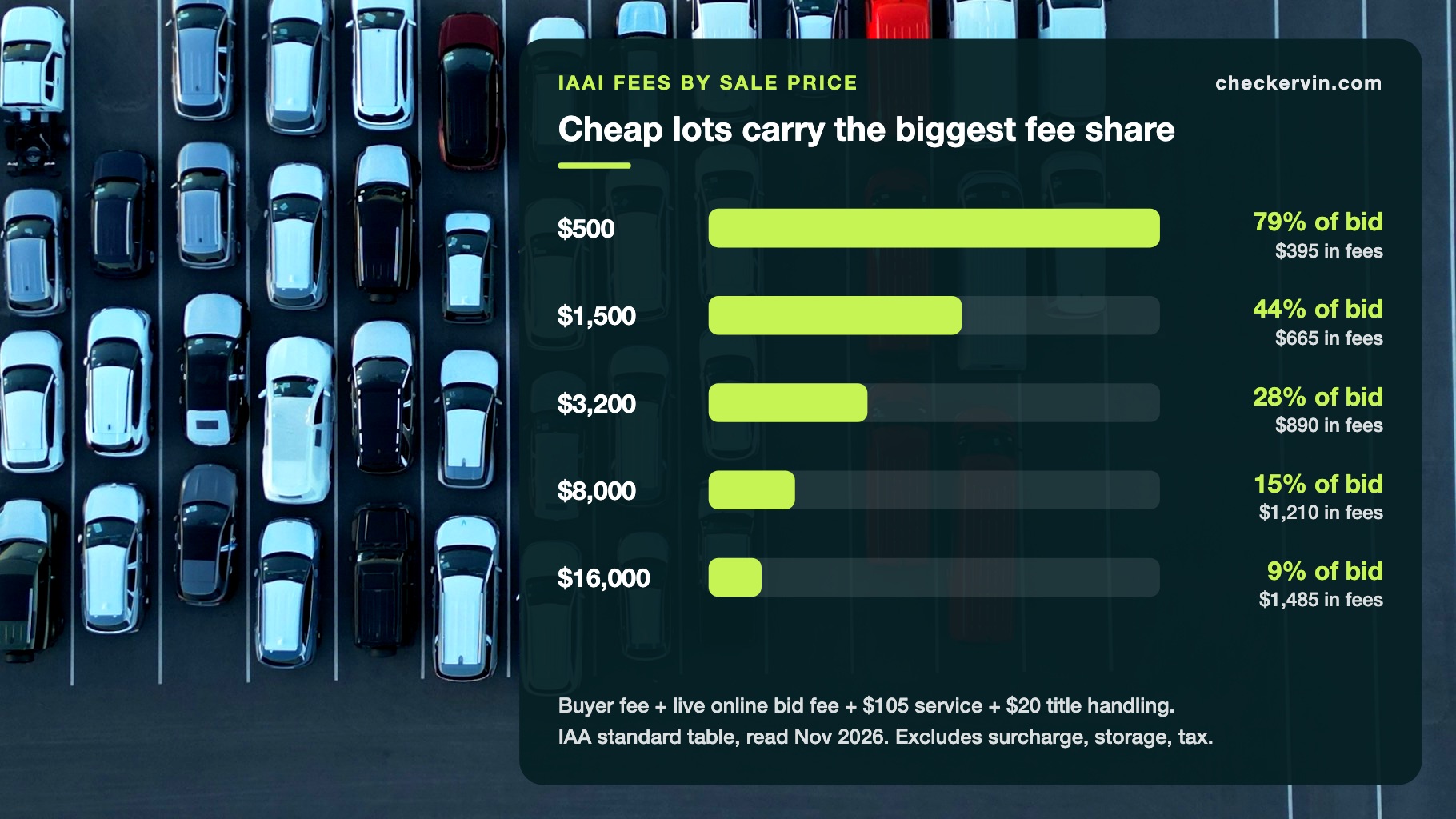
For a buyer chasing a cheap parts car or a first project, that table is the case for doing the sum before bidding. A lot that looks like a bargain at $500 costs $895 in published charges alone, before it leaves the yard.
IAAI fee calculator: what IAA's Cost Calculator does, and doesn't, promise
IAA does run its own fee calculator. Its help center says registered buyers who are logged in can pre-calculate buyer fees for any vehicle from the IAA Cost Calculator, in the Bid Information box on the Vehicle Information page. That is the right tool for a specific lot, because it knows the branch and the vehicle.
Read the fine print, though. IAA’s Auction Rules describe the Cost Calculator and its Estimated Repair Cost as estimates, “neither a quote nor offer of finance,” say there is no assurance the estimate is current or correct, and say buyers remain responsible for all required fees even if the calculator did not show them. In practice: use the calculator, then sanity-check it against the published tables above, and keep a screenshot with the lot number.
Third-party “IAAI fee calculators” also circulate. We do not use or link them, because a copied table goes stale the day IAA updates its own, and none of them can know a branch’s storage rate or the surcharge.
IAAI membership: the yearly registration fee
To bid on IAA inventory you need a paid account. IAA’s registration page says a $225 registration fee is required to bid on all IAA inventory, payable by credit card or PayPal (not debit card), and its help center gives the same figure as the yearly membership fee for both Public and Licensed Business accounts. Additional bidders can be added to a Licensed Business account at $100 each per year.
- Registration for IAA Gov Auctions (GSA inventory only) is free, with a GSAFleet.gov account and a card on file for extra services
- Membership renews automatically each year on the card on file; the Auction Rules let you cancel or turn off auto-renewal with 30 days' notice before the period ends
- Membership fees are non-refundable, even if a prospective buyer is not approved
- IAA's registration page mentions three membership tiers compared in a chart; the chart did not render as readable text for us, so we do not list them
Registration also asks for a government ID, proof of address if the ID lacks one, and, for a licensed account, the business license. Buyers outside the US can register as licensed only with an automotive-related business license.
Licensed vs public buyers: which schedule you pay
IAA sorts buyers by license. A non-licensed buyer pays the non-licensed schedule. A licensed buyer pays the standard-volume schedule unless it qualifies for high volume, which IAA reserves for buyers with a business license on file, 25+ units and $75,000+ in total sale price over the past 12 months, and fewer than 5 bidder accounts.
The surprise is that, on November 25, 2026, the non-licensed table and the standard-volume licensed table carried the same figures in every band. So for most individual buyers the license question is about access, not price: which lots you can bid on. The price difference shows up only at high volume:
| Sale price | Buyer fee by schedule |
|---|---|
| $1,500 | Standard or public $445 · High volume $315 |
| $5,000 | Standard or public $775 · High volume $650 |
| $12,000 | Standard or public $1,000 · High volume $875 |
| $20,000 | Standard or public $1,500 · High volume $1,200 |
IAA’s registration page adds one nuance: a business with a non-automotive license is usually limited to the same inventory as public buyers and is not tax-exempt, but is placed on the licensed fee structure. Ask IAA which schedule your account sits on before you assume.
IAAI public buyer: where you can buy without a broker
IAA defines public buyers as those without a qualifying business license, and lets them bid on vehicles available to the public. Which ones depends on state law. IAA’s public buyer eligibility table (help center article dated August 7, 2025) lists, state by state, the branches public buyers can use and the title types they can buy there. A few lines show the range:
| State | What IAA's table lists for public buyers |
|---|---|
| Michigan | Clear titles only |
| Utah | Clear titles only |
| Kansas | Salvage titles only |
| Texas | Salvage titles only, limited to 5 salvage vehicles per calendar year for in-state buyers |
| Tennessee | Salvage and rebuildable titles, limited to 5 vehicles over 365 days, with a disclosure form per stock number |
| Arizona, Indiana, North Carolina and others | Clear and salvage titles |
If your state does not permit public buying, IAA’s registration page says you will be asked to confirm you understand you cannot bid in your state and must find a broker, or to upgrade to a business account. Before bidding on any lot, open the Who Can Bid list in the Bid Information box on its vehicle page; it is the lot-level answer. GSA government inventory is open to public buyers in all states. Our salvage title guide explains what each title type lets you do once the car is yours.
Buying through a broker when the lot isn't public
When a lot is closed to public buyers, IAA points to its Find a Broker page. It splits brokers into Official Market Alliances, which run IAA auction centers in other countries, and Licensed Brokers, which IAA describes as experienced buyers able to help individuals and businesses buy practically any vehicle from any IAA auction. IAA’s public-buyer page says brokers can also help with payment, customs and shipping.
On November 25, 2026 the Licensed Brokers list included “Salvagebid Inc” under the United States; our SalvageBid reviewcovers how a broker purchase works and how its fee layers stack. The short version for this page: a broker’s own fee sits on top of every IAA fee above, because on IAA’s books the broker is the buyer. Get the broker’s schedule in writing and add it to the worked example before you bid.
IAAI Buy Now: how it works and what it costs
IAA Buy Now sells vehicles between auctions at a set price, with no bidding. IAA says a vehicle that did not sell at a live auction may become available through Buy Now, and that featured auctions such as Dream Rides, Rec Rides and EV auctions also offer Buy Now stock ahead of their events. You find Buy Now lots from the Auctions menu, the Featured Filters on the search page, or the Buy Now price shown above the current bid on a vehicle page.
- 1Hold a paid accountBuy Now is open to buyers with a paid Licensed Business or Public account. Check the Who Can Bid filter or the vehicle page for eligibility.
- 2Review the lotPrice, title information, damage details and photos. The same Auction Rules that govern an auction win govern a Buy Now sale.
- 3Confirm Buy NowIAA says this finalizes the purchase and cannot be canceled. The car moves to Won Vehicles on your dashboard.
- 4Pay and arrange pickupPay with an available IAA method, then collect or book transport before storage starts.
On fees, IAA’s pages say less than a Buy Now buyer would like. The Auction Rules charge a buyer fee on each vehicle sold and say they apply to Buy Now vehicles, so expect the buyer fee and the flat per-vehicle fees. The internet fee is defined as applying when a vehicle is awarded on a successful internet bid, and Buy Now is not a bid; we found no IAA page that says whether it applies. Open the Cost Calculator on the lot before you click, and note that the Buy Now price expires at 8 p.m. the day before the live auction. IAA also reserves the right to void a Buy Now sale made at an incorrect price.
Charges that start after the sale
The fee schedule covers the purchase. Late payment, renege, storage and cancellation charges kick in if the timeline slips, and our Bidcars reviewsets out IAA’s deadlines and those penalties from the Auction Rules, so we will not repeat them here. One detail that page does not cover: IAA’s public-buyer page says payment is due by 5 p.m. local branch time 2 business days after the award for US buyers and 4 business days after for non-US buyers, with daily storage once the limit passes.
Storage is the fee most buyers underestimate, because it is set per branch and per day and is not on the fee schedule. Look it up on the Branch Details page for the yard the car sits in, and book transport before you win, not after.
Check the VIN and the title record before you bid
Every fee above is owed once you win, whatever the car turns out to be. IAA’s Auction Rules tell buyers not to base a bid on the information IAA provides, including the VIN, mileage and title, and our auction history guide explains how a lot listing is produced. So the cheapest money in the whole purchase is what you spend checking the car before the fees attach.
CheckerVIN does not sell auction access and does not sell a title or accident history report today. What our free check returns now, with no account and no card:
- Factory build and specifications decoded from the VIN
- Factory warranty terms
- Open NHTSA safety recalls
- Photos filed against the VIN
- Market and listing prices
For an IAA bidder, the decode answers one question fast: does the lot description match the car the VIN belongs to? A listing that says one engine when the factory build says another is worth knowing before you pay $890 in fees on a $3,200 car.
Decode an IAA lot's VIN before you bid
Decoded from official manufacturer and NHTSA records
For title brands, odometer readings and total loss history across states, buy an NMVTIS report from one of the 12 providers the Department of Justice lists for consumers, as of November 25, 2026:
- Bumper.com
- Carsforsale.com
- Carvertical.com
- Checkthatvin.com
- Clearvin.com
- EpicVin.com
- GoodCar.com
- Titlecheck.us
- Vinaudit.com
- Vindata.com
- VinReport
- Vinsmart.com
The department says the list is alphabetical and implies no preference between providers. Our NMVTIS report guide explains what the federal record holds.
Before you bid at IAA: a fee-first checklist
- 1Confirm you can bid on the lotOpen the Who Can Bid list. If it is not open to public buyers in that state, price in a broker's fee too.
- 2Decode the VIN and check recallsMake sure the factory build matches the listing. Free, and it catches a mismatched lot before any fee attaches.
- 3Buy the NMVTIS title recordTitle brands, odometer and total loss history from a DOJ-listed provider, so you know what the title will say.
- 4Price the published feesBuyer fee for the band, live or proxy fee, service and title handling, and premium imagery if the lot has it.
- 5Add the unpublished onesThe EH&S and fuel surcharge, the branch's storage rate, transport, tax and your state's title costs.
- 6Set the maximum bid lastCeiling minus every fee. Prefer a proxy bid if it fits your plan; it carries the lower internet fee.
Where this information comes from
- IAA — Standard IAA Non-Licensed Buyer FeesRead November 25, 2026: buyer fee and internet/proxy fee tables effective November 4, 2024 (embedded as SVG images, read from the files the page links), and the flat fees effective October 1, 2026
- IAA — Standard IAA Licensed Buyer FeesRead November 25, 2026: standard-volume and high-volume tables, high-volume eligibility, internet/proxy fees and flat fees
- IAA — Auction RulesBuyer fee on each vehicle sold, online bidding fee, proxy and tie rules, Buy Now clause, Cost Calculator disclaimer, registration and payment-method fees
- IAA Help Center — Auction FeesThe four fee schedules, the heavy-vehicle threshold and where to find the Cost Calculator
- IAA Help Center — What is the registration fee?Yearly membership for Public and Licensed Business accounts, and the additional-bidder fee
- IAA — How to Register as an IAA BuyerRegistration fee, payment methods, free GSA registration, public vs licensed business types
- IAA — Auto Auctions Open to Public BuyersPublic buyer definition, brokers, payment deadlines for US and non-US buyers
- IAA Help Center — Public Buyer State by State EligibilityArticle dated August 7, 2025: branches and title types open to public buyers, Texas and Tennessee limits
- IAA — Find a BrokerMarket Alliances and Licensed Brokers; "Salvagebid Inc" listed under the United States on November 25, 2026
- IAA — IAA Buy NowHow Buy Now works, eligibility, the no-cancel rule and the price expiry
- NMVTIS — approved data providersDepartment of Justice list, consumer tier read November 25, 2026
- How we made this pageWritten by the CarCheckerVIN editorial team with AI assistance from NHTSA vPIC and other public records; facts checked November 2026. Fee figures are IAA's own, held in a table in the page's code with source and retrieval date, and every total is computed from it.
Keep reading
Frequently asked questions
How much are IAAI fees on a car?
It depends on the sale price and how you bid. On IAA's standard schedule (effective November 4, 2024, read November 25, 2026), a $3,200 car won with a live online bid carries a $655 buyer fee, a $110 live online bid fee, a $105 service fee and a $20 title-handling fee: $890 in fees before storage, tax, transport and an environmental and fuel surcharge whose amount IAA does not publish on that page.
Is there an IAAI fee calculator?
Yes. IAA says registered buyers who are logged in can pre-calculate buyer fees from the IAA Cost Calculator on each Vehicle Information page. Its Auction Rules also say the calculator is an estimate, not a quote, and that buyers remain responsible for all required fees even if the calculator did not show them. The worked example on this page uses IAA's published tables, so you can check the arithmetic yourself.
How much is an IAAI membership?
IAA's help center and registration page put the yearly membership fee for Public and Licensed Business buyer accounts at $225, with additional bidders on a Licensed Business account at $100 each per year. Registration for IAA's GSA-only government inventory is free. The Auction Rules say membership renews automatically unless canceled and that membership fees are non-refundable.
Can a public buyer buy at IAAI without a dealer license?
In some states and on some lots. IAA's public buyer table lists which branches public buyers can use and which title types they can buy there, and a few states add limits: Texas public buyers are capped at 5 salvage vehicles per calendar year. The Who Can Bid list on each vehicle page says whether that lot is open to the public. Where it is not, IAA points public buyers to a licensed broker.
How does IAAI Buy Now work?
Buy Now lets a buyer with a paid Licensed Business or Public account purchase a vehicle at a set price between auctions instead of bidding. Clicking Confirm Buy Now finalizes the purchase, and IAA says it cannot be canceled. The Buy Now price expires at 8 p.m. the day before the live auction, and IAA's Auction Rules apply to Buy Now vehicles the same as auction wins.
Do public buyers pay higher fees than licensed buyers at IAA?
Not on the standard table, when we read it. On November 25, 2026 IAA's non-licensed buyer fee table and its standard-volume licensed table carried identical rows. The difference appears only on the high-volume schedule, which IAA reserves for licensed buyers with 25+ units and $75,000+ in purchases over 12 months, among other conditions.
Check the VIN before the fees attach
Decode any VIN free for the factory build, specifications, warranty and open safety recalls. No account, no card. Full vehicle history reports are launching soon.
Run a free VIN check