The short answer
- What is SalvageBid?
- A broker for salvage-auction cars. "Salvagebid Inc" is listed on IAA's Find a Broker page as a U.S. licensed broker, so a buyer without a dealer's license can bid on IAA vehicles through it.
- Is it legit?
- IAA lists it by name, which is a fact you can check. Its own fees and terms we could not read, because salvagebid.com blocked our requests, so read them yourself before you pay a deposit.
- What should I do before bidding?
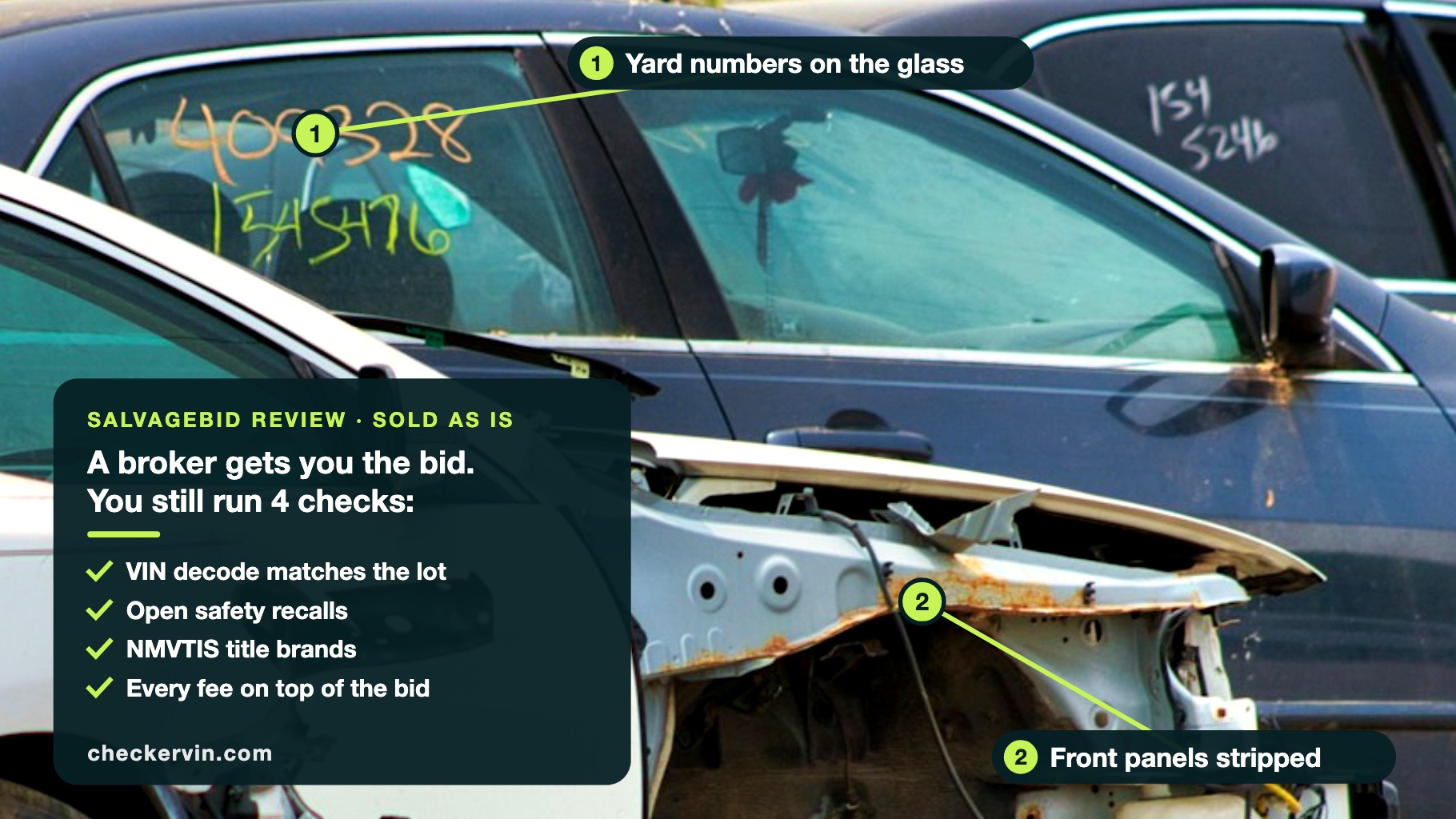
- Decode the VIN, check open recalls, and buy an NMVTIS title record from a Department of Justice-listed provider. The auction disclaims its own listing, VIN and title fields included.
Listed
SalvageBid on IAA's Find a Broker page
Read November 2026
3 days
IAA's payment window
Business days, auction day included
5
Indicators in an NMVTIS title report
DOJ program page
12
DOJ-listed title providers for the public
Primary providers, November 2026
The short verdict
SalvageBid does the job a broker exists to do: it holds the auction registration so you do not have to. IAA names it on its own broker page, and that is the strongest independent fact about the company we could find. If you live somewhere a salvage lot needs a business license to bid on, a listed broker is the legitimate route in.
The access is the easy part. What decides whether the car is a good buy is everything a broker does not change: the auction sells as is, the listing carries a disclaimer that covers its own VIN, mileage and title fields, and the price you pay is the winning bid plus several layers of fees. A broker gets you to the lot. Checking the car is still your job, and the federal title record is where that check starts.
What SalvageBid is, and what we could not check
SalvageBid is a bidding broker for salvage auctions. Search volume for the name is high because buyers meet it when an auction lot says a license is required and they look for a way around that. In our trade it sits in the same family as the auction-photo archives, but it does a different job: an archive shows you an old listing; a broker lets you buy a live one.
We set out to read salvagebid.com first-hand: its how-it-works page, fee schedule, membership terms, about page and terms of use. On 24 November 2026 every request returned a Cloudflare security-verification page instead of content, whether from a script, a fetch tool or a browser, and we did not try to get around the block. So this review does not tell you SalvageBid’s membership tiers, deposit rules, fee amounts, refund policy or who owns it beyond the name IAA prints. If you are about to pay a deposit, read those pages yourself and confirm you are on salvagebid.com and not a look-alike.
What we could check, we did: what IAA and Copart publish about brokers, what IAA’s auction rules put on any buyer, and what the federal title system records about cars that pass through a salvage auction.
SalvageBid and IAA (IAAI): what IAA's broker list shows
IAA, the auction that trades at iaai.com (hence “IAAI”), runs a Find a Broker page. It splits brokers into Official Market Alliances, which operate IAA auction centers in other countries, and Licensed Brokers, which IAA describes as experienced buyers able to help individuals and businesses buy practically any vehicle from any IAA auction.
In the Licensed Brokers table, under United States of America, the entry reads “Salvagebid Inc.” Its listed services mention live online bidding on IAA vehicles, domestic and international shipping, and that a dealer’s license is not required. That last line is the broker’s pitch as it appears on IAA’s page, and it describes what the broker relationship is for: the broker holds whatever license the lot demands.
Two cautions. A listing on IAA’s page tells you IAA recognizes the broker; it is not a rating, and IAA does not set the broker’s fees. And IAA’s own buyer agreement bars its buyers from assigning their rights to a third party and makes the registered buyer responsible for every bid on the account. So the contract that protects you is the one you sign with the broker, not anything with IAA.
SalvageBid and Copart: what Copart's broker page shows
“SalvageBid Copart” is a common search, so we checked. Copart publishes its own Brokers page with a U.S. list, a non-U.S. list and its Alliance Gateways. On 24 November 2026 the U.S. list, with no yard-location filter set, showed 26 businesses. None was named SalvageBid.
That is all it shows. Lists change, a broker can have arrangements we cannot see, and we could not read SalvageBid’s own site to learn what it says about Copart. What it does mean is practical: if the car you want sits in a Copart yard, confirm with the broker, in writing, that it can bid on that specific lot, and check Copart’s list for that yard yourself. Copart’s page also warns that not all brokers can buy every vehicle.
Copart is also clear about who you are dealing with. Its licensing page says that when you use a broker you are buying the car from the broker and not from Copart, and its broker FAQ says you do not need your own Copart account to buy through one, because the broker handles the purchase on your behalf.
Why brokers exist: licensing rules at Copart and IAA
Salvage auctions sell into a patchwork of state rules about who may buy a damaged or non-repairable vehicle. Copart’s licensing page puts it in one line: states and provinces all have different laws about who can bid and buy cars at online auction. The two auctions handle that the same basic way.
| Auction rule | What it means for a public buyer |
|---|---|
| Copart: government photo ID for everyone | Any member scans an ID. A business license is needed only where the state or the lot requires one. |
| Copart: a No License Required filter | Some lots, in what Copart calls public states, can be bought directly as a member without a broker. |
| Copart: brokers for restricted lots | Where a license is required and you lack it, Copart points private buyers to a licensed broker. |
| IAA: proof of required licensing at registration | IAA's buyer registration asks for ID, any required licenses and a registration fee, renewed yearly. |
| IAA: public auctions and licensed brokers | IAA runs public auctions for some inventory and lists licensed brokers for the rest. |
So the first question before paying any broker is whether you need one. If the lot you want is open to the public, buying directly as a member removes one layer of fees and one party from the chain. If it is not, a listed broker is the lawful route, and the rest of this page applies.
How buying through a broker like SalvageBid works
We could not read SalvageBid’s own walkthrough, so this is the general shape of a broker purchase as Copart and IAA describe the broker role. Ask the broker to confirm each step for its own process.
- 1Open an account with the brokerYou register and usually place a deposit with the broker, not the auction. The broker's own terms set the deposit, refunds and limits. Copart's broker FAQ sends deposit refund questions to the broker.
- 2Pick a lot and run the VINChoose the specific lot, then decode its VIN and order a title record before you bid. The auction's listing is not something its rules let you rely on.
- 3Bid through the brokerCopart says you can bid yourself through the broker's platform or have the broker bid for you. Either way the bid lands at the auction under the broker's registration.
- 4Pay the broker on its deadlineThe broker owes the auction on the auction's clock. At IAA that is 3 business days, auction day included, with a renege charge if a car is still unpaid after 7 calendar days. Your deadline with the broker is set by its terms, and is often tighter.
- 5Arrange pickup or shippingStorage starts if the car stays past the yard's window. IAA charges a cancellation fee if a paid car is not collected within 30 calendar days. Brokers commonly offer transport for an added charge.
- 6Receive the sale document and title the carWhat arrives is the document the lot was sold on: a clear title, a salvage certificate or a non-repairable document. That paper decides whether the car can go back on the road.
SalvageBid fees: the model, layer by layer
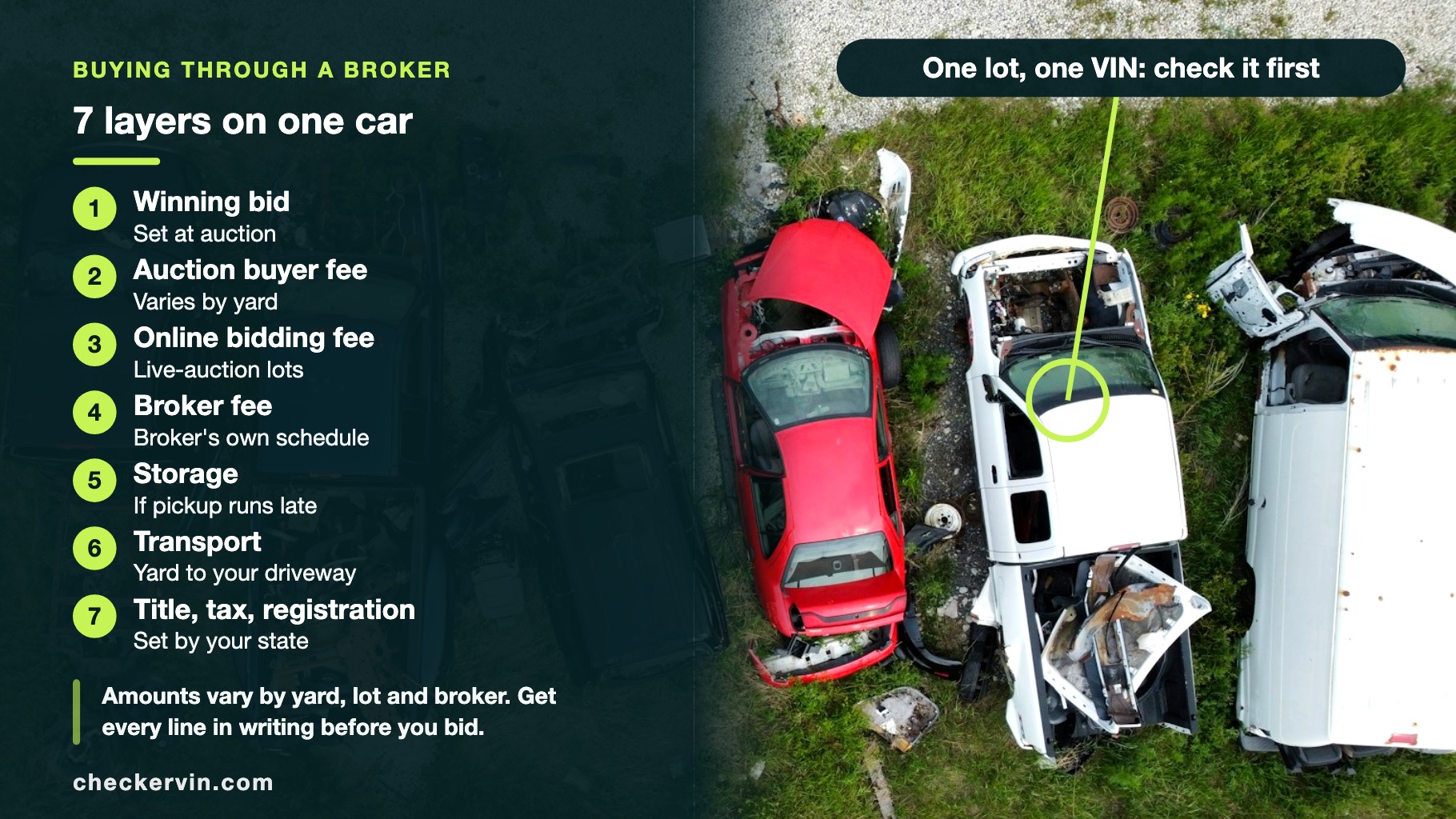
People search for SalvageBid fees because the number that wins the lot is not the number that leaves their bank. We do not print a broker’s prices: they change, and we could not read SalvageBid’s schedule. What does not change is the structure. Copart’s licensing page names four sources of fees on a broker purchase: Copart, brokers, transporters and state or provincial regulators.
| Layer | Who sets it, and what to ask |
|---|---|
| The winning bid | Set at auction. IAA sales are with reserve, so the seller can still approve or counter the high bid. |
| The auction's buyer fee | IAA charges a buyer fee on every vehicle sold and says fees vary by facility. Ask the broker whether it passes this through at cost. |
| Online bidding fee | IAA adds one to vehicles bought online from a live auction. Ask whether it appears on your invoice. |
| The broker's own fee | Copart says broker fees vary with services, vehicle type and location. Get the broker's full schedule, including any membership or deposit terms. |
| Late payment and renege charges | The auction charges these if payment is late. Ask how the broker passes them on, and what your own payment deadline is. |
| Storage | Charged per day once a car outstays the yard's pickup window. |
| Transport | From the yard to you. A car that does not run costs more to move. |
| Title, tax, registration and inspection | Set by your state. A salvage car also needs whatever rebuilt inspection your state requires before it can be registered. |
Two habits make the arithmetic honest. First, work out your all-in ceiling, then subtract every layer you can price before deciding your maximum bid, not after. Second, get the broker’s fee schedule as a document, dated, before you place a deposit. If a broker will not show its fees until you have won, that tells you something on its own.
Title types you will see on a salvage lot
The lot’s title type matters more than its price, because it decides what you can do with the car afterward. Federal NMVTIS rules give the background definitions. A salvage automobile is one damaged to the point that its salvage value plus repair cost exceeds its value just before the damage, and it includes any car an insurer designates a total loss. A junk automobile is one that cannot be driven on public roads and has no value except as parts or scrap.
| Document on the lot | What it usually lets you do |
|---|---|
| Clear title | Register it like any used car. IAA's rules still warn that a clear-title car may have a salvage history. |
| Salvage certificate or salvage title | Where the state allows it: repair, pass the state's rebuilt inspection, then register under a branded title. Rules differ by state. |
| Non-repairable, junk or certificate of destruction | Treated as parts or scrap. The document exists to keep the car off the road, however good it looks in the photos. |
| Federal SF-97-1 (government sales) | Evidence of title only, which IAA's rules say the buyer uses to obtain a state registration. |
IAA adds a warning worth reading twice: a state can change a car’s title or brand classification after you buy it. Its own example is a car bought in one state on a clear document that must be resold on a salvage document in another. If the car will be titled somewhere other than where it sits, check that state’s rules first. Our salvage certificate guide covers what that document is, and buying a car with a rebuilt title covers the road back to registration.
As is, where is: what the auction rules put on you
Going through a broker does not soften the auction’s terms. IAA’s buyer agreement is blunt about where responsibility sits, and the points below come straight from it.
- Every vehicle is sold as is, where is, with no warranty of any kind
- IAA undertakes no duty to confirm the accuracy of anything it says about a car, including information from a DMV
- Buyers agree not to base a bid on IAA's information, which the rules say includes the VIN, mileage, odometer disclosure, title, airbags, damage type and images
- An airbags-intact note means only that they did not appear deployed on arrival; IAA does not test them
- IAA's images are not meant to show a vehicle's condition exhaustively
- IAA does not promise that a car can be registered in any state or exported
- Risk of loss passes to the buyer once the vehicle is awarded
The practical reading: the listing is a starting point for your own checks, not a description you can hold anyone to. IAA’s rules even say that if mileage matters to you, you should get a vehicle history report before you bid, and that you should verify the title type and brand before making any repairs.
Why to run the VIN before you bid, not after you win
Every check worth running costs less before the hammer falls than after, because after it you own the car. The VIN is how you run them, and the auction itself tells you not to trust the one on its listing without checking.
| Check | What it catches before you bid |
|---|---|
| Decode the VIN | Whether the year, model, body, engine and plant match the listing and the photos. A mismatch is a reason to walk away. |
| Open safety recalls | Campaigns still open on that exact VIN. The repair is free at a dealer, but you should know before pricing the car. |
| NMVTIS title record | Brands from any state, total-loss and salvage reports, and odometer readings that can contradict the listing. |
| Earlier auction listings | Whether the same VIN has been through an auction before, with different damage or a different title type. |
| Inspection, if the yard allows it | What photos cannot show. Some buyers pay a local inspector. IAA sells condition products such as a vehicle score and an OBDII report, and its rules disclaim those too. |
The earlier-listing check is where our auction history guide and the Bidfax review come in: a car on its second trip through a salvage auction is telling you how the last repair went.
Decode the lot's VIN free, before you bid
Decoded from official manufacturer and NHTSA records
What a title check adds that a broker can't
A broker sees the auction listing. The federal title record sees reports from the businesses that handle wrecked cars, under rules in 28 CFR Part 25, and salvage auctions are among them: the federal definition of a salvage yard expressly includes salvage pools and salvage auctions. IAA’s rules say as much from its side, warning that vehicles it sells may have been reported to NMVTIS.
- 1Insurers report the cars they totalMonthly, an insurer reports the junk or salvage cars it took possession of, from the current model year and the 4 before it: VIN, date, who it came from and the owner's name.
- 2Salvage yards and auctions report what they handleMonthly, with the VIN, the date obtained, who it came from, and whether the car was crushed, sold on or intended for export.
- 3States add title brandsState titling agencies apply brands such as junk, salvage and flood, and NMVTIS keeps the brands any state has applied.
An NMVTIS report condenses that into five indicators: current state of title and last title date; brand history, such as junk, salvage or flood, from any state; odometer reading; total loss history; salvage history. For an auction buyer the use is specific. It tells you whether the title type on the lot matches what states have recorded, whether the car has been totaled before, and whether the odometer on the listing fits the readings on file.
Note the insurer window. That monthly report covers a 5-model-year span, so an older car totaled by an insurer may not be caught by that particular rule, and a clean result on an older car is weaker evidence than on a new one. The program also says repair histories are not meant to be in the report. Our NMVTIS report guide covers the rest, and the salvage title VIN check explains how brands differ by state.
Is SalvageBid legit?
Here is what can be checked, stated plainly, so you can judge for yourself.
| Question | What we found, 24 November 2026 |
|---|---|
| Does an auction list it? | Yes. IAA's Find a Broker page lists "Salvagebid Inc" among U.S. licensed brokers. |
| Is it on Copart's broker list? | Not among the 26 U.S. brokers Copart's page showed with no location filter. |
| What are its fees and terms? | Unverified. salvagebid.com returned a bot-verification block to every request. |
| What does the BBB say? | Unverified. bbb.org blocked our requests, so we report no rating or complaint count. |
| Does it sell title records? | It is a bidding broker, not a title-data provider, and it does not appear on the Department of Justice NMVTIS provider list. Get the title record elsewhere. |
On that evidence, SalvageBid is a recognized broker on at least one major salvage auction. Whether it is the right broker for a given car depends on things only its own documents can answer: its fees, its deposit and refund terms, which auctions and yards it can buy from, and how it hands over the title. Read those before you pay anything.
Reading SalvageBid reviews and complaints
Search for SalvageBid reviews and you mostly find BBB pages, forum threads and videos. We could not open the BBB pages, and we do not repeat allegations from forums as fact. What we can offer is a way to read any broker review usefully: work out whose rule the complaint is really about. Many disputes over auction cars turn on rules the broker passes through rather than writes.
| If a review is about | Whose rule usually governs |
|---|---|
| The car being worse than the photos | The auction's as-is terms. IAA disclaims its images and condition notes outright. |
| A sale canceled or a counteroffer | The auction. IAA sales are with reserve and subject to the seller's approval. |
| A late fee or renege charge | The auction's payment clock, plus whatever the broker's own terms add. |
| Storage charges | The yard's pickup window, and how quickly transport was arranged. |
| The broker's fee or a deposit refund | The broker's own terms. Copart refers deposit refunds on broker accounts to the broker. |
| Title paperwork | Shared: the document the lot was sold on, the broker's assignment, and your state's rules. |
Reviews in the first three rows tell you more about salvage auctions than about the broker. Reviews in the last two are the ones that tell you about the broker itself. Check the date on any review, too: terms and fee schedules change.
A pre-bid checklist for any salvage-auction broker
- 1Decide whether you need a broker at allCheck whether the lot is open to public buyers. If it is, buying directly as a member removes a layer of fees.
- 2Confirm the broker on the auction's own pageIAA's Find a Broker page and Copart's Brokers page are the references. Make sure the broker can buy at that auction and that yard.
- 3Get every fee in writingBuyer fee, online fee, broker fee, deposit, storage, transport and your state's charges. Set your maximum bid from the all-in ceiling.
- 4Decode the VIN and check recallsMatch the build to the listing and photos, and note any open safety campaigns.
- 5Buy the NMVTIS title recordFrom a provider on the Department of Justice list. Compare its brands, total-loss reports and odometer readings with the lot.
- 6Read the title type, then the priceKnow whether the document lets you register the car in your state, and ask the broker how title will be assigned to you.
Free decode and recall check, no card
Decoded from official manufacturer and NHTSA records
Which of our pages you actually need
This page is about buying through a salvage-auction broker. If your question is narrower or wider, one of these fits better.
| If you want to | Read |
|---|---|
| See what auction records exist for a car, and where to find them free | Auction history by VIN |
| Look up an old auction listing and its photos | Bidfax review |
| Know whether a car carries a salvage brand | Salvage title VIN check |
| Understand the document a salvage lot is sold on | Salvage certificate |
| Plan the repair, inspection and re-titling | Buying a car with a rebuilt title |
| Understand the federal title report itself | NMVTIS report explained |
Where this information comes from
- IAA — Find a BrokerLicensed Brokers table listing Salvagebid Inc under United States, read 24 November 2026
- IAA — Buyer Agreement and Auction RulesRegistration, fees, payment and pickup deadlines, as-is terms, title and NMVTIS warnings
- Copart — BrokersU.S. broker list and broker FAQ, read 24 November 2026
- Copart — Member Licensing & DocumentationID and license requirements, No License Required lots, and buying through a broker
- NMVTIS — approved data providersThe Department of Justice list of businesses approved to sell NMVTIS title reports
- NMVTIS — Understanding a Vehicle History ReportThe five indicators and where the data comes from
- 28 CFR 25.52 — DefinitionsSalvage and junk automobile definitions; salvage auctions count as salvage yards
- 28 CFR 25.55 — Responsibilities of insurance carriersMonthly total-loss reporting, five-model-year window
- 28 CFR 25.56 — Junk yards, salvage yards and auto recyclersMonthly inventory reporting, including disposition and export
- How we made this pageWritten by the CarCheckerVIN editorial team with AI assistance from NHTSA vPIC and other public records, including IAA's and Copart's published pages and the Department of Justice NMVTIS pages; facts checked November 2026. salvagebid.com and bbb.org blocked our requests, so none of their content is quoted.
Keep reading
Frequently asked questions
Is SalvageBid legit?
It is a real, named broker: "Salvagebid Inc" appears in the Licensed Brokers table on IAA's own Find a Broker page, read in November 2026. That tells you IAA lists it; it does not tell you what SalvageBid charges or how its terms read. We could not open salvagebid.com (it returned a bot-verification block), so read its fee schedule and terms yourself before you place a deposit.
How does SalvageBid work?
As a broker, it bids at the auction under its own registration so that a buyer without the required business license can still buy. You open an account with the broker, not the auction, place bids through it, and pay the broker, which pays the auction. Copart puts it plainly on its licensing page: when you use a broker, you are buying the car from the broker, not from Copart.
What fees does SalvageBid charge?
We do not print a broker's prices, and we could not read SalvageBid's fee page. The model is the same across broker purchases: the winning bid, then the auction's own buyer fee and any online-bidding fee, then the broker's fee, then storage if pickup runs late, transport, and your state's title, tax and registration costs. Ask for the full list in writing before you bid.
Can I buy Copart cars through SalvageBid?
We could not confirm it. SalvageBid's site blocked us, and on 24 November 2026 the U.S. broker list on Copart's Brokers page showed 26 businesses with no location filter, none named SalvageBid. Lists change, so check Copart's page for the yard your car is in before assuming any broker can buy it.
Does a broker check the car's history for me?
Do not assume so. IAA's rules tell its buyer not to rely on any information IAA provides, VIN, mileage and title included, and to verify the title type and brand before repairing. Decode the VIN yourself, check open recalls, and buy an NMVTIS title record from a provider on the Department of Justice list.
Can a car sold at auction with a clean title have a salvage history?
Yes, and IAA says so in its own rules: vehicles sold with a clear title may have a salvage history, and may appear as junk or salvage in later NMVTIS reports. A state can also change a car's title or brand classification after the sale.
Know which car it is before you bid on it
Decode any VIN free for the factory build, specifications and open safety recalls. No account, no card. Full vehicle history reports are launching soon.
Run a free VIN check