The short answer
- What is bidcars?
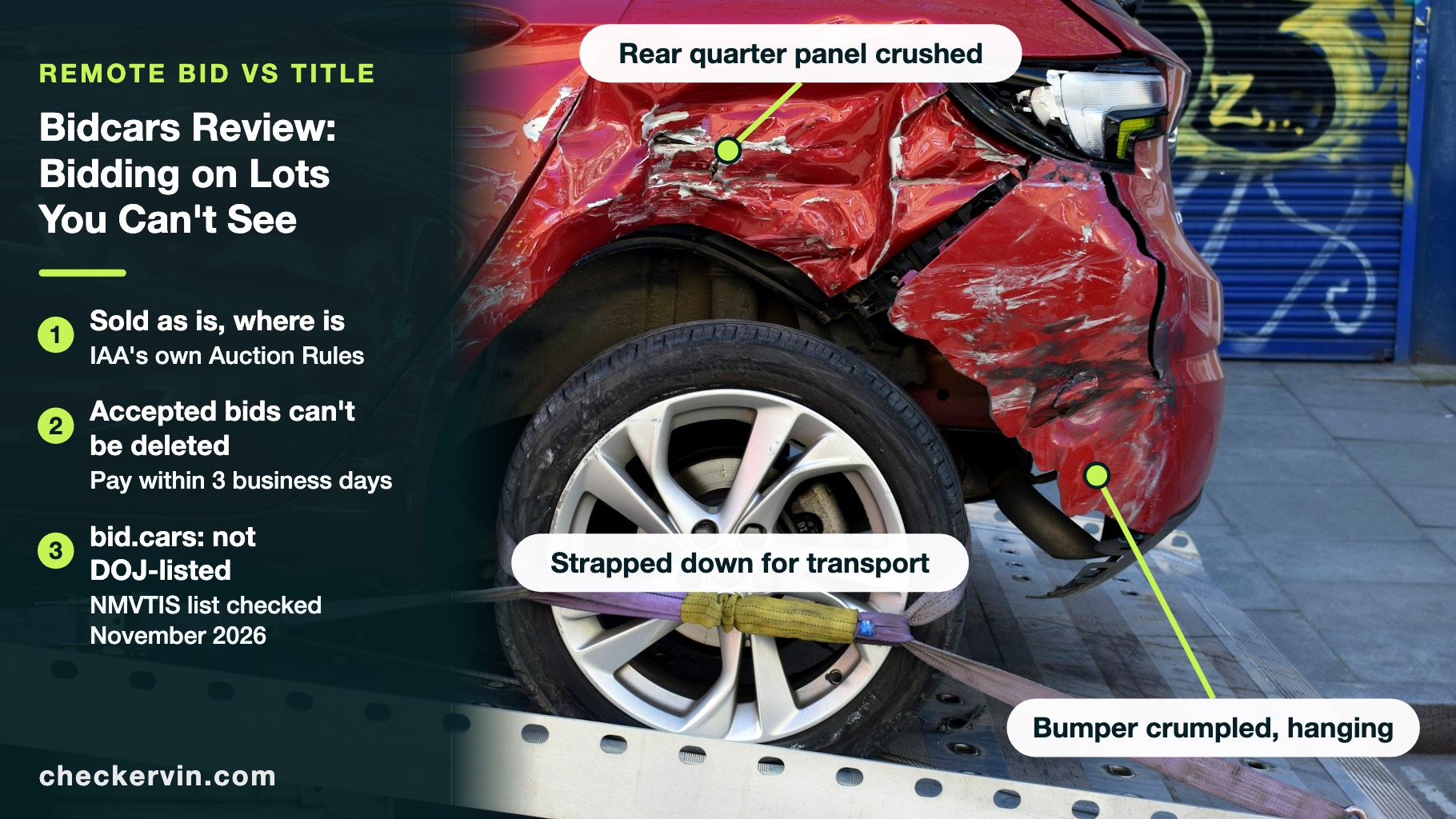
- A name searched in connection with buying from US salvage auctions. bid.cars blocked our requests, so we could not confirm what it sells or who runs it.
- Is it a title history report?
- No. bid.cars is not on the Department of Justice list of approved NMVTIS providers (checked November 24, 2026).
- What should I read before bidding remotely?
- The auction's own rules. IAA's say every car is sold as is, where is, and that an accepted online bid cannot be deleted.
Not listed
bid.cars on the DOJ NMVTIS list
Checked November 24, 2026
3 business days
To pay after winning at IAA
Per IAA's Auction Rules
7 calendar days
Unpaid, and IAA treats it as a renege
Counted from the day of the award
72 hours
Title and car at the port before sailing
19 CFR 192.2, export by vessel
The short verdict
We cannot review bid.cars as a service, because it would not let us read it. On November 24, 2026 every page we requested returned an access block, and we did not try to get around it. So this page does something narrower and, we think, more useful: it sets out what any remote bidder on a US salvage lot is agreeing to under the auction’s own published rules, and where a title record has to come from, whichever site you bid through.
The one fact we could check about bid.cars itself is that it is not an approved NMVTIS data provider. That is not an accusation; an auction-access or auction-archive site does not need federal approval. It does mean that any title brand, odometer reading or total loss flag it shows is not the federal record, and should be checked against one before money moves.
First, which bidcars this is
The search term is shared by at least three unrelated businesses, and mixing them up is the first mistake to avoid. Here is what each one’s own pages say, where we could read them:
| Name or domain | What its own pages say |
|---|---|
| bid.cars | Not verified: every page returned HTTP 403 to us on November 24, 2026 |
| BidCars Boston (bidcarsboston.com) | A used car, SUV and truck dealer at 623 Providence Hwy, Walpole, Massachusetts, with financing, trade-ins and a service department |
| bidcars.lt | An “international auto auction platform” for buying from US and Canadian auctions online or through a broker, with transport and customs help |
So if you searched “bidcars Boston” or “bidcars Walpole,” you are most likely looking for a Massachusetts dealership, and the rest of this page, which is about salvage auctions, does not describe it. If you searched “bidcars USA,” “bid cars auction” or “bidcars Copart,” you are in the auction-access market, and the domain you land on matters: with three businesses answering to one name, type the address yourself and check it before you register, upload an ID or pay a deposit.
What we could not check, and why
A review should be built from the company’s own pages. On November 24, 2026 we requested the bid.cars home page, its English home page, its FAQ path, its robots file and its sitemap. Each one returned HTTP 403. That leaves gaps we would rather name than fill:
- Who operates bid.cars and where the business is registered
- Whether it bids on your behalf, lets you bid directly, or only archives listings
- What deposit it asks for, whether it is refundable, and what it charges per car
- Its terms of use, its cancellation terms and its dispute process
- Whether a bidcars app exists and who publishes it
Descriptions of the site you may see in search snippets, forum threads or video comments are not repeated here, because we could not confirm them at the source. Copart’s help and terms pages also returned no readable content to our fetches that day, so the auction rules on this page are IAA’s. Where Copart’s rules differ, read them on copart.com before you bid on a Copart lot.
Auction access, auction archive and title record are three different things
Most confusion around names like bidcars comes from treating three separate jobs as one. Sites in this market do one or more of them, and only one of the three is regulated as a vehicle history source:
| What it is | What it gives you, and what it does not |
|---|---|
| Auction access (bidding through someone else's account) | A way to bid on lots you could not otherwise reach. No guarantee about the car, which the auction itself does not give |
| Auction archive (past lot listings by VIN) | Pre-repair photos, damage notes and a sale date. Nothing about what happened before or after that one sale |
| NMVTIS title record (from a DOJ-listed provider) | Title state, brand history, odometer, total loss and salvage history, reported by state titling agencies, insurers, junk and salvage yards and recyclers. No photographs |
Our auction history guide covers how a lot listing is produced and how to read its damage descriptors. Our reviews of Bidfax and stat.vin cover the archive side: what a saved lot shows and why a missing one proves nothing. This page is about the first row, the act of bidding, which those pages do not cover.
Who the auction thinks bought the car
When you bid through an intermediary, the auction does not see you. IAA’s rules define the buyer as the registered party on the account. They let a business authorize additional people to bid on its behalf where the law allows, and they say the buyer “assumes all responsibility for any bidders authorized by Buyer.” Accounts cannot be transferred.
Read together, that means something the rules do not spell out but which follows directly: on the auction’s books, the intermediary is the buyer. Your rights over the car, your deposit and your recourse if something goes wrong come from your agreement with the intermediary, not from the auction. If that agreement is thin, so is your protection.
The clock that starts when you win
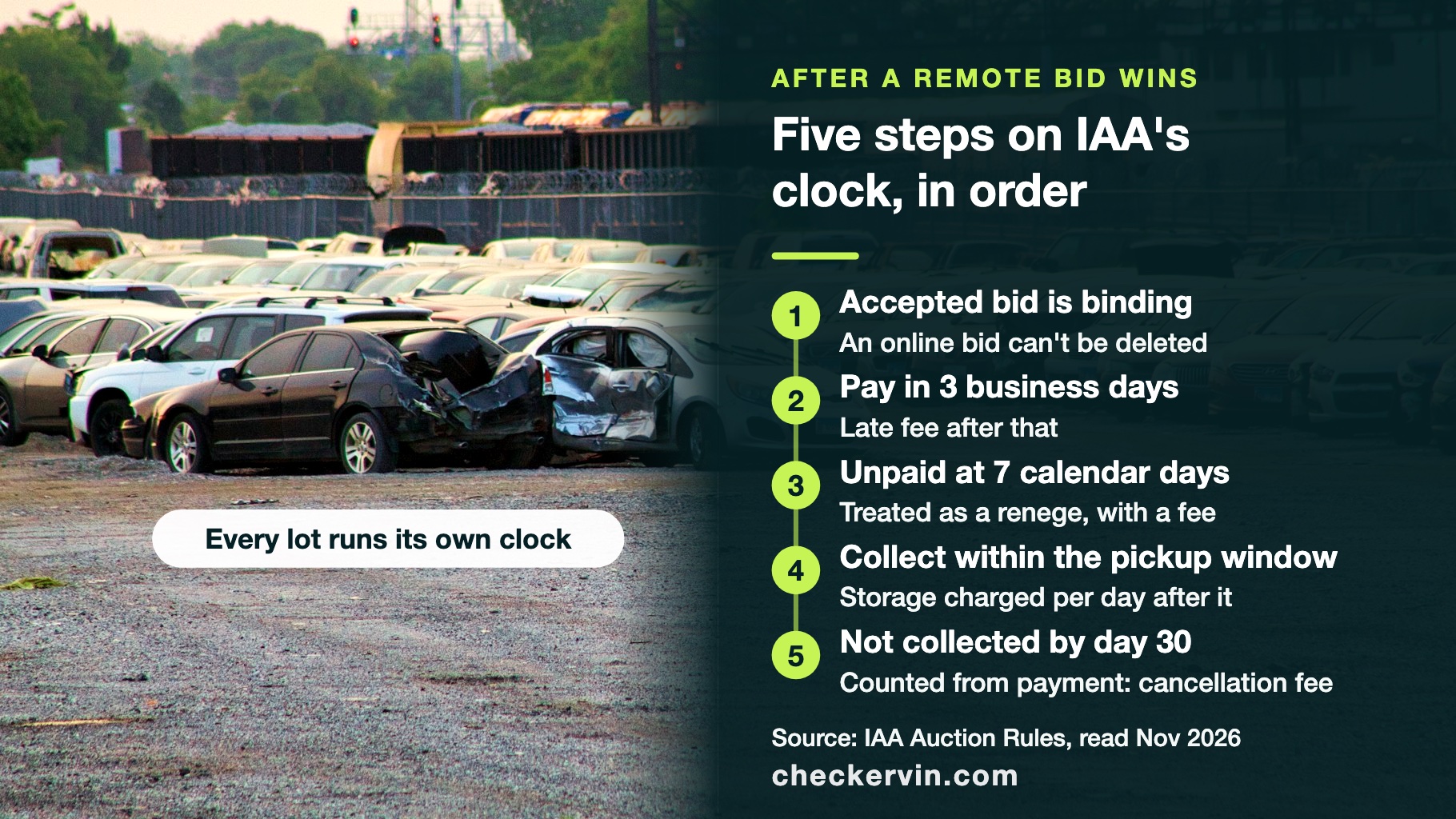
A remote bid feels provisional until the car arrives. Under IAA’s rules it is not. Once the system accepts an online bid, the rules say it cannot be deleted, only reduced to the current high bid. After a win, the auction runs to a published timetable:
- 1The bid is bindingAn accepted online bid cannot be deleted. If yours is the high bid when the lot closes, the vehicle is awarded to the registered buyer.
- 2Pay within 3 business daysIAA's rules put payment due within 3 business days of the award. Late payment draws a late fee, set in IAA's Auction Rules as a flat amount or a percentage of the selling price, whichever is greater.
- 3Unpaid after 7 calendar days is a renegeA buyer who has not paid within 7 calendar days, counting the day of the award, is charged a renege fee, again the greater of a flat amount or a percentage of the sale price; read the current figures in IAA's Auction Rules.
- 4Storage starts after the pickup windowVehicles not picked up within the specified time frame are charged storage per day, per vehicle.
- 5Uncollected after 30 days is a cancellationIf a paid vehicle is not picked up within 30 calendar days of payment, IAA charges a cancellation fee: the renege fee plus daily storage until it can resell the car.
Those figures are the auction’s, read from its rules on November 24, 2026, and they apply to the registered buyer. An intermediary bidding for you will usually pass them on, and may add its own deadlines for your payment to it, which have to land before the auction’s. If your money has to cross a border, 3 business days is not long, so ask how the intermediary handles that before you bid, not after you win.
What the photos and condition notes actually promise
A remote bidder buys from photographs and a few lines of description. IAA’s rules are explicit about how far those go. Every vehicle is sold “as is, where is,” with no warranty. The images “are not intended to exhaustively display the current condition” of the car. A general damage statement, such as front end damage, is not meant to list all of the damage. Personal property visible in photos may not be there on collection. And the buyer agrees not to base a bid on information IAA provides.
The note remote bidders lean on most is Run and Drive. IAA’s rules define it narrowly: at arrival, the engine started and the gears and steering were checked. The rules say it is not a representation that the car will do so at any time afterwards, and a Starts note is no promise either. A car that ran into the yard can sit for weeks before it is collected.
- Assume damage beyond what the photos show, and price for it
- Treat Run and Drive as a note about one day, not a description of the car
- Do not count on keys, spare wheels or contents that appear in a photo
- If the rules allow an in-person preview at the yard, use it or pay someone local to
Title type, brands and whether the car can be registered
The document a salvage lot sells on decides what the car can become. IAA’s rules tell the buyer to “verify the title type and brand before making any repairs,” and to title the vehicle in its own name as state law requires. Three further lines in the same rules matter more to a remote buyer than to anyone standing in the yard:
- IAA may rescind, postpone or cancel a sale at any time before the buyer receives the assigned title
- A state may change a vehicle's title or brand classification after the purchase, and IAA takes no responsibility for that
- IAA does not warrant that vehicles it sells can be legally registered in any state or country
The buyer also accepts the risks of differences in state or country sale-document and registration laws. For a buyer who will never see the paperwork until the car is shipped, that is the line to read twice. Our salvage title guide explains what each common brand means and which ones can be rebuilt and re-titled.
If the car is leaving the United States
Much of the interest in bidcars comes from buyers outside the US, and an export adds a federal step that no auction site controls. Under 19 CFR 192.2, whoever exports a used vehicle must present both the car and its documents to Customs at the port, and for a US-titled car that means the original certificate of title, or a certified copy, plus 2 complete copies. A salvage title that remains in force counts.
For export by vessel or aircraft, the documents and the vehicle must reach Customs at least 72hours before export. If the car is leased or carries a recorded lien, the regulation also requires a signed letter on the lienholder’s letterhead saying it may be exported. The exporter may use an agent, which is where intermediaries usually come in.
IAA’s rules add the auction’s side: the buyer acts as the foreign principal party in interest for an export, must work out any export license requirement, and warrants that it is not dealing with anyone on the Treasury’s OFAC sanctions list. The practical upshot is simple. Customs permits the export only once the rule is met, so a car cannot sail until its title, original or certified copy, is in hand, and a title delay at the auction becomes a delay at the port.
Fees: the pricing model in words
The search interest in “bidcars fees” is real, and we are not going to print a number for a site we could not read. What we can describe is the shape of the cost, from IAA’s rules:
- The hammer price is not the total. IAA charges a buyer fee on each vehicle sold, and other fees may apply
- Fees vary by facility, and the rules tell buyers to verify them before incurring them
- Buying online from a live auction adds an online bidding fee to the purchase price
- Membership fees cannot be refunded, even if a prospective buyer is not approved
- Late payment, renege, storage and cancellation charges are on top, as set out in the timeline above
An intermediary’s own charges sit on top of the auction’s. bidcars.lt, for example, lists transport, customs clearance and registration help among its services, and each of those is a cost line of its own. Ask for a written all-in estimate for one specific lot, including what happens to the deposit if you lose or decide not to bid, and compare it with the car’s value after repair. A cheap lot with an expensive route to a registrable title is not cheap.
Bidcars VIN and history searches
Many people who search “bidcars VIN,” “bidcars VIN check” or “bidcars history” are not bidding at all. They are looking at a car that was imported or resold and want to know if it passed through a US salvage auction. A past lot listing can answer that, and it is worth finding. But it answers a narrow question: what the car looked like, and how the auction described it, on one day.
Search by the full 17-character VIN rather than a lot number, because one car can be sold more than once and a lot number identifies only one sale. Then make sure the listing is for your car: every VIN character, the decoded year, make, model and engine, and an odometer reading that has only gone up since the sale. The stat.vin review walks through those matching checks in more detail, and VIN check with photos explains where the pictures on VIN sites come from.
When an auction car comes back onto the market
Every car bought remotely from a salvage auction is eventually somebody else’s used car. If you are that second buyer, the auction listing and the title record do different jobs, and you need both:
| The question | Where to look |
|---|---|
| Did it go through a salvage auction, and what did the damage look like? | Past auction listings, searched by full VIN |
| What brand did the title carry, and in which states? | An NMVTIS report from a DOJ-listed provider |
| Has the odometer gone backwards since the sale? | The lot's intake reading against NMVTIS readings and the dash |
| Was it repaired properly? | Neither record. Only an inspection on a lift |
The pattern to watch for is a salvage sale followed by a clean, unbranded title with no total loss entry. It can have innocent explanations, and it can also be a title moved between states until the brand fell away. Either way it is a question for the seller and for a mechanic. Our NMVTIS report guide explains what the federal record holds and who reports into it.
If something goes wrong: the auction's dispute terms
Remote buyers tend to discover the dispute terms only after a car arrives worse than the photos. IAA’s rules set them out in advance, and they bind the registered buyer:
- Written notice of a dispute must be sent at least 30 days before starting arbitration or a small claims action
- The parties then have 30 days after IAA receives the notice to try to resolve it
- A buyer can opt out of arbitration only by sending notice within 30 days of first registering
- Claims must be filed within 1 year of arising or they are barred
Put that next to the who-buys point above. If an intermediary’s account bought the car, the intermediary is the party with standing under these terms, and any complaint you have runs through your contract with it first. That is one more reason to read that contract before the deposit rather than after delivery, and to keep the lot photos, the lot number and every message about the car in one place from the day you bid.
Is bidcars legit?
It helps to split the question, because the parts have different answers. Is BidCars Boston a real business? Its own website describes a dealership with a street address in Walpole, Massachusetts. Is bid.cars a federal title-history source? No: it is not on the Department of Justice list of approved NMVTIS providers, which we read on November 24, 2026. Is bid.cars a trustworthy place to send a deposit? We cannot tell you, because we could not read its terms, its operator details or its refund policy, and we will not guess.
What we can tell you is how to protect yourself with any intermediary. Read its terms and the auction’s rules before you register. Confirm in writing whose name the auction invoice and the title will carry. Pay only through the method the terms name. And run the VIN through a title record before you bid, so you are not relying on any site’s own summary of the car’s past.
Where CheckerVIN fits, stated plainly
CheckerVIN does not sell auction access, does not archive auction lots, and does not sell a title or accident history report today. What our free check returns now, with no account and no card:
- Factory build and specifications decoded from the VIN
- Factory warranty terms
- Open NHTSA safety recalls
- Photos filed against the VIN
- Market and listing prices
For a remote bidder, the decode does one job well: it tells you whether the lot description matches the car the VIN belongs to. If a listing says one engine and the factory build data says another, you have learned something before spending a cent. An open safety recall is also worth knowing about before you bid, because it is a repair you may be able to get done free.
Decode a lot's VIN before you bid
Decoded from official manufacturer and NHTSA records
For the title record itself, buy an NMVTIS report from one of the 12 providers the Department of Justice lists for consumers, as of November 24, 2026:
- Bumper.com
- Carsforsale.com
- Carvertical.com
- Checkthatvin.com
- Clearvin.com
- EpicVin.com
- GoodCar.com
- Titlecheck.us
- Vinaudit.com
- Vindata.com
- VinReport
- Vinsmart.com
The department says the list is alphabetical and implies no preference between providers.
Before you bid on a salvage lot remotely
- 1Confirm which site you are onType the domain yourself. bid.cars, a Massachusetts dealership and a .lt auction platform share the name.
- 2Read the auction's rules and the intermediary's termsThe auction's rules bind the registered buyer; the intermediary's terms are your only contract. Both, before any deposit.
- 3Decode the VIN and check recallsMake sure the factory build matches the lot description. Free, and it catches a mismatched listing early.
- 4Buy the NMVTIS title recordTitle brands, odometer and total loss history from a DOJ-listed provider, so you know what the title will say before it is assigned.
- 5Price the worst caseDamage the photos do not show, a car that will not start, every fee, storage, transport and, for an export, port time.
- 6Save the lot photos and the lot numberArchived listings disappear. Keep your own copy for the inspection, the export paperwork and any dispute.
Where this information comes from
- IAA — Auction RulesRead November 24, 2026: as-is sale, image and damage-statement limits, Run and Drive meaning, binding online bids, payment, renege, storage and cancellation terms, title, export and dispute clauses
- 19 CFR 192.2 — requirements for exporting a used vehicleOriginal title plus copies, the 72-hour vessel rule and the lienholder letter
- NMVTIS — approved data providersRead November 24, 2026; no name containing "bid" appears in any tier
- NMVTIS — understanding a vehicle history reportWho is required to report into NMVTIS, and the five indicators a report covers
- BidCars BostonRead November 24, 2026; describes a used car dealership in Walpole, Massachusetts
- bidcars.ltRead November 24, 2026; describes an international auto auction platform, and its "VIN Clean" section names bid.cars among the sites it offers to clean
- bid.carsRequested November 24, 2026; HTTP 403 on every page, so its own pages could not be read
- How we made this pageWritten by the CarCheckerVIN editorial team with AI assistance from NHTSA vPIC and other public records; facts checked November 2026. bid.cars and Copart's help pages could not be read, so neither is quoted.
Keep reading
Frequently asked questions
Is bidcars legit?
We could not judge that from the source. bid.cars refused every request we made on November 24, 2026, so we could not read its terms, its operator details or what it charges. What we could check is that it is not on the Department of Justice list of approved NMVTIS data providers, so whatever vehicle history it shows is not the federal title record. If you bid through any intermediary, read its terms and the auction's own rules before you pay a deposit.
Is bid.cars the same as BidCars Boston?
Nothing we could read connects them. BidCars Boston's own website describes a used car, SUV and truck dealership at 623 Providence Hwy in Walpole, Massachusetts, selling pre-owned vehicles with financing, trade-ins and a service department. bid.cars is a separate domain that blocked our requests. A third site, bidcars.lt, describes itself as an international auto auction platform. Check the domain in your address bar before you register or pay anywhere.
Can I bid on Copart or IAAI cars through bidcars?
We could not confirm what bid.cars offers, because its pages blocked us. In general, sites in this market let you bid on salvage-auction lots through a registered buyer account that is not yours. IAA's rules allow a business to authorize additional bidders, and they make the registered buyer responsible for every bidder it authorizes. That matters: on the auction's books, the intermediary is the buyer, not you.
What happens if I win a bid and change my mind?
Under IAA's published rules, an online bid the system has accepted cannot be deleted. Payment is due within 3 business days, a late fee applies after that, and a buyer who has not paid within 7 calendar days of the award is treated as reneging and charged a renege fee. An intermediary may layer its own deposit and penalty terms on top, which we could not read for bid.cars.
Does a bidcars VIN search show a car's title history?
An auction listing describes one sale: photographs, a damage description and the title type the auction recorded that day. That is not a title history. Title brands, odometer readings and total loss history across states come from NMVTIS, sold only by the providers on the Department of Justice list. bid.cars is not on it.
Is a salvage auction car a bad buy?
Not automatically, but you take every risk in writing. IAA sells every vehicle as is, where is, says its photos are not meant to show the full condition, says a Run and Drive note only describes the car on arrival, and says it does not warrant that a vehicle can be registered in any state or country. Price the car as though the worst of those applies.
Check the VIN before you place the bid
Decode any VIN free for the factory build, specifications and open safety recalls. No account, no card. Full vehicle history reports are launching soon.
Run a free VIN check