The short answer
- What is SalvageReseller?
- A Copart broker website. Its terms say Inloher Corp, a Florida licensed dealer and authorized Copart broker, owns and operates it, and that buyers purchase from Inloher, not from Copart.
- Is it legit?
- Copart lists "SALVAGE RESELLER" on its own U.S. Brokers page and hosts its terms. That is verifiable. The terms themselves are strict: as-is sales, short deadlines, deposit forfeiture and Florida arbitration.
- What should I check before bidding?
- Decode the VIN, check open recalls, and buy an NMVTIS title record from a Department of Justice-listed provider. The terms disclaim the accuracy of descriptions, odometer readings and title history.
Listed
On Copart's U.S. Brokers page
Checked November 24, 2026
3 business days
To pay in full after winning
Terms §6.1, auction day included
3 calendar days
To remove the car from the yard
Terms §7.2, auction day included
4
State rules that limit what you can buy
Terms §8.3 and §10.2
The short verdict
SalvageReseller is a recognized way into Copart’s restricted lots. Copart names it on its own broker list and hosts its terms, and those terms are unusually complete: they say who the seller is, what every category of fee is, when each payment and document is due, what happens to your deposit if you miss a date, and which states you cannot buy from.
The same document puts nearly all the risk on you. The car is sold as is. The descriptions, photos, odometer readings and title history on the listing are expressly not warranted. The deadlines are short, and missing one can cost the deposit plus a relist fee. Disputes go to individual arbitration in Broward County, Florida. None of that is unusual for a salvage purchase, but it means the checks on the car are yours to run, and the time to run them is before the bid, because bids are irrevocable.
Who runs SalvageReseller.com, and what we could read
The first clause of the terms answers the ownership question directly. Inloher Corp, described as an independent licensed dealer in the State of Florida and an authorized broker of Copart, owns and operates www.SalvageReseller.com. The site is described as an online platform that lets registered users access vehicle auctions organized by Copart, with Inloher acting as an authorized intermediary. The last clause refers to the business as Inloher DBA Salvage Reseller.
Copart’s listing for the broker gives a business address in Coconut Creek, Florida, and a contact email at Inloher’s own domain, which fits the terms. We tried to confirm the Florida dealer license and the corporate filing independently; the state search we tried returned a bot-verification page, so we report the operator as the terms describe it and no further.
We also set out to read salvagereseller.com directly: its home page, FAQ, fee page and terms. On November 24, 2026 every request got a Cloudflare security-verification page instead of content, and we did not try to get around it. The terms file we quote is a nine-page print of salvagereseller.com/terms-and-conditions stamped October 19, 2026, published on copart.com and linked from the broker’s entry on Copart’s Brokers page. If the live site has changed since then, the live site governs. Read it before you pay anything.
SalvageReseller and Copart: the relationship as both sides document it
People search “SalvageReseller Copart” because they want to know whether this is Copart itself. It is not, and both sides say so in writing.
| Who says it | What the document says |
|---|---|
| Copart, Brokers page | Lists "SALVAGE RESELLER" among 26 U.S. brokers (no yard filter), with a Coconut Creek, Florida address and a link to its terms |
| Copart, Brokers page | Brokers are licensed third-party businesses, independent of Copart; when you use one you are buying through the broker, not Copart |
| Copart, broker details | All payments go directly to the broker; Copart does not process any payments |
| SalvageReseller terms §1 and §3.1 | Inloher Corp is an authorized Copart broker; auctions are organized by Copart |
| SalvageReseller terms §5.1 | Copart acts solely as the auctioneer and platform operator |
| SalvageReseller terms §8.4 | Copart's terms and policies are incorporated for auction operations, fees, cancellations, storage and yard access, and prevail where Copart's rules require |
So the arrangement has two layers. Copart runs the auction and sets the auction’s fees, storage and yard rules. Inloher holds the registration that lets it bid on lots a member without a business license cannot, and sells the car on to you under its own contract. Copart’s page also reminds buyers that you do not need a broker for every purchase: some lots in what it calls public states can be bought directly as a Copart member. If the lot you want is one of those, a broker is optional. Our SalvageBid reviewsets out how Copart’s and IAA’s licensing rules create the broker market in the first place.
Who actually sells you the car
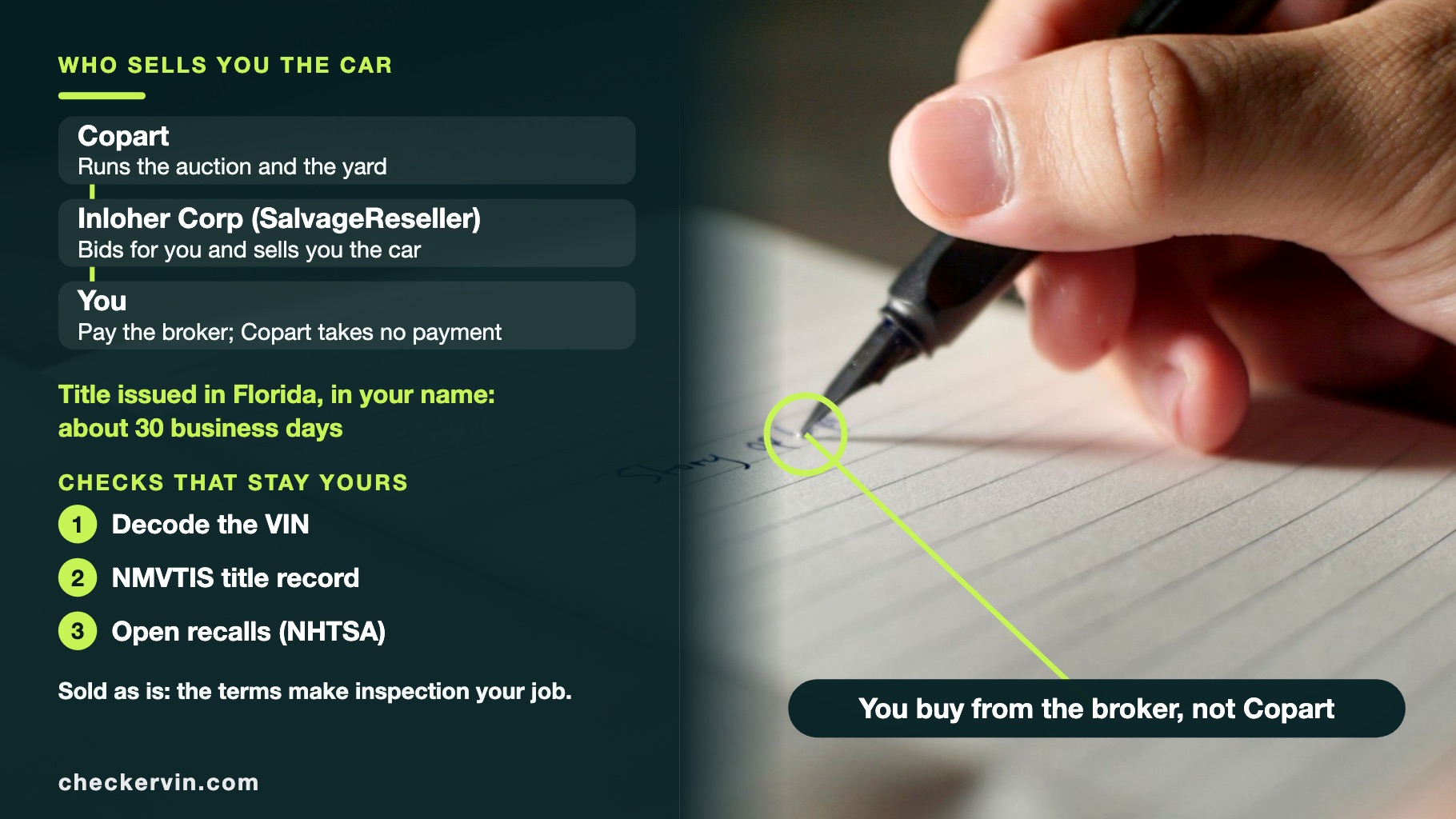
This is the clause to read twice. Section 5.1 says that by bidding on Copart auctions through the site, you are purchasing vehicles from Inloher Corp, not from Copart, and that all invoices, ownership documents and contractual communications are issued only by Inloher.
The practical effects follow from that. Your deposit sits with Inloher. Your invoice comes from Inloher. Your title is issued through Inloher. If something goes wrong, your claim is against Inloher, under Inloher’s terms, and those terms also waive claims against Copart for risks at its yards (§7.7) and ask you to indemnify Copart as well as Inloher (§11.5). Copart’s own broker FAQ sends deposit-refund questions to the broker for the same reason: the contract you signed is with the broker.
SalvageReseller fees: the model, in words
The search “SalvageReseller fees” usually comes after someone has seen a winning bid and wants to know the real total. We do not print broker prices, since schedules change and a page that quotes them ages into being wrong. The terms make the structure clear enough to plan with.
| Fee | How the terms build it |
|---|---|
| Membership | Three tiers: a free membership, a monthly one and an annual one. Paid memberships renew automatically unless canceled first, and membership fees are non-refundable (§4.2, §4.4). |
| Broker fee, per car | The greater of a flat minimum or a percentage of the sale price. The percentage is highest on the free tier and falls on the monthly and annual tiers. Cars located in Canada have their own schedule (§6.3). |
| Copart buyer fee | Copart's published schedule, which steps up with the sale price and is higher for non-clean titles than for clean ones. Broker fees are quoted exclusive of it (§4.2, §6.4). |
| Internet bidding fee | Also Copart's, set by sale price, and different for a preliminary bid than for a live online bid (§6.5). |
| Fixed charges | A gate fee (higher for non-clean titles), document processing, an environmental fee, Copart postal shipping and certified mailing (§6.6). |
| Card processing | A non-refundable percentage convenience fee on card payments made through Stripe (§6.2). |
| Sales tax | Collected by Inloher: Florida tax where it applies, or your state's rate capped at 7%, unless you provide valid exemption documents (§5.4). |
| Storage and transport | Copart's daily storage once the free days run out, and a carrier you arrange or book through Inloher's partners (§7.3, §7.5). |
Then there are the charges you only pay when a date slips: a late fee per vehicle, a non-compliance penalty that steps up in three bands with the car’s price (§6.7), and a relist fee if the sale is canceled, set as the greater of a flat sum or a percentage of the sale price (§6.8). Price the car on the assumption that you will not trigger them, but read them, because the deposit is what pays them first.
One habit makes the arithmetic honest. Start from the most you are prepared to spend all-in, subtract the broker fee, Copart’s buyer and bidding fees for that price band and title type, the fixed charges, tax, transport and a few days of storage, and bid only what is left. Our guide to what vehicle checks cost covers the separate question of what the title record and other reports will add.
The security deposit: what it buys and what it covers
You cannot bid without one. Section 4.3 sets a minimum deposit and ties it to a bidding limit of ten times the deposit, rising in steps as the deposit rises. Several simultaneous bids need separate deposits. The deposit can be paid by card through Stripe or by bank wire.
- The deposit sets your bidding power; it cannot be used to pay for a car (§6.9)
- It can be applied to penalties, fees, fines and unpaid balances (§4.3)
- If it does not cover what you owe, Inloher may charge the card on file, then invoice the rest (§6.9)
- It is refundable only when nothing is outstanding, with refunds processed within 3 business days, subject to clearance (§4.3)
- A chargeback can end the account and forfeit the deposit (§4.6)
Read those together and the deposit is less a down payment than a bond. It is what the broker draws on if you miss a deadline, and the card on file is the backstop. If you plan to bid on a car and walk away if it goes too high, that is fine; if you plan to win and then decide, the deposit is what you would lose.
The clock after you win: every deadline in the terms
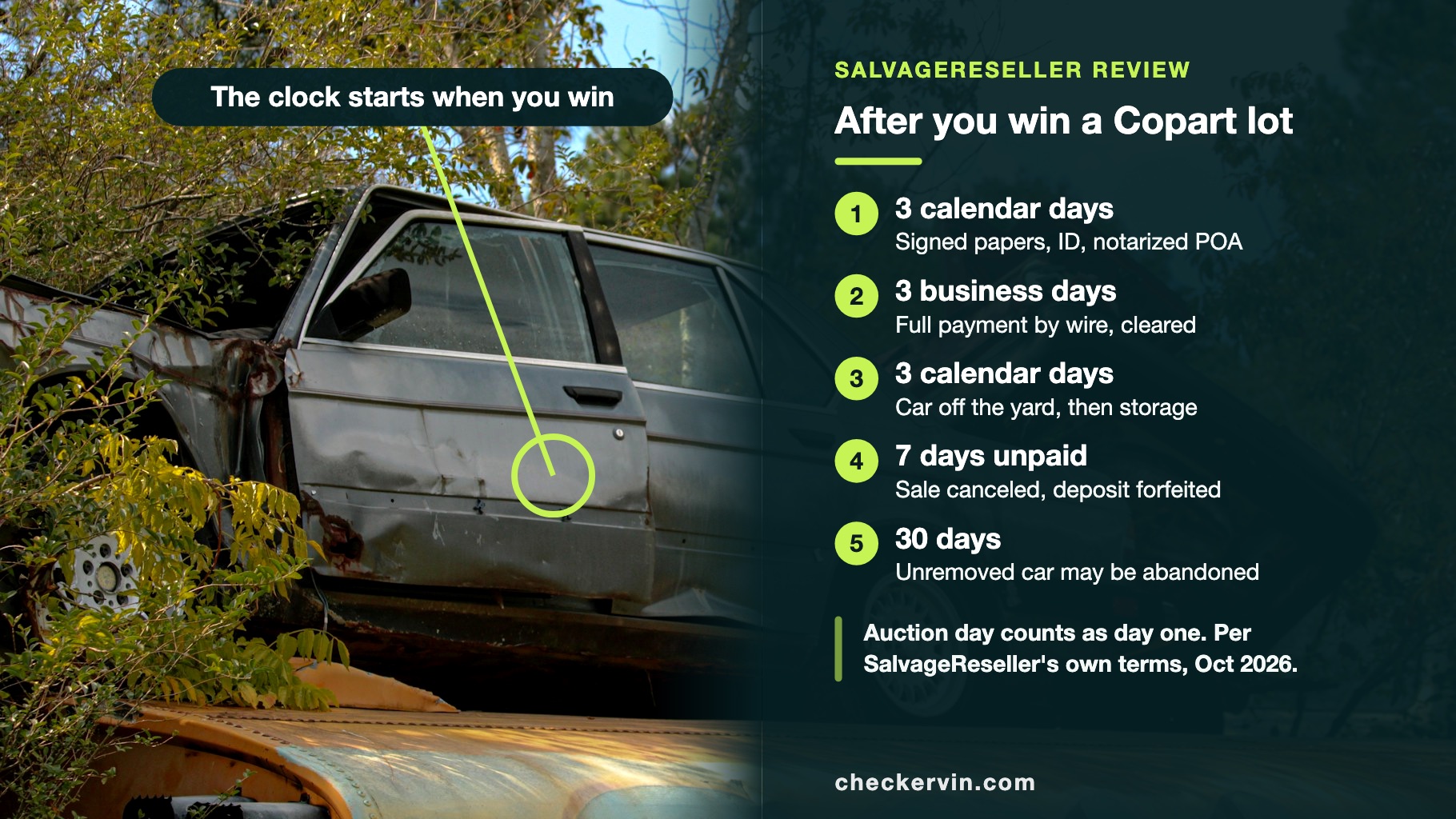
This is what most buyers underestimate. Several clocks start on auction day, and they run in calendar days or business days depending on the clause. Here they are in order, from the terms.
- 1Auction day is day oneThe storage table counts the day of purchase as day 1, and both the payment window and the removal window include auction day. A car won late in the week has fewer working days than the numbers suggest.
- 2Documents within 3 calendar daysSigned purchase documents, a valid government-issued ID and, where required, a notarized power of attorney. Missing this is a material breach that can bring penalties, cancellation or deposit forfeiture (§5.7).
- 3Full payment within 3 business daysSale price, sales tax, broker fee and Copart fees, received as cleared funds. Payment counts only when the funds clear, and bank transfers can take one to four business days to do so (§6.1, §6.2).
- 4Removal within 3 calendar daysOnly after a Vehicle Release Authorization is issued, and only by tow truck with the right equipment for the car's type and condition (§7.1 to §7.3).
- 5Cancellation after 7 calendar days unpaidThe sale can be canceled, the deposit forfeited, the car relisted by Copart and a relist fee charged, plus collection costs (§6.1, §6.8).
- 6Abandonment at 30 daysA car not removed may be deemed abandoned and disposed of to recover costs, and you remain liable for what is unpaid (§7.6).
Pickup, storage and the Buy It Now rule
Storage is Copart’s charge, passed through by the broker, and it starts sooner than many buyers expect. The terms print a day-by-day table. For a car won by online bid, days 1 through 3 are free; daily charges begin on day 4 and climb in steps after that. For Buy It Now, only days 1 and 2 are free, payment is due the same day as the purchase, and a late fee applies if it is not made that day (§7.3, §7.4).
| Rule | What it means in practice |
|---|---|
| Weekends and holidays count | Storage is charged on them, unless they fall inside the first three days (§7.3) |
| Rates vary by yard | The terms point to the location pages on Copart for each yard's rates (§7.3) |
| No release, no pickup | A carrier cannot collect the car until the Vehicle Release Authorization is issued, which follows payment (§7.1) |
| Transport is yours | Inloher may pass on estimates from third-party carriers but does not transport cars and accepts no liability for carriers (§7.5) |
| California-located cars | Under the California agreement, storage fees remain the buyer's responsibility while the out-of-state move is arranged (§10.2) |
The habit that saves money: book the carrier before the auction for the yard the car is in, so the truck can be dispatched the day the release arrives. A car that does not run needs a carrier with the right equipment, and those take longer to find.
How you are allowed to pay
Copart’s summary of the broker lists credit card, debit card, PayPal and wire. The terms are more specific, and the difference matters, because the summary covers every kind of payment while the terms split them by purpose (§6.1).
| Payment | Accepted methods, per the terms |
|---|---|
| The vehicle itself | Bank wire transfer only |
| Security deposit | Credit or debit card through Stripe, or bank wire |
| Membership fees | Credit or debit card through Stripe, or PayPal |
| Not accepted for vehicles | Credit card, PayPal, cash, checks, Zelle, Western Union, or paying Copart directly |
That last row is a useful fraud check in its own right. If anyone claiming to act for the broker asks you to pay for a car by Zelle, gift card, cash or a payment app, the request does not match the published terms. Confirm wire details by phone through the number on Copart’s listing before you send money.
States SalvageReseller restricts
A broker can open doors that a public buyer finds closed, but not every door. Section 8.3 and the California Purchase Agreement in §10.2 list the limits, which the terms attribute to regulatory requirements. They depend on where the car is located, and in California also on where you live.
| Where | The restriction |
|---|---|
| Kansas and Missouri | Buyers may not purchase vehicles located in these states |
| Michigan | Only clean-title vehicles may be purchased |
| Colorado and Wisconsin | Live bidding is restricted; only preliminary (pre-)bids are allowed |
| California | California residents may not buy California-located vehicles, and the car must be transported out of the state by an authorized carrier at the buyer's expense |
The California agreement adds an administrative processing fee and warns that breaking it leads to cancellation, forfeiture and account termination. If the car you want sits in one of these states, check the restriction before you bid; filtering the auction by yard location first saves the trouble.
These are the broker’s own limits. Your home state may have its own rules about registering a salvage or non-repairable vehicle, which no broker can change.
The Florida title, and what it does not promise
Section 8.1 says every car bought through the site with transferable documentation will be titled in the State of Florida, in the name of the buyer registered with Inloher, and never in the name of a third party. The title can be clean, salvage, destruction or another classification, depending on the car. Inloher may hold the title back until every balance, investigation or dispute is settled.
- Title processing is estimated at 30 business days from the auction date, and the terms say DMV, seller, holiday and postal delays can stretch it (§8.2)
- Inloher does not guarantee that a car can be registered in any jurisdiction (§11.4)
- Inloher says it complies with NMVTIS reporting and is not responsible for prior records or branding consequences (§8.5)
- Buying for someone else does not work: the title goes only to the registered buyer (§8.1)
What this means for you: you will be taking a Florida title to your own DMV. If it carries a salvage or destruction brand, your state’s rules decide whether the car can be repaired, inspected and registered, and a destruction-type document generally exists to keep a car off the road. Check your state’s requirements before you bid. Our salvage certificate guide explains those documents, and buying a car with a rebuilt title covers the route back to registration.
Bids you cannot take back
The auction rules in the terms are short, and each one closes off a way buyers hope to back out (§9).
| Rule | What it means |
|---|---|
| Irrevocable bids | Every bid binds you once placed, whether or not the auction has ended or the car has been awarded |
| Seller approval | Some cars sell only if the seller approves; the sale is not final until then |
| Ties | A live bid beats a pre-bid at the same amount; automatic increments can be switched on to avoid losing ties |
| BID4U | Copart's system raises your bid automatically up to the maximum you set |
| Copart's decisions | Copart may reject or invalidate bids for errors, fraud or policy breaches, and its decisions are final |
| Cancellation | Copart or Inloher may cancel or postpone a sale for errors, a seller withdrawing or events outside their control, without liability |
An automatic maximum is easy to set and easy to forget. Set it only after the VIN checks below, and at a figure you would be content to pay all-in once fees are added.
If something goes wrong: arbitration, limits and caps
Section 2 is printed in capitals for a reason: the agreement contains a binding arbitration clause, a jury-trial waiver and a class-action waiver.
- 1Written notice firstThe side with a complaint sends written notice describing it, and both sides try to settle it informally for 30 days (§2.6).
- 2Then individual arbitrationUnder the American Arbitration Association's Commercial Arbitration Rules, in Broward County, Florida, in English or Spanish, with each side paying its own legal costs unless the law or the arbitrator says otherwise (§2.1).
- 3Within 12 monthsAny claim must be started within that time from the event behind it, or it is barred (§2.4).
Two more clauses limit what a win would be worth. Inloher’s total liability is capped at the lesser of a small fixed sum or the broker fees you paid on the transaction, with no indirect or consequential damages (§11.6). Inloher keeps the right to go to court itself to collect unpaid balances, enforce liens or recover deposits (§2.5). Florida law governs (§15.1).
The honest reading is that, after the hammer falls, there is very little a dispute can recover. The protection available to a buyer under this contract sits almost entirely before the bid.
The checks that stay yours: VIN, title record and recalls
Section 5.2 disclaims any warranty on the accuracy of descriptions, images, odometer readings or title history, and puts the risk of prior damage, repairs and mileage discrepancies on the buyer. Section 5.3 makes inspection your job, including review of vehicle history reports, and says bids rest on your own judgment, not on anything Inloher or Copart provides. Section 5.6 adds that history and VIN reports on the site come from third parties, including ClearVIN, and that Inloher does not verify them.
| Check | What it tells you before you bid |
|---|---|
| Decode the VIN | Whether the year, model, body, engine and plant match the listing and photos. A mismatch is a reason to stop. |
| Open safety recalls | Campaigns still open on that exact VIN, from NHTSA. The remedy is free at a dealer, but you should know before you price the car. |
| NMVTIS title record | Title brands from any state, insurer total-loss reports, salvage-yard and auction reports, and odometer readings that can contradict the listing. |
| Earlier auction appearances | Whether the same VIN has passed through a salvage auction before, with different damage or a different title type. |
| Inspection | What photos cannot show. The terms allow physical or third-party inspection and expect you to arrange it. |
The title record matters more here than on a retail purchase because salvage auctions are part of the federal reporting chain. NMVTIS rules count salvage pools and salvage auctions as salvage yards (28 CFR 25.52), and salvage yards report their monthly inventory: the VIN, the date the car was obtained, who it came from, and whether it was crushed, sold on or headed for export (28 CFR 25.56). ClearVIN, the report source the terms name, appears on the Department of Justice list of approved NMVTIS providers; whichever provider you use, buy the record from that list. Our NMVTIS report guide explains what the record holds and what it leaves out, and auction history by VIN covers finding earlier listings.
Decode the lot's VIN free, before you bid
Decoded from official manufacturer and NHTSA records
Is Salvage Reseller legit? What can be checked
A salvage reseller review should separate what can be verified from what cannot. Here is that split, as of November 24, 2026.
| Question | What we found |
|---|---|
| Does Copart list it? | Yes. "SALVAGE RESELLER" appears on Copart's U.S. Brokers page with a Coconut Creek, Florida address. |
| Who operates it? | Inloher Corp, per its terms, described there as a Florida licensed dealer and authorized Copart broker. |
| Are its terms public? | Yes. A print dated October 19, 2026 is hosted on copart.com and linked from its broker entry. |
| Florida dealer license and corporate filing | Unverified by us. The state lookup we tried blocked automated requests. |
| Its live website | Unverified. salvagereseller.com returned a security-verification page to every request. |
| Does it sell NMVTIS title records? | It is a broker, not a title-data provider, and is not on the Department of Justice NMVTIS list. Its terms name ClearVIN as a third-party report source. |
On that evidence it is an established broker that Copart recognizes, operating under terms anyone can read. We do not rate it or repeat forum and review-site claims we could not check. What decides whether it is right for you is whether you can live with those terms: if you can wire the money, sign and notarize within days, and have a carrier ready, the deadlines are workable. If you cannot, they are where the cost lands.
Before you place a deposit
- 1Check whether you need a brokerIf the lot is in a public state and open to members, buying directly from Copart removes the broker fee. If not, a listed broker is the lawful route.
- 2Check the state rulesKansas, Missouri, Michigan, Colorado, Wisconsin and California all carry limits in the terms. Filter by yard location first.
- 3Read the current fee scheduleMembership tier, broker fee, Copart's buyer and bidding fees for your price band and title type, the fixed charges and sales tax.
- 4Decode the VIN and check recallsConfirm the car is the one described and note any open campaigns.
- 5Buy the NMVTIS title recordFrom a Department of Justice-listed provider. Compare the brands, total-loss reports and odometer readings with the lot.
- 6Line up money, paperwork and a truckWire ready, ID and notary ready, carrier booked for that yard, so the payment, document and removal windows are not a race.
Free decode and recall check, no card
Decoded from official manufacturer and NHTSA records
Where this information comes from
- Copart — Brokers (U.S. Brokers tab and broker details)SALVAGE RESELLER listing, address, payment methods, broker independence and FAQ, read November 24, 2026
- Inloher Corp (Salvage Reseller) — Terms & ConditionsPrint of salvagereseller.com/terms-and-conditions dated October 19, 2026, hosted on copart.com; sections cited inline, read November 24, 2026
- NMVTIS — approved data providersThe Department of Justice list of businesses approved to sell NMVTIS title records
- 28 CFR 25.52 — DefinitionsSalvage pools and salvage auctions included in the definition of junk or salvage yards
- 28 CFR 25.56 — Junk yards, salvage yards and auto recyclersMonthly inventory reporting: VIN, date obtained, source, and disposition including export
- NHTSA — Recalls lookupOpen safety recalls by VIN
- NHTSA — vPIC VIN decoderFederal decoding of the manufacturer's VIN data
- How we made this pageWritten by the CarCheckerVIN editorial team with AI assistance from NHTSA vPIC and other public records, including Copart's published broker pages, the broker terms Copart hosts, and the Department of Justice NMVTIS pages; facts checked November 2026. salvagereseller.com blocked our requests, so nothing is quoted from the live site.
Keep reading
Frequently asked questions
Is Salvage Reseller legit?
It is a real, named Copart broker. Copart's own U.S. Brokers page lists "SALVAGE RESELLER" at an address in Coconut Creek, Florida, and links its Terms & Conditions, which name the operator as Inloher Corp. Whether it suits you is a separate question that turns on those terms: an as-is sale, tight payment and pickup deadlines, deposit forfeiture for missed ones, and binding arbitration in Florida.
Who owns SalvageReseller.com?
Its Terms & Conditions say Inloher Corp owns and operates the site, and describe Inloher as an independent licensed dealer in Florida and an authorized broker of Copart. The final clause calls the business Inloher DBA Salvage Reseller. We could not independently confirm the dealer license or the corporate filing, because the state lookups we tried blocked automated requests.
What are SalvageReseller fees?
We do not print a broker's prices, because they change. The model, from its terms: a broker fee on each car that is the greater of a flat minimum or a percentage of the sale price, with the percentage falling as you move from the free membership to the monthly or annual one; Copart's own buyer and internet-bidding fees on top; fixed gate, document, environmental and mailing charges; storage if pickup runs late; and sales tax. Read the current schedule on the site before you bid.
How long do I have to pay and pick up a SalvageReseller car?
Under its terms, full payment is due within 3 business days, auction day included, and a car still unpaid after 7 calendar days can be canceled, with the deposit forfeited and a relist fee charged. Signed documents are due within 3 calendar days of purchase, and the car must be removed from the yard within 3 calendar days including auction day. A car not removed within 30 days may be treated as abandoned.
Can I buy a car in any state through SalvageReseller?
No. Its terms bar purchases of cars located in Kansas and Missouri, allow only clean-title cars in Michigan, allow only preliminary bids (no live bidding) in Colorado and Wisconsin, and bar California residents from buying California-located cars, which must be shipped out of state.
Does SalvageReseller give me a vehicle history report?
Its terms say vehicle history and VIN reports on the site come from third parties, including ClearVIN, and that Inloher does not verify or guarantee that data. The same terms put the duty to inspect and to review history reports on the buyer. Decode the VIN, check open recalls and buy an NMVTIS title record before you bid.
Check the car before the bid becomes irrevocable
Decode any VIN free for the factory build, specifications and open safety recalls. No account, no card. Full vehicle history reports are launching soon.
Run a free VIN check