The short answer
- What is it?
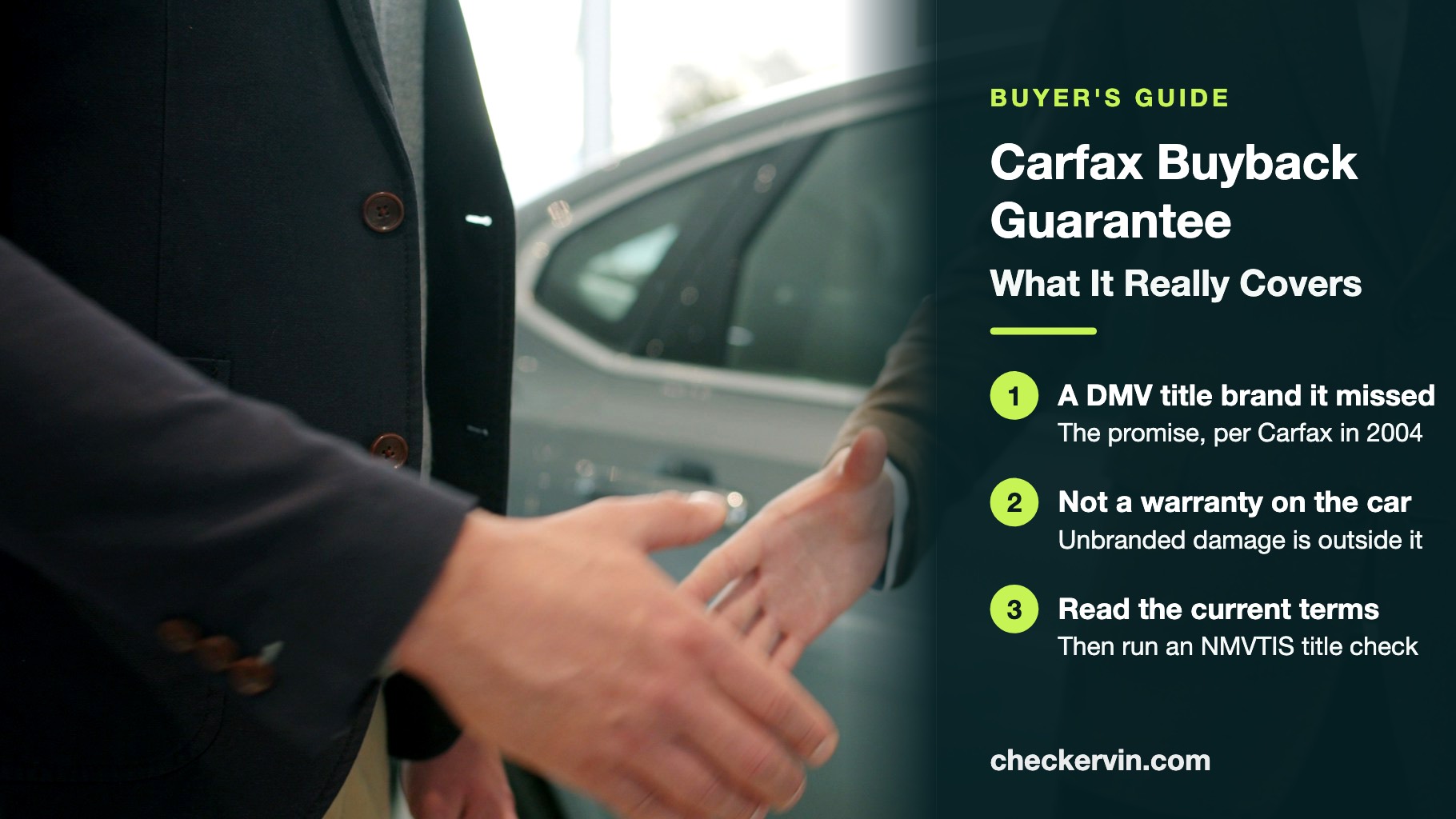
- Carfax's promise, announced in 2004, to buy back a car if a DMV had reported a problem, such as a salvage or lemon brand, that the Carfax report failed to show.
- What does it not cover?
- Anything no state wrote onto a title: repaired accidents, wear, mechanical faults. It is not a warranty on the car's condition.
- What should I do instead of relying on it?
- Read Carfax's current terms, run an NMVTIS title check from a DOJ-listed provider, and have the car inspected before you pay.
2004
Year Carfax announced it
Launch release, March 10, 2004
Title brands
What triggers it
Problems a DMV recorded
Not covered
Unbranded accident damage
Nothing a state never wrote down
12
NMVTIS sellers open to consumers
DOJ list, November 2026
The short answer
The Carfax Buyback Guarantee is narrow by design. It answers one question: did a state already brand this car’s title, and did the Carfax report fail to say so? If both are true and the claim meets Carfax’s terms, Carfax buys the car back. If the car simply turns out to be worse than it looked, the guarantee has nothing to say about it.
That narrowness is not a trick. A history report can only be as good as the records behind it, and the guarantee stands behind the records Carfax holds. It does not stand behind the car. Buyers who read it as a warranty on condition get the wrong idea, and the difference matters most at exactly the moment a problem turns up.
Two things people mean by “Carfax buyback”
The phrase covers two unrelated things, and it is worth knowing which one you are looking at.
| What you saw | What it means |
|---|---|
| “Buyback Guarantee” on a clean Carfax report | Carfax's promise about its own report: if a DMV-recorded problem was missed, it buys the car back |
| “Manufacturer buyback” or “lemon” in a report's title section | A carmaker repurchased the vehicle, usually under a state lemon law, and the state branded the title |
The second is a warning about the car. Carfax’s App Store listing says its reports include title information such as whether a car was salvaged, junked or declared a lemon. If that is what you are dealing with, our guide to lemon law buyback cars explains what to ask about the original defect. The rest of this page is about the first meaning.
How the Carfax Buyback Guarantee works
Carfax announced the guarantee in a release dated March 10, 2004, datelined Fairfax, Virginia. The promise was simple: if a consumer or dealer found that a vehicle had a severe problem reported by a Department of Motor Vehicles that the Carfax report did not show, Carfax would buy the vehicle back. The release said the guarantee came on every Carfax report that showed no DMV-reported problems, and that Carfax would pay what the buyer had paid.
The first payout came less than a year later. In February 2005 Vehicle Remarketing reported that Carfax was buying back a 2001 Corvette that a state DMV had given a salvage title in June 2002. The article said the buyback amount was set using the Kelley Blue Book retail value, and that the car’s report was then updated to show the salvage and rebuilt titles.
Two details from that history are worth holding onto. The guarantee was always keyed to what a DMV recorded. And the way the amount was worked out in the first real case was not the same as the launch line, which is a reminder that the payout rules live in the terms, not in the headline.
The guarantee also has a commercial life. In a February 24, 2016 release on PR Newswire, Carfax said eligible Chevrolet, Buick and GMC vehicles in GM’s Certified Pre-Owned program had to qualify for the Carfax Buyback Guarantee. So on some certified cars, qualifying for the guarantee is part of how the car got certified.
What the Carfax Buyback Guarantee covers
On Carfax’s own public record, the guarantee covers problems a state DMV reported. The examples Carfax and the trade press gave over its first year line up with the brands states put on titles:
| Source | Examples it named |
|---|---|
| F&I Magazine on the 2004 launch, quoting Carfax | Lemon history, major wrecks, major odometer problems |
| Vehicle Remarketing on the first buyback, 2005 | Salvage, flood damage, lemon, odometer problems |
A “major wreck” enters DMV records the way the 2005 Corvette did: when the state issues a salvage title. A wreck that was repaired without ever producing a brand leaves no DMV record to miss. Our guide to what a branded title is goes through each brand word, including fire and hail.
The precise current list, and any brands Carfax excludes, are set out on its terms page. That is the one document that decides a claim, and the next section explains why we cannot quote it.
What we could not verify in November 2026
On November 25, 2026Carfax’s terms page and its support article on the guarantee both returned an HTTP 403 error to our requests. We did not try to get around the block, and we have not filled the gap with summaries from other sites, because a guarantee is only worth what its exact wording says. So the following are not stated anywhere on this page, and you should read them on Carfax’s own page before you rely on the guarantee:
- The current list of covered brands, and any brands the terms exclude
- How long after the report date the guarantee lasts
- Whether the report must be dated before the purchase, and how close to it
- Which vehicles qualify, by type and model year
- Limits on claims per vehicle or per household
- How the payout is calculated, and any cap on it
- What documents a claim needs, and where to send it
Title, not condition
The single most useful thing to understand about any buyback guarantee is what event triggers it. It is not damage. It is paperwork: a brand a state put on the title before your report was run. A flooded car that was dried out and sold before any insurer or state got involved carries no flood brand, and a report that does not mention flood damage has not missed anything a guarantee covers.
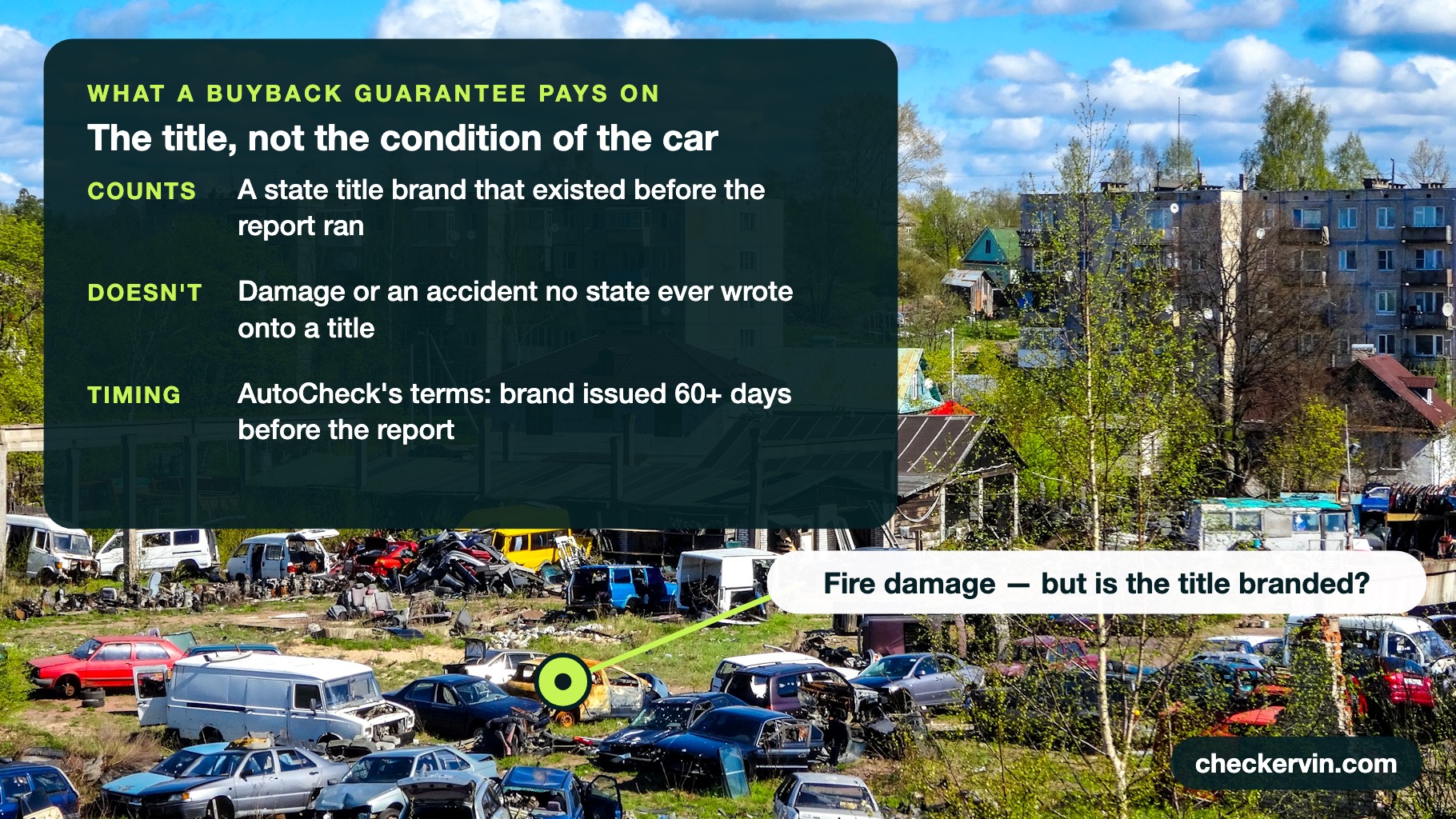
That is why the guarantee and an inspection do different jobs. The guarantee protects you against a records failure. An independent pre-purchase inspection protects you against the car itself, including every repair that never reached a record.
How to file a Carfax buyback claim
Carfax handles claims under the process set out in its terms and support pages, which we could not load to confirm. What we can describe is the evidence any title-brand claim rests on, because it follows from what the guarantee covers:
- 1Keep the report you relied onThe guarantee attaches to a specific report. Keep a copy showing its date, the VIN and the clean title section. A report run after you bought the car proves nothing about what you knew before.
- 2Get the brand on paper from the stateAsk the titling agency in the state that issued the brand for a certified copy of the branded title or title record. It shows the brand and the date it was issued, which is the fact the claim turns on.
- 3Gather proof that you own the carYour bill of sale and the current title in your name. Expect to sign the title over if the claim is paid, since a buyback means the company takes the car.
- 4Contact Carfax under its current termsFollow the claim route on Carfax's own guarantee page and note any deadline it sets. Keep copies of everything you send and when you sent it.
If the brand was applied after your report was run, the report did not miss it, and the guarantee is unlikely to help. That timing point is spelled out in AutoCheck’s terms below and is worth checking in Carfax’s.
AutoCheck Buyback Protection, from Experian's own terms
Experian publishes the full terms of AutoCheck Buyback Protection, and they loaded for us. They are not Carfax’s terms and should not be read as a stand-in for them. They are useful because they show, in plain contract language, how a title-brand guarantee is actually built. Read on November 25, 2026:
| Term | What AutoCheck's terms say |
|---|---|
| Trigger | A report run before purchase (and on or after June 27, 2005) showed no branded title, but one actually existed |
| Brand timing | The branded title must have been issued at least 60 days before the report was run |
| Registration | Consumers and later buyers from a dealer must register within 90 days of buying the car |
| How long it lasts | Until you sell the car or 1 year after the first report run for you, whichever comes first |
| Vehicles | Passenger vehicles and light trucks, model year 1981 or later |
| Payout | The purchase price, plus warranties and add-ons such as installed accessories up to $500 in total |
| Payout cap | If you paid more than NADA Used Car Guides retail value, no more than 10% above that value |
| What you hand over | A claim form, the report, the original bill of sale, a certified copy of the branded title, and the title signed over to Experian |
| Prior knowledge | No protection if you knew or had evidence of the brand before buying |
| Dealers | Only reports bought through an AutoCheck commercial service carry protection to the dealer's buyers |
| Governing law | Illinois |
The brands its definition of a branded title covers:
- Junked or salvaged
- Dismantled, rebuilt or reconstructed
- Flood damaged
- Fire damaged
- Hail damaged
- Bought back by its manufacturer (a lemon law vehicle)
- Odometer exceeds mechanical limits
- Odometer not actual mileage
- Any other word or symbol signifying a substantially similar brand
And what it specifically leaves out:
- A title first issued clean and later stamped with a brand without being reissued
- Salvage titles issued because the vehicle was stolen
- Damage disclosure documents
- Brands issued in error and later corrected
- Accident information, unless it falls inside the definition of a branded title
Our AutoCheck review covers the report itself; this is only its guarantee.
Carfax Buyback Guarantee vs AutoCheck buyback protection
A fair comparison can only use what each company let us read, so here it is with the gaps marked rather than filled in.
| Carfax Buyback Guarantee | AutoCheck Buyback Protection |
|---|---|
| Trigger: a DMV-reported problem the report missed (2004 launch) | Trigger: a branded title the report missed |
| Brands: examples named were salvage, flood, lemon and odometer | Brands: 8 named types, plus substantially similar brands |
| Accidents without a brand: outside a DMV-keyed promise | Accidents without a brand: expressly excluded |
| Registration step: not verified, terms page blocked | Registration step: within 90 days of purchase |
| Time limit: not verified, terms page blocked | Time limit: 1 year, or until you sell |
| Amount: what the buyer paid at launch; Kelley Blue Book retail in the first case (2005) | Amount: purchase price, capped at 10% over NADA retail |
| NMVTIS reports to consumers: no, per the DOJ | NMVTIS reports to consumers: no, per the DOJ |
The honest conclusion is that the two are the same kind of product. Neither is a reason to choose one report over the other on its own, and neither replaces the checks below. How the two reports differ in what they record is set out in AutoCheck vs Carfax.
Where both guarantees stop
Read together, the public record on both products points to the same blind spots. None of them is hidden; they follow from guaranteeing records rather than cars.
- Damage that never produced a brand: repaired accidents, uninsured floods, private-party fixes
- Brands applied after the report ran, or, under AutoCheck's terms, fewer than 60 days before it
- Events a state never reported, which a report cannot miss because no database holds them
- Mechanical condition, wear and maintenance, which no title records at all
- Claims from a buyer who already knew about the brand
The federal government is candid about the third point. The Department of Justice says about 87 percent of the U.S. vehicle population is in NMVTIS, that more than half of the states report into it, and that a search can therefore return a false negative such as “no junk or salvage history.” It adds that the same gaps can exist in private vehicle history databases. Our page on how accurate Carfax is looks at what that means for a single report.
Run the NMVTIS title check before you buy
A guarantee pays after something has gone wrong. The cheaper move is to look at the federal title record first. NMVTIS, the National Motor Vehicle Title Information System, keeps every brand a reporting state has applied, and the Department of Justice says a brand becomes a permanent part of the vehicle’s record. That is what defeats title washing, where a car is retitled in another state to shed its brand.
Carfax is not the route to that record for a private buyer. The department’s provider page says it directly: “Consumers CANNOT receive NMVTIS Vehicle History Reports from Carfax, DMVDesk, or Experian.” It lists Carfax for NMVTIS data to commercial customers in California only. The businesses it approves to sell the record to the public, in its alphabetical order, are:
- Bumper.com
- Carsforsale.com
- Carvertical.com
- Checkthatvin.com
- Clearvin.com
- EpicVin.com
- GoodCar.com
- Titlecheck.us
- Vinaudit.com
- Vindata.com
- VinReport
- Vinsmart.com
That is 12 names, and the department says the order implies no preference. The DOJ also encourages buyers to consider looking at the actual state title record before buying. Our NMVTIS report guide explains each field in the federal record.
What CarCheckerVIN checks free today
We do not sell a guarantee, and we do not sell a history report today. What our free VIN scan returns now:
- Factory build and specifications decoded from the VIN
- Factory warranty terms
- Open NHTSA safety recalls
- Photos filed against the VIN
- Market and listing prices
A sensible order before you pay for any car: decode the VIN free and match it to the title and the listing, check open recalls, buy one NMVTIS title report from a listed provider, read the terms of any guarantee on the report you were given, and have the car inspected.
Start with the free decode and recall check
Decoded from official manufacturer and NHTSA records
Where this information comes from
- CARFAX launches Buyback Guarantee — Carfax release, March 10, 2004 (The Auto Channel)The launch terms in Carfax's own words: DMV-reported problems, what the buyer paid
- Carfax raises consumer confidence with new guarantee — F&I Magazine, March 2004Examples Carfax gave: lemon history, major wrecks, major odometer problems
- Carfax buys back first car under its Buyback Guarantee — Vehicle Remarketing, February 2005The first buyback, a salvage-titled 2001 Corvette, valued at Kelley Blue Book retail
- Carfax expands role in GM Certified Pre-Owned program — PR Newswire, February 24, 2016GM CPO vehicles must qualify for the Carfax Buyback Guarantee
- CARFAX — New & Used Cars, Apple App Store listingReports include whether a car was salvaged, junked or declared a lemon
- CARFAX Buyback Guarantee terms and conditionsThe governing terms; returned HTTP 403 to our requests on November 25, 2026, so not quoted
- AutoCheck Buyback Protection Terms and Conditions (Experian)Every AutoCheck term on this page; read November 25, 2026
- NMVTIS — approved data providers (DOJ / BJA)Consumers cannot get NMVTIS reports from Carfax or Experian; the public provider list
- NMVTIS — information for consumers (DOJ / BJA)Coverage figure, false-negative warning, permanent brands and brand washing
- How we made this pageWritten by the CarCheckerVIN editorial team with AI assistance from Carfax's own dated press releases, Experian's published AutoCheck terms, the Department of Justice's NMVTIS pages and other public records; facts checked November 2026.
Keep reading
Frequently asked questions
How does the Carfax Buyback Guarantee work?
When Carfax announced it in March 2004, the company said it would buy back a vehicle if a Department of Motor Vehicles had reported a severe problem with it that the Carfax report failed to show, and that the guarantee came with every report showing no DMV-reported problems. The current eligibility rules, time limits and payout terms are on Carfax's terms page, which refused our requests in November 2026, so read that page yourself before relying on the guarantee.
What does the Carfax Buyback Guarantee cover?
Problems that a state DMV recorded, which in practice means title brands. Carfax's own announcements and the press coverage of its first buyback named salvage, flood damage, lemon history and odometer problems as examples. It does not reach damage that no state ever wrote onto a title, and it is not a warranty on the car's mechanical condition.
How do I file a Carfax buyback claim?
Claims go to Carfax under the process on its terms and support pages, which we could not load to confirm. Before you contact it, gather the dated report you relied on, your bill of sale and current title, and a certified copy of the branded title from the state that issued it. That last document is what proves the brand existed before your report did.
Does the Carfax Buyback Guarantee cover accidents?
Not as such. Carfax framed the guarantee around problems reported by a DMV. An accident that was repaired and never led a state to brand the title is not a DMV-reported problem, so nothing in Carfax's published statements extends the guarantee to it. AutoCheck's terms say this outright: accident information is excluded unless it falls within the definition of a branded title.
Carfax Buyback Guarantee vs AutoCheck buyback protection: which is better?
We can only compare what each company let us read. Experian publishes AutoCheck's full terms: a covered brand list, a 90-day registration window, a one-year limit, and a payout cap tied to NADA retail value. Carfax's current terms page blocked us, so we cannot set its rules against those line by line. Both are built the same way: they pay on a title brand that existed but went unreported, not on the car's condition.
Does “buyback” on a Carfax report mean the car was a lemon?
Usually, yes, and that is a different thing from the guarantee. A manufacturer buyback brand means a carmaker repurchased the vehicle, typically under a state lemon law, and the state recorded that on the title. Carfax's app listing says its reports show whether a car was declared a lemon. The guarantee, by contrast, is Carfax's promise about its own report.
Should the guarantee replace an NMVTIS check or an inspection?
No. The Department of Justice says consumers cannot get NMVTIS reports from Carfax or Experian, so the federal title check has to come from a provider on its list. And no title guarantee touches the car's mechanical condition, which only an independent inspection can.
Check the VIN before you rely on any guarantee
Decode any VIN free for the factory build, specifications, warranty and open safety recalls. Full vehicle history reports are launching soon.
Run a free VIN check