The short answer
- What is AutoCheck best at?
- Auction history. Experian's ownership of the data relationships means wholesale and salvage auction appearances — loss type, damage area, run-and-drive status — surface in more detail than anywhere else.
- What does the Score actually mean?
- A 1–100 estimate of the odds a vehicle is still on the road in five years, versus similar cars. It was built for dealers deciding fast at auction, not for you deciding about one car.
- Should you buy it instead of Carfax?
- They hold different records on the same car, so neither is a superset of the other. Buy AutoCheck when auction and salvage lanes matter, Carfax when service history does.
Experian
Who owns it
Hence the auction data access
1–100
The AutoCheck Score range
Five-year survival odds, vs peers
15 vs 3
Service records on one tested car
Carfax vs AutoCheck, per Edmunds
Commercial
Its NMVTIS listing category
Not the public-customer list
The short verdict
AutoCheck is a serious report with a genuine specialism. If a car has been through a wholesale or salvage auction, this is the mainstream product most likely to say so and in the most useful detail. Its weakness is the mirror image: routine maintenance history is thinner than Carfax’s, and its headline score answers a question most private buyers are not actually asking.
Where it genuinely leads — auction lanes
Experian’s ownership matters here in a way corporate parentage usually does not. AutoCheck draws on wholesale and salvage auction feeds — Manheim and ADESA on the wholesale side, IAAI and Copart on the salvage side — and surfaces appearances with the detail that makes them meaningful: what loss type was recorded, which area took the primary damage, whether the car ran and drove through the lane, and when it sold.
For a used-car buyer that is genuinely valuable intelligence. A car that crossed a salvage auction block and then appeared on a retail lot with a clean-looking title is exactly the vehicle you want the report to catch, and auction records catch it even when the paperwork was later tidied. It also tells you something more mundane but useful: whether the “one careful owner” car was bought wholesale six weeks ago.
The AutoCheck Score, explained properly
The Score compresses a report into a number from 1 to 100 representing how likely the vehicle is to still be on the road in five years, measured against similar vehicles of the same class and age. Every report shows the car’s score alongside the normal range for its peer group, which is the part buyers most often skip — a 78 means nothing until you see whether comparable cars score 70 to 90 or 40 to 60.
What the Score is not
It was designed as a dealer tool. At auction a buyer has minutes and hundreds of cars, and a single comparable number is exactly the right instrument for that job. A private buyer looking at one specific car has the opposite problem — plenty of time, one vehicle — and for them the underlying records matter far more than the summary statistic derived from them.
Two reports on one car do not match
You will find a widely repeated statistic claiming a precise overlap percentage between the two major reports. We do not use it, because we could not trace it to any study — no publisher, no method, no sample. What can be shown is better anyway, because someone published the actual test.
Edmunds ran both products against the same vehicles and wrote up what came back. On a 2014 Porsche Boxster that had spent most of its life in Florida, Carfax returned fifteen service records going back to 2014 while AutoCheck returned three. The same pair of reports disagreed about ownership too — five owners on one, three on the other — and the explanation is instructive rather than sinister: Carfax counted dealerships that took possession of the car between private owners, and AutoCheck counted only the people who bought it.
Their second example is the one that should change how you read a clean report. On a 2017 Honda Accord carrying a salvage title, AutoCheck held two accidents including an insurer’s total-loss entry. Carfax held both of those and also front-end damage recorded in November 2024. Running the reports in early December 2024, the most recent incident AutoCheck showed was from July 2022. The 2024 damage may well reach AutoCheck eventually — which is the point. A report is a snapshot of what has been reported to that network by that date, not a statement about the car.
| What the test showed | What a buyer should take from it |
|---|---|
| Fifteen service records against three, one Boxster | Maintenance depth differs sharply; Carfax's dealer network is denser |
| Five owners against three, same car | Definitions differ — one counted dealers taking possession, one did not |
| Recent damage on one report and not the other | Reporting lag is real; the newer the event, the likelier one lags |
| Neither report was a superset of the other | A clean report is the absence of records, not the absence of history |
The practical consequence for a buyer spending real money: a clean AutoCheck plus a clean NMVTIS title record plus a physical inspection is a meaningfully stronger position than any single report at any price. Our head-to-head comparison covers which to reach for when you can only justify one.
Its NMVTIS position, stated accurately
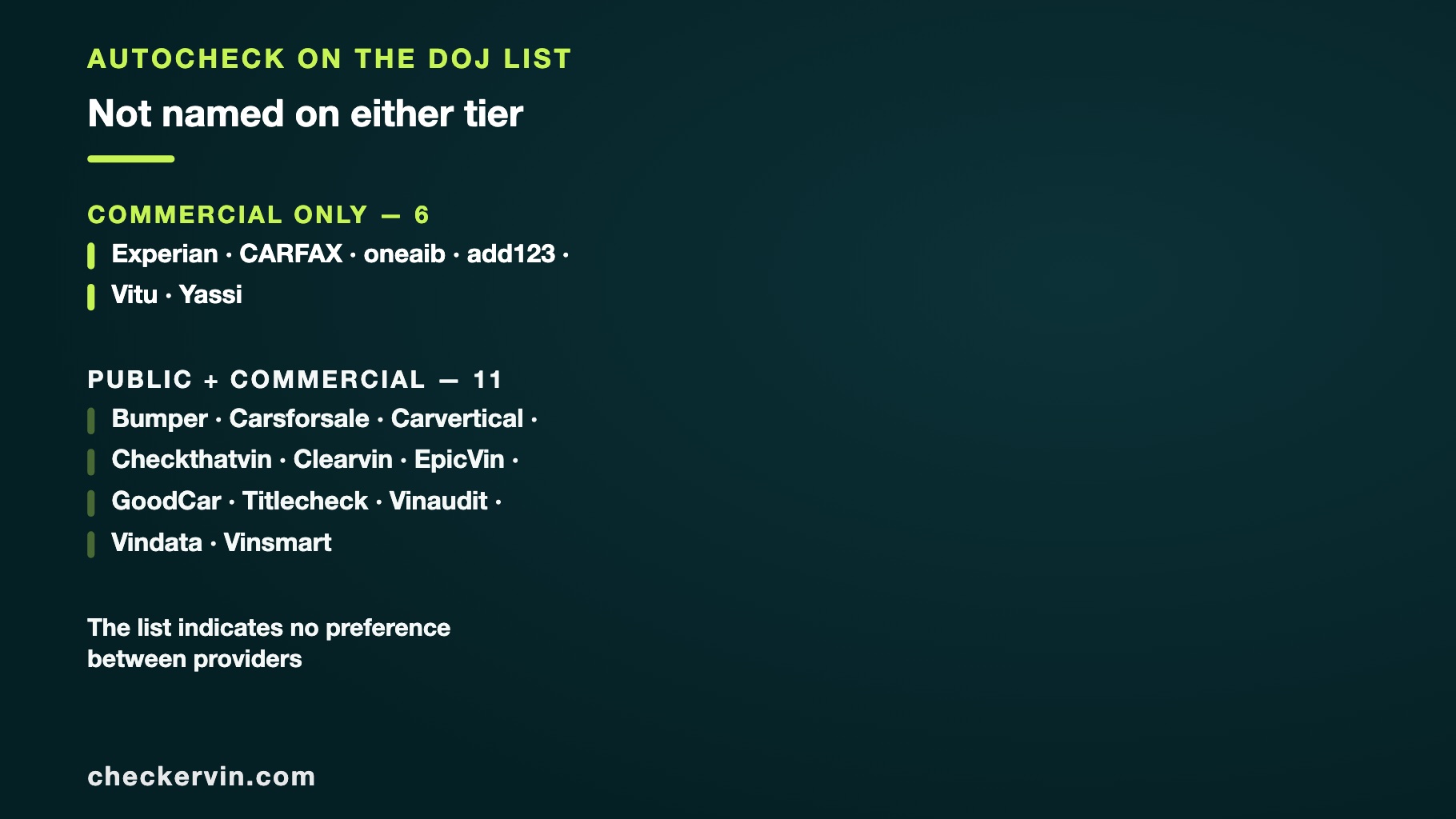
The Department of Justice publishes which companies may sell NMVTIS reports and to whom. Experian appears under commercial customers rather than the public-customer list — the same category as Carfax, which is listed for commercial customers in California. This is worth knowing rather than alarming: it means that if your specific goal is federally sourced title-brand data, an approved public provider such as VinAudit or EpicVIN is the direct route, and AutoCheck is a complement rather than a substitute for it.
One point of precision, because it is easy to blur. AutoCheck does not appear on the list under its own name at all, in either tier. What appears is Experian.com, in the commercial-only group. Those are two separate facts about a published page, and we are reporting both rather than reconstructing the corporate arrangement that connects them. If you want to know exactly what an AutoCheck report contains, the company’s own documentation is the source for that, not this list.
What it under-reports
- Routine maintenance — oil changes and scheduled services are thinner here than in Carfax's dealer network
- Minor accidents repaired privately, which generate no claim, no police report and no title event
- Damage repaired under warranty at a shop that reports to neither network
- Owner identity — federal privacy law puts that beyond every provider, always
- Mechanical condition today, which no report from anyone has ever measured
Who is listed, if the federal record is what you need
The practical value of that list is the other side of it. These businesses are approved to provide the federal title record to all interested parties, consumers included:
- Bumper.com
- Carsforsale.com
- Carvertical.com
- Checkthatvin.com
- Clearvin.com
- EpicVin.com
- GoodCar.com
- Titlecheck.us
- Vinaudit.com
- Vindata.com
- Vinsmart.com
11 names, and the federal data in each of their reports is the same underlying record — so choosing among them is a matter of presentation and price rather than of dataset. The department notes the list is alphabetical and indicates no preference between them.
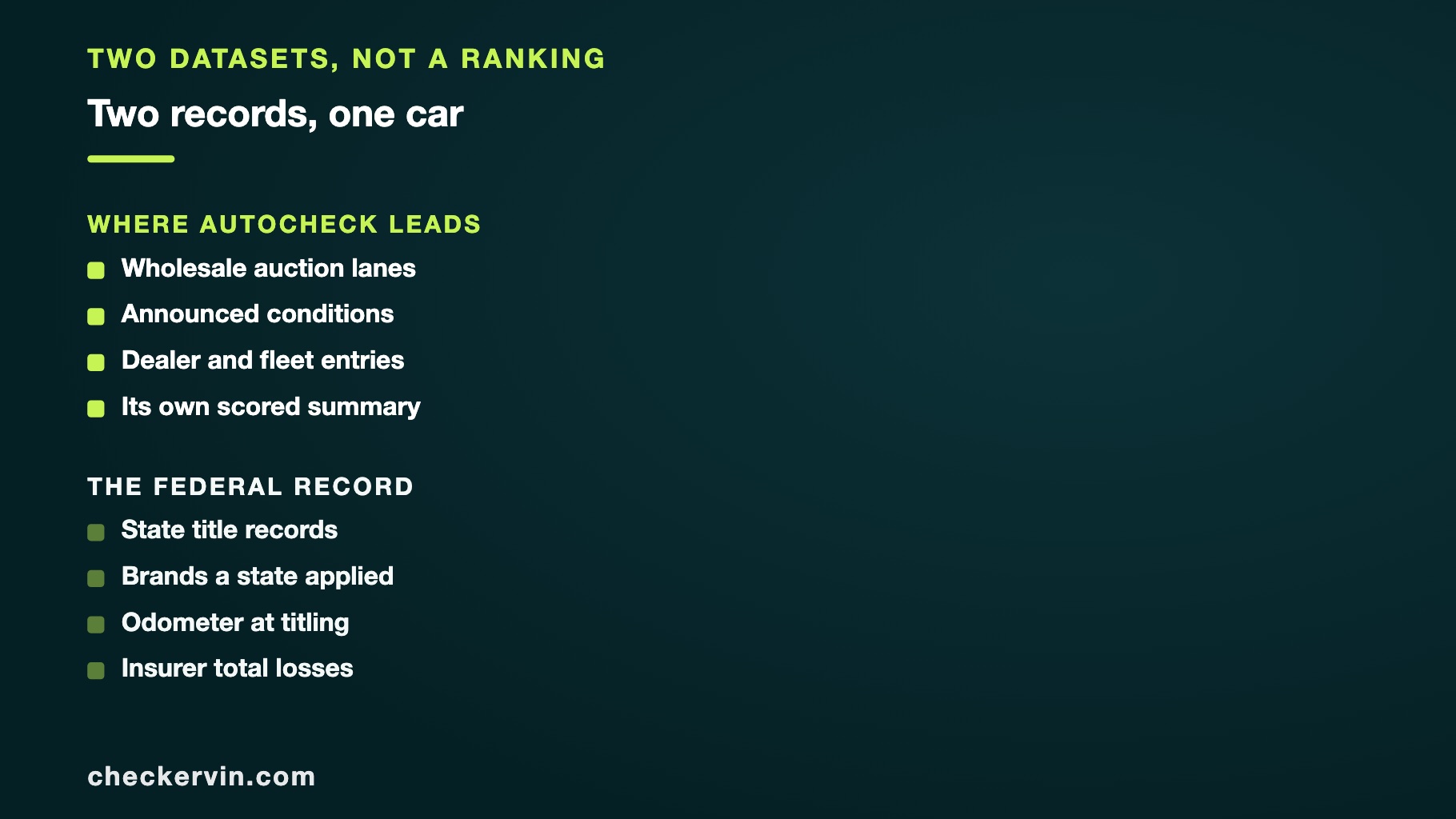
Pair one of those with AutoCheck rather than treating either as a replacement. The auction-lane detail this page opens with is genuinely something the federal record does not hold, and the reverse is equally true.
Several of those names are one company
A detail from the same page, useful if you go comparing after reading this. Alongside several approved providers the department lists the other websites they own that sell reports containing the same federal data.
| Approved provider | Also sold as |
|---|---|
| Bumper.com | BeenVerified.com |
| Carsforsale.com | VehicleHistoryReport.com |
| EpicVin.com | VinGurus.com and Vininspect.com |
| GoodCar.com | InfoTracer, Recordsfinder.com and StateRecords.org |
| Vinaudit.com | VinCheck.Info |
So a comparison between two names in the same row is a comparison of storefronts over one approval. We reproduce both tiers with these lines on how to choose a VIN check.
Buying it without overpaying
AutoCheck sells single reports and multi-report packages, and the package is often priced close enough to a single report that buying one report is poor value if you are genuinely shopping. The trap is the reverse: buying a multi-report window, checking one car, and forgetting the window exists. Decide honestly how many cars you will check this month, then buy the tier that matches — and put the expiry date in your calendar. Our guide to report pricing sets the tiers side by side.
Who it suits
It suits the buyer looking at a suspiciously cheap car, anything that might have run through a salvage lane, or a dealer vehicle whose recent history you want to understand. It suits dealers and frequent buyers, whose workflow the Score was designed around. It suits less well the private buyer of a well-documented car from a long-term owner, where maintenance depth decides more than auction history — and it never replaces the inspection.
Start free: decode the VIN and check open recalls
Decoded from official manufacturer and NHTSA records
Where this information comes from
- NMVTIS — approved data providersThe federal list showing Experian under commercial customers
- Edmunds — AutoCheck vs. Carfax, tested on the same vehiclesThe Boxster and Accord comparisons cited above — a named, dated, hands-on test rather than an unattributed statistic
- NHTSA recall lookupOpen recalls, free from the regulator, whichever report you buy
- NICB VINCheckFree theft and total-loss screen, independent of both networks
- FTC — buying a used carThe Buyers Guide rule and your rights at a dealership
Keep reading
Frequently asked questions
Is AutoCheck as good as Carfax?
It is better at some things and worse at others, which is why buyers who can afford both sometimes buy both. AutoCheck's auction coverage is the deepest in the market because Experian owns the data relationships. Carfax carries more service and maintenance history. When Edmunds ran both on one 2014 Porsche Boxster, Carfax returned fifteen service records to AutoCheck's three — a concrete illustration that the two networks do not hold the same file on the same car.
What is the AutoCheck Score?
A single number from 1 to 100 estimating how likely a vehicle is to still be on the road in five years, benchmarked against similar cars of the same class and age. Experian built it primarily so dealers could make fast decisions at auction, which is worth remembering: it is an acquisition tool, not a verdict on whether one specific car suits you.
Does AutoCheck show auction history?
Yes, and this is its strongest suit. Reports surface wholesale and salvage auction appearances including loss type, primary damage area, run-and-drive status and sale date — detail that comes from Experian's access to feeds including Manheim, ADESA, IAAI and Copart. For spotting a car that quietly passed through a salvage auction, it is the most informative mainstream report.
Is AutoCheck an approved NMVTIS provider?
Experian appears on the Department of Justice's NMVTIS provider list under commercial customers rather than public customers. That does not make AutoCheck reports less useful, but it does mean a consumer wanting federally sourced title data is better served buying an NMVTIS report from a provider approved to sell to the public.
Is AutoCheck worth it?
It earns its price when auction history matters — cars priced suspiciously low, vehicles that may have been through salvage lanes, or any purchase where you want to know whether a dealer bought it at wholesale last month. It earns it less on a one-owner car with a thick folder of dealer service receipts, where Carfax's maintenance depth tells you more.
Free first, paid when it earns it
Decode any VIN free for the factory build, specifications and open safety recalls. No account, no card.
Run a free VIN check