The short answer
- What is a lemon buyback?
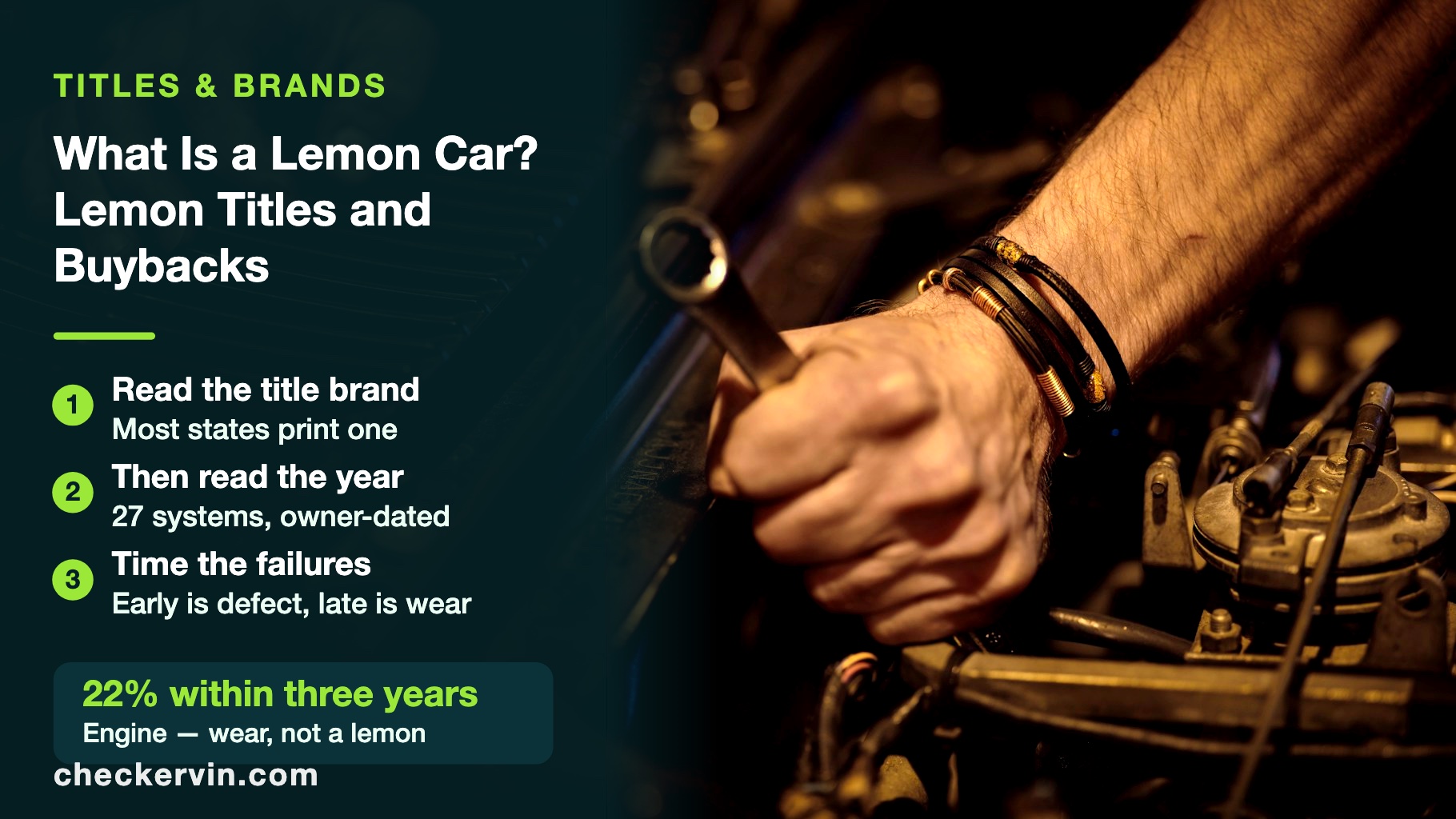
- A car the manufacturer repurchased under a state lemon law after repeated failed repairs of a substantial warranty defect. In branding states the returned title carries a permanent lemon or manufacturer-buyback mark.
- How do you spot one?
- The brand follows the VIN through the national title record. Where branding is weak, the tell is a manufacturer-owned title chapter followed by an auction sale — read that shape as a buyback.
- Should you buy one?
- With the buyback file in hand — defect, repairs, extended coverage — a repaired lemon at a lemon price can be rational. Without the file, you are buying the mystery, not the discount.
Factory
Who takes the car back
Repurchase under state law
Repeats
What earns the brand
Failed fixes of one substantial defect
Permanent
The brand's lifespan
It follows the VIN forever
The file
What makes one buyable
Defect, repairs, extended coverage
How a car becomes a lemon — the repair-attempt clock
Lemon laws are state warranty statutes with a shared skeleton: a substantial defect covered by the factory warranty, a reasonable number of repair attempts — several for ordinary defects, fewer for safety-critical ones, or a cumulative month-plus out of service — and a manufacturer that still has not fixed it. At that line the maker owes the owner a repurchase or replacement: refund of price and fees, minus a usage offset for the miles driven. The repurchased car goes back to the manufacturer, and that is where the resale story begins.
The buyback brand at resale
Manufacturers do not crush buybacks; they repair them — or declare them repaired — and wholesale them back into the market through auctions. In branding states the title now carries a permanent mark: “Lemon Law Buyback,” “Manufacturer Repurchase,” or that state’s wording, and the brand follows the VIN through the national title recordlike salvage or flood. California’s version is the strictest — a decal on the doorjamb and title branding — while a few states brand weakly or not at all, which is how unbranded buybacks surface two states away. The title chain tells on them: a manufacturer as a titled owner, then an auction, is the buyback silhouette whether or not a brand printed.
Disclosure rules — what sellers must say
Branding states require the buyback’s disclosure at retail sale — in writing, sometimes on a state form, sometimes with the doorjamb decal — and the federal used-car ecosystem layers ordinary fraud law on top: knowingly concealing a buyback is misrepresentation with teeth. In practice disclosure quality tracks the seller: franchise dealers paper it correctly, auction-flip retailers mumble, and private resellers two owners downstream may genuinely not know. The record checks exist for exactly that last case — the brand outlives every seller’s memory.
The federal law underneath every state lemon law
Lemon laws are state law, but they sit on top of a federal one. The Magnuson-Moss Warranty Act, signed on January 4, 1975, is the federal statute governing warranties on consumer products, and it is the backstop when a state statute does not reach a particular situation.
The practical division is simple enough. State lemon laws set the specific tests — how many repair attempts, how many days out of service, over what period. Magnuson-Moss supplies a broader federal warranty claim that is not tied to those thresholds, which matters when a vehicle misses a state test but the warranty clearly failed the owner.
Who pays the lawyer, and why that is the whole mechanism
There is a question sitting underneath this entire page that most accounts skip. A lemon claim is worth the price of one car. Legal fees can approach that quickly. So how does anyone ever pursue one to the point where a manufacturer writes a check — which is the event that creates the brand you are reading on a title years later?
The answer is a single sentence of federal law. Under the Magnuson-Moss Warranty Act, at 15 U.S.C. 2310(d)(2), a consumer who finally prevailsmay be allowed by the court to recover, as part of the judgment, the aggregate cost and expenses of the case — explicitly including attorneys’ fees based on actual time expended, where the court finds them reasonably incurred.
That provision is why a lawyer will take a case whose subject is one vehicle. The fee does not have to come out of the owner’s recovery, so a claim that would be economically irrational to fund privately becomes something a firm will run. Manufacturers know this too, which is a large part of why disputes settle into repurchases rather than litigating to judgment.
For a buyer, none of this is academic. It explains why the population of branded cars exists at all, and why it is skewed: the vehicles that got repurchased are disproportionately the ones whose owners found representation, not simply the ones that were worst. That is the same selection effect this page has already warned about from the other direction — an unbranded title records that nobody won a case, not that nothing was wrong.
Prior resort: the arbitration you may have to do first
This is the trap that catches owners who assume the next step is a lawyer.
Since Magnuson-Moss, most states have enacted lemon laws requiring consumers to use an informal dispute settlement mechanism — the manufacturer’s arbitration program — before filing suit. Some states run their own; others require manufacturers to operate one meeting the federal rule’s standards.
Whatever route you are on, the record you build is the same: dated repair orders, the complaint as you described it each time, and how long the vehicle was unavailable.
Why the answer changes at the state line
There is no single national test for a lemon, which is why confident numbers you read online are usually somebody’s state quoted as though it were everyone’s.
- How many repair attempts count, and for what kind of defect
- How many cumulative days out of service qualify
- The window the clock runs in, by time or by mileage
- Whether used and leased vehicles are covered at all
For anything consequential, the state attorney general’s office or a private attorney is the right source. This page is not legal advice, and the variation between states is exactly the thing that makes general advice unreliable here.
Should you buy a car with a lemon title?
- The file exists — repurchase paperwork naming the defect, the repair orders, and the final fix; no file, no deal
- The defect is the fixable kind — a software-plagued infotainment unit reads differently than intermittent stalling never reproduced
- Extended coverage came with it — manufacturers often warrant the repurchase repair; verify what transfers to you
- The price is a buyback price — brand-adjusted against clean comparables, not detailing-adjusted
- Your insurer and lender agree — some balk at branded titles; confirm before the deposit, not after
Checking for one by VIN
The sequence is the site’s usual stack with one extra reading: pull the NMVTIS record and look for the brand itself, then read the title chain for the buyback silhouette — manufacturer ownership followed by auction resale — that weak-branding states leave behind. A warranty checkfills in what factory coverage survived, and the free decode confirms you are reading the right car’s story before any of it.
Decode the VIN free
Decoded from official manufacturer and NHTSA records
The lemons that never got branded
Every guide to spotting a lemon tells you to research the model, and then sends you to a paid history report to do it. For this particular question that is the wrong instrument. A buyback brand exists because a manufacturer repurchased the car, and a manufacturer generally does that only after an owner pursued a claim under state lemon law and prevailed or settled. That takes documentation, patience and often the arbitration described above. Most owners of a genuinely troubled car never start.
So an unbranded title means something narrower than it appears to: nobody won a case against this car. It is not evidence that the defect pattern is absent. The pattern lives somewhere else entirely — in what owners of that model year reported to NHTSA, whether or not one of them ever filed for a repurchase.
That record is the one to read before you buy, because lemon law runs on defects that surface inside the warranty period, and every complaint carries the date the owner says the failure happened. The gap between that date and the model year is how old the car was when it broke. Systems that fail early are the ones a lemon-law clock would have been running on.
The comparison that matters is not against cars in general — it is against the rest of the same car. Every vehicle has systems that fail late, because that is what wear looks like. A defect shows up as one or two systems failing at an age nothing else on that car is failing at. The 2010 Prius separates cleanly:
| 2010 Toyota Prius, by system | Reports, and the median age when owners said it failed |
|---|---|
| Service brakes | 1,967 reports · median age 0.1 years — about five weeks |
| Hydraulic | 842 reports · median age under a month |
| Electric | 501 reports · median age under a month |
| Vehicle speed control | 286 reports · median age under a month |
| Electrical system | 193 reports · median age 5.8 years |
| Exterior lighting | 147 reports · median age 5.3 years |
| Engine | 141 reports · median age 7.3 years |
Read the bottom three rows first, because they are the control. On this same car, the electrical system took 5.8 years to draw a complaint, the lights 5.3, the engine 7.3. That is an ordinary car aging normally. Then the top four arrive at five weeks and under. Nothing about a car’s condition at five weeks is wear; that is the shape of a defect, and it is the shape a lemon-law claim is built on.
The volume says the same thing. The 2010 Prius is the heaviest year of its whole run — 2,826 complaints against a nameplate median year of 207, and nearly double the next worst year — yet a 2010 Prius with a clean title tells a buyer none of that, because the brand only ever records the owners who fought and won.
Which systems the lemon-law clock actually reaches
The Prius reads cleanly because its early failures are extreme. Most cars are not that obliging, and the method above needs a baseline: what does a warranty-window failure look like in general? Our own complaint records answer that, and the answer rearranges the problem.
Across the 73 model years in this dataset, 27system categories have enough dated reports to measure — each one appearing on at least eight separate vehicles, so a single bad year cannot set the number. For each, we know the median age at which owners said the failure happened, and the share of reports arriving inside the first three years, which is roughly the bumper-to-bumper window a lemon-law claim has to live in.
Rank those categories by how loud they are and engine leads everything, with 14,353 reports. Rank them instead by whether the failure arrived while the manufacturer still owed a repair, and the order inverts. Engine complaints are the most numerous on the site and among the latest to arrive: a median age of 5 years, with only 24% inside three years. That is a durability story, and no lemon law reaches it.
The categories that cluster early are different ones:
| System | Share reported within three years, and median age at failure |
|---|---|
| TIRES | 65% within three years · median age 2.2 years |
| VISIBILITY/WIPER | 47% within three years · median age 3.5 years |
| VISIBILITY | 43% within three years · median age 4.3 years |
| STRUCTURE | 42% within three years · median age 3.7 years |
| VEHICLE SPEED CONTROL | 42% within three years · median age 4.2 years |
| ELECTRONIC STABILITY CONTROL | 41% within three years · median age 3.8 years |
And at the other end, the systems a lemon claim will almost never be built on — these fail long after the warranty has closed:
| System | Share within three years, and median age |
|---|---|
| FORWARD COLLISION AVOIDANCE | 22% within three years · median age 5.9 years |
| BACK OVER PREVENTION | 15% within three years · median age 6.6 years |
| LANE DEPARTURE | 13% within three years · median age 6.3 years |
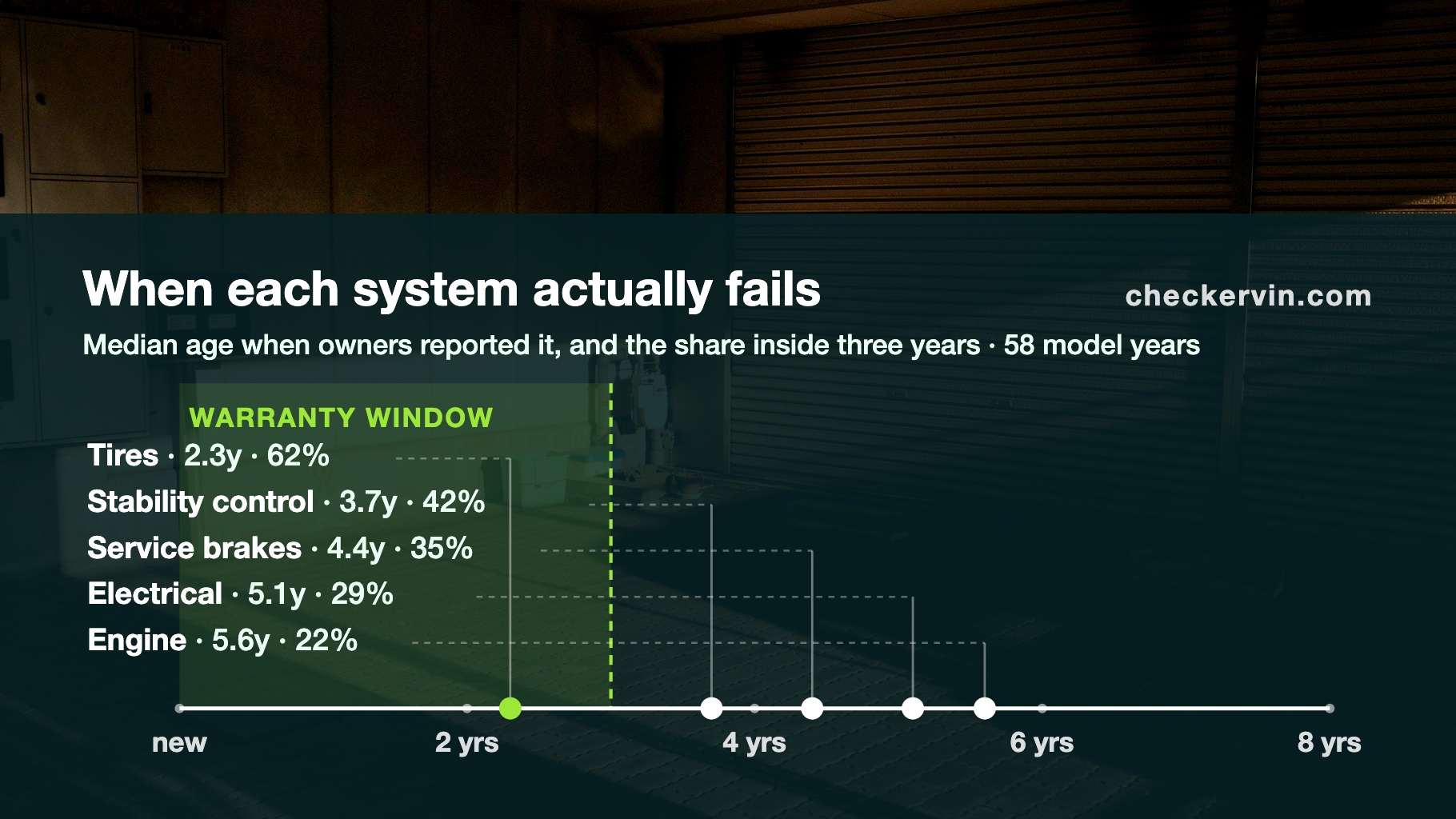
Two cautions before you use this. Tires tops the early table at 65%, and tires are a consumable that most bumper-to-bumper warranties exclude outright — an early failure there is usually a supplier or specification problem, not a claim. And a high share within three years is a property of the category across many cars, not a verdict on the one in front of you. It tells you which systems are worth checking on a specific car’s record, not what that car did.
Used properly, it is a shortlist. Pull the model year you are considering, look first at the systems in the top table, and ask whether that car reported them at an age nothing else on it was failing at. If it did, a lemon-law clock was running whether or not anyone chose to start it — which is exactly the history an unbranded title does not carry.
If your own car is turning into a lemon
- 1Keep every repair orderThe attempt count is the whole case — same defect, dated visits, days out of service, in writing.
- 2Report the defect inside the warrantyThe clock runs on warranty-period complaints; late-discovered patterns fight uphill.
- 3Invoke the law in writingStates differ on notice letters and arbitration steps — your attorney general's lemon-law page has the sequence.
- 4Expect the usage offsetRepurchase refunds subtract for miles driven; the formula is statutory, not negotiable mood.
Where this information comes from
- 15 U.S.C. 2310 — Magnuson-Moss remedies and the fee provisionSubsection (d)(2): costs and attorneys' fees to a consumer who finally prevails, at the court's discretion
- FTC — auto warranties and lemon lawsThe federal consumer framing around state lemon laws
- California DMV — lemon law buybacksThe strictest branding-and-decal regime, as the model
- NMVTIS — national title recordWhere buyback brands follow the VIN across states
- NHTSA — file a vehicle safety complaintDefect complaints that feed investigations and recalls
Keep reading
Frequently asked questions
What is a lemon car?
A car with a substantial defect the manufacturer cannot fix within a reasonable number of attempts, while it is still under the factory warranty. State lemon laws then require the maker to refund or replace it. When that happens the car is repurchased, and in branding states its title carries a permanent lemon or manufacturer-buyback mark on return to market. Most troubled cars never reach that point, so an unbranded title is not proof a car was never a lemon.
How many repair attempts make a lemon?
State formulas vary around a common shape: several failed attempts at the same substantial defect — fewer if it is a serious safety defect like brakes or steering — or a cumulative stretch of days out of service inside the warranty period. The manufacturer then owes a repurchase or replacement under that state's law.
Does a lemon buyback show on a vehicle history check?
In branding states, yes — the title brand follows the VIN through the national NMVTIS record like any other brand. Some states brand weakly or not at all, which is why a manufacturer-owned title chapter followed by an auction sale is worth reading as a buyback even when no brand printed.
Should you buy a car with a lemon title?
Sometimes genuinely — the defect may have been fixed for good, and the brand discounts the price permanently. The test is documentation: the buyback file names the exact defect and repairs, warranty coverage on the repurchase is often extended, and a car whose paperwork is complete can be priced rationally. A buyback without its file is a mystery wearing a discount.
Do lemon laws cover used cars?
The classic laws cover new vehicles inside the factory warranty, and a handful of states extend versions to used cars or certified pre-owned. Everywhere else, used-car remedies run through the federal warranty act and ordinary fraud law — which is why the buyback brand on a used listing matters more than the law that created it.
The factory's defeat is on the record — read it first
Decode any VIN free for the factory build, specifications and open safety recalls. No account, no card.
Run a free VIN check