The short answer
- In one line?
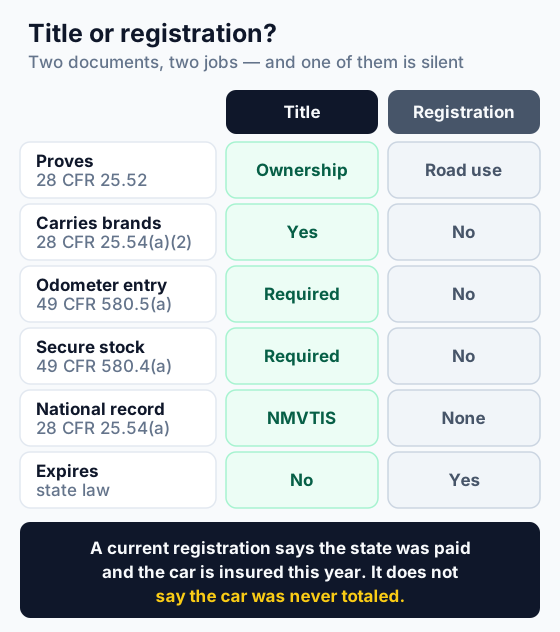
- The title says who owns it and what has happened to it. The registration says the state has been paid for this year.
- Which one carries a salvage brand?
- The title. Brands are reported to the national system as a field on the certificate of title, not on the registration.
- Why does that matter to a buyer?
- A current registration is easy to produce and proves nothing about the car's history. Work from the VIN instead.
Ownership
What a title is defined as showing
28 CFR 25.52
All brands
What the state reports from the title
28 CFR 25.54(a)(2)
24 hours
How often titling data is sent nationally
28 CFR 25.54(a)
Secure stock
How a physical title must be printed
49 CFR 580.4(a)
Two documents, two questions
A certificate of title and a vehicle registration are produced by the same agency, are often handed over in the same envelope, and answer completely different questions. The title answers who owns this vehicle, and what has happened to it. The registration answers is this vehicle permitted on the road right now.
Stated that way the distinction sounds like trivia, and for most of a car’s life it is. It stops being trivia at two moments: when the vehicle changes hands, and when it crosses a state line. Both of those are title events. Neither is a registration event, and a buyer who has been shown a crisp, current registration card has been shown something that cost the seller a fee and told them almost nothing.
The rest of this page is the evidence for that claim, taken from the federal rules that govern what each document has to carry. It is deliberately not a list of what your state charges or which office you visit — that varies, it changes, and your state’s own site is the authority on it. What does not vary is the division of labor between the two documents, because that part is set nationally.
The definition that exists, and the one that does not
The federal regulations that run the national title system open with a definitions section, and it is short. 28 CFR 25.52 defines a certificate of title as a document issued by a state showing ownership of an automobile. Eleven words, and the operative one is ownership.
What that same section does not contain is any definition of a registration. Not because the drafters forgot it, but because the system those rules build has no use for one. Everything the regulations go on to require — the reporting, the brands, the odometer figures, the verification checks — hangs off the certificate of title. The registration is simply not part of the machinery.
The brand is a field on the title
This is the part that changes how you shop. Under 28 CFR 25.54(a), every state must send titling information for all automobiles to the national system, in electronic form, every 24 hours. The regulation then lists what that information must include, and the second item is the one to read twice: any description of the automobile included on the certificate of title (including any and all brands associated with such vehicle).
Here is the full list of what travels:
- The VIN
- Any description of the vehicle included on the certificate of title, including any and all brands associated with it
- The name of the individual or entity to whom the certificate was issued
- Junk and salvage acquisition information from yards and insurers, where the state collects it
- The odometer disclosure required by 49 U.S.C. 32705 as of the date the certificate was issued, and later mileage if noted
Five fields, and every one of them is a fact about the certificate of title or about reports attached to that vehicle’s record. The registration contributes nothing to this feed. So when somebody tells you a car has a clean title, they are describing a field that is nationally reported on a 24-hour cycle. When somebody tells you it has a current registration, they are describing a payment.
If you want the full vocabulary of what those marks mean — salvage, flood, lemon, reconstructed, and the ones that vary by state — that is the subject of what is a branded title. And the reason a brand sometimes fails to survive a state line has its own page in title washing.
How a brand gets there
A brand does not appear because a clerk formed an opinion about a car. It is the end of a chain of reporting duties, most of which are federal, and following the chain shows exactly where the registration sits — which is nowhere.
It begins with an insurer. 28 CFR 25.55(a) requires any insurance carrier doing business in the United States to report monthly on every automobile of the current model year or the four prior model years that it has taken possession of and decided is a junk or salvage automobile, including anything it has designated a total loss under its own policy terms.
What counts as salvage is not left to the carrier’s taste either. 28 CFR 25.52 defines a salvage automobile as one damaged by collision, fire, flood, accident, trespass or other event to the extent that its fair salvage value plus the cost of repairing it for legal operation would exceed its fair market value immediately before the damage. That is an arithmetic test, and it is the same test whichever state the car happens to be sitting in.
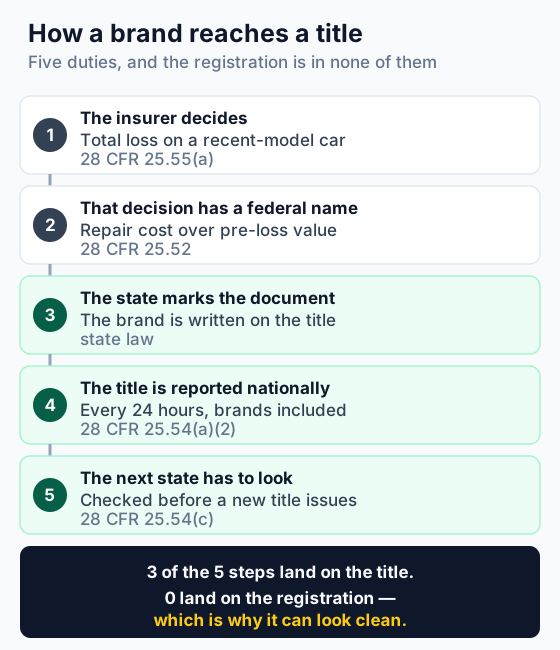
The state then writes the mark onto the title, reports the title nationally, and the next state that is asked to issue a title on that vehicle has to look the record up before it does. At no point in the sequence does anyone consult, mark or report the registration — which is the mechanical reason a car with a serious history can carry a registration card that looks exactly like everybody else’s.
The mileage rides on the title
The second permanent fact a title carries is the mileage, and federal law is specific about where it goes. 49 CFR 580.5(a) provides that at the time a title is issued or made available to the transferee, it must contain the mileage disclosed by the transferor when ownership of the vehicle was transferred, and must contain a space for the same disclosure at the next transfer.
49 CFR 580.5(c)then puts the disclosure itself on the title rather than on a side document: in connection with a transfer of ownership, the transferor discloses the mileage to the transferee on the title, signed, printed name included. Where the vehicle is titled in the transferor’s own name, the rule is explicit that the disclosure goes on the title and not on a reassignment document.
The disclosure has to carry, alongside the signature:
| Required with the disclosure | 49 CFR 580.5(c) |
|---|---|
| The odometer reading at transfer | Whole miles, not tenths |
| The date of transfer | Paragraph (c)(2) |
| The transferor's printed name and current address | Paragraph (c)(3) |
| The transferee's printed name and current address | Paragraph (c)(4) |
| Make, model, year, body type and VIN | Paragraph (c)(5) — the identity of the vehicle |
Two details are worth carrying away. First, the transferor must certify that the reading reflects the actual mileage, or else state that it exceeds mechanical limits, or else warn that it is not actual — a graded set of statements rather than a box to tick. Second, 49 CFR 580.5(h) forbids one person from signing as both transferor and transferee in the same transaction, outside the narrow power-of-attorney cases. That single sentence is why a seller cannot quietly complete both halves of a chain, and it is the paperwork foundation of title jumping.
None of this touches the registration. A registration renewal is not a transfer of ownership, so it triggers no disclosure and records no mileage. A car can be registered for twenty consecutive years and the registration will never have carried a single odometer figure.
One is printed like a bank note
The physical difference between the two documents is not decorative. 49 CFR 580.4(a) requires that each physical title shall be set forth by means of a secure printing process or other secure process, and extends the same requirement to the documents used to reassign a title. That is the rule behind the intaglio printing, watermarks, holograms and void pantographs you find on a title and never on a renewal sticker. Our page on the car title check goes through those features one by one.
The electronic equivalent is stricter still. 49 CFR 580.4(b) requires an electronic title to be held in a secure environment protected from unauthorized modification, alteration or disclosure, and requires the system to record the dates and times the document was created, the odometer disclosures were signed, and the record was accessed — including the date and time any unauthorized attempt is made to alter or modify it.
A national title record — and no national registration record
There is one national system for vehicle titles, and there is nothing comparable for registrations. 28 CFR 25.53(b) sets out what that system has to let a user establish instantly and reliably, and the list runs to five items:
- Whether a document purporting to be a certificate of title is valid, and its status
- Whether a vehicle with a known VIN is titled in a particular state
- Whether a vehicle titled in a state is or has been a junk or salvage automobile
- The odometer disclosure carried on the title when it was issued, plus later mileage if the state noted it
- Whether a VIN has been reported as junk or salvage by an insurer, junk yard or salvage yard
4 of the 5 are questions about a certificate of title. The fifth is about reports filed by insurers and yards against a VIN. None of them is a question about a registration, because no national registration record exists to ask.
There is also a privacy line in the same section that is worth knowing before you go looking for owner names. 28 CFR 25.53(c) provides that the operator may not make personally identifying information contained within NMVTIS, such as the name or address of the owner of an automobile, available to an individual prospective purchaser. So the national title record will tell a buyer the vehicle’s story and will not tell them whose driveway it sat in. If you want the reasoning behind that split, previous owners by VIN covers what is actually inferable, and motor vehicle records covers the separate law that governs the personal data.
Access is through approved providers rather than a public portal, which is why the NMVTIS report has its own page here.
The check your next state has to run
The clearest demonstration that the title is the record, and the registration is not, sits in 28 CFR 25.54(c). Every state must have a practice of performing a title verification check through the national system before issuing a certificate of title to somebody claiming to have bought a vehicle from a person or business in another state, or in cases of title transfers.
The regulation describes what the check consists of:
- 1The state sends the VINIt communicates to the system operator the VIN of the vehicle for which a certificate of title is sought.
- 2The operator answers, and the state uses the answerThe results are used to determine the validity and status of the document presented as a title, whether the vehicle has been a junk or salvage vehicle or been reported as one, to compare the odometer information presented against what the system holds, and to determine the validity of other information presented, such as lienholder status.
Read that second step slowly, because it is a description of a state checking your paperwork against a national record while you wait. It is also why a title transaction can take longer than it feels like it should, and why a discrepancy between the mileage written on a title and the mileage already in the system is caught at a counter rather than in a lawsuit.
No parallel duty attaches to a registration. A state renewing a registration is not required by this rule to check anything nationally, because renewing permission to use a road is not a statement about the vehicle’s past.
Why a current registration proves nothing about history
Put the previous sections together and a specific used-car scenario becomes obvious. A vehicle is written off by an insurer, reported, branded, rebuilt and retitled. That history is on its title, and it is in the national record, and it will be found the next time a state is asked to issue a title on it. And the car is then registered — perfectly legally, in most states, since a rebuilt vehicle that passes inspection is allowed on the road — and the registration card that comes back is indistinguishable from the one on a car that has never been touched.
A seller showing you that card is not necessarily hiding anything. The card genuinely is the document they were sent. It simply is not the document that carries the answer to the question you are asking.
If the seller genuinely does not have a title — lost, never issued, still with a lienholder, or the previous owner never signed it over — that is a solvable problem with a defined process, and registering a car without a title walks through what states actually require.
One expires. The other does not.
A registration has an end date printed on it. That is the single most visible difference between the two documents and it follows directly from what each one is for: permission to use a public road is granted for a period and then renewed, while a statement of who owns a thing does not lapse on a schedule.
A title stops being current when ownership changes, when a brand is added, when a lien is recorded or released, or when another state issues its own title in its place. Those are all events, not dates. It is why an unregistered car sitting in a garage for a decade still has a valid title and no valid registration, and why the owner of that car has an administrative errand ahead of them rather than an ownership problem.
| What ends it | Which document |
|---|---|
| A date on the calendar | Registration |
| A sale or gift | Title |
| A brand being added after a total loss | Title |
| Moving to another state | Both, and in that order |
| Simply not driving the car | Registration only |
Who holds the title while there is a loan
If there is money owed on the car, the two documents usually end up in two different places, and this is where the practical confusion starts. In many states the lender holds the certificate of title, or holds it electronically, until the loan is satisfied — while the borrower holds the registration and drives the car every day.
The federal odometer rules acknowledge this arrangement directly rather than pretending it does not happen. 49 CFR 580.13 and 580.14 set out the power-of-attorney procedure for the cases where a transferor cannot make the disclosure on the title itself, and the situations they contemplate include a lienholder holding the physical title and a lienholder holding or controlling the electronic one.
For a buyer this produces a rule of thumb worth applying literally: a seller who cannot produce a title is not necessarily evasive, but they are necessarily not yet able to sell you the car outright. Find out which of the recognized situations they are in, and get the lien release in writing. The vehicle lien check covers how to look before you commit.
The plate is a third thing again
A plate is not the registration, although the two are so closely linked in daily life that people use the words interchangeably. The registration is the record; the plate is the visible token attached to the vehicle so the record can be found from the roadside.
Which of them stays with the car when it is sold is a genuinely state-by-state matter rather than a national rule, and it is one of the few areas where getting the wrong answer costs real money — a plate left on a sold car can leave the seller carrying tolls and citations. Our license plate lookuppage covers what a plate can and cannot be turned into, and the individual state pages carry each state’s own rule.
The one thing a plate never does is carry history. It is a pointer, reassigned freely, and a car’s past does not follow it.
Which document each errand needs
The pattern underneath all of this is simple enough to use at a counter: anything permanent is a title errand, and anything annual is a registration errand.
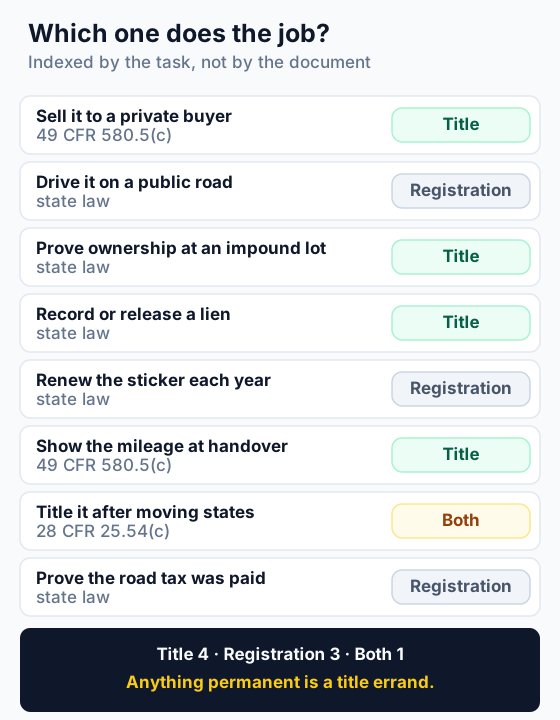
The row worth dwelling on is the last kind: moving states needs both, and needs the title first. The new state cannot issue you a registration on a vehicle it has not titled, and it cannot title the vehicle until the check under 28 CFR 25.54(c) has come back. That is the whole reason the errand has an order to it, and registering a car in another state takes it step by step.
What to check before you rely on either
Both documents describe a vehicle, and the vehicle itself is identified by seventeen characters that the manufacturer filed and nobody at a counter can change. That makes the VIN the thing to start from and the paperwork the thing to reconcile against it.
- Read the VIN off the vehicle — dash plate and door jamb — rather than off the seller's paperwork, and confirm the two agree
- Decode it and check the make, model, year and body type against what the title says; those four fields are exactly what 49 CFR 580.5(c)(5) requires the disclosure to carry
- Run the free NHTSA recall lookup on the VIN, which is a manufacturer record and owes nothing to either document
- Compare the mileage on the title against the odometer, and against any earlier disclosure you can see
- Treat a registration as evidence of a payment and nothing else
Where a title and a decode disagree on something structural — a body type that does not match, a model year that is off by one — that disagreement is worth resolving before money moves, and the free VIN decoderwill give you the manufacturer’s own answer to compare against.
CheckerVIN returns the factory build, the full specifications and open safety recalls for any VIN at no cost. Accident, title and odometer history are launching soon rather than available today; until then the national title record reached through an approved NMVTIS provider is the route to the title side of the story, and the free vehicle history report page is honest about which parts of it can be had without paying.
Where this information comes from
- 28 CFR 25.52 — NMVTIS definitionsDefines a certificate of title as a document issued by a state showing ownership, and defines salvage automobile, junk automobile and total loss. Contains no definition of a registration.
- 28 CFR 25.53 — responsibilities of the operatorLists the five things the system must let a user establish instantly and reliably, and bars the release of owner names and addresses to an individual prospective purchaser.
- 28 CFR 25.54 — responsibilities of the statesRequires titling information including any and all brands to be reported every 24 hours, and requires a title verification check before a title is issued on an out-of-state purchase.
- 49 CFR 580.4 — security of titles and electronic titlesRequires each physical title to be produced by a secure printing process, and requires electronic title systems to log access and unauthorized alteration attempts.
- 49 CFR 580.5 — disclosure of odometer informationPuts the odometer disclosure on the title at transfer of ownership, lists what must accompany it, and forbids one person signing as both transferor and transferee.
- NMVTIS vehicle history — US Department of JusticeThe government's own page on the national title record, including the list of approved providers through which a consumer can reach it.
Keep reading
Frequently asked questions
What is the difference between a car title and a registration?
The title is the document a state issues to show who owns a vehicle, and it carries the vehicle's permanent marks — brands such as salvage or flood, and the odometer disclosure made when ownership last changed. The registration is permission to use that vehicle on public roads for a set period, and it carries none of those marks. One records history; the other records that this year has been paid for.
Does a registration prove I own the car?
Not on its own. A registration establishes that somebody is entitled to operate the vehicle and that the state has been satisfied on fees and, usually, insurance. The federal definition of a certificate of title, at 28 CFR 25.52, is the one framed in terms of ownership. In practice a buyer, a lender, an insurer or an impound lot will ask for the title when the question is who owns the car.
Does a salvage or flood brand appear on the registration?
It appears on the title. Under 28 CFR 25.54(a)(2), what each state reports to the national title system is the description of the vehicle carried on the certificate of title, including any and all brands associated with it. There is no equivalent federal reporting duty attached to a registration, which is why a car with a serious history can hold a perfectly ordinary registration card.
Can I sell a car with only the registration?
Generally no, because the transfer of ownership is a title transaction. Federal odometer rules make that explicit: 49 CFR 580.5(c) requires the transferor to disclose the mileage to the transferee on the title itself, signed, with both parties named. If the title is missing, the route is to replace it or to use whatever no-title procedure your state offers, not to hand over the registration instead.
When I move to a new state, do I need a new title as well as a new registration?
Usually both. The new state issues its own certificate of title and its own registration, and under 28 CFR 25.54(c) it is required to run a national title verification check before issuing that title to somebody who says they bought the vehicle in another state. That check is the reason the paperwork sometimes takes longer than the counter visit suggests it should.