The short answer
- Can it be done?
- Usually — but by getting titled first. No state issues a registration to settle an ownership question it has not answered.
- What is the usual route?
- A bonded title: post a surety bond for a multiple of the car's value, and the state issues a title with the bond behind it.
- What decides whether you get one?
- What the state's VIN checks return. A lien under ten years old, or a stolen record, stops the application.
5 of 7
Texas clerk checks that are VIN queries
Form VTR-130-SOF
1.5x
Texas bond, against vehicle value
txdmv.gov
2x
Georgia bond, against average retail
dor.georgia.gov
10 years
Lien age that still blocks the application
Form VTR-130-SOF
You are not missing a registration
The question people type is how do I register a car without a title, and the honest first answer is that the sentence contains its own obstacle. A registration is permission to use a vehicle on public roads for a period of time. A state grants it to somebody it believes is entitled to the vehicle, and the document it uses to settle that belief is the certificate of title. Take the title out of the sequence and there is nothing for the registration to hang on.
So the work in front of you is titling work. That reframing is not pedantry — it changes which office you visit, which forms you fill in, what it costs and how long it takes. The division of labor between the two documents is set out in full on our page comparing a car title and a registration; the short version is that one of them records ownership and history and the other records that this year has been paid for.
What follows is the route through the titling problem, with two states worked end to end from their own published requirements. It is deliberately not a fifty-state table. Bond multipliers, floors and filing windows are exactly the kind of number that changes without announcement, and a figure copied from a stale source is the sort of error that costs a reader real money at a counter.
First: is the title actually gone?
Before spending anything, work out which of these you are actually in, because three of the four have cheaper exits than a bond.
| Your situation | Where it usually goes |
|---|---|
| The title exists, in your name, and you lost it | Duplicate title from your own state — the cheapest route by far |
| The title exists, in the seller's name, and they never handed it over | Chase the seller first; this is a transfer problem, not a lost-title problem |
| The seller signed a title that was never in their name | Stop. This is title jumping, and the chain has to be repaired |
| No title exists anywhere that anyone can produce | Bonded title, or your state's equivalent no-title procedure |
The third row is worth dwelling on. If somebody handed you a title with a stranger’s name printed on it and their own signature in the buyer’s box, you have not been given a defective document — you have been handed the middle of a broken ownership chain. Federal odometer rules make that arrangement unlawful rather than merely untidy, and the mechanics are set out on our page on title jumping. A bond does not repair it.
The cheap answer, which most people skip
If the vehicle is already titled in your name and the paper is simply missing, you do not need a bond, an inspection or an affidavit. You need a duplicate, and every state issues them: an application, identification, a modest fee, and in most places the replacement arrives in the post within a few weeks. The record already says you own the car; you are only asking for another copy of the record.
Two situations complicate it. If a lienholder is recorded, the duplicate goes to the lienholder rather than to you, because they hold the interest the document secures. And if the title was issued by a state you no longer live in, you will normally need to obtain the duplicate from that state before your new state will act, which is the subject of registering a car in another state.
What a bonded title is
A bonded title is not a special class of title. It is an ordinary certificate of title, issued in the normal way, with one addition: a surety bond stands behind it. The bond is a three-cornered promise. You are the principal, an insurer is the surety, and the state is the obligee. If somebody later establishes that the vehicle was really theirs — a prior owner, an heir, a lienholder — they claim against the bond rather than being left with nothing.
That structure explains the two things applicants most often misunderstand. First, the bond amount is not what you pay. The face amount is the cover; what you hand the surety company is a premium, a percentage of it, and the percentage depends on your credit and on the insurer. Second, the bond is not a fee to the state. It is protection for other people, bought at your expense, in exchange for the state agreeing to title a vehicle it cannot fully document.
The bond runs for a fixed term, and the term varies by state. During that period the title is typically marked to show it was issued on a bond. When the term ends without a claim, the mark drops away in most states and the title becomes an ordinary one. That is worth knowing if you plan to sell: a buyer looking at a bonded title is looking at an ownership history the state itself could not verify, and will often price accordingly.
The check the state runs on your VIN
This is the section that does not appear in the state-by-state walkthroughs, and it is the one that decides most applications. Texas prints its own internal checklist on page two of Form VTR-130-SOF, under the heading TxDMV Department Use Only. A representative works through it before a Notice of Determination is issued. Here it is, in the form’s own wording:
- MVDI checked?
- Texas record found?
- If no Texas record, STOLEN checked?
- If no Texas record, ISO Claim Search (VIN decoding) checked?
- If no Texas record, was VTR-68-A provided?
- Is there a lien less than 10 years old?
- NMVTIS checked?
Read that list as an applicant and it is a queue. Read it as what it is — a set of lookups — and the shape becomes clear: 5 of the sevenare database queries run against the vehicle identification number. MVDI is the state’s own dealer and inspection system. The Texas record query asks whether the state has ever titled this VIN. STOLEN is exactly what it says. ISO Claim Search is the insurance industry’s claims database, and the form annotates it VIN decoding in parentheses. And NMVTIS is the national title system.
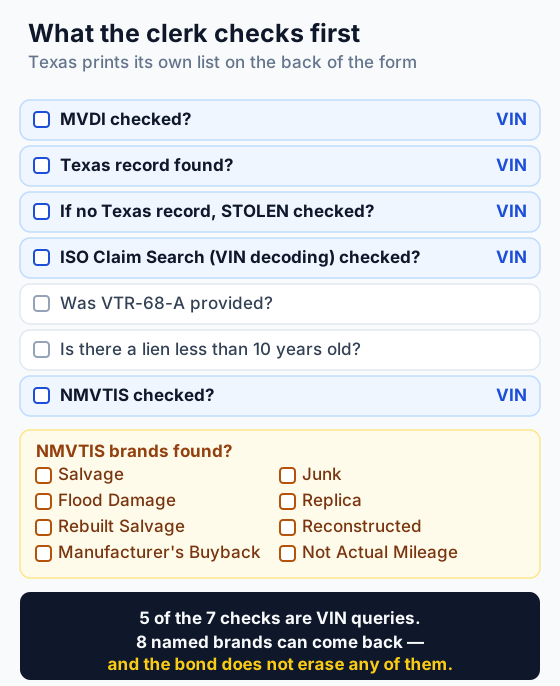
Notice how the conditionals work. Three of the checks are prefixed if no Texas record— meaning the state’s first move is to ask whether it has seen this VIN before, and only when the answer is no does it widen the search to the stolen file, the insurance claims database and a physical inspection. A car with a clean Texas history takes the short path. A car that arrived from somewhere else gets the long one.
Georgia arrives at the same place by a different route. Rather than running the national check itself, the Department of Revenue requires the applicant to supply a report from National Motor Vehicle Title Information System (NMVTIS) or an equivalent system authorized by the Department as one of the filing documents. You cannot submit a Georgia bonded title application without a NMVTIS report in the envelope. Our page on the NMVTIS report covers what that document is and how a consumer obtains one.
What happens when a brand comes back
The Texas checklist does not simply record whether NMVTIS was checked. It has a second field, NMVTIS brands found?, followed by a row of checkboxes. Setting aside the boxes for None and Other, the form names 8 brands the clerk may have to tick:
- Salvage
- Junk
- Flood Damage
- Replica
- Rebuilt Salvage
- Reconstructed
- Manufacturer's Buyback
- Not Actual Mileage
A brand coming back does not automatically end the application. What it does is change the document you end up with. Brands are carried on the title record and reported nationally — under 28 CFR 25.54(a)(2), what each state sends to the national system includes any description of the automobile included on the certificate of title (including any and all brands associated with such vehicle). A bond secures your ownership. It has no effect at all on the vehicle’s history, and the brand travels onto the new title.
There is a related mechanism working in your favor here, whether you want it or not. 28 CFR 25.54(c) requires a state to perform a title verification check through NMVTIS before it issues a certificate of title to somebody claiming to have purchased a vehicle in another state. That duty is why a brand from a previous state usually survives a move, and why the failure of that mechanism is worth understanding — it is the subject of title washing. What each mark actually means for value and insurability is on what is a branded title.
The lien that ends the conversation
Of everything on the Texas checklist, one line stops more applications than the rest combined: Is there a lien less than 10 years old?The requirement behind it is item 5 of the form’s own instructions, which calls for an original release(s) of lien or letter(s) of no interest if the vehicle has a lien of less than 10 years old. Not a photocopy, not an assurance from the seller — an original release from the lender.
Georgia reaches the same conclusion through the document trail rather than a stated age limit. Because the applicant must attach an NMVTIS report, and because the Department requires a certified title history from the issuing state whenever that report shows the title of record is out of state, any recorded security interest surfaces during the application — and when it does, a Form T-4 Notice of Satisfaction of Security Interest or Lien Holder Affidavit must be included.
This is the single most common way a cheap car turns out not to be cheap. A vehicle sold for cash by somebody who never finished paying for it carries a lender’s interest that no amount of bond money dissolves. If the lender has folded, been acquired, or simply cannot be reached, the release can be genuinely difficult to obtain, and that difficulty belongs to whoever currently holds the car.
Texas, end to end
Texas splits the process into two parts across two different offices, which catches people out. Part one is a determination from a TxDMV Regional Service Center. Part two is the actual title application at a county tax assessor-collector’s office. You cannot do the second without having done the first.
- 1File the statement of factBoth pages of Form VTR-130-SOF go to a TxDMV Regional Service Center with a $15 processing fee, by check or money order, never cash. The fee is non-refundable.
- 2Attach whatever ownership evidence existsA title, a bill of sale, a canceled check — the form asks for any evidence of ownership and any other available documentation. Thin evidence does not disqualify you; it simply leaves the state relying more heavily on its own checks.
- 3Add the conditional documentsAn original lien release if there is a lien under ten years old. A VIN inspection by law enforcement on Form VTR-68-A if the vehicle has no Texas record. Form VTR-61 if it is a repaired or newly assembled vehicle.
- 4Wait for the Notice of DeterminationThe department works through its checklist, establishes a value, and issues Form VTR-130-ND telling you the bond amount. Nothing you buy before this point is informed by the state's figure.
- 5Buy the bondThe bond is written for one and a half times the vehicle value the department established, on Form VTR-130-SB, with a power of attorney attached where the agent needs one.
- 6File at the county officeForm 130-U, both pages of the VTR-130-SOF, the VTR-130-ND with all its enclosures, the original bond, the lien releases and your ownership evidence. If you are registering at the same time, add a vehicle inspection report and proof of financial responsibility in your own name.
Two timing details matter and neither is obvious. You have one year from the date of the Notice of Determination to obtain the bond, and once you hold it, thirty days to file the application. Miss the second window and the work in the first is wasted. Everyone signing the form must supply a copy of current government-issued photo identification, and Texas is unusually forgiving here: an ID expired by no more than twelve months still counts as current.
Eligibility is narrower than the forms suggest. The applicant must be a Texas resident, or military personnel stationed in Texas. The vehicle must be complete — motor, body and frame, or motor and frame for a motorcycle — although it does not have to be operational. If you want the wider picture of how Texas treats title records, our Texas title checkpage covers the state’s brand vocabulary.
Georgia, end to end
Georgia runs the whole thing through a County Tag Office rather than splitting it, and front-loads the evidence. Its published gate has four conditions before any paperwork starts: the owner must be a legal resident of Georgia, the vehicle must require a Georgia title, it cannot be a 1985 or older year model, and it cannot be an abandoned vehicle.
The filing itself is a stack rather than a form:
| Document | What it does |
|---|---|
| Form MV-1 Title/Tag Application | The ordinary title application every Georgia titling uses |
| Form MV-46 Certificate of Title Bond | The bond itself, from an insurer licensed to write surety in Georgia, in the owner's legal name |
| Form MV-46A Bond Affidavit | Sworn in the same name as the bond, and notarized |
| Form T-22B Certification of Inspection | A physical inspection of the vehicle, required in every case |
| Form T-128 | Only if the inspection finds the serial plate missing |
| NMVTIS report | Or an equivalent system authorized by the Department |
| Certified title history | Required when the NMVTIS report shows the title of record is from another state |
| Form T-4 | Required when the history shows a security interest or lien |
The bond wording is unusually blunt. Georgia requires that, regardless of condition, the bond be written for two times the average retail value of the vehicle according to values established by the Department of Revenue, and never for less than $5,000. That floor bites hardest on cheap cars: a $900 project vehicle still needs a $5,000 bond written against it. Signatures on the bond must be witnessed, joint owners must each sign, and a power of attorney authorizing the agent must be attached.
The title fee is $18, and the application must be made within six monthsof the bond’s issue date — a longer window than Texas allows, but one that starts from a different event. Georgia’s wider title record practice is covered on our Georgia title check page.
Same instrument, different numbers
Set the two states beside each other and the reason to distrust a generic walkthrough becomes obvious. These are neighboring states operating the same legal instrument, and almost nothing lines up.
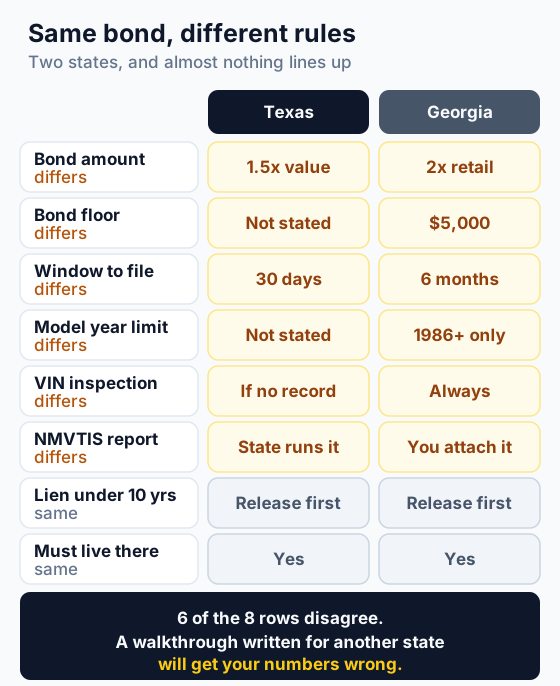
The two rows that agree are the interesting ones. Both states require you to live there, and both require a lien to be released before they will proceed. Those are not coincidences of drafting — they are the two things a bond fundamentally cannot substitute for. A state will not adjudicate ownership for a non-resident, and no bond overrides an interest a lender has already recorded.
Everything else is local policy, which is why the only safe procedure is to open your own state’s titling agency site and read its bonded title page before you spend anything. If the page you are reading elsewhere does not name the state in its heading, its numbers are decorative.
How the state decides what the car is worth
Since the bond is a multiple of value, the valuation is the number that determines your cost — and applicants do not get to choose it. Texas sets out a ladder on the form itself. The department first tries its Standard Presumptive Value calculator. If the calculator returns nothing, it uses a value from a national reference guide. Only if it cannot determine a value that way does it fall back on an appraisal, which must be made by a licensed dealer or licensed insurance adjuster on Form VTR-125, legible, carrying the appraiser’s business name, address and license number, with an original signature.
The internal checklist has a fourth option beside those three: a checkbox reading 25+ years old. Older vehicles are handled separately rather than being forced through a calculator built for the current market — which is a sensible accommodation, and one worth knowing about if the car in question is a classic.
Georgia takes the simpler path of applying its own established values and doubling them, with the $5,000 floor underneath. That combination produces a counterintuitive result: the cheaper the vehicle, the more disproportionate the bond. On a car the Department values at $2,000, the bond is written at $5,000 rather than $4,000, because the floor applies regardless of condition.
What a bond will not fix
Search results for this topic are dominated by surety brokers, and the framing there is consistently optimistic. It is worth setting out plainly what the instrument does not reach — every item below taken from a state’s own requirements or from the federal rules, not from general caution.
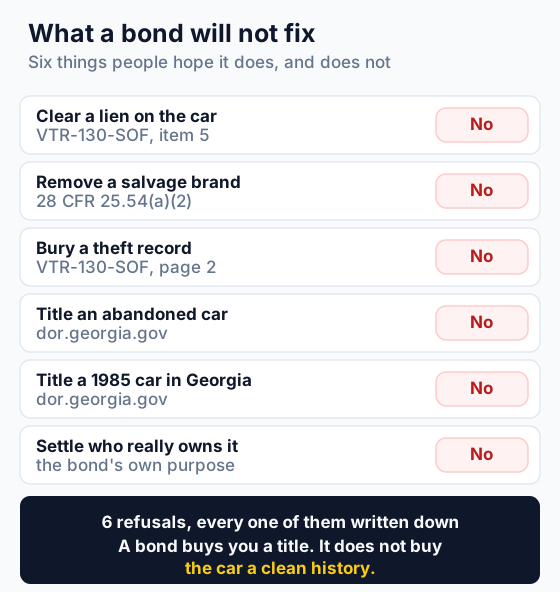
The last row is the one people find hardest. A bonded title makes you the titled owner and lets you register, insure and sell the vehicle. It does not decide the underlying ownership question — it funds the answer if somebody later proves you were wrong. That is why the bond has a term, and why a claim during that term is a real possibility rather than a theoretical one.
It follows that a bonded title is a poor plan when you have specific reason to think somebody else has a claim. If you know there is an estate in dispute, a lender who was never paid, or a prior owner who says the car was taken, the bond simply positions you as the person the claim will be made against.
The cars no bond reaches
Some vehicles are outside the process entirely, and the exclusions are worth checking before you buy anything with missing paperwork.
- Abandoned vehicles — Georgia excludes them from the bonded route outright; abandoned property has its own statutory procedure in most states
- Very old vehicles in some states — Georgia will not issue a bonded title for a 1985 or older year model
- Incomplete vehicles — Texas requires a motor, body and frame, or a motor and frame for a motorcycle
- Vehicles carrying a lien under ten years old that cannot be released — Texas asks the question directly
- Vehicles already recorded as nonrepairable or junk — these are not titling problems but dead ends
That last exclusion is absolute in a way the others are not. A vehicle recorded as nonrepairable, or issued a certificate of destruction, has been removed from the road permanently by the record itself; no bond and no state procedure brings it back. Our page on the certificate of destruction explains why that particular document has no route out.
Incompleteness catches people who bought a shell. Texas will title a vehicle that does not run — the requirement is that it be complete, not that it be operational — but a car that arrived without an engine is not eligible until it has one.
The version of this that costs nothing
Everything above is remedial. The cheap version of this problem is the one solved before money changes hands, and it takes about a minute: run the VIN and see what the record says before you agree to buy a car whose seller cannot produce a title.
You are looking for the same things the clerk will look for. Is the vehicle titled somewhere, and where? Does the record show a brand? Is there any indication of a lien or a theft report? Those are precisely the questions the national system was built to answer — 28 CFR 25.53(b) requires it to establish instantly and reliably whether a vehicle with a known VIN is titled in a particular state, and whether it is or has been a junk or salvage automobile.
A free decode will not give you the title record. What it will give you, in seconds, is confirmation that the VIN is structurally valid and describes the car in front of you, which is where VIN verification starts. If the plate on the dash does not decode to the vehicle you are standing next to, no amount of paperwork later will fix that, and you have just saved yourself a bond premium.
Where the decode looks right and the seller still cannot produce a title, the questions to ask are on our page about what to do after buying a used car — asked before the purchase rather than after it. And if you want to understand how many hands the car has been through, previous owners by VIN explains why that count is inferred from title events, which is the same record the bonded title process is trying to reconstruct.
Where this information comes from
- Bought a Vehicle Without a Title — Texas DMVThe state's own bonded title page: eligibility, the 1.5x bond, the one-year and thirty-day windows, and the completeness requirement.
- Form VTR-130-SOF — Bonded Title Application or Tax Collector Hearing Statement of FactRev 11/24. Page 2 carries the filing requirements, the valuation ladder, and the TxDMV Department Use Only checklist quoted on this page.
- Bonded Vehicle Title — Georgia Department of RevenueGeorgia's eligibility gate, the full document list including the NMVTIS report requirement, the 2x bond with its $5,000 floor, and the six-month filing window.
- 28 CFR 25.53 — responsibilities of the NMVTIS operatorLists what the national system must establish instantly and reliably, including whether a VIN is titled in a particular state and whether it is or has been junk or salvage.
- 28 CFR 25.54 — responsibilities of the statesRequires titling information including any and all brands to be reported every 24 hours, and requires a title verification check before a title issues on an out-of-state purchase.
- NMVTIS vehicle history — US Department of JusticeThe government's page on the national title record and the approved providers a consumer can obtain a report through.
Keep reading
Frequently asked questions
Can I register a car without a title?
Not directly. Registration is permission to use a vehicle on the road, and a state will not grant it until the ownership question is settled, which means a title in your name. So the real task is getting titled, not getting registered. Where the ownership paperwork is missing, most states offer a bonded title: you post a surety bond for a multiple of the vehicle's value, the state issues a title, and the bond stands as security in case a rightful owner or lienholder appears later.
What is a bonded title and how much does the bond cost?
A bonded title is an ordinary certificate of title backed by a surety bond, which is a promise from an insurer to pay a claim if your ownership turns out to be defective. The bond amount is set as a multiple of the vehicle's value and the multiple varies by state — Texas requires one and a half times the value, Georgia requires twice the average retail value with a floor of five thousand dollars. What you pay the surety company is a premium, a fraction of that face amount, not the amount itself.
Will the DMV check the VIN before issuing a bonded title?
Yes, and more thoroughly than most applicants expect. Texas prints its own checklist on page two of Form VTR-130-SOF: the representative records whether MVDI was checked, whether a Texas record was found, whether the stolen file was checked, whether ISO Claim Search VIN decoding was run, and whether NMVTIS was checked, along with any brands that came back. Georgia takes a different route to the same place and requires the applicant to attach an NMVTIS report to the application.
Does a bonded title remove a salvage brand?
No. Brands live on the title record and are reported nationally under 28 CFR 25.54(a)(2), so a bonded title issued on a branded vehicle is issued with the brand still on it. The bond covers a defect in your ownership, not a defect in the vehicle's history. If the state's check turns up a salvage, flood or junk brand, you can expect that brand to carry across onto whatever title you end up holding.
Can I get a bonded title if there is still a lien on the car?
Generally not until the lien is dealt with. Texas requires an original release of lien or a letter of no interest whenever the vehicle carries a lien less than ten years old, and asks about it directly on its internal checklist. Georgia requires a Form T-4 release whenever the title history it pulls shows a security interest. A bond is security against a claim on ownership; it is not a way to walk past a lender whose interest is already recorded.