The short answer
- Is the document genuine?
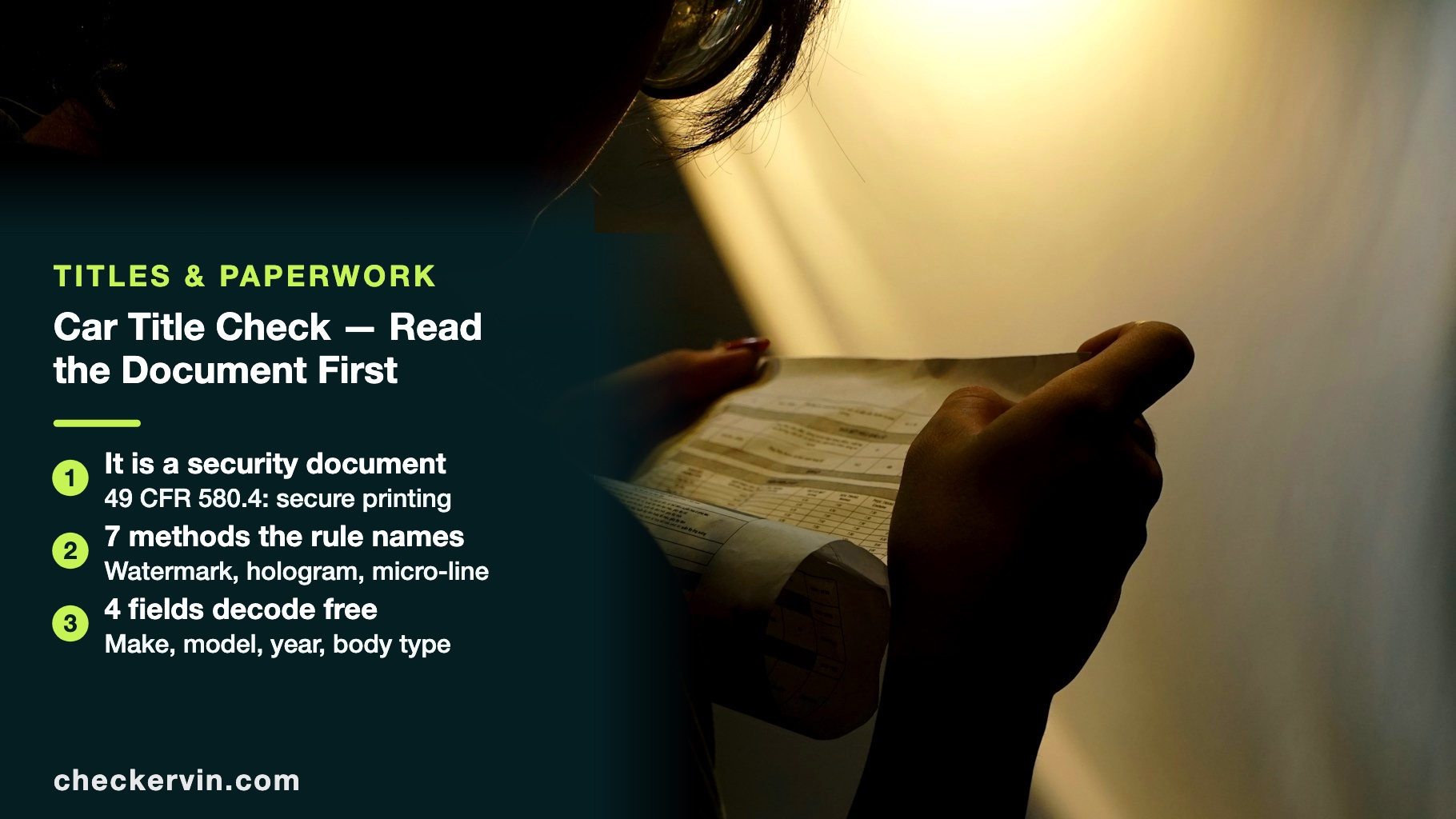
- Federal law requires a secure printing process. The rule names the methods — hold the title to the light and look for them.
- Does it match the car?
- Make, model, year and body type must be printed on it. All four come back from a free VIN decode.
- Is a photo enough?
- No. The rule expressly excludes a scanned or imaged paper title from being an electronic one.
7
Anti-counterfeiting methods named
In the rule's own appendix
5
Identity fields required on the title
Four are free to verify
0
Titles exempt from secure printing
The requirement has no carve-out
A title check is two checks, and most people only run one
Type the phrase into a search engine and almost everything that comes back is about history: whether the car was totaled, whether a brand follows it, what a records system holds against the number. That is a real check and it matters. But it answers a question about the car, and it quietly assumes something about the document that nobody has tested.
The second check is the one you can run yourself, in the seller’s driveway, before any money moves and before you have paid anybody for anything. It asks whether the piece of paper is what it claims to be, and whether the car standing next to it is the car it describes. Those two questions fail independently. A car with a spotless history can be sold on a forged title. A perfectly genuine title can sit on a car whose brand was laundered through a state that did not carry it forward.
| The check | What it answers |
|---|---|
| The document, in your hands right now | Is this title genuine, and does it describe this car? |
| The history, through a records search | What has been recorded against this VIN over time? |
The rest of this page is the first row, because it is the row nobody writes about and the only one that costs nothing. The second row is real work too and we have written it up elsewhere — the federal title record is the place that question actually gets answered.
The title is a security document, and that is a federal requirement
Most people handle a car title the way they handle a utility bill. It is closer to a bank note, and the rule that makes it so is short enough to quote.
On its own that would be a phrase you could not test. The rule anticipates the problem and defines the term. Under § 580.3, a secure printing process or other secure process means “any process which deters and detects counterfeiting and/or unauthorized reproduction and allows alterations to be visible to the naked eye.”
Read that definition slowly, because it contains three separate jobs and they are not the same job. Deterring a forgery is about making the document hard to reproduce. Detecting one is about making a reproduction identifiable when it exists. And the third clause — alterations visible to the naked eye — is not about forgery at all. It is about somebody changing a real title: a mileage figure, a name, a brand.
The phrase “to the naked eye” is the part that should interest a buyer. The rule does not say alterations must be detectable by a laboratory or by a clerk with a scanner. It says they must be visible to a person looking. That is a design requirement written on the assumption that somebody like you will hold the document and look at it.
The features the rule actually names
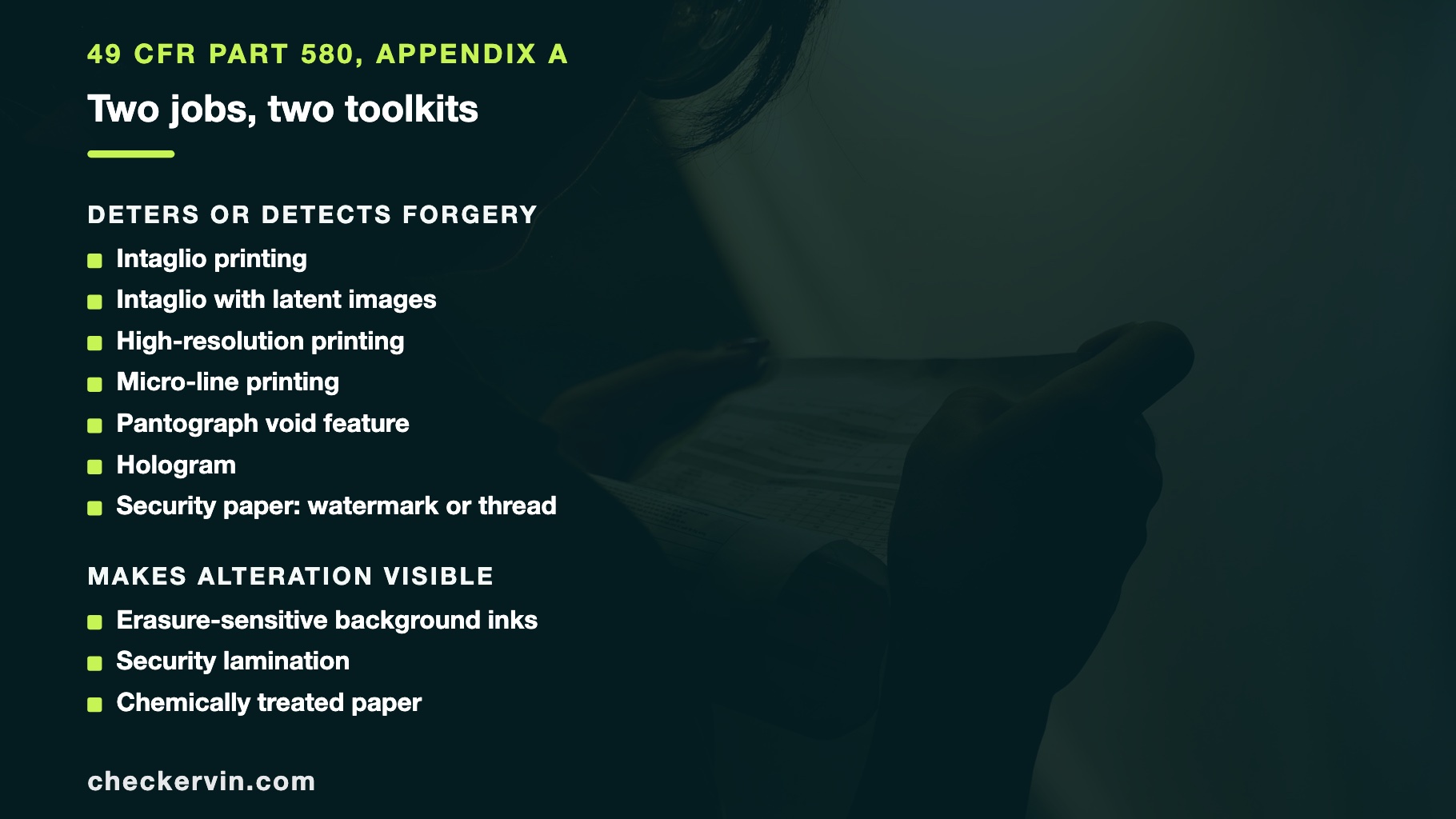
Part 580 does not stop at the principle. Its own appendix lists the methods, split into two groups doing two different jobs. The first group deters or detects counterfeiting.
| Method | What it is |
|---|---|
| Intaglio printing | An engraved plate pressed into the paper under extreme pressure, the process used for bank notes |
| Intaglio with latent images | The same process, cut so that a hidden image appears in the raised surface |
| High-resolution printing | Art clarity approaching intaglio, achieved without the press |
| Micro-line printing | A line that reads as solid to the eye and resolves into words under magnification |
| Pantograph void feature | Wording hidden in a screened background that appears when the document is photocopied |
| Hologram | A diffraction foil made from a split laser beam, giving a three-dimensional effect |
| Security paper | Paper carrying a watermark, a security thread, or both |
You will not find all 7on any one title. States choose from the list, and a title issued in one state looks nothing like a title issued in the next — different color, different layout, different features. That variation is exactly why a buyer cannot rely on recognizing a familiar document, and why knowing the menu is more useful than knowing one state’s design.
Three of these are checkable in a driveway with no equipment at all. Tilt the document against a light and a hologram moves. Hold it up to a window and security paper shows a watermark or a thread running through the fiber rather than printed on top of it. Bring a phone camera close and micro-line printing resolves from a solid rule into readable text — a line that stays a line under magnification was printed by an ordinary printer.
Alterations must be visible to the naked eye
The second group in the appendix exists for a different threat. A forged title is one problem; a genuine title with a changed number on it is another, and historically the more common one. Three methods are named.
| Method | What it does |
|---|---|
| Erasure-sensitive background inks | Dark text over a fine prismatic tint that will not survive an eraser intact |
| Security lamination | Retro-reflective laminate laid over the entered data after it is filled in |
| Chemically treated paper | Paper that reacts visibly to solvents used to lift ink |
Security lamination is the one worth understanding, because it dictates where you look. The laminate goes over the vital information afterit has been entered — the mileage, the names, the VIN. So the question is never whether the blank form looks right. It is whether the laminate over the filled-in fields is intact, unlifted at the corners, and unbroken across the figures that matter.
Erasure-sensitive background inks and chemically treated paper both work by staining. Neither is subtle when it has been triggered. A pale halo around an odometer figure, a patch where the background tint has gone flat, a number sitting on paper that is a slightly different shade from the field around it — those are the marks the rule is designed to produce, and they are meant to be obvious.
The five fields the title must carry about the car
Federal odometer law reaches the title for a reason that is stated openly. The purpose of the part, in its own words, is to give buyers mileage information “by making the disclosure of a vehicle’s mileage a condition of title.” Because the disclosure has to live on the title, so does everything needed to tie the disclosure to a specific car.
Under § 580.5(c), the disclosure must be signed by the transferor, carry their printed name, and include the odometer reading with no tenths, the date of transfer, the printed name and current address of both seller and buyer, and the identity of the vehicle. Paragraph (c)(5) spells out what identity means:
- Make
- Model
- Year
- Body type
- Vehicle identification number
That is a short list and it is the most useful thing on the document, because unlike a signature or an address it can be checked against an independent source in under a minute. Four of the 5 come back from a free decode of the fifth.
Check four of the five before you get in the car
The VIN printed on the title is the join between the paperwork and the vehicle, and the federal decoding database is open to anybody. Run the number that is printed on the title — not the number the seller told you, and not the one from the advertisement — and compare what comes back against the other four fields on the same document.
Here is what that looks like on a real number. The VIN below is the demo vehicle used throughout this site, put through the NHTSA decoder:
| Field required on the title | Returned for 1G1ZD5ST4PF233170 |
|---|---|
| Make | CHEVROLET |
| Model | Malibu |
| Year | 2023 |
| Body type | Sedan/Saloon |
Four fields, no account, no fee, no waiting. The decode returned them at error code zero, which is the decoder’s way of saying the number is well formed and it recognized the manufacturer. If the title beside you says the car is a coupe and the number says sedan, or the title says one model year and the number says another, you have found something before you have spent anything.
Check any VIN free
Decoded from official manufacturer and NHTSA records
Two honest limits on this. It is a decode of the number, so it describes the car the factory built and says nothing about what has happened since — and a mismatch is a question rather than a verdict, because clerical error exists and a body type can be recorded differently by a state than by the manufacturer. What it does is convert a vague worry into a specific one you can put to the seller.
A photograph of a title is not a title
This comes up in nearly every remote sale. The seller sends a photograph, or a scan, and it looks like a title. The rule has an unusually direct answer, and it arrives through the definition of what an electronic title is.
A scanned paper title is not an electronic title. It is an image of a physical one, and the physical one is still somewhere. So a photograph is neither of the two things the rule recognizes — and every feature Part 580 requires is a feature that a photograph destroys. A watermark does not survive a phone camera. A hologram photographs as a gray smear or not at all. Micro-line printing resolves into pixels. Security lamination is invisible in an image and its condition unknowable.
None of that makes a photograph worthless. It is genuinely useful for the thing it can do: reading the VIN and the four identity fields so you can decode them before you drive across town. Treat it as a preview of the document, never as the document.
What an electronic title records about itself
If the state holds the title electronically, the security question changes shape rather than disappearing. You cannot tilt an electronic record against the light. What you get instead is a required audit trail, and it is more thorough than most people assume.
Note what the last clause assumes. The rule does not merely require that unauthorized changes be prevented; it requires that attempts be logged. That is the electronic equivalent of the naked-eye standard — not a promise nothing will happen, but a requirement that if it does, there is a record of it.
There is a second definition worth knowing here. The rule defines access as authorized entry and display in a manner allowing modification of the stored data, even if nothing is modified. Display for viewing only, where modification is not possible, is not access. So when a state or a lienholder shows you an electronic title, whether that event appears in the log depends on which kind of view it was.
When the seller does not have the title in hand
A missing title reads as a red flag, and sometimes it is. But federal law expects the situation and names the circumstances under which a seller may sign the mileage disclosure through a power of attorney instead of on the title itself. There are exactly four.
- A lienholder is holding the physical title
- The physical title has been lost
- A lienholder holds or controls the electronic title
- The electronic title cannot be accessed
Those four are the answer to the most-searched version of this question — some variant of “where is my title” or “why has the title not arrived.” A financed car’s title generally sits with the lienholder until the loan is satisfied, and in most states that title is electronic, which is why nothing arrives in the mail even after the last payment clears. It is not lost. It is held, and it has to be released before it can be printed or transferred.
What matters at a sale is that the seller can say which of the four applies and show it. “The bank has it” is a checkable statement with a payoff letter behind it. “It is around here somewhere” is not a category the rule recognizes. And if the title is genuinely lost, the route is a duplicate from the state before the sale, not a handshake and a promise to mail it later.
The right to see the previous owner's title
Here is a provision that almost nobody uses, tucked at the end of the part. Where a power of attorney has been used and the person selling to you holds the title in their own name after being granted one by their own seller, you can ask to see what came before.
The word is must, and the trigger is your request. It is a narrow provision — it applies to a specific chain, not to every sale — but the chain it applies to is a common one in the trade, where a car passes through a hand that never registered it. Asking converts an assertion about where the car came from into a document you have looked at.
A related paragraph, § 580.16(a), covers the case where you decide to go back to your seller to sign the disclosure on the title itself rather than granting a power of attorney: on request, they must show you the power of attorney they received from their own transferor. Between the two, a buyer who asks can see one link further back than the document in front of them.
The two statements that change what the car is worth
The odometer block on a title is not just a number. Under § 580.5(e) the seller must certify one of three things, and two of them are warnings.
| What the seller certifies | What it means |
|---|---|
| The reading reflects the actual mileage | The ordinary case, and the certification is made to the best of their knowledge |
| Mileage exceeds mechanical limits | The odometer rolled past its designed maximum and started again |
| Not the actual mileage | The reading cannot be relied on, and the rule requires a warning notice that a discrepancy exists |
The third is a permanent mark on the car’s paperwork and it moves the price. The rule requires more than a checked box: where the seller knows the reading does not reflect a valid display, or differs from the mileage by more than a calibration error would explain, the statement must be accompanied by a warning alerting the buyer that a discrepancy exists.
Neither of the two warning statements means fraud. An odometer that exceeded its mechanical limit is a mechanical fact about older instruments. A not-actual mark can come from a legitimate cluster replacement that nobody documented well. What they mean is that the mileage on the dash is not evidence, and any value you have in mind that was built on it needs rebuilding. If mileage is the reason you are buying the car, read how odometer readings are recorded before you negotiate.
Reading the document is not reading the history
Everything above is about the artifact. It is worth being blunt about the ceiling on that, because the confidence a clean, genuine, matching title produces is larger than the confidence it earns.
A title carries the brand its issuing state applied at the time it was issued. It does not carry a collision that was repaired and never claimed, a flood in a state whose branding threshold the car did not meet, a loss that an insurer settled without declaring a total, or anything a previous state recorded and a later one did not carry forward. That last one is the mechanism behind title washing, and it is invisible on the document by design — the whole point of a laundered title is that it looks clean.
| Question | Answered by the document? |
|---|---|
| Is this piece of paper genuine? | Yes — the security features are on it |
| Does it describe this car? | Yes — four fields decode from the VIN |
| What brand does this state currently carry? | Yes, as of issue |
| What did other states record? | No — that is a records search |
| Was it wrecked, flooded or totaled? | Not reliably |
For those bottom rows the destination is the federal title record, which pulls from state motor vehicle agencies, insurers and salvage yards rather than from any single state. Start at the NMVTIS report, and if the specific worry is a total loss, the salvage check is the shorter path. For what the brands themselves mean, the branded title explainer is the reference.
The state layer, and what a status check actually returns
Titles are issued by states, not by the federal government, and the practical experience of checking one differs enormously by jurisdiction. Federal law sets the floor — secure printing, the disclosure, the identity fields — and each state builds its own document, its own electronic system, and its own public tools on top of it.
Many states publish a title status lookup. What those tools return is narrower than the name suggests: typically whether a title has been issued, whether it is held electronically, whether a lien is recorded, and sometimes whether a brand is carried. They are answering an administrative question about the state’s own file. They are not a history search and they generally stop at the state line.
That is still worth running, for two reasons. It is the only source that can tell you the state currently holds a record matching the document in your hand, and it is where a lien shows up. A lien is the single most expensive thing to discover after payment, because it travels with the car rather than with the seller. If nothing else on this page gets done, run a lien check.
We have written up the process state by state where the state offers something to write up. The Florida, Texas, California and New Yorkpages cover the four largest, and each explains what that state’s tool actually returns rather than what it sounds like it should.
The order of operations before money moves
Sequence matters here more than completeness, because each step is cheaper than the one after it and each can end the transaction on its own.
- 1Decode the VIN from the title, not from the adFree, instant, and it checks four of the five identity fields the document is required to carry. Do it before you travel.
- 2Match the title's VIN to the car's VINRead it off the vehicle yourself — dashboard and door jamb — rather than off a photograph or the seller's phone. Two places, character by character.
- 3Examine the document in daylightTilt it for a hologram, hold it to a window for a watermark or thread, magnify a solid line to see whether it resolves into words, and check the laminate over the filled-in fields.
- 4Read the odometer certificationLook at which of the three statements is marked, not just at the number. Two of the three are warnings.
- 5Confirm who holds the title, if the seller does notOne of the four lawful conditions should apply, and the seller should be able to evidence which. A payoff letter is evidence; a promise is not.
- 6Run the records searchThe federal title record and a lien check cover what the document cannot. This is the step that costs money, and it is worth reaching it having already eliminated the free failures.
If the paper and the car disagree
Mismatches are not all the same and the right response depends on which field disagrees. A useful way to sort them is by how easily the discrepancy could have been created by a tired clerk.
| What disagrees | How to read it |
|---|---|
| A single transposed VIN character | Most often clerical, and most often fixable — but it must be fixed by the state before transfer, not after |
| Body type or trim | Frequently a recording difference between a state and the manufacturer; ask, do not assume |
| Model year | Serious. The year is encoded in the VIN and a state does not usually invent a different one |
| Make or model | Stop. The document and the car are not describing the same vehicle |
| The VIN plate looks disturbed | Stop, and treat it as a cloning question rather than a paperwork one |
The bottom row deserves its own note. A VIN plate that has been removed, replaced, or re-riveted is a different category of problem from a typographical error, and the paperwork will usually look immaculate, because the point of the exercise is to make a stolen car match a legitimate document. Our page on VIN cloning covers what to look for, and where the VIN appears on the vehicle covers the locations to compare.
In every one of these cases the correct move is the same and it is unglamorous: do not hand over money to fix it later. A title problem that exists before the sale is the seller’s to resolve. After the sale it is yours, and it is generally slower and more expensive to resolve than it would have been to walk away.
Where this information comes from
- 49 CFR § 580.4 — Security of physical documents, electronic titles and electronic powers of attorneyThe secure printing requirement and the electronic audit-trail requirement
- 49 CFR § 580.3 — DefinitionsDefines secure printing process, electronic title and access
- 49 CFR Part 580, Appendix A — Secure Printing Processes and Other Secure ProcessesThe named methods, in two groups
- 49 CFR § 580.5 — Disclosure of odometer informationThe identity fields and the three certifications
- 49 CFR § 580.13 — Disclosure of odometer information by power of attorneyThe four conditions under which the title is not in the seller's hands
- 49 CFR § 580.16 — Availability of prior title and power of attorney documents to transfereeThe buyer's right to see the previous owner's title
- NHTSA vPIC — VIN decoding APISource of the decode used above
Frequently asked questions
How do I check if a car title is real?
Hold it up and work through the features federal law requires. Every physical title must be produced by a secure printing process, defined in the rule as one that deters and detects counterfeiting and lets alterations be seen with the naked eye. The rule's own appendix names the methods states use — intaglio printing, micro-line printing that resolves into words under magnification, a pantograph void feature that appears on a photocopy, holograms, watermarked or threaded paper. A document that shows none of them is not a title.
What should a car title have on it?
Among other things, the identity of the vehicle: make, model, year, body type and the vehicle identification number, alongside the odometer reading at transfer, the date, and the printed names and addresses of both the seller and the buyer. Federal law puts those elements on the title because mileage disclosure is made a condition of title. Four of the five identity fields can be checked against a free VIN decode before you go any further.
Is a photo of a car title enough?
No, and the rule is unusually direct about it. An electronic title means a record created electronically by the jurisdiction. The definition specifically excludes a physical title that was executed on paper and then converted by scanning or imaging. A photograph is neither a physical title nor an electronic one — it is a picture of a document you have not examined, and every security feature the rule requires is a feature a photograph destroys.
Why does the seller not have the title?
There are four situations federal law expects, and they are not all bad news. A lienholder may be holding the physical title, the physical title may be lost, a lienholder may hold or control the electronic title, or the electronic title may be inaccessible. Each of those is a lawful reason and each has a route through it. What matters is that the seller names which one applies and can show it, rather than leaving the question open.
Can I ask to see the previous owner's title?
In one common situation, yes, and the right is explicit. Where a transferor was granted a power of attorney by their own seller and holds the title in their own name, the rule says that on the buyer's request they must show the buyer the previous owner's title and the power of attorney form. It is a small provision that almost nobody invokes, and it is the difference between taking a dealer's word for the chain and looking at it.
Does a title check show accidents or flood damage?
No. Reading the document tells you what the document says — the brand printed on it, the mileage disclosed at the last transfer, whether the paper itself is genuine. It cannot tell you about a repaired collision nobody reported, a flood in a state that never branded it, or a loss that was settled without a total-loss declaration. Those questions belong to the title history record, which is a different search against a different system.
What is the difference between a title check and a title search?
A title check, as most sellers use the phrase, means confirming the document in front of you is genuine and matches the car. A title search usually means querying a records system for what has been recorded against that VIN across states over time. Both are worth doing and they fail in different ways: a perfect document can sit on a car with a laundered brand history, and a genuine history can come attached to a forged piece of paper.
Keep reading
Decode the VIN printed on the title
Free, instant, and it checks four of the five identity fields the document is required to carry.
Run a free VIN check