The short answer
- Why does a lien matter more than a brand?
- Because a lienholder's interest survives your purchase. A branded car is worth less; a lien-encumbered car can be repossessed from you after you have paid for it in full.
- How do you check?
- The title face names any lienholder, the state record is the legal source, and NMVTIS-sourced reports carry lien indicators. Verify the state record before paying.
- Can you still buy it?
- Yes — pay the lender the payoff directly and the seller the balance, ideally at the lender's branch. Never hand over the full price on a promise to settle later.
Survives
What a lien does at sale
The lender's claim follows the car
The state
Where the lien legally lives
Not the paper in the glovebox
Direct
How to pay off a loan safely
To the lender, not the seller
E-title
How most states hold titles now
Verify the record, not the paper
Why a lien outranks every other check
Most of what a buyer investigates affects price. A salvage brand, high mileage, a patchy service history — each is an argument about what the car is worth. A lien is different in kind, because it is a claim on the vehicle held by someone who is not at your transaction and did not agree to it. If the loan is not settled, the lender’s security interest remains attached to the car after the money leaves your hands.
That asymmetry is why this check belongs before the inspection, not after. A car with bad brakes is a negotiation. A car with an undisclosed lien is a lawsuit.
What a lien actually is
When someone finances a vehicle, the lender records a security interest against it — the legal right to take the car back if the loan is not repaid. That interest is recorded with the state titling agency and, on a paper title, printed on the face of the document as a named lienholder. It is released when the loan is paid, at which point the state updates the record and, in paper states, the lienholder signs off or issues a release letter.
Everything that goes wrong in private-party sales comes from a seller trying to sell during that window: still owing money, still recorded as encumbered, hoping to use the buyer’s payment to settle the loan afterwards.
Where liens are recorded, and which source is authoritative
| Source | What it tells you |
|---|---|
| The state title record | Authoritative. The lien exists here whether or not a paper title reflects it |
| The paper title's face | Names the lienholder — but a printed title can be outdated or withheld |
| State online tools | Several states publish free title-status checks, notably Florida |
| NMVTIS-sourced reports | Carry lien indicators where states report them — a strong signal |
| Commercial history reports | Often show lienholder records; treat as corroboration, not proof |
| The seller's word | Not evidence, however sincere |
How a lien attaches to a car, and why the title is the record
Most guidance tells you to check the title without saying why the title is the thing that matters. The reason is a rule of commercial law, and knowing it tells you which searches are worth running and which are theater.
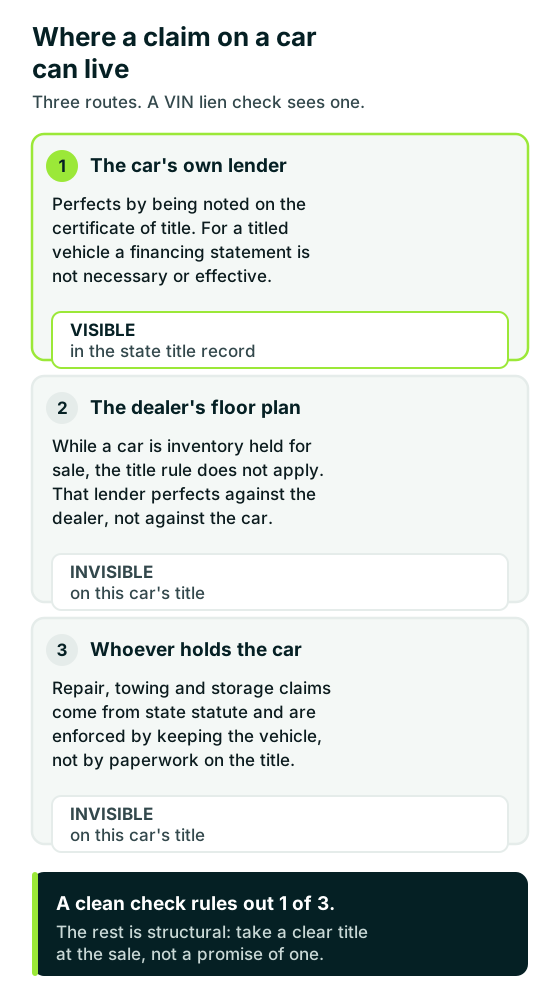
For ordinary goods, a lender secures itself by filing a financing statement in a public registry. Vehicles are carved out. Where a state issues certificates of title, the code says that filing a financing statement is not necessary or effectiveto perfect a security interest in a titled vehicle, and that compliance with the title statute is what counts instead — a security interest in that vehicle “may be perfected only by compliance with those requirements.”
So the lienholder’s claim is created by getting its name onto the certificate of title. Not by a filing somewhere else, not by the loan agreement, and not by anything the seller can show you on a phone. That is why a title record answers this question and a stack of paperwork does not, and it is why a seller who cannot produce a clear title has told you something important regardless of what they say next.
Why a national lien check may not answer the question
Search for a lien check and you will be offered a VIN lookup that promises hidden loans, usually free. It is worth understanding what the national title system is actually required to hold before you rely on one, because the answer is narrower than the marketing.
Federal regulation tells every state what it must send to the national system, in electronic form, once every 24 hours. The mandatory list is five items: the VIN; any description on the certificate of title including all brands; the name of the individual or entity the certificate was issued to; junk and salvage acquisition information where the state collects it; and the odometer disclosure recorded when the title was issued, plus later mileage where the state notes it.
| In the mandatory federal data set | Not in it |
|---|---|
| VIN | The lienholder's name |
| Title description and every brand | The loan balance |
| Who the certificate was issued to | The payoff figure |
| Junk and salvage acquisitions | Whether a release has been filed |
| Odometer at title issue | Any lien created against a dealer's stock |
Lienholder detail is not absent by oversight. A separate paragraph lets a state send anything else on its certificates of title if the state and the system operator both agree, which is exactly how lien indicators reach these reports where they do. The same regulation mentions lien-holder status only in one other place: as one of the things a state checks for validity when it is about to issue a title on a vehicle arriving from another state.
Read that carefully and the practical rule falls out. A national report showing a lien is meaningful — something was reported. A national report showing no lien isnot proof of a clean car, because the field it would have appeared in is optional. Only the state title record settles it, which is why the ordered sequence above starts where it does.
The exception that applies to the car on a dealer's lot
There is a carve-out inside the carve-out, and it covers a large share of used-car purchases: the vehicle sitting on a dealer’s forecourt.
While a vehicle is inventory held for sale or lease by someone in the business of selling goods of that kind, the title-notation rule does not apply to a security interest created by that person. Dealers finance their stock — the arrangement is usually called a floor plan — and that lender does not perfect by getting itself onto each car’s title. It perfects the ordinary way, against the dealer.
For a buyer this has one blunt consequence. A car can carry a real, perfected claim created by the dealer, and that claim is invisible on the vehicle’s title record, because it was never supposed to be there. Nothing about checking the VIN will surface it. It normally causes nobody any trouble at all, because the floor-plan lender is paid out of the sale — which is precisely why the danger concentrates in the case where it is not.
- A dealership that closes or is seized between your payment and your title arriving
- A sale where the dealer takes the money but never clears the unit with its lender
- Consignment sales, where the dealer holds a car it does not own
- Any purchase where the title is promised later rather than handed over
- An unusually urgent discount from a dealer whose lot has thinned out
The protection is not a better database search; there is not one to run. It is structural: buy where the title is delivered at the sale rather than promised, hold back final payment until you have it or it is confirmed in transit through the state system, and treat a delayed title from a dealer as the same warning it would be from a private seller.
How to check for a lien, in order
- 1Ask to see the title, earlyBefore the test drive. A seller who cannot produce it, or whose name is not on it, has answered the important question already.
- 2Read the lienholder fieldA named lender means an active or recently released interest. A release letter or signed-off lien section is what closes it.
- 3Verify against the state recordUse the state's own tool where one exists — our registration lookup guide maps them — because the record outranks the paper.
- 4Pull an NMVTIS-sourced reportA few dollars, and it surfaces lien indicators alongside the title-brand history you should be checking anyway.
- 5Match every nameTitle name, seller's ID, and the person taking your money must be the same. Any mismatch stops the deal.
Decode the VIN free while you check the paperwork
Decoded from official manufacturer and NHTSA records
The claims held by whoever has the car
The third route is the one buyers almost never think about, because it is not created by a loan at all. State statutes give repair shops, towing operators and storage yards a claim over a vehicle for work done or space used, and that claim is enforced by keeping the car rather than by any entry on its title.
The mechanics are worth understanding because they invert the usual advice. A financing lien follows the paperwork, so paperwork answers it. A possessory claim follows the vehicle, so it is answered by where the car has been and who has had it. The exact notice, timing and sale procedures are set state by state and vary considerably, which is another way of saying no national lookup abstracts them.
In practice these surface in a narrow set of situations, and they are recognizable in advance:
- A car being sold straight out of a repair shop by someone other than the registered owner
- A vehicle recovered from impound or long-term storage, sold quickly and cheaply
- An estate or divorce sale where the car has been sitting somewhere for months
- Any seller who cannot explain where the car has physically been
- A price that only makes sense if the seller needs the car gone this week
The defense is the same one that answers the dealer case, which is why the two belong together: the question to press is not only who financed this car, but who has had it, and whether anyone was owed money for holding it. A seller who can account for the vehicle’s recent physical custody has addressed the whole of the third column; one who cannot has left it open, and no report you buy will close it.
Electronic titles change what you are verifying
Most states now hold titles electronically by default. Florida is the clearest example — the state record is the title, and paper exists only when someone requests it printed. That is good news for fraud prevention and confusing for buyers who were taught to inspect a document.
The adjustment is simple: verify the record rather than the paper. A seller saying “it’s an electronic title” is describing the normal case in many states, not dodging. What matters is whether the state record shows their name and no active lienholder, which our Florida title check guide walks through for the state where this comes up most.
Why the risk concentrates on a car that has crossed a state line
A lien is created under one state’s title law and recorded in that state’s system. Nothing about that record automatically follows the vehicle when it is titled somewhere else, and the handover between two state systems is where an active claim is most likely to be lost.
The federal rules are alive to this. Before issuing a title to someone claiming to have bought a vehicle from another state, a state has to run a verification check through the national system: sending the VIN, and using what comes back to confirm the vehicle is not reported as junk or salvage, to compare the odometer reading against what was reported, and to establish the validity of other information presented — with lien-holder status named as the example.
That check is a real protection and it is worth knowing its shape. It runs at the moment of retitling, on the information presented to the new state, and it depends on what the previous state chose to send. Where lien detail was optional and not supplied, the check has less to compare against.
The practical version is short. Establish which state issued the title the seller is holding and when. If the vehicle was titled elsewhere recently, treat the older state’s record as part of the check rather than history, and be more insistent than usual about seeing the physical title before money changes hands.
Buying a car that does have a lien — the safe structure
Plenty of good cars are sold with money still owed on them, and the transaction is routine when it is structured correctly. The principle: the lender gets paid by you, not by the seller.
- Get a written payoff quote from the lender, with an expiry date and exact figure
- Pay the payoff amount directly to the lender, and only the balance to the seller
- Complete the transaction at the lender's branch where possible — they release the lien on the spot
- Where that is impossible, use a licensed escrow service rather than trust
- Confirm the lien release lands in the state record before you consider the deal closed
Only one person can clear the lien, and it may not be the seller
One item in the mandatory federal data set does more work on a lien question than it first appears: states must report the name of the individual or entity the certificate of title was issued to. That is the person a lender will deal with, and the only person who can direct a payoff and a release.
It matters because the seller in front of you is not always that person. A car can be sold on by someone who never titled it, which leaves you negotiating a lien payoff with a party the lender does not recognize and cannot take instructions from. Our title jumping guide covers that practice on its own terms; the narrow point here is that it breaks the mechanism this whole page depends on.
The check is quick and it belongs before any payoff conversation, not after. The name on the title, the name on the seller’s identification and the name the lender has on the account should be the same. Where they are not, stop and establish why before money moves, because a payoff routed through someone who is not the titled owner can leave the lien attached and your money gone.
The lien scams worth recognizing
- The stale title — a printed paper title from before the loan, presented as current; the state record is the answer
- The 'title is in the mail' sale — payment now, paperwork later, and the paperwork never resolves
- Curbstoning with borrowed paperwork — a dealer posing as a private seller, using a title not in their name
- The out-of-state title shuffle — moving a car between states to obscure an interest; NMVTIS is what defeats it
- The deposit hold — a request for money before you have seen title or record at all
If you already bought one
Act quickly, because the lender is not the wrongdoer here and will act on its own timetable. Contact the lienholder to establish the payoff position, then the seller in writing demanding they settle it. Your state DMV can confirm the record and, in many states, the attorney general’s consumer division handles title-fraud complaints — patterns are how curbstoners get caught. Where the sum is significant, a consumer attorney is worth the consultation; misrepresenting a lien in a sale is generally actionable.
Where this information comes from
- 28 CFR 25.54 — what states must report to NMVTISThe five mandatory fields, every 24 hours. Lienholder is not among them; paragraph (b) makes anything further optional between a state and the operator
- UCC 9-311, as adopted at RCW 62A.9A-311 (Washington State Legislature)For a titled vehicle a financing statement is “not necessary or effective” — perfection is by title notation only. Subsection (d) removes dealer inventory from that rule, which is the floor-plan case
- NMVTIS — national title recordTitle records and lien indicators where states report them
- FLHSMV — Motor Vehicle Information CheckA free state title-status tool, in an electronic-title state
- FTC — buying a used carFederal consumer protections, including dealer obligations
- NICB VINCheckFree theft and total-loss screen to run alongside
Keep reading
Frequently asked questions
How do I check if a car has a lien?
Start with the title itself: a lienholder is printed on the face of a paper title, and a title the seller cannot produce is the first warning. Then check the state record, because that is where the lien legally lives — several states publish free title-status tools, and every state will tell a titled owner. A vehicle history report from an approved NMVTIS provider also surfaces lien indicators on many vehicles.
Can I buy a car that still has a lien on it?
Yes, but only if the money is routed through the lienholder rather than around it. The standard safe structure is to pay the payoff amount directly to the lender and the balance to the seller, ideally completing the transaction at the lender's branch. Handing the full price to a seller who promises to settle the loan afterwards is how buyers end up owning a car the bank can repossess.
What happens if I buy a car with an undisclosed lien?
The lienholder's security interest survives the sale. That means the lender can still repossess the vehicle even though you paid someone else in good faith, and you are left pursuing the seller for your money. It is the single most expensive paperwork mistake in private-party car buying, and it is entirely preventable before payment.
Does a vehicle history report show liens?
Often, but not universally. NMVTIS-sourced reports carry lienholder indicators where states report them, and commercial reports frequently show them too. Treat the report as a strong signal rather than proof — the state title record is the legal source, and it is the one to confirm before money moves.
What is an electronic lien and title?
Most states now hold titles electronically, so the lender's interest is recorded in the state system rather than printed on paper the seller keeps in a drawer. It makes fraud harder and paperwork easier, but it changes the buyer's job: you verify the record, not the document, because a printed title in someone's hand may simply be out of date.
Check the car and the paperwork
Decode any VIN free for the factory build, specifications and open safety recalls. No account, no card.
Run a free VIN check