The short answer
- How long do I have?
- Between 20 and 90 days depending on the state — and in 3 of the six below, the clock can start before you arrive.
- Title or registration first?
- Title. Your new state issues its own certificate of title, and the registration follows from it rather than the other way round.
- What holds it up?
- A federally required check of the national title record, plus whatever inspection your new state adds on top.
20 days
Shortest deadline of the six below
Cal. Veh. Code 6700(a)
90 days
Longest deadline of the six below
C.R.S. 42-3-103(4)
Before title
When the national check has to run
28 CFR 25.54(c)
All brands
What travels with the record
28 CFR 25.54(a)(2)
The clock, and what starts it
Every guide to this question tells you that you have thirty days. Most of the time that is roughly right, and the exceptions are the expensive part. Below are six states read from their own statutes rather than from a summary, and the spread is 70 days wide.
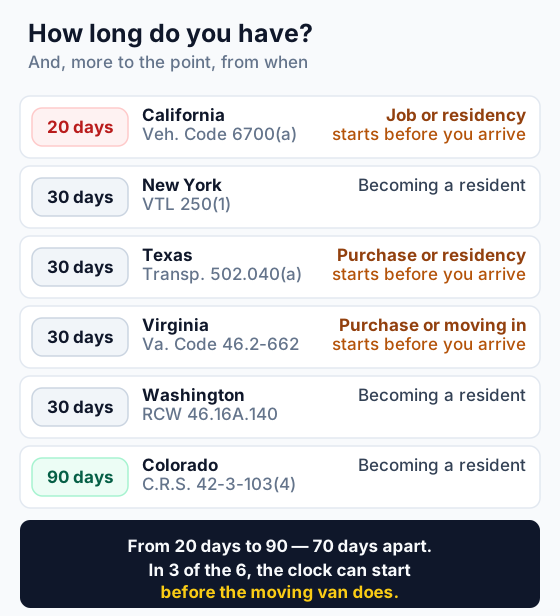
Read the right-hand column before the numbers. California’s Vehicle Code section 6700(a) lets a visitor operate a vehicle registered elsewhere until gainful employment is accepted in this state or until residency is established in this state, whichever occurs first, and then requires the registration application within 20 days of that event. Accept a job offer that starts in California and the clock is running whether or not your belongings have arrived.
Texas runs a similar double trigger from the other direction. Its Transportation Code section 502.040(a) requires an application not more than 30 days after purchasing a vehicle or becoming a resident of this state. Virginia’s DMV states the same pairing in its own operating manual: within thirty days of purchase or of moving into Virginia, apply for a certificate of ownership.
At the other end, Colorado allows ninety days after becoming a resident — and its statute also provides for fees to be prorated back to the residency date if you miss it, which is a reminder that a generous deadline is not the same as a free one.
When exactly do you become a resident?
Since most of these clocks start at residency, the definition matters more than the day count does. States do not agree on it, and several of them define it by presumption rather than by a bright line.
New York is the clearest example of how the drafting actually works. Its Vehicle and Traffic Law section 250does not say “register within thirty days.” It says a non-resident who becomes a resident is entitled, for a period not exceeding thirty days, to the same exemption from registering his vehicles in this state as he would have enjoyed had he remained a non-resident. The duty is the background rule; the thirty days is a grace period carved out of it.
The same section then defines the trigger: resident means domiciliary, one who lives in the state with the intention of making it a fixed and permanent abode, and it is presumptive evidencethat somebody maintaining a place of abode in the state for at least ninety days is a resident. That is a presumption, not a safe harbor — it is the state’s evidence, not your allowance.
The title has to be dealt with first
The single most common misunderstanding on this topic is that moving states is a registration errand. It is not. Your new state issues its own certificate of title, and it issues the registration to the person that title names. The registration is downstream of the title, always, and everything slow about the process lives upstream of it.
That is why appointment slots labeled “vehicle registration” so often end in a second appointment. The counter cannot register a vehicle the state has not titled, and it cannot title one until the ownership document from your previous state has been surrendered and the checks have cleared. Our page comparing a car title and a registration sets out why the two documents are not interchangeable in the first place.
In most states the old title is physically surrendered and destroyed or retained; you do not end up holding two. That is a deliberate feature of the system, because two live titles for one vehicle is exactly the condition the national record exists to prevent.
The check federal law makes your new state run
Here is the step that does not appear in the DMV walkthroughs, because it is not something you do. 28 CFR 25.54(c) requires each state to perform an instant title verification check through the national system before issuing a certificate of title to an individual or entity claiming to have purchased a vehicle from an owner in another state, and in cases of title transfers.
It is worth being precise about what that check is for. The regulation describes it as verifying the validity and status of the document purporting to be a certificate of title. In other words, the receiving state is not taking your paper at face value — it is asking the issuing state’s record whether the paper is what it appears to be.
What the check returns is shaped by 28 CFR 25.54(a), which requires every state to report titling information every twenty-four hours, and by (a)(2), which puts into that feed any description of the automobile included on the certificate of title (including any and all brands associated with such vehicle). So the record your new state queries is current to within a day, and it carries the marks. Our page on the NMVTIS report explains what a consumer sees of that same system.
The order it actually goes in
Put the pieces in sequence and the reason for the delay becomes obvious: the registration is the last event in a chain of five that have to complete first.
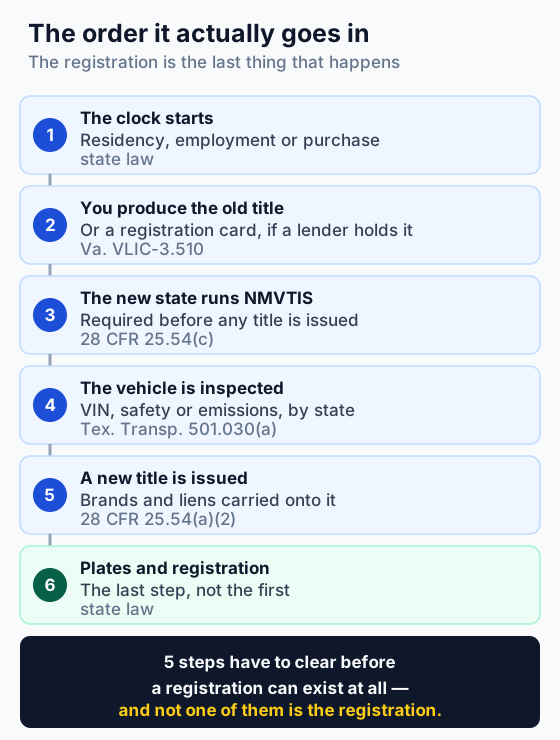
Two of those steps are outside your control entirely — the national check and, where it applies, the inspection queue. Planning around that is the practical takeaway: start the process in the first week rather than the last, because the deadline applies to your application, and an application waiting on a check is an application you have already filed.
When the lender is holding your title
If you are still paying for the car, you almost certainly do not have the title. The lienholder does, either as paper in a filing cabinet or as an electronic record with your previous state. Neither version can simply be handed to a new state by you.
States handle this routinely and some publish exactly how. Virginia’s DMV manual states that a registration card may be used to transfer a vehicle into Virginia when the title is currently titled in the owner’s name in another state and the title is not available due to its being held by a lienholder, or for other reasons beyond the owner’s control — with the caveat that the owner will not receive a printed title until the out-of-state title is submitted to DMV. The same manual notes that Virginia titles carrying a lien are printed centrally and mailed to the lienholder rather than to the owner.
- 1Tell the lender before you moveMost lenders have a standard out-of-state transfer process and it is not fast. Starting it after you arrive is what turns a thirty-day deadline into a problem.
- 2Ask what your new state accepts in place of the titleA current registration card, a title-in-lieu, or a direct request from the new DMV to the old one are all common. This is the question to ask at the counter, and it has an answer.
- 3Expect the lien to be re-recordedVirginia requires that all security interests held against the vehicle be recorded on the newly issued title. The lender's interest follows the car, it does not lapse in transit.
- 4Do not expect to hold the new titleWhere a lien is recorded, the printed title generally goes to the lienholder. You get a registration and, in most states, a record you can look up.
What the new state inspects
On top of the federal check, states add their own verification — and these are the requirements that most often surprise somebody arriving from a state that did not have them.
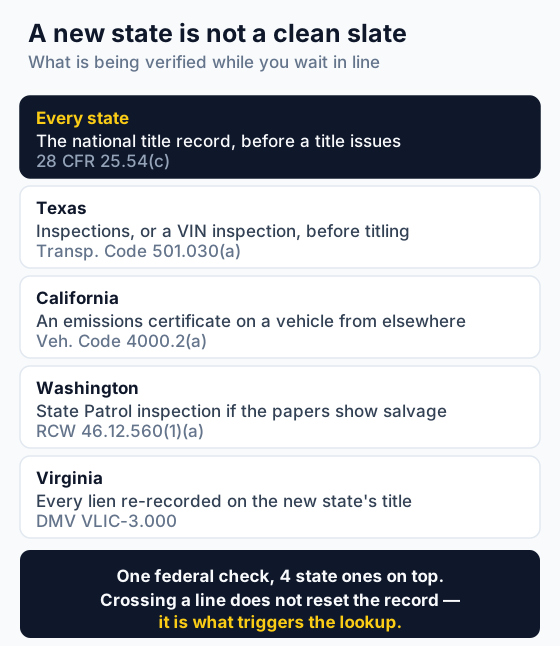
Texas puts its requirement squarely before the title. Transportation Code section 501.030(a) provides that before a motor vehicle last registered or titled in another state or country may be titled in Texas, the county assessor-collector shall verify that it has passed the required inspections, or that the owner has obtained an identification number inspection. That is a gate on titling, not a condition of registration.
California’s equivalent is emissions. Vehicle Code section 4000.2(a) requires a valid certificate of compliance or noncompliance on registering a motor vehicle previously registered outside the state. If you are moving a car into California, the smog question is not optional and is worth answering before the vehicle is on a transporter.
Washington’s is the most interesting of the three because it is triggered by the paperwork rather than by the calendar. RCW 46.12.560(1)(a) requires a State Patrol inspection where a vehicle is presented with documents from another state showing it was a total loss or salvage vehicle and has not since been reissued a valid registration certificate by that state.
Your old brands come with you
The hope that a state line resets a car’s history is old, persistent, and mostly wrong. The reporting duty at 28 CFR 25.54(a)(2) puts every brand associated with a vehicle into the national feed, and the verification duty at 25.54(c) makes the receiving state look at that feed before it issues a title. The two rules together are the mechanism by which a salvage brand survives a move.
States reinforce it at their own end. Washington’s inspection trigger above is one example. Idaho publishes its version plainly, telling owners that a comparable brand on an out-of-state title will be carried forward.
Where that mechanism fails, it has a name and its own page: title washingcovers how a brand occasionally does disappear across a line and what the pattern looks like from a buyer’s side. The vocabulary of the marks themselves — salvage, flood, lemon, reconstructed — is on what is a branded title.
What to have in the folder
Requirements vary, but the union of what the states above ask for is short and it is worth assembling before the first appointment rather than during the second.
- The out-of-state title, or your current registration card plus the lienholder's details if the title is held
- Proof of identity and proof of your new address — the address is what establishes the residency the deadline runs from
- Proof of insurance meeting the new state's minimums, in your name, at the new address
- An odometer reading, and the disclosure paperwork if ownership changed at any point in the move
- Whatever inspection your new state requires: safety, emissions or a VIN inspection
- Payment for title fee, registration fee, plate fee and, in many states, a use or excise tax
The tax line is the one that generates the most unpleasant surprises. Several states charge a use tax on a vehicle brought in by a new resident, sometimes with credit for sales tax already paid elsewhere and sometimes not. It is not a fee you can estimate from another state’s page, and it is worth asking your new state directly before you budget.
The driver license runs on its own clock
The vehicle deadline and the license deadline are two separate obligations, and they do not always match. Washington sets both at thirty days: RCW 46.16A.140 gives new residents thirty days to obtain Washington registration, and RCW 46.20.021(1)gives them thirty days to obtain a Washington driver’s license.
Whether one has to come before the other is a state-by-state practical question rather than a universal rule, and we are not going to assert a sequence that is not written down. What is worth knowing is that many counters will ask for a local license or at least local proof of address when you register, so obtaining the license first often removes a step even where nothing requires it.
What happens if you miss the deadline
The consequence is rarely dramatic and is usually financial. Late fees are the common outcome, and some states go further: Colorado’s statute provides for registration fees to be prorated back to the date residency was established, so the months of delay are charged rather than forgiven.
The sharper risk is the one that arrives from outside the DMV. A vehicle registered in a state you no longer live in can create an argument with an insurer, because the policy was rated for a garaging address that is no longer true. That is a quiet problem until there is a claim, at which point it is a loud one.
If you have already missed the deadline, the answer is still to file rather than to wait for a better moment. Every state above frames its rule as an application deadline, and a late application is a materially better position than an absent one.
Buying in one state to register in another
A related case, and the one the federal check was most obviously written for: you have not moved at all, but you bought the car across a state line. Here the trigger in Texas and Virginia is explicit — the clock starts at purchase, not at residency — and 28 CFR 25.54(c) applies directly, because it names the person claiming to have purchased a vehicle from an owner in another state.
The practical differences are about the paperwork at the moment of sale rather than about the registration afterwards: a temporary tag or transit permit to get the car home, a bill of sale that will satisfy a state that did not witness the transaction, and an odometer disclosure executed on the title itself. We cover the transaction end of this on buying a car out of state.
If the seller cannot produce a title at all, this is a different problem with a different route, and it is set out on registering a car without a title. Do not buy first and plan to solve it at the counter.
Students, military and people who did not really move
Three groups routinely fall outside the ordinary rule, and all three should check the specific provision rather than assuming the general one.
| Situation | Why the ordinary rule may not apply |
|---|---|
| Active-duty military | Federal and state provisions commonly allow a servicemember to retain the registration of their home state while stationed elsewhere |
| Students | Many states treat a student maintaining domicile elsewhere as a non-resident for vehicle purposes, but the definitions differ |
| Seasonal residents | A state that presumes residency after a set period of abode can reach somebody who never considered themselves to have moved |
| Long-term visitors | The New York presumption at ninety days of abode is evidence of residency whatever the visitor intended |
The last two rows are the ones that catch people. A presumption based on physical presence does not care about your intentions, and a state that has decided you live there will expect the vehicle to be registered there.
Run the VIN before the counter does
Everything above describes a process in which the state looks up your vehicle’s record and then decides what to do. There is no reason you cannot look at the same question first, and a good reason to: if a brand or a lien is going to surface at the counter, you would rather know while the car is still somebody else’s problem.
Start with the decode. A free VIN lookup confirms the number is structurally valid and describes the vehicle you are actually looking at, which is the foundation everything else rests on — the mechanics are on VIN verification. If the plate does not decode to the car, no amount of paperwork downstream repairs that.
Then think about the record itself. The national title system is designed to answer, instantly, whether a vehicle with a known VIN is titled in a particular state and whether it is or has been a junk or salvage automobile. That is the same question your new state is about to ask. If you are moving a car you have owned for years, there is nothing to find. If you are moving one you bought recently and cheaply, a salvage title VIN check is a better use of an afternoon than a surprise at the inspection lane.
And once the plates are on, the follow-up list is on what to do after buying a used car — most of it applies equally to a car that has just changed states rather than owners.
Where this information comes from
- 28 CFR 25.54 — responsibilities of the statesParagraph (a) requires titling information to be reported every 24 hours; (a)(2) includes any and all brands; (c) requires the title verification check before a title issues on an out-of-state purchase.
- California Vehicle Code 6700 — non-resident vehiclesSets the 20-day application deadline and starts it at gainful employment or residency, whichever occurs first.
- California Vehicle Code 4000.2 — certificate of complianceRequires a valid certificate of compliance or noncompliance on registration of a vehicle previously registered outside California.
- New York Vehicle and Traffic Law 250 — non-residentsFrames the 30 days as an extension of the non-resident exemption, and makes 90 days of abode presumptive evidence of residency.
- RCW 46.16A.140 — new Washington residentsAllows thirty days from the date of becoming a resident to obtain Washington registration.
- RCW 46.12.560 — inspection by state patrolRequires inspection where documents from another state show the vehicle was a total loss or salvage and no valid registration was reissued after the declaration.
- Texas Transportation Code chapter 501 — certificate of titleSection 501.030(a) requires the county assessor-collector to verify inspections before a vehicle last titled in another state may be titled in Texas.
- Virginia DMV VLIC-3.510 — evidence of ownership to title a motor vehicleStates that a registration card may be used to transfer a vehicle into Virginia where a lienholder holds the title, and that no printed title issues until the out-of-state title is submitted.
Keep reading
Frequently asked questions
How long do I have to register my car after moving to a new state?
It depends on the state and the range is wider than most guides suggest. California allows 20 days, New York, Texas, Virginia and Washington each allow 30, and Colorado allows 90. More important than the number is the event the count runs from: California starts the clock when you accept gainful employment or establish residency, whichever comes first, so it can begin before you have physically moved anything.
Do I need a new title as well as a new registration?
In almost every case, yes. Registration is permission to use the vehicle on that state's roads and the state grants it to a titled owner, so your new state issues its own certificate of title before it issues plates. That is why the process takes longer than a single counter visit implies — the title work has to complete first, and part of it is a check the state runs rather than something you hand over.
Will my new state check the car's history when I retitle it?
Yes, and it is required to. Under 28 CFR 25.54(c), a state must perform a title verification check through the national system before issuing a certificate of title to a person claiming to have purchased a vehicle in another state, and in cases of title transfers. Some states add their own checks on top: Washington requires a State Patrol inspection where out-of-state paperwork shows a total loss or salvage.
What if my lender is holding the title?
This is common and states have a route for it. Virginia's own DMV manual says a registration card may be used to transfer a vehicle into Virginia when it is currently titled in the owner's name in another state and the title is unavailable because a lienholder holds it — but the owner will not receive a printed title until the out-of-state title is submitted. Practically, tell your lender you are moving early, because the transfer usually runs between the two states and the lender.
Does a salvage or rebuilt brand follow the car to the new state?
It normally does, and that is by design. The national title record carries any and all brands associated with a vehicle under 28 CFR 25.54(a)(2), and the receiving state is required to query that record before issuing its own title. States also act on the paperwork itself: Washington triggers a State Patrol inspection when documents from another state show the vehicle was a total loss or salvage and no valid registration was reissued afterwards.