The short answer
- What does it cost?
- RepairPal lists $979–$1,150 nationally, of which only $298–$437 is labor. KBB's 2020 page gives a general $375–$787.
- Internal or external pump?
- External and belt-driven, on the 2.7L, 3.3L/3.5L, 3.5L EcoBoost and 5.0L, per Ford's own Motorcraft listings.
- Is there a recall?
- No NHTSA recall names the F-150 water pump, 2008–2022. Ford bulletins cover nearby hose and housing leaks instead.
$298–$437
RepairPal labor estimate
National, F-150
0
NHTSA recalls naming the pump
All years 2008–2022
18%
Of F-150 complaints filed as ENGINE
2008–2022
4
F-150 pump listings with a pulley flange
Ford Motorcraft catalog
The numbers, and whose numbers they are
We do not sell repairs, so every dollar figure on this page belongs to whoever published it. RepairPal’s estimator gives the clearest national reading for this truck: $979 to $1,150 for a Ford F-150 water pump, made up of $298 to $437 of labor and $682 to $713 of parts. The page says its estimates were last updated September 3, 2026, and we read it in October 2026. Its year-by-year table displayed inconsistently when we checked, so we quote only the national figure.
Kelley Blue Book’s 2020 F-150 SuperCrew page offers a general range of $375 to $787 for the job, while its own local pricing box reports no data. Both sources point the same way, and the detail worth noticing is the labor line. On RepairPal’s numbers, labor is the smaller half of the bill. Compare that with our Explorer water pump post, where RepairPal’s 2019 Explorer page put labor alone at $1,281 to $1,880. Same brand, same engine size on paper, roughly three to six times the labor dollars. The rest of this page is about why.
Pulley, not sprocket: what Ford's catalog shows
The question most F-150 owners are really asking is whether their truck has the “internal” Ford water pump, the one that lives behind the timing cover and turns off the timing chain. That design is real. It belongs to the transverse 3.5-liter Duratec V6 in the Explorer, Edge, Flex and Taurus, and a failed pump there can leak coolant into the oil. The F-150 mounts its engines lengthwise, and its pumps are built differently.
The evidence we trust most is Ford’s own parts catalog, read on ford.com in October 2026. Four Motorcraft pumps listed for the F-150 each specify the bolt pattern of a pulley, the part a drive belt turns:
| Ford Motorcraft listing | What the listing specifies |
|---|---|
| PW568 — 3.5L Expedition/F-150/Transit | “For 3 Bolt Pulley Flange” |
| PW591 — 3.3L/3.5L F-150, 3.7L Transit | “For 3 Bolt Pulley Flange” |
| PW632 — 2.7L F-150 | “For 3 Bolt Pulley Flange” |
| PW535 — 5.0L F-150/Mustang | “For 4 Bolt Pulley Flange” |
| PW683 — 3.5L Duratec (the control) | “Single Tooth Water Pump Sprocket” — chain-driven |
The last row is the check on the method. Ford lists the internal Duratec pump with a sprocket and a single row of teeth, the signature of a pump the timing chain drives. None of the F-150 listings use that language. Ford’s product pages name the engines in their titles, but the fitment tables did not load when we read them, so we name engines here rather than claim exact model years for each part number.
Engine by engine: which job your truck needs
Which pump you are pricing depends on the engine, and the F-150 has carried a lot of them. The federal fuel-economy records at fueleconomy.gov list every engine Ford certified in each model year, and they fall into five lineups:
| Model years | Engines EPA lists for the F-150 |
|---|---|
| 2008–2010 | 4.6L and 5.4L V8 (plus a 4.2L V6 in 2008) |
| 2011–2014 | 3.5L EcoBoost, 3.7L V6, 5.0L V8, 6.2L V8 |
| 2015–2017 | 2.7L EcoBoost, 3.5L V6, 3.5L EcoBoost, 5.0L V8 |
| 2018–2020 | 2.7L EcoBoost, 3.0L diesel, 3.3L V6, 3.5L EcoBoost, 5.0L V8 |
| 2021–2022 | 2.7L EcoBoost, 3.3L V6, 3.5L EcoBoost and PowerBoost hybrid, 5.0L V8 (3.0L diesel in 2021) |
For the 2.7L EcoBoost, the 3.3L and naturally aspirated 3.5L V6s, the 3.5L EcoBoost and the 5.0L V8, Ford’s catalog points to a belt-driven pump on the front of the engine. We did not find a Ford page settling the drive for the 2008–2010 4.6L and 5.4L V8s, the 2011–2014 6.2L, the 3.0L Power Stroke diesel or the PowerBoost hybrid, so we leave those unassigned. If your truck has one of them, ask the shop where the pump sits and how many hours the job books. An engine lookup by VIN settles which engine you have before any of that.
What 19,248 complaints say, lineup by lineup
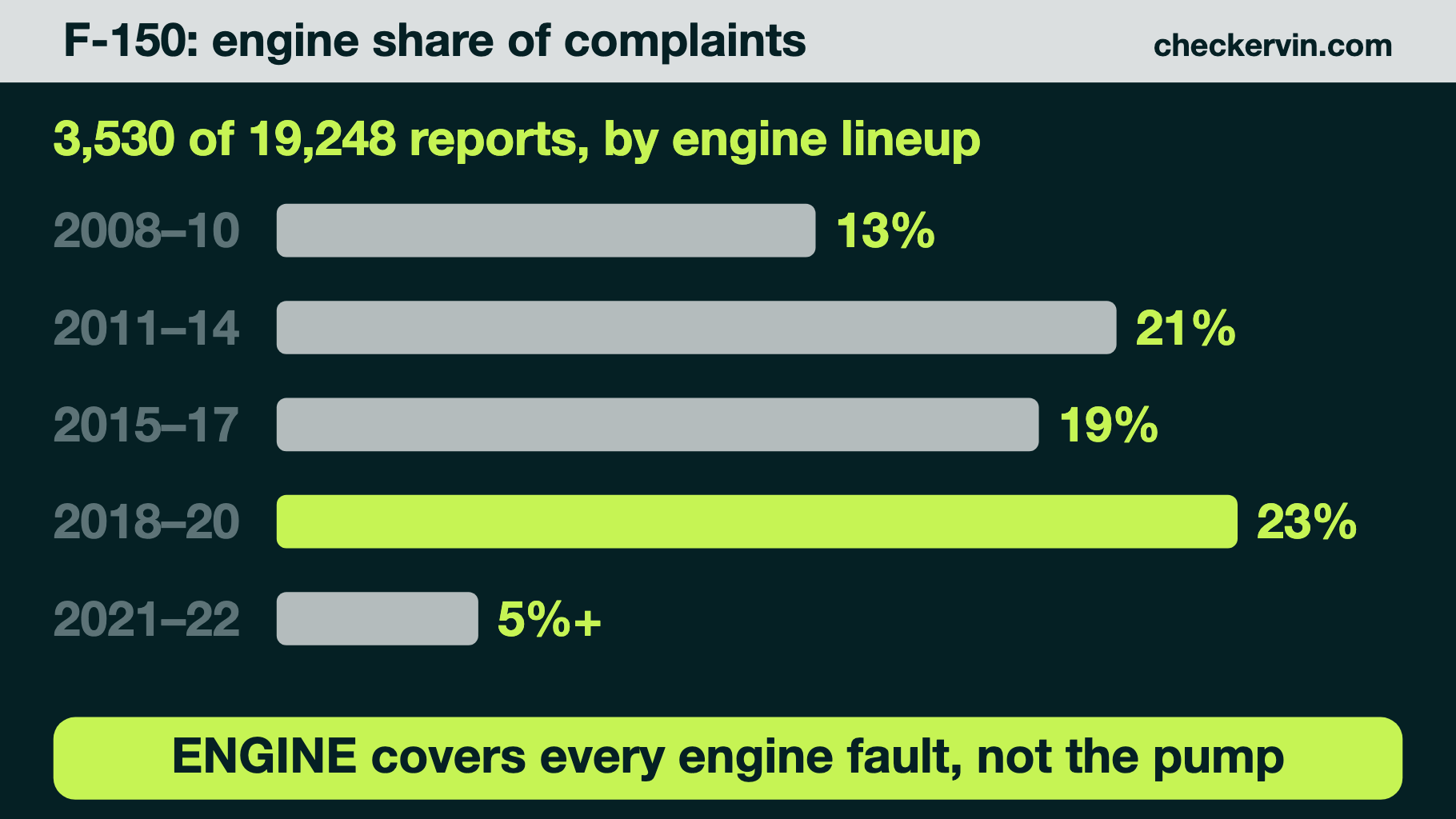
Our corpus of federal NHTSA complaints holds 19,248 reports against the 2008–2022 F-150, and 3,530 of them, about 18%, sit in the ENGINE category. Rather than count them year by year, which our F-150 timing chain cost post already does, the chart below asks how much of each engine lineup’s record is engine trouble at all.
The answer moves with the hardware. The 2008–2010 trucks with the old modular V8s file about 13% of their complaints as ENGINE. The first EcoBoost lineup, 2011–2014, rises to 21%; 2015–2017 sits at 19%; and 2018–2020 is the highest at 23%. The newest pair, 2021–2022, shows 5%, and that one is a floor rather than a measurement for reasons explained below. Even at the 2018–2020 peak, 77% of complaints are about something other than the engine, and on this truck the bigger pile is usually the transmission: power train complaints outnumber engine complaints in 12 of the 15 model years, 6,106 to 3,530 counted overall.
What the record can't tell you about pumps
NHTSA has no water pump category. ENGINE holds every kind of engine complaint from every engine sold that year, from timing noise to oil consumption, so none of the shares above is a pump failure rate. Complaints are also unverified owner reports. What the chart can support is narrower: engine trouble is a real but minority part of the F-150 record, and it shifts with the engines Ford fitted.
The one place NHTSA’s smaller ENGINE AND ENGINE COOLING category surfaces is the 2019 truck, where it ranks number 5of that year’s five most-reported components at 54 reports. In every other year it falls below the fifth slot, which in our data means “smaller than the fifth,” not zero. The same rule explains the newest bar. For 2022, ENGINE itself is not among the five most-reported components, so that year adds nothing to the count and the 2021–2022 share is a minimum. Every sum on this page is likewise a counted minimum, not a total. The F-150 years-to-avoid page breaks the full record down by year.
Leaks that look like the pump and aren't
A coolant puddle under the front of an F-150 gets blamed on the water pump by default. Ford’s own service messages, which NHTSA indexes by vehicle, describe several leaks that sit right next to it and cost far less to fix:
| Ford document | What it describes |
|---|---|
| Bulletin 15-0073 (2015, 5.0L) | Heater outlet hose disconnected from the heater outlet tube on the coolant pump |
| TSB 21-2373 (2021, 3.5L EcoBoost and PowerBoost) | External coolant loss from the degas bottle hose to the thermostat housing, trucks built on or before March 31, 2021 |
| SSM 50835 (2021–2022, 3.5L EcoBoost) | Coolant leak from an incomplete weld on the thermostat housing, built on or before March 8, 2022 |
| SSM 47791 and TSB 21-2168 (2.7L EcoBoost) | Over-temperature warnings and coolant-sensor codes caused by sensor wiring or voltage, not by overheating |
| TSB 20-2292 (2019–2020, 3.3L) | Intermittent lack of heat because software did not run the auxiliary coolant pump at stop-start |
The pattern is worth taking to the shop. On a 2015 5.0L, a wet front of the engine can be a hose that has come off the pump’s outlet tube rather than the pump itself. On a 2021 3.5L, the degas hose and the thermostat housing are documented leak points. On a 2.7L, an over-temperature warning can be an electrical fault in the sensor circuit. Ask the shop which of these it ruled out before it quoted a pump, and ask to see where the coolant is actually coming from.
Is there a recall on the F-150 water pump?
No. We queried NHTSA’s recall database for every F-150 model year from 2008 through 2022. No campaign summary mentions the water pump. To make sure the search could see one, we ran it against a vehicle with a known pump recall, a 2012 BMW 328i, and it found it. The two F-150 campaigns filed under NHTSA’s engine-cooling heading are unrelated to the pump: 08V523 covers 213 2007–2008 trucks converted by Roush to run on propane, and 24V635 covers 2021–2022 trucks with the 2.7L or 3.0L EcoBoost whose intake valves may break.
| Program | What it pays for |
|---|---|
| Recall | Safety defect — free fix at any dealer, none exists for this pump |
| Technical service bulletin or SSM | Repair instructions and labor time — pays nothing outside warranty |
| Factory warranty | Covers the pump only while the truck is inside Ford's coverage terms |
| Goodwill | Dealer and Ford discretion, usually near the end of warranty |
The difference between those rows is spelled out on our TSB versus recall page. Most F-150 years carry several recalls on other systems, and the Ford recall check by VIN shows which are still open on a specific truck.
When the front cover is off anyway
The pump is external, but on the 3.5L EcoBoost it still bolts to the engine’s front cover, and that creates one situation where pump and timing work overlap. Ford’s 2020 bulletin and 2021 satisfaction program for 2017–2020 cam phaser replacement both list a new coolant pump gasket and a coolant pump O-ring among the parts the job requires. The pump comes off so the cover can come off.
That turns the usual advice around. On the Explorer, a pump job drags the timing chain into the bill. On the F-150, a timing job is the moment a pump replacement costs little more than the part, because the labor to remove it is already paid for. If a 3.5L EcoBoost is going in for phasers or chains at high mileage, ask for a line-item price on a new pump while it is out.
The coolant question
Two Ford notices are reminders that the fluid matters as much as the part. A 2016 program for F-150s built at Kansas City on February 1–2, 2016 corrected coolant mixed below specification, and Ford’s notice lists “water pump noise or leaks” among the consequences. And a 2019 service message says F-150s built on or after January 2, 2019 were filled with Motorcraft Yellow coolant, with an instruction not to mix colors or types.
So a 2019 truck could carry either coolant depending on its build date, and a shop topping up from the wrong jug adds a second problem to the first. The coolant type lookup by VIN confirms which one the truck shipped with. Ask for the refill to be listed on the invoice by name.
Signs, and when to stop driving
- Coolant drips or dried crust at the front of the engine, below the belt-driven pulleys
- A growl or whine from the front of the engine that changes with RPM
- A pump pulley that wobbles or has play when the engine is off
- Coolant reservoir dropping between checks
- Temperature gauge climbing, or an over-temperature warning on the dash
The first four give you time to schedule the repair. The fifth does not. An external pump usually announces itself with a visible leak before it fails, which is the good news about the F-150 design, but a pump that seizes or loses its seal can still overheat the engine quickly. If the gauge is climbing, pull over and tow it; on a 2.7L, let the shop confirm with its own reading first, since Ford documented false over-temperature warnings on that engine.
Before you authorize the repair, or buy the truck
- Confirm the engine by VIN — the pump and the labor differ by engine
- Ask the shop to show where the leak is coming from, not only that coolant is low
- On a 2015 5.0L or 2021–2022 3.5L, ask whether the hose and housing bulletins were ruled out
- Compare quoted labor with RepairPal's $298–$437 national range; ask why if it is far above it
- If timing work is planned on a 3.5L EcoBoost, price the pump in the same visit
For a shopper, a water pump is one of the smaller risks on a used F-150, but receipts still matter. An invoice showing a pump and fresh coolant of the right type takes it off the list. A F-150 VIN decode confirms the engine and build date, and a warranty check by VIN shows whether any factory coverage remains on a newer truck.
Where this information comes from
- NHTSA — recalls by vehicle and VINOur 2008–2022 query found no F-150 campaign naming the water pump; 08V523 and 24V635 are the engine-cooling-heading campaigns.
- EPA and DOE — fueleconomy.gov vehicle recordsThe per-year F-150 engine listings behind the lineup table and the chart's five bars.
- Ford Customer Satisfaction Program 21N03 (NHTSA copy)Lists the coolant pump gasket and O-ring among required parts for the 2017–2020 3.5L EcoBoost front-cover job.
- Ford SSM 50835 (NHTSA copy) — 3.5L EcoBoost thermostat housing leakThe 2021–2022 thermostat housing weld leak, built on or before March 8, 2022.
- Ford program 16U11 (NHTSA copy) — coolant concentrationFord's statement that under-spec coolant can cause water pump noise or leaks.
- Ford — Motorcraft PW568, 3.5L F-150 water pump“For 3 Bolt Pulley Flange” — the belt-driven design; PW591, PW632 and PW535 read the same way.
- Ford — Motorcraft PW683, 3.5L Duratec water pumpThe control: a sprocket pump driven by the timing chain, the Explorer-family design.
- RepairPal — Ford F-150 water pump estimateThe $979–$1,150 national figure and its labor and parts split, retrieved October 2026.
Keep reading
Frequently asked questions
How much does it cost to replace the water pump on a Ford F-150?
RepairPal's estimator lists $979 to $1,150 nationally, with $298 to $437 of that in labor and $682 to $713 in parts, on a page it says was last updated September 3, 2026 (retrieved here in October 2026). Kelley Blue Book's 2020 F-150 SuperCrew page gives a general range of $375 to $787 but shows no local pricing data. The labor share is small because on the F-150 engines Ford's catalog covers, the pump bolts to the outside of the engine and is turned by the accessory belt.
Is the water pump on the F-150 3.5 EcoBoost internal?
No. Ford's Motorcraft listing for the 3.5L F-150 EcoBoost pump specifies a three-bolt pulley flange, meaning a belt-driven pulley bolts to it. The internal, chain-driven pump people associate with Ford's 3.5-liter engines belongs to the transverse 3.5L Duratec in the Explorer, Edge, Flex and Taurus; Ford lists that pump with a single-row sprocket instead of a pulley. Ford's 2.7L, 3.3L/3.5L and 5.0L F-150 pump listings also specify pulley flanges.
Is there a recall on the Ford F-150 water pump?
No. We checked NHTSA's recall database for every F-150 model year from 2008 through 2022 and no campaign mentions the water pump, while the same search does find one on a 2012 BMW 328i. Ford has issued service bulletins for nearby coolant leaks instead: a heater hose that can pull off the coolant pump tube on the 2015 5.0L, a degas bottle hose on early 2021 3.5L trucks, and a thermostat housing weld on 2021–2022 3.5L EcoBoost trucks.
How long does an F-150 water pump last?
Ford does not publish a replacement interval for it, and the pump is not a scheduled maintenance item. Ford's Motorcraft product pages say its replacement pumps are durability tested to a 10-year/150,000-mile lifetime equivalent, which is a test standard, not a promise about the original pump in a given truck. Coolant condition matters: Ford's own 2016 program notice says coolant mixed below specification can cause water pump noise or leaks.
Should I replace the water pump with the timing chain on a 3.5 EcoBoost?
It is worth asking about. Ford's cam phaser documents for 2017–2020 3.5L EcoBoost trucks list a new coolant pump gasket and O-ring among the required parts, because the pump has to come off for the front cover to come off. Since the labor to remove it is already in the timing job, adding a new pump costs mostly the part. On a low-mileage pump with no seepage it is optional; on a high-mileage one it is usually the cheaper moment to do it.
Confirm the engine before you price the pump
A free CheckerVIN report shows the factory build, engine, specifications and open recalls for any VIN, so you know which F-150 water pump job you are paying for.
Run a free VIN check