The short answer
- What does it cost?
- Remanufactured units listed at $3,199 (6R80) and $4,593.75 (10R80) before labor when we checked in October 2026. Those are the sellers' figures, quoted with attribution.
- Do I need a whole transmission?
- Maybe not. Ford's 6R80 downshift fault traces to a lead frame or speed sensor, and Ford's dealer bulletin allots 2.2 hours to replace the lead frame in the truck.
- Which years carry the risk?
- 2011–2017 holds 63% of the F-150's power-train complaints, and every one of those years is under a downshift recall.
6,106
Power-train complaints
2008–2022, federal record
63%
In 2011–2017
every year under a 6R80 recall
2.2 hrs
Ford lead-frame labor
CSP 19N01, done in the truck
0.3 hrs
10-speed TSB reflash
TSBs 18-2079 and 18-2274
The numbers, and whose numbers they are
Nobody publishes one honest price for this job, because there are two different transmissions behind the same search. On October 25, 2026, Powertrain Products listed a remanufactured 6R80 six-speed for 2011–2014 F-150 3.5L 4WD trucks at $3,199, marked down from $3,699, with what it calls a 7-year, million-mile warranty. For the ten-speed, Powertrain Company’s listing for a remanufactured 10R80 for 2018–2020 4WD trucks showed $4,593.75 in search results; the page itself refused our direct request, so that figure is the search-served one. BD Diesel lists its heavier-duty RoadMaster 10R80 package for the 2018–2020 3.0L Power Stroke at $4,999.95 plus a $2,500 refundable core deposit.
Those are parts prices, shipped to a shop. Jerry, the car-insurance app whose Q&A pages lead this search, puts the full F-150 job at $3,000 to $5,000, a range that only works for the cheaper unit or a used one. Add labor, fluid, a core charge if you keep your old unit, and programming. Every figure here belongs to the business that published it. We sell VIN checks, not repairs, and price none of this ourselves.
Two transmissions, two price tiers
The 2011–2016 F-150 used Ford’s 6R80 six-speed automatic, and NHTSA’s recall reports name it for 2011–2013 and again for 2015–2017. The ten-speed 10R80 arrived for 2017 behind the 3.5L EcoBoost, which is why a 2017 truck can carry either one; Ford’s 2017 roll-pin recall covers “2017 F-150 vehicles equipped with ten-speed transmissions.” From 2018 the ten-speed went behind most engines, but not all. A separate 2018 recall covers trucks with “a 3.3L engine, a 6-speed transmission.”
So the first thing a quote depends on is which unit is actually in the truck, and the model year alone does not settle it for 2017–2020. A transmission lookup by VIN answers that before anyone prices a part. The price gap is real: the reman listings above put the 10R80 about $1,400 above the 6R80 before labor, and the 10R80 has a programming step that belongs on the quote (more on that below).
What 6,106 power-train complaints say
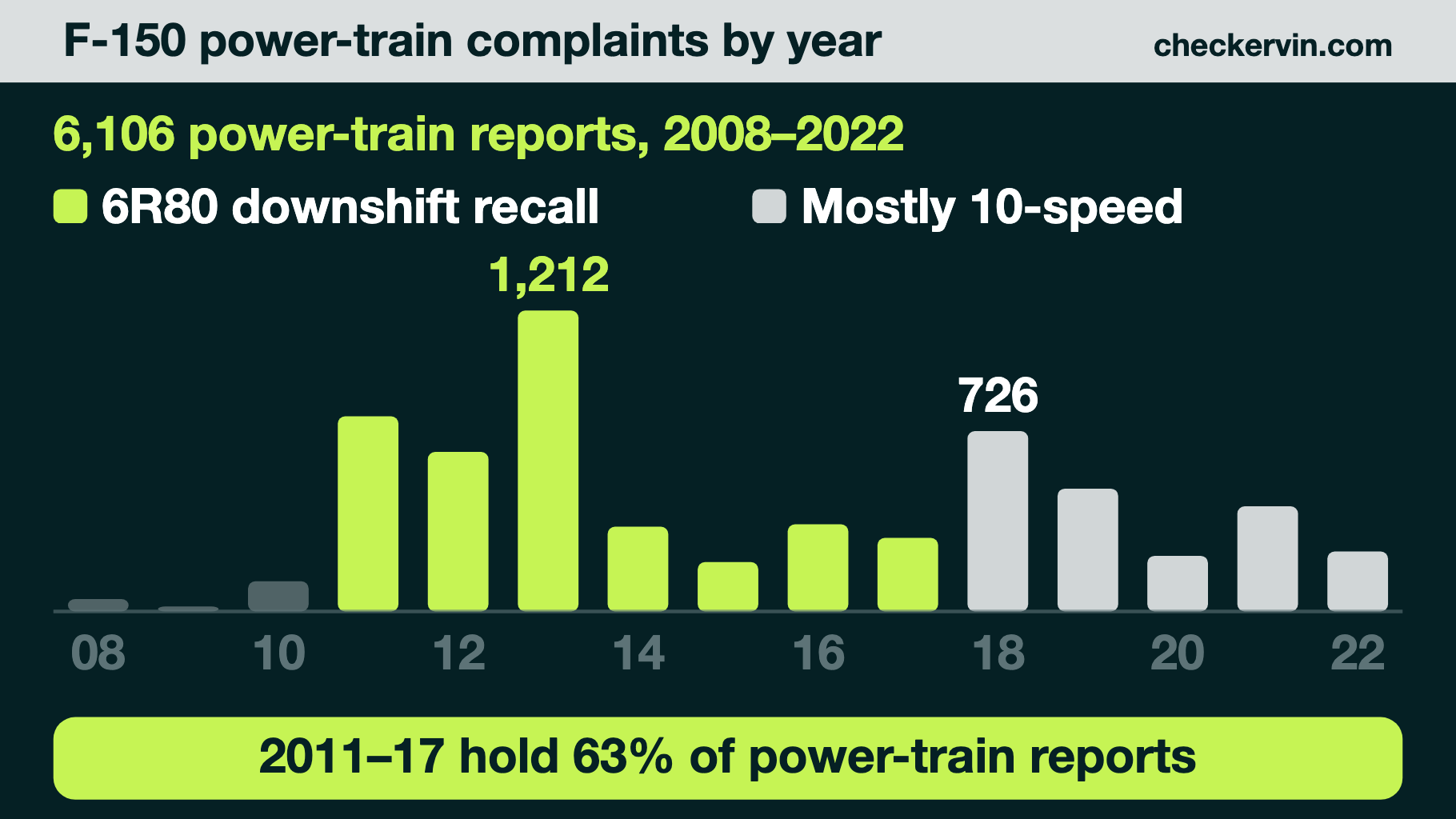
Our corpus of federal NHTSA complaints holds 19,248 reports against the 2008–2022 F-150. 6,106 of them, 31.7%, are filed under power train, and that category is the single most-reported one in 11 of the nameplate’s 15 model years. It is not spread evenly. The 2011–2017 span holds 3,826 of those reports, 63% of the total. The first three years of it alone, 2011–2013, hold 43%, and 2013 peaks at 1,212, which is 43% of every complaint filed against that model year. The three years before 2011 show just 171 combined.
The ten-speed years are the second cluster: 2018–2022 holds 2,109 reports, 35% of the total, with 2018 highest at 726. By share, the 2019 truck is the most transmission-heavy year in the record: 51% of its complaints are power train. Two caveats apply. Complaints are unverified owner reports, not a failure rate. And NHTSA’s power-train bucket also takes driveshaft and axle reports. The 2021 truck, for one, carries several driveshaft recalls, so not every count here is the transmission.
Three recalls, one downshift
The 6R80’s documented failure is not the gearbox wearing out. It is the truck’s computer losing a sensor signal and commanding a sudden downshift, in the worst case into first gear at highway speed, which NHTSA’s summaries say can lock or slide the rear tires. Ford has recalled it in three waves, plus repeat campaigns for trucks fixed wrong the first time:
| Campaign | What it covers and what the dealer does |
|---|---|
| 16V-248 (2016) | Certain 2011–2012 F-150s; downshift to first gear; PCM software update |
| 19V-075 (2019) | 1,263,051 trucks, 2011–2013, 6R80; output speed sensor signal loss; PCM reprogram |
| 19V-433 (2019) | 2013 5.0L/6.2L trucks whose 19V-075 software lacked the fix; reprogram again |
| 24V-444 (2024) | 552,188 trucks, 2014; same output-speed-sensor fault; PCM update |
| 26V-237 (2026) | 1,392,935 trucks, 2015–2017; range-sensor signal through a degraded lead frame; downshift to second; PCM update |
Every remedy in that table is software. 19V-075’s report says the new calibration will “prevent an unintended downshift into first gear and illuminate the Malfunction Indicator Light.” That stops the dangerous shift. It does not repair the sensor circuit that caused it, and the fault light that now comes on can be the start of a transmission quote. The 2026 campaign followed an NHTSA preliminary evaluation opened in March 2025 and upgraded to an engineering analysis in January 2026, so the 6R80 story is still active, not historical.
Two practical points. The 24V-444 report says owners who paid for the repair themselves may be eligible for reimbursement under Ford’s plan on file with NHTSA. And recalls do not expire on the owner’s side, so a truck that never got its reflash can still get it free. A Ford recall check by VIN settles which of these campaigns are still open on a given truck.
The 2.2-hour repair that gets quoted as a transmission
On the 6R80, the speed and range sensors live on a molded lead frame, a plastic carrier with embedded circuits that bolts to the valve body inside the pan. Ford’s own Part 573 report for 26V-237 blames “degradation of the electrical connections in the transmission lead frame due to thermal cycling and vibration.” When that part fails, the truck throws codes, shifts strangely, and feels like a transmission on its way out.
Ford’s dealer bulletin for Customer Satisfaction Program 19N01 shows what fixing it costs Ford. For 2011–2013 trucks logging codes P0720, P0722, P0731 or P1500, the dealer replaces the lead frame with the main control assembly removed in the vehicle, under labor operation 19N01B, allotted 2.2 hours. The program extended coverage on that one part to 10 years or 150,000 miles from the truck’s warranty start. For a 2013 truck sold new, that clock has run out by now, so this is a repair you would pay for, not one Ford still covers.
For the 2015–2017 trucks, 26V-237 goes one step further: if a truck already logged the relevant codes before the software update, dealers will replace the lead frame “in accordance with the corresponding extended warranty program” at no charge. The report does not state that program’s time or mileage limits, and we could not confirm them, so ask a Ford dealer to check the VIN.
The 10-speed: bulletins and a lawsuit, not a recall
The 10R80’s reputation is about shift quality: clunks, harsh or delayed shifts, gears hanging and then banging in. Ford’s answer came as technical service bulletins, not recalls. TSB 18-2079 (March 2018) covers 2017 F-150 and Raptor trucks built on or before August 1, 2017, with harsh or delayed shifts or code P0711. TSB 18-2274 (September 2018) covers 2018 trucks with the 2.7L, 3.5L or 5.0L built on or before May 15, 2018 that “may exhibit harsh/bumpy upshift, downshift and/or engagement concerns.” Both fixes are a PCM reprogram, allotted 0.3 hours. Our guide to TSBs versus recalls explains why that difference matters for who pays.
Owners took it to court. In O’Connor v. Ford, consolidated in the Northern District of Illinois (No. 19-cv-5045), plaintiffs sued over 2017–2020 F-150s with the 10R80. The judge dismissed the first complaint in August 2020 with leave to refile, then in October 2021 let parts of the consolidated complaint go forward and dismissed others. The opinion summarizes the complaint’s allegation that Ford told owners the harsh shifting was normal. Ford’s outside counsel later reported that in January 2023 the court sent some class members’ claims to arbitration and stayed them. We found no settlement or claims process, and could not confirm the case’s status after that, so do not plan a repair around one.
The 10-speed recalls that do exist are about Park and gear selection: a missing or loose roll pin (17V-671, 18V-213), shift cable clips (18V-214, 20V-197), a false low-pressure code that can drop a 2021 truck into neutral (22V-188), and a 2026 campaign, 26V-402, for a 2021 park pawl that may engage while moving. Its remedy includes replacing “any damaged transmission components,” but Ford does not expect the fix until April 2027. For trucks just past this corpus, TSB 25-2587 covers 10R80 units built from August 16, 2022 with harsh 3-4 and 4-5 shifts traced to brinelled F-clutch plates, and its labor table runs to double-digit hours. That is a teardown, not a reflash.
New, remanufactured or used
| Option | What you are actually buying |
|---|---|
| Ford new or reman | Highest price; dealer-installed, factory calibration support, Ford parts warranty |
| Third-party reman | Rebuilt to a spec with updated parts; warranties vary from 3 years to multi-year 'million mile' terms |
| Local rebuild of your unit | Labor-heavy; only as good as the shop and what it finds inside |
| Used / salvage | Cheapest; unknown history, short warranty, same failure risk as the one it replaces |
For a 6R80 the used market is deep, because millions of these trucks were built. That is also its problem: a salvage 2011– 2017 unit may carry the same lead-frame wear that caused the recalls. A remanufactured unit that ships with a new lead frame removes that question, so ask whether yours does. For a 10R80, the question is whether a rebuilder addresses the parts Ford’s own later bulletins replace. Jasper says its 10R80 corrects “inherent issues in OEM design” and carries a three-year, 100,000-mile parts and labor warranty, but doesn’t list the parts. Ask whoever sells you one.
Programming, the line item that gets left off
A replacement 10-speed is not plug-and-play. The control module has to be given the new unit’s solenoid data, and the adaptive shift strategy has to relearn from scratch. Jasper offers rental of a remote programming device “to enter the solenoid strategy and ID into the TCM” on its 10R80. Ford’s own 10-speed bulletins carry a warning in capitals that after a reset, the relearn “may result in firmer than normal upshifts and downshifts for several days.”
Two consequences for your bill. A shop without Ford-capable programming tools may need a dealer for this step, and that charge may not be on the first quote. And a freshly installed transmission that shifts hard in its first week is not necessarily defective. Ask whether the quote includes programming and a road-test relearn, and whether the shop will check open recalls and apply any pending PCM calibration at the same visit, since 19V-075, 24V-444 and 26V-237 are themselves PCM updates.
Before you authorize a replacement
- Confirm which transmission the truck has, 6R80 or 10R80. Model year alone does not settle it for 2017–2020
- Get the stored trouble codes in writing. P0720, P0722, P0731 or P1500 on a 6R80 points at the lead frame first
- Run the VIN for open recalls, especially 19V-075, 24V-444, 26V-237 and, on a 2021, 26V-402
- Ask whether the quote covers the unit, labor, fluid, core charge and programming as separate lines
- Ask the reman supplier what its warranty covers in labor, and whether it ships with a new lead frame or updated clutches
- If you already paid for a downshift repair before a recall letter, ask Ford about reimbursement
If you are buying the F-150, not repairing it
The same record works as a shopping guide. On a 2011–2017 truck, the question is whether its downshift recalls were done and whether the transmission has had a lead frame replaced. On a 2017–2020 ten-speed, ask whether the shift-quality bulletin reflash was applied. A F-150 VIN decode confirms the engine and model year, and checking what Ford coverage remains by VIN settles whether the 5-year, 60,000-mile powertrain warranty described in the O’Connor opinion could still apply to a late truck.
Then drive it cold and hot, at highway speed, and through a few gentle stops. A clunk into reverse or a hard 3-4 shift on a ten-speed is worth noting. A sudden lurch down a gear on a six-speed is worth walking away over until the recall history is clear. For the bigger picture, check which F-150 model years draw the most complaints overall, and if the seller can’t say when the fluid was last changed, look up the fluid spec by VIN before you budget for a service.
Where this information comes from
- NHTSA — F-150 complaints and recalls by model yearThe federal complaint record this page's figures are computed from, and the recall list for each year.
- NHTSA — Part 573 report, recall 19V-0751,263,051 trucks, 2011–2013, 6R80 named; output speed sensor cause and software remedy quoted above.
- NHTSA — Part 573 report, recall 26V-2372015–2017 downshift recall: lead-frame cause, PE25002/EA26001 chronology, lead-frame replacement under extended warranty.
- NHTSA-hosted Ford bulletin — CSP 19N01 lead-frame extended coverageSource of the 2.2-hour labor allowance, the trouble codes and the 10-year/150,000-mile terms.
- NHTSA-hosted Ford TSB 18-2274 — 10R80 harsh/bumpy shiftThe 2018 shift-quality bulletin and its 0.3-hour reprogram, quoted above.
- O'Connor v. Ford, N.D. Ill. — October 2021 opinion (govinfo.gov)The 10R80 class action's scope, rulings and warranty terms, as the court summarized them.
- Powertrain Products — 6R80 2011–2014 F-150 reman listingThe $3,199 (from $3,699) figure quoted above, retrieved October 25, 2026.
- MOTOR — Jasper's remanufactured 10R80Warranty terms and the TCM programming step quoted in the programming section.
Keep reading
Frequently asked questions
How much does it cost to replace a transmission in a Ford F-150?
Published figures cluster in the low-to-mid thousands before labor. Powertrain Products listed a remanufactured 6R80 for 2011-2014 F-150 3.5L 4WD trucks at $3,199 (marked down from $3,699) when we checked on October 25, 2026, and Powertrain Company's search listing showed $4,593.75 for a remanufactured 10R80 for 2018-2020 trucks. Jerry's general F-150 range is $3,000 to $5,000. Labor, fluid, a core charge and programming sit on top. None of these numbers is ours. We sell VIN checks, not repairs.
Why does the 10-speed F-150 transmission cost more to replace?
The 10R80 is a newer, more complex unit with ten forward gears, and the remanufactured supply is thinner and pricier than for the 6R80. The listings we found put a 10R80 reman roughly $1,400 above a 6R80 reman before labor. A replacement 10R80 also needs its solenoid strategy loaded into the control module, which Jasper handles by renting out a remote programming device.
Is there a recall that covers an F-150 transmission?
Not one that replaces it. Ford has recalled every 2011-2017 F-150 model year for an unintended 6R80 downshift (NHTSA campaigns 19V-075, 24V-444 and 26V-237), and each remedy is a powertrain control module software update. 26V-237 adds a lead frame replacement under an extended warranty program if certain trouble codes were already stored. No recall covers 10-speed shift quality; Ford addressed that with service bulletins.
Which F-150 model years have the most transmission complaints?
In the federal record, 2011-2017 holds 63% of the F-150's 6,106 power-train complaints, with 2013 alone at 1,212. The 10-speed years, 2018-2022, hold another 35%, led by 2018 at 726. NHTSA's power-train category also takes driveshaft and axle reports, so treat these as an upper bound on transmission complaints.
Does a replacement F-150 transmission need to be programmed?
Plan on it. For the 10R80, Jasper rents out a remote programming device so the installer can load the replacement unit's solenoid strategy and ID into the transmission control module, and Ford's own bulletins warn that after the adaptive strategy resets, shifts may be firmer than normal for several days. Ask whether a quote includes programming and the relearn drive, because that step is easy to leave off a first quote.
Check the recalls before you price the transmission
A free CheckerVIN report shows the factory build, specifications and open recalls for any VIN. On an F-150, an open downshift recall can change what the repair should cost.
Run a free VIN check