The short answer
- What does it cost?
- RepairPal lists $2,282–$3,280 for the F-150, nearly all of it labor. Ford's bulletins book 8.9 to 10 hours for the chain or phaser job.
- Chain or belt?
- Chain, on every 2008–2022 gasoline F-150 engine. A 'timing belt' quote on these trucks is mislabeled.
- Which years carry the risk?
- 2011–2014 and 2017–2020, the years Ford's bulletins name, hold 77% of the F-150's engine complaints on record.
The numbers, and whose numbers they are
The most specific published estimate for this truck comes from RepairPal, and it is not ours. Its Ford F-150 estimator lists $2,282 to $3,280, splitting that into $2,135 to $3,133 of labor and roughly $147 of parts, on a page marked as last updated October 16, 2025 and retrieved here in October 2026. The page is titled timing belt replacement. No gasoline F-150 from 2008 through 2022 has a timing belt, so read it as a timing drive estimate with the wrong name on it. RepairPal also lists a timing chain tensioner replacement at $2,074 to $2,821 as a related repair on its 2020 F-150 front cover gasket page.
We sell VIN checks, not repairs, and publish no price of our own. What we can add is the part of the estimate that does not depend on anyone’s survey: the hours Ford itself pays a dealer to do the work, and the model years where the federal complaint record says the work is most likely to be needed.
Ford's own labor clock
A Ford technical service bulletin includes the time Ford reimburses a dealer for the repair under warranty. Those times are the closest thing to an objective floor on what a shop will bill, because independent shops price from labor guides built on the same teardown. Four Ford documents cover F-150 timing-system work in the years our corpus spans, and each was read in full:
| Ford document | Job and warranty labor time |
|---|---|
| TSB 17-0026 (2011–2014, 3.5L EcoBoost) | Diagnose and replace the primary timing chain — 8.9 hours |
| TSB 20-2191 (2017–2018, 3.5L EcoBoost) | Replace all four VCT units and reprogram the PCM — 10.0 hours (10.1 on Raptor) |
| Program 21N03 (2017–2020, 3.5L EcoBoost) | Replace all four cam phasers — 9.5 hours |
| TSB 12-7-10 (2007–2010, 5.4L 3V) | Diagnose and replace both VCT solenoids — 3.6 hours |
Read the table against RepairPal’s split and the shape of the bill becomes obvious. Parts are a rounding error; the money is the eight to ten hours spent removing the front of the engine and putting it back. Take the hours from the row that matches your truck, multiply by the hourly rate your shop posts, and you have a reasonable check on whether a quote is in range before parts and fluids are added. A quote far above that product is either including more parts than the bulletin calls for, or pricing a different job.
Chain, not belt, with one diesel asterisk
“How much does it cost to replace the timing belt on a Ford F-150?” is one of the most common questions attached to this search, and for the gasoline trucks the honest answer is that there is no belt. The 4.6L and 5.4L V8s, the 5.0L, the 6.2L, the 3.7L and 3.3L V6s, and every EcoBoost from the 2.7L to the 3.5L time their valves with chains. Kelley Blue Book and RepairPal both publish F-150 pages titled timing belt replacement anyway, which is how the question keeps circulating.
The asterisk is the 3.0L Power Stroke diesel offered from 2018 through 2021. Secondary reports describe it as belt-driven with a long replacement interval. We could not confirm that against a Ford document, so we label it unverified rather than repeat it as fact. If the truck you are pricing is a diesel, the timing belt or chain lookup by VIN and a dealer service history are the places to settle it.
What 19,248 complaints say about eight model years
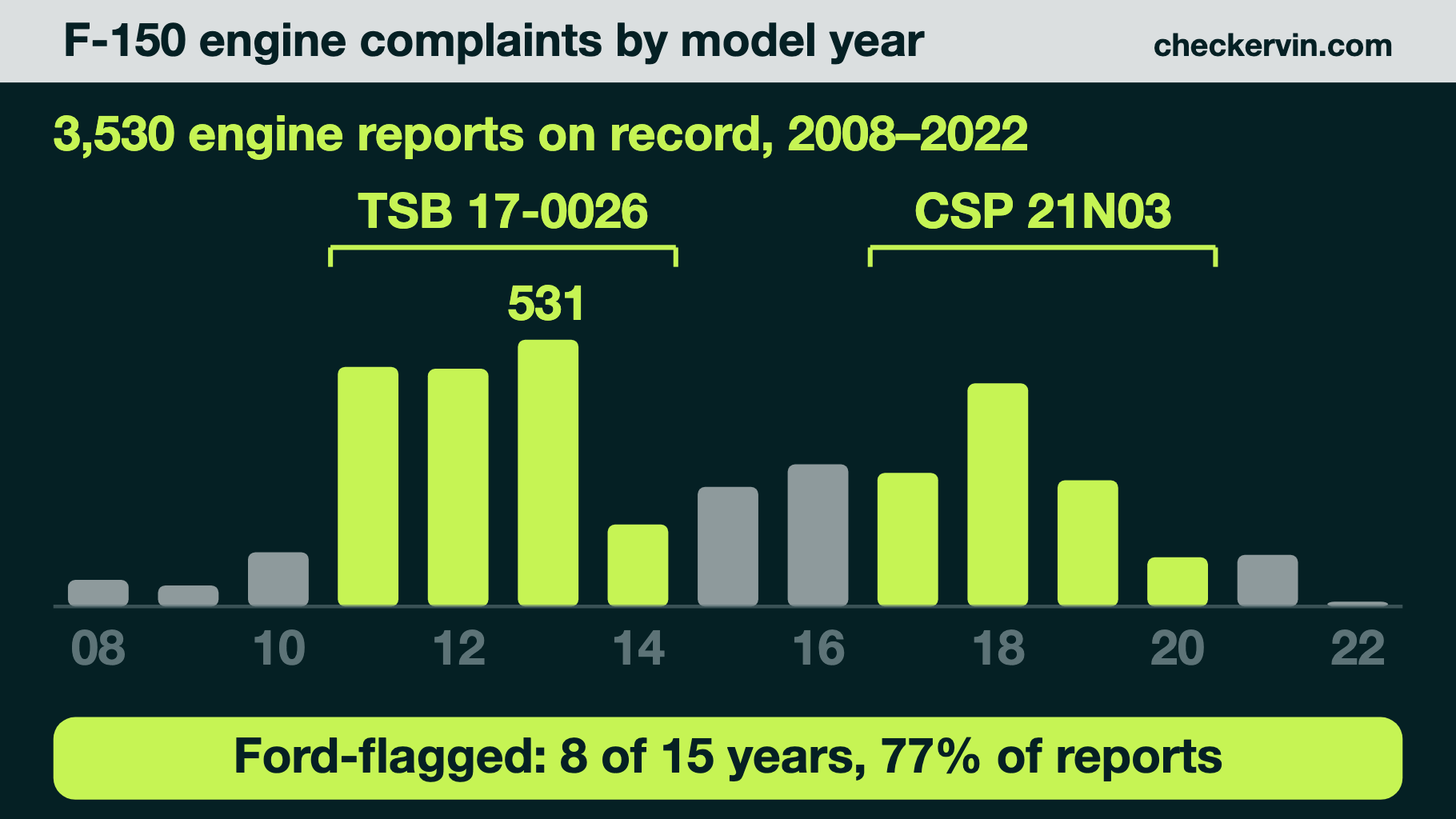
Our corpus of federal NHTSA complaints holds 19,248 reports against the 2008–2022 F-150, and 3,530of them land in the ENGINE component category. Lay those engine reports out by model year and they do not form a smooth line. They bunch into two humps, and the humps sit on the same model years Ford’s bulletins name: 2011–2014 holds 47% of all engine complaints and 2017–2020 holds another 30%. Together that is 77% in 8 of fifteen model years. A year inside those windows averages about 338 engine reports; a year outside them averages about 118.
Two caveats keep that honest. Complaints are unverified owner reports, not a measured failure rate. And the ENGINE category covers every engine Ford sold in a given year, so a 2013 count includes 5.0L and 3.7L trucks alongside the EcoBoost. The overlap says where the record concentrates; it does not prove every report is a stretched chain. One more limit: for 2022, ENGINE is not among the five most-reported components in our data, so it plots as zero rather than as a number we would have to guess.
2011–2014: the stretched primary chain
The 2011 model year brought the 3.5-liter EcoBoost twin-turbo V6 to the F-150, and the engine complaint record jumps that year: from 108 reports against the 2010 truck to 477 against the 2011. The peak of the whole fifteen-year series is the 2013 truck, at 531 engine reports.
Ford’s bulletin for this era is specific. TSB 17-0026, published March 8, 2017 and superseding TSB 15-0044, covers 2011–2014 F-150s with the 3.5L engine built on or before October 10, 2014 that show a check-engine light with code P0016. The bulletin says the concern “may be due to a worn primary timing chain,” tells the technician to confirm the intake cam reading is six degrees or more off before going further, and lists a repair kit Ford calls a timing chain tensioner kit. Its warranty status is ordinary new-vehicle and emissions coverage, and we found no extended-coverage program for this era, so on a truck this old the repair is the owner’s bill.
The 2014truck sits inside the bulletin’s range but carries only 163 engine reports, a fraction of the three years before it. The record does not say why, and we would rather leave that gap visible than explain it away.
2017–2020: cam phasers, and a program that has expired
The second hump arrives with the next 3.5L generation and peaks on the 2018 truck at 444engine reports. The noise owners describe in this era usually comes from the variable cam timing units, or cam phasers, that sit on the ends of the camshafts and are driven by the timing chain. Ford addressed it twice. TSB 20-2191, dated June 4, 2020, covers 2017–2018 trucks built on or before July 10, 2018 that make a ticking or rattle noise from the front cover for two to five seconds after a cold soak of six hours or more. The fix is all four VCT units plus a PCM update, and the bulletin explicitly tells technicians not to replace other timing components that are not on its parts list.
Then, on March 2, 2021, Ford issued two Customer Satisfaction Programs for 2017–2020 trucks built through November 30, 2019. Program 21B10 reflashed the powertrain control module. Program 21N03 extended cam phaser coverage, prorated by mileage, until September 1, 2022, but only for trucks that received the 21B10 reflash by August 31, 2021. Raptor and Limited variants were excluded. Ford wrote that a noisy phaser “does not affect the vehicle safety, performance, or emissions,” which is why this became a satisfaction program and not a recall.
2008–2010: the 5.4L three-valve
The 5.4-liter three-valve V8 has its own long reputation for start-up rattle and phaser noise, and most of that history belongs to 2004–2007 trucks that predate our corpus. Within it, the 2008–2010 F-150 carries 203engine complaints across three model years, the quietest stretch of the series. Ford’s TSB 12-7-10, published July 23, 2012, covers an intermittent rattle or rough idle at operating temperature on 2004–2010 F-150s with this engine, caused by oscillating cam timing. Its remedy is not a chain at all: replace both VCT oil control solenoids, booked at 3.6 hours on a 2007–2010 F-150.
That is worth knowing before a shop quotes a full timing job on one of these trucks. A solenoid-only fix is a fraction of the work, and the bulletin gives a scan-tool test for whether it applies. Owner forums also describe worn phasers and tensioners on high-mileage 5.4L engines that a solenoid swap does not cure, so the test result decides which job you are paying for.
What the recall record covers, and what it doesn't
We queried NHTSA’s recall database for every F-150 model year from 2008 through 2022. No campaign names the timing chain, the tensioner or the cam phasers. Two engine recalls sit close enough to cause confusion. Campaign 17V672 covers certain 2018 F-150s with 3.5L engines whose cylinder heads “may have been machined without lubrication supply holes for the camshaft bearing journals” — a camshaft problem, not a chain problem. Campaign 24V635 covers 2021–2022 F-150s with the 2.7L or 3.0L EcoBoost whose intake valves may break. Neither pays for a timing chain.
| Program | What it actually pays for |
|---|---|
| Recall | Safety defect — free fix at any dealer, no time limit on the remedy |
| Customer satisfaction program | Ford pays, within its stated dates and mileage — 21N03 ended in 2022 |
| Technical service bulletin | Repair instructions and labor time — pays nothing outside warranty |
| Goodwill | Dealer and Ford discretion, usually only near the end of warranty |
The useful step is still to run the specific truck’s VIN. Most F-150 years carry several recall campaigns on other systems, and the Ford recall lookup by VIN shows which ones remain unrepaired on that truck.
What failure sounds like before it costs anything
- 2011–2014 EcoBoost: check-engine light with code P0016, sometimes with other codes and drivability complaints
- 2017–2018 EcoBoost: tick or rattle from the front cover for 2–5 seconds after sitting six hours or more
- 2017–2020 EcoBoost: rattle at start-up after sitting, or a knock at warm idle
- 2007–2010 5.4L: intermittent rattle or rough idle once warm, with codes P0021, P0022, P0340 or P0341
Every item on that list comes from a Ford document, and each one is cheaper to deal with early. A phaser that rattles for a few seconds at start-up is a scheduled repair. A chain that has stretched far enough to move cam timing past spec is the same repair with a tow bill attached, and on any of these engines timing that keeps drifting eventually costs more than the chain.
Before you authorize the repair
- Confirm the engine and build date by VIN — both bulletins have build-date cutoffs
- Scan for codes and keep the printout; P0016 is the 2011–2014 bulletin's entry condition
- Ask which document the shop is working from and whether the quote matches its parts list
- On a 2017–2020 truck, ask whether the quote is phasers only or phasers plus chains and guides
- Compare the quoted labor hours with Ford's 8.9 to 10 hours for the matching job
The third and fourth items matter most. TSB 20-2191 tells technicians to replace the four VCT units and nothing else in the timing system unless parts are on its list, and that is where a lot of quote spread comes from. Some shops replace chains, guides and tensioners at the same time because the front of the engine is already open. That can be reasonable on a high-mileage truck, but it is a choice you should make, not one buried in a total.
If you are buying the truck, not repairing it
The same record reads as a shopping map. On a 2011–2014 or 2017–2020 EcoBoost truck, ask for paperwork showing the bulletin work was done, or budget for it in the price. A F-150 VIN decode confirms the engine and the build year, and the build date matters here because both bulletins stop at a cutoff. A warranty check by VIN settles whether any factory powertrain coverage is left on a newer truck.
Then do the one test no report replaces: start the truck cold, after it has sat overnight, and listen to the first five seconds. Ask the seller not to warm it up before you arrive. The F-150 years-to-avoid breakdown covers the rest of the complaint record by year, including power train complaints, which outnumber engine complaints in 12 of the fifteen model years. For a smaller Ford with a different timing story, see the Escape timing chain cost post.
Where this information comes from
- Ford TSB 17-0026 (NHTSA copy) — 3.5L primary timing chain wearThe 2011–2014 bulletin: P0016, built on or before October 10, 2014, 8.9 labor hours, standard warranty only.
- Ford TSB 20-2191 (NHTSA copy) — 3.5L cold-start rattle2017–2018 trucks built on or before July 10, 2018: replace all four VCT units, 10.0 labor hours.
- Ford Customer Satisfaction Program 21N03 (NHTSA copy)The prorated 2017–2020 cam phaser coverage, its September 1, 2022 end date and its 9.5-hour labor allowance.
- Ford Customer Satisfaction Program 21B10 (NHTSA copy)The PCM reflash a truck needed by August 31, 2021 to qualify for 21N03.
- Ford TSB 12-7-10 — 5.4L 3V rattle and rough idleFord's own copy: oscillating cam timing on 2004–2010 F-150s, fixed with VCT solenoids at 3.6 hours.
- NHTSA — recalls by VINThe official lookup; our year-by-year query found no recall naming the F-150 timing chain or phasers.
- RepairPal — F-150 timing estimateThe $2,282–$3,280 figure quoted above, retrieved October 2026; the page labels the job a belt.
Keep reading
Frequently asked questions
How much does it cost to replace the timing chain on a Ford F-150?
RepairPal's F-150 estimator lists $2,282 to $3,280, of which $2,135 to $3,133 is labor and about $147 is parts — its figures, retrieved October 2026, on a page that labels the job a timing belt even though the trucks it covers use chains. Ford's own service documents explain why labor dominates: the warranty clock for replacing the primary chain on a 2011-2014 3.5L EcoBoost is 8.9 hours, and replacing all four cam phasers on a 2017-2020 truck is 9.5 to 10 hours. Multiply those hours by your shop's posted rate and add parts to sanity-check any quote.
Does the 3.5 EcoBoost have timing chain problems?
Ford documented two. TSB 17-0026 covers 2011-2014 F-150s with the 3.5L EcoBoost built on or before October 10, 2014 that set code P0016 from a worn primary timing chain. Customer Satisfaction Program 21N03 covered cam phaser rattle on 2017-2020 trucks with the same engine size, with prorated coverage that ended September 1, 2022. Those eight model years hold 77% of the F-150's engine complaints in the federal record, though that count includes every engine sold in those years, not the EcoBoost alone.
How much does it cost to replace the timing belt on a Ford F-150?
Every gasoline engine in the 2008-2022 F-150 drives its camshafts with chains, so there is no belt to replace on those trucks, and a quote labeled 'timing belt' should be read as a chain, tensioner or phaser job. The one possible exception is the 2018-2021 3.0L Power Stroke diesel, which secondary reports describe as belt-driven; we could not confirm that against a Ford document, so check the specific VIN's engine before pricing anything.
Is the F-150 cam phaser program still active?
No. Ford's Customer Satisfaction Program 21N03 extended cam phaser coverage only until September 1, 2022, and only for trucks that had first received the 21B10 powertrain control module reflash by August 31, 2021. Coverage was prorated by mileage: 100% up to 69,999 miles, 66% to 79,999, 33% to 89,999, nothing beyond. Raptor and Limited variants were excluded. A truck that missed those dates pays for the phaser job itself today.
What does a failing timing chain or cam phaser sound like on an F-150?
Ford's own bulletins describe it best: a ticking, tapping or rattle from the front cover area for two to five seconds after a cold soak of six hours or more on 2017-2018 trucks, and on 2017-2020 trucks either a rattle at start-up after sitting or a knock at warm idle. On 2011-2014 EcoBoost trucks the documented sign is a check-engine light with code P0016, a crankshaft-to-camshaft correlation fault. A rattle that lasts longer, or that is joined by rough running, means the timing has moved further than a start-up noise.
Confirm the engine before you price the repair
A free CheckerVIN report shows the factory build, engine, specifications and open recalls for any VIN, so you know which Ford bulletin, if any, applies.
Run a free VIN check