The short answer
- What does it cost?
- RepairPal lists $1,858–$2,476 for a 2019 Explorer and $534–$637 for a 2008. The 2011–2019 V6 job is mostly labor.
- Why so much on 2011–2019?
- The 3.5L V6 pump sits inside the engine and is driven by the timing chain, so the front of the engine comes apart.
- Is there a recall?
- No NHTSA recall names the Explorer water pump. A Canadian class action covers 2011–2019 owners; the U.S. case closed in 2024.
87%
Of Explorer engine complaints
2011–2019 model years
1,775
Engine complaints on record
2008–2022
0
NHTSA recalls naming the pump
All years 2008–2022
$1,858+
RepairPal, 2019 Explorer
Low end of its range
The numbers, and whose numbers they are
We do not sell repairs and publish no price of our own, so every dollar figure here belongs to someone else. RepairPal’s estimator, retrieved in October 2026, gives three useful readings. Its national figure for a Ford Explorer water pump is $1,253 to $1,617, with $746 to $1,095 of labor and $507 to $523 of parts. Its page for a 2019 Explorer lists $1,858 to $2,476, of which $1,281 to $1,880 is labor and $577 to $596 is parts. Its page for a 2008 Explorer lists $534 to $637. Both year pages say the estimates were last updated October 16, 2025.
Kelley Blue Book reads lower. Its 2018 Explorer page, at one ZIP code, shows $817 to $911, and its 2017 page offers a general range of $375 to $787 while its own pricing table reports no data. Neither KBB page we saw separated the Explorer’s engines, and that is the whole problem with this search: a single number for “the Explorer” blends a pump you can reach from the front of the engine with one buried inside it.
Two different jobs under one name
Which job you have depends on the engine, and the engine depends on the model year. The federal fuel economy records at fueleconomy.gov list every engine Ford certified for each Explorer model year, and they split cleanly into three eras:
| Model years | Engines EPA lists for the Explorer |
|---|---|
| 2008–2010 | 4.0L V6, 4.6L V8 |
| 2011 | 3.5L V6 |
| 2012–2015 | 3.5L V6 (turbocharged version from 2013), 2.0L four-cylinder |
| 2016–2019 | 3.5L V6 (naturally aspirated and turbocharged), 2.3L four-cylinder |
| 2020–2022 | 2.3L four-cylinder, 3.0L V6, 3.3L V6 and hybrid — no 3.5L |
The 3.5-liter V6 appears in exactly nine model years, 2011 through 2019, and it is the engine with the internal pump. The RepairPal spread lines up with that split: its 2008 page, an Explorer with the 4.0L or 4.6L, prices the job at roughly a quarter of its 2019 page. Not every 2011–2019 Explorer has the V6, though, which is why the first step in pricing this repair is confirming the engine. An engine lookup by VIN settles it in a minute.
We found no primary document describing how the pump is driven on the 2.0L and 2.3L four-cylinders, or on the 2020-and-later engines, so we do not assign them to either camp. If your Explorer has one of those, ask the shop where the pump sits and how many hours the job books before comparing its quote with any number on this page.
What an internal pump means on the 3.5-liter V6
The clearest public description of the design is in a federal court opinion. In Roe v. Ford Motor Co., filed in the Eastern District of Michigan, Judge Laurie Michelson summarized the plaintiffs’ complaint in an August 6, 2019 opinion: from 2007 on, Ford’s “Cyclone” V6 powered the Edge, Fusion, Taurus and Explorer, and one feature of that engine was placing the water pump inside it, where the timing chain could spin it without a separate belt.
The cost of that efficiency, as the plaintiffs told it, shows up when the pump fails. A pump mounted on the outside of an engine drips coolant onto the driveway, which is a warning you can see. An internal pump can leak coolant into the oil instead, and the complaint described the resulting “chocolate milk” mix reaching places only oil should go, with some engines seizing while the vehicle was moving. Those are allegations from the complaint, not findings, and the court said so.
The same V6 family sits in the Edge, Flex, Taurus, Lincoln MKX and others, which is why owner forums for all of them read alike. The Explorer-specific point is the labor: reaching the pump means removing the front of the engine, and in a mid-size SUV that is most of the bill. RepairPal’s 2019 split puts labor at roughly three-quarters of the total.
What 15,059 complaints say about nine model years
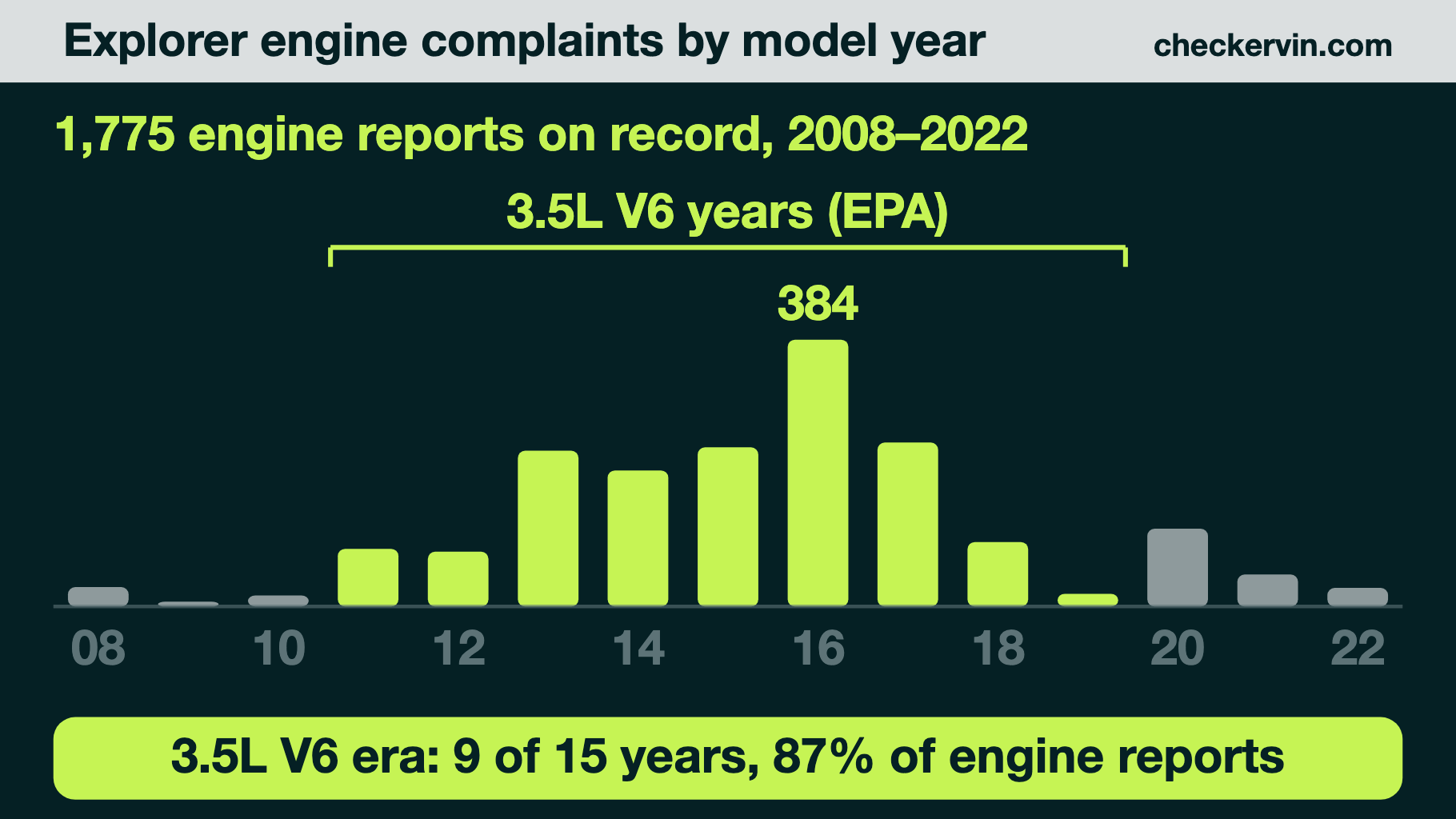
Our corpus of federal NHTSA complaints holds 15,059 reports against the 2008–2022 Explorer, and 1,775 of them land in the ENGINE component category. The 2011–2019 model years, the 3.5-liter V6 era, hold 1,542 of those engine reports, or 87%. A model year inside that era averages about 171 engine reports; the three years before it average about 16, and the three after it about 62. The single worst year is 2016, at 384 engine reports.
The 2019 Explorer is the odd year inside the era, with 18 engine reports ranking 5 of its top five components. It was the last year of that body and drew 290 complaints of every kind, far fewer than the years before it. A younger vehicle has also had less time to fail: the twelve Roe plaintiffs reported pump failures between 54,000 and 117,000 miles, mileage many 2019 Explorers had not reached when their owners were filing complaints.
What the record does not prove
Two caveats keep the chart honest. First, the ENGINE category is not a water pump category. It holds every kind of engine complaint, from every engine sold that year, so the 2012–2019 counts include four-cylinder Explorers and problems that have nothing to do with coolant. Complaints are also unverified owner reports, not a measured failure rate.
Second, the 3.5-liter era dominates the Explorer’s record in general, not only its engine complaints. Those nine model years carry 85% of all complaints in our data. Measured as a share of each era’s own complaints, engine reports run about 12% for 2011–2019, against 14% for the earlier trucks and 10% for the 2020-and-later models. So the record does not show the V6 years as unusually engine-heavy for their size. What it shows is that most of the engine trouble anyone has ever reported on an Explorer happened on the generation with the internal pump, and that is the generation still for sale in volume on used lots. The Ford Explorer years-to-avoid page breaks the rest of that record down by year.
The lawsuits, in the U.S. and in Canada
The U.S. case is closed. Roe v. Fordwas filed August 14, 2018, and in its August 2019 opinion the court dismissed most of the claims. It found the plaintiffs had not plausibly alleged that Ford knew or should have known of a defect, and that every named plaintiff had sought repair after the powertrain warranty’s five years or 60,000 miles had run out. The court docket shows the case terminated on January 16, 2024. Car Complaints reported that Ford reached a confidential settlement with the named plaintiffs and the case was dismissed with prejudice, which means no payout to the wider group of owners.
The Canadian case is alive. According to a notice issued October 8, 2026 by class counsel Koskie Minsky LLP, the Ontario Superior Court of Justice certified a class action against Ford on June 8, 2021, and has since widened it twice. The class covers owners and lessees in Canada of listed vehicles, including the 2011–2019 Explorer and the 2013–2019 Police Interceptor Utility, whose water pump failed and damaged the vehicle on or before September 8, 2026. Newly added members who want out must opt out by January 6, 2027. The notice mentions no settlement.
Is there a recall on the Explorer water pump?
No. We queried NHTSA’s recall database for every Explorer model year from 2008 through 2022, and no campaign mentions the water pump. To make sure the search could find one, we ran the same query against a vehicle with a known water pump recall, a 2012 BMW 328i, and it came back with two. The Explorer simply has none.
The coolant-related recalls the Explorer does have involve the engine block heater, an optional plug-in accessory. Campaign 16V183 covers 2016 Explorers with the 2.3L engine whose block heater element may overheat. Campaign 25V685 covers 2016–2023 Explorers, among others, whose block heater “may crack and develop a coolant leak,” and 26V012 adds certain 2019 Explorers. A coolant leak from a recalled block heater is a free fix and a very different job from a pump, so it is worth ruling out first. The Ford recall check by VIN shows whether a specific Explorer has one open.
| Program | What it pays for |
|---|---|
| Recall | Safety defect — free fix at any dealer, no time limit on the remedy |
| Powertrain warranty | Water pump covered for 5 years or 60,000 miles, per the warranty language the Roe court quoted |
| Class action | Only class members, only on the court's terms — the active one is Canadian |
| Technical service bulletin | Repair instructions — pays nothing outside warranty |
We did not find a Ford technical service bulletin about the Explorer water pump in the bulletins NHTSA hosts, though that search is not exhaustive. The difference between the four lines in that table is explained on our TSB versus recall page.
Pump and timing chain: one job or two
Because the timing chain drives the pump on the 3.5-liter V6, both live behind the same front cover, and most of the labor to reach one is the labor to reach the other. Parts sellers package timing chain and water pump kits for 2011–2019 Explorers for exactly that reason. The part cost of adding the chain set is modest next to the hours, and opening the engine a second time later repeats almost the whole bill.
That does not make bundling automatic. On a lower-mileage engine with a quiet chain, a pump-only repair is a defensible choice. On an engine past roughly 100,000 miles, or one with any start-up rattle, ask for two written quotes, one for the pump alone and one for the pump plus chains, guides and tensioners, and compare the difference. Our posts on F-150 timing chain cost and Escape timing chain cost show what Ford’s own bulletins book for front-of-engine work on its other engines.
Can you keep driving it?
- Temperature gauge climbing, or a coolant over-temperature warning
- Coolant reservoir dropping repeatedly with no leak visible under the vehicle
- Oil on the dipstick or under the cap that looks milky or tan
- Low oil pressure warning following a temperature warning
- On older external-pump engines: coolant drips or crust at the front of the engine
On a 2011–2019 V6, any of the first four is a reason to stop. The Roe opinion quotes an Explorer owner whose dash showed an engine coolant over-temperature warning and then low oil pressure before the vehicle shut down on a highway. A missing puddle is not reassurance on this engine; it is the symptom. Towing costs far less than the difference between a pump job and an engine.
Is it worth fixing?
The deciding question is whether the oil is clean. If the pump is caught while it is still only weeping or leaking externally, the repair is the pump job and nothing more, which on RepairPal’s numbers sits around $1,900 to $2,500 for a late-model V6 Explorer. If coolant has already reached the bearings, the bill changes category. The Roe plaintiffs alleged costs of $1,500 for a pump alone and up to $9,000 when the mixture damaged the engine, and individual repair bills of $4,500 at 54,000 miles and $7,600 at 63,500 miles. One plaintiff’s 2015 Explorer needed a $2,500 water pump repair at 73,000 miles. Those are the owners’ figures, not ours.
Before committing, ask the shop to drain and inspect the oil, and on a contaminated engine to say in writing whether it recommends the pump or an engine. Whatever the outcome, refill with the coolant that engine was built for; a coolant type lookup by VIN confirms it, since topping up with the wrong one adds a second problem.
Before you authorize the repair, or buy the SUV
- Confirm the engine by VIN — the 3.5L V6, the four-cylinders and the 2020+ engines are different jobs
- Rule out an open block heater recall before paying for a pump diagnosis
- Ask whether the quote is pump only or pump plus timing chain set
- Ask for the oil to be checked for coolant before the work starts
- Keep the invoice — a documented pump replacement is a selling point later
For a shopper looking at a 2011–2019 Explorer, the useful question is whether the pump has already been done, and when. A receipt for a pump and chain job at 80,000 miles takes the biggest known repair off the table for a long while. Without one, the price should leave room for it. A Ford VIN decode confirms the engine and build year, and a warranty check by VIN shows whether any factory powertrain coverage is left on a newer one.
Where this information comes from
- Roe v. Ford Motor Co., No. 2:18-cv-12528 (E.D. Mich.) — opinions on govinfo.govThe August 6, 2019 opinion describing the internal, chain-driven pump, the alleged repair costs and the 5-year/60,000-mile warranty.
- CourtListener — Roe v. Ford docketFiled August 14, 2018; terminated January 16, 2024.
- NHTSA — recalls by vehicle and VINOur 2008–2022 query found no campaign naming the Explorer water pump; block heater campaigns 16V183, 25V685 and 26V012 are the coolant-related ones.
- EPA and DOE — fueleconomy.gov vehicle recordsThe per-year Explorer engine listings behind the era table and the chart's 2011–2019 bracket.
- Koskie Minsky LLP — Canadian Ford water pump class action noticeOctober 8, 2026: certification date, the 2011–2019 Explorer in the class, the September 8, 2026 cutoff and the January 6, 2027 opt-out date.
- Car Complaints — U.S. water pump case dismissedReports the confidential settlement with the named plaintiffs and dismissal with prejudice.
- RepairPal — Ford Explorer water pump estimateThe national, 2019 and 2008 figures quoted above, retrieved October 2026.
Keep reading
Frequently asked questions
How much does it cost to replace the water pump on a Ford Explorer?
It depends on the engine. RepairPal's estimator lists $1,858 to $2,476 for a 2019 Explorer, with $1,281 to $1,880 of that in labor, and $534 to $637 for a 2008 Explorer — its figures, retrieved October 2026. Its all-years national figure is $1,253 to $1,617. The 2011–2019 Explorers with the 3.5-liter V6 cost the most because the pump sits inside the engine, driven by the timing chain, so the front of the engine has to come apart to reach it.
Is there a recall on the water pump for the Ford Explorer?
No. We queried NHTSA's recall database for every Explorer model year from 2008 through 2022 and no campaign mentions the water pump. The closest are engine block heater recalls, including 25V685 for 2016–2023 Explorers, where the heater may crack and leak coolant. We also found no Ford extended-warranty program for the pump. In Canada, a certified class action covers owners of 2011–2019 Explorers whose pumps failed and damaged the vehicle; it is a lawsuit, not a recall.
Can I still drive my Explorer with a bad water pump?
Not for long, and on a 2011–2019 3.5-liter V6 not at all once the signs appear. On that engine the pump sits inside the engine, and according to the plaintiffs in a federal lawsuit, a failing pump can leak coolant into the oil, which can ruin bearings and seize the engine. A rising temperature gauge, a coolant level that keeps dropping with no puddle, or milky oil on the dipstick are reasons to stop and tow rather than drive to the shop.
Is it worth fixing a water pump on a Ford Explorer?
Usually yes, if the engine has not already been damaged. A pump-only repair on a 2011–2019 V6 runs about $1,900 to $2,500 by RepairPal's 2019 estimate, which is far less than an engine. The math changes if coolant has already mixed with the oil: the plaintiffs in the federal Ford case alleged repair bills of up to $9,000 when that happened. Ask the shop to check the oil for coolant and the bearings for damage before you commit to the pump job.
Should I replace the timing chain at the same time as the water pump?
On the 2011–2019 3.5-liter V6 it is worth pricing both. The timing chain drives the pump, and both sit behind the engine's front cover, so the labor overlaps heavily. Parts sellers market timing chain and water pump kits together for these Explorers for that reason. On a high-mileage engine with any chain noise, doing both while the engine is open usually costs less than opening it twice. Ask for two written quotes: pump only, and pump plus chain set.
Confirm the engine before you price the pump
A free CheckerVIN report shows the factory build, engine, specifications and open recalls for any VIN, so you know which Explorer water pump job you are paying for.
Run a free VIN check