The short answer
- What does it cost?
- One used-engine seller quotes $4,500–$17,000 installed, depending on used, remanufactured or new and on which engine. Ford pays dealers up to 16.3 hours of labor for the swap.
- Can someone else pay?
- Possibly. Certain 2021–2022 2.7L trucks have an open recall and a 10-year, 150,000-mile long block program. Trucks inside 5 years or 60,000 miles have powertrain coverage.
- How common is it?
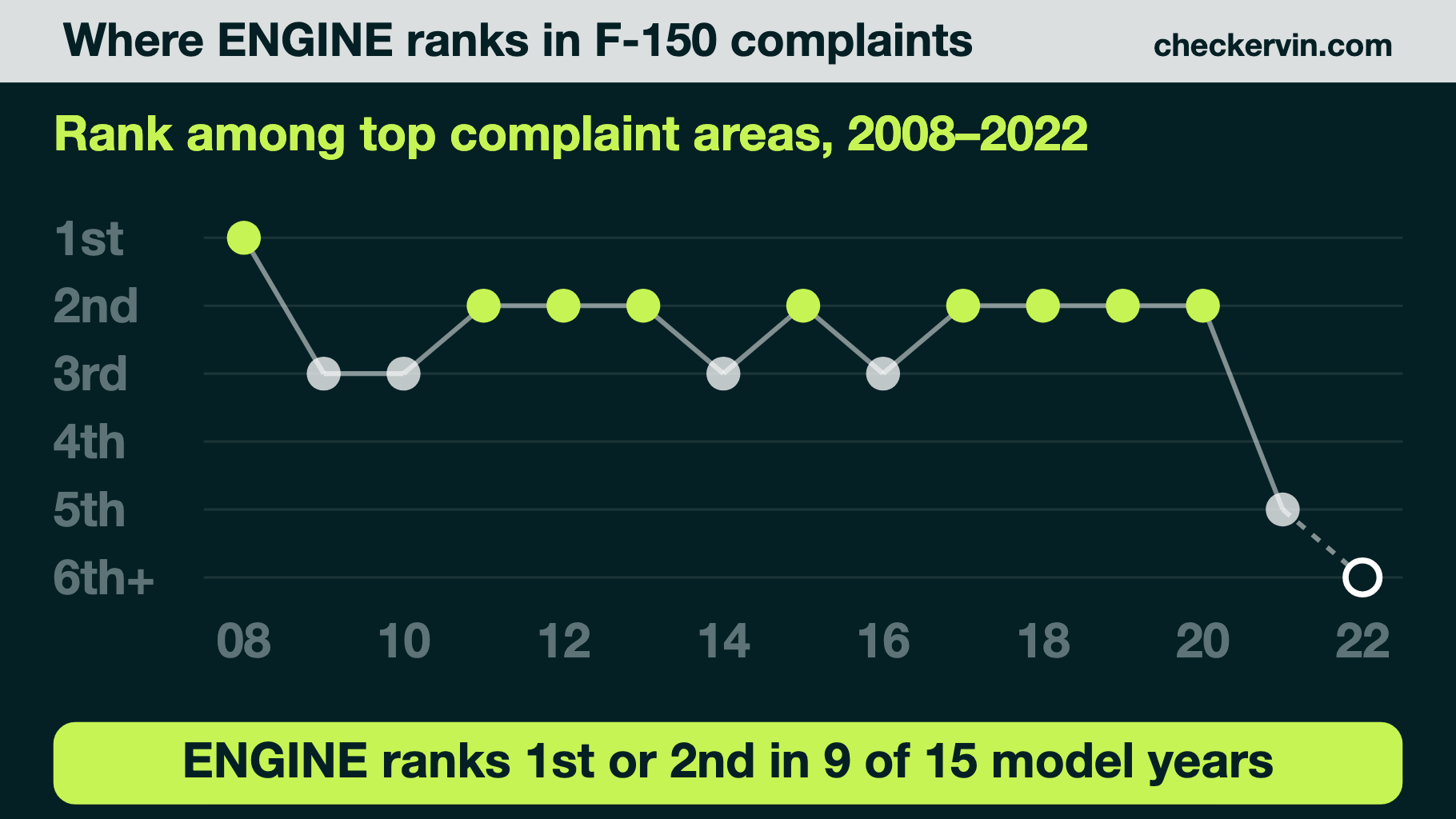
- ENGINE ranks first or second among complaint areas in 9 of 15 F-150 model years on record, usually behind the transmission.
15.8–16.3 h
Ford's long block labor allowance
Program 24N12, 2021–2022 F-150
5 yr / 60k
Ford powertrain warranty
Engine block, heads, turbos
3 yr / unl.
Ford reman gas engine warranty
Including labor
9 of 15
Years ENGINE ranks top two
Federal complaint record
The price routes, and whose numbers they are
The figure Google’s AI overview repeats for this search, $4,500 to $17,000, comes from a single page by Premium Used Auto Parts, dated September 30, 2026 and retrieved here in October. The company sells used engines, so read its numbers as a seller’s survey rather than a neutral one. Its installed ranges are $4,500 to $9,500 for a used engine, $8,000 to $14,000 for a remanufactured one and $10,000 to $17,000 for a new crate engine. By engine, it puts the 3.5L EcoBoost highest at every tier, $6,000 to $9,500 used up to $12,000 to $17,000 new, and the 5.4L Triton lowest, with a new crate unit listed as limited availability.
Owner reports bracket the same band from both ends. A 2023 thread on f150ecoboost.net describes a mechanic quoting “around $10,000 altogether” to replace a 3.5L EcoBoost, with 27 hours of labor the owner thought excessive. On f150forum, a 2018 3.5L owner counted about 25 used engines for sale within 50 miles, from $2,300 with 28,000 miles on it to $6,000 with 60,000. Both are single experiences, read from the pages’ indexed text because neither forum would serve the page to our fetch; we quote them as anecdotes, not benchmarks.
We sell VIN checks, not engines or repairs, and publish no price of our own. What we can add is the part that does not depend on a seller’s survey: the hours Ford pays for the same job, the trucks Ford is still obliged to fix, and how often the engine is the thing owners complain about in the first place.
Ford's own labor clock: 15.8 to 16.3 hours
When Ford pays a dealer to do a repair, it publishes the time it will reimburse. For an F-150 engine, that number now exists in writing. Customer Satisfaction Program 24N12, issued June 19, 2025 and supplemented August 25, 2025, covers replacing the long block on certain 2021–2022 trucks, and its labor table reads: F-150 4x2, up to 15.8 hours; F-150 4x4, up to 16.3 hours. The program lists the F-150 service long block as part RL3Z-6006-A, and it adds small allowances on top for borescope photos and parts handling.
| Source | Labor time for an F-150 engine |
|---|---|
| Ford Program 24N12 (2021–2022, 2.7L, 4x2) | Up to 15.8 hours |
| Ford Program 24N12 (2021–2022, 2.7L, 4x4) | Up to 16.3 hours |
| Premium Used Auto Parts (seller), V6 and V8 | 12 to 18 hours book time |
| Premium Used Auto Parts (seller), EcoBoost | 16 to 24 hours book time |
| f150ecoboost.net member quote, 3.5L | 27 hours |
Multiply Ford’s hours by the independent-shop rates the same seller cites, $110 to $180 an hour, and labor on a 2.7L truck comes to roughly $1,738 to $2,934before fluids and one-time-use hardware. That is not a quote. Ford’s table covers the 2.7L only; a 3.5L twin-turbo engine has more plumbing, and a truck with seized fasteners will take longer. But it gives you a figure to hold a written estimate against. A labor line far above Ford’s hours should come with an explanation of what else is being replaced while the engine is out.
Where the engine ranks in 19,248 complaints
Our corpus of federal NHTSA complaints holds 19,248 reports against the 2008–2022 F-150. For each model year we keep the five most-reported components, and ENGINE is among them in 14 of 15 years, accounting for at least 3,530 reports counted across those years. The chart below does not plot those counts; the timing chain post already does. It plots where ENGINE ranks against everything else owners reported that year.
The answer is consistent. ENGINE ranks first or second in 9 of 15 model years, and first only in 2008, where it ties with another category. The category ahead of it is most often POWER TRAIN, which outranks ENGINE in 12 of the 15 years. For a buyer budgeting against a catastrophic repair on a used F-150, the transmission is the more frequent complaint; the engine is a close and steady second.
The newest trucks break the pattern. ENGINE drops to fifth in 2021 and falls out of 2022’s top five altogether, which means no more than 77 reports in our data, not zero. Newer trucks have had less time to accumulate complaints, so treat that as provisional. It is also, pointedly, the pair of model years with the only open engine-replacement recall on the F-150. One labeling note: in 2019, NHTSA’s separate “engine and engine cooling” category also made the top five; the chart ranks ENGINE alone.
Which engine is in the truck decides the price
“F-150 engine” covers eleven different engines across these fifteen model years, twelve if the PowerBoost hybrid counts separately, and the replacement price follows the engine, not the badge. The EPA’s fuel economy records list the lineup by year:
| Model years | Engines offered (EPA listings) |
|---|---|
| 2008 | 4.2L V6, 4.6L V8, 5.4L V8 |
| 2009–2010 | 4.6L V8, 5.4L V8 |
| 2011–2014 | 3.5L EcoBoost, 3.7L V6, 5.0L V8, 6.2L V8 |
| 2015–2017 | 2.7L EcoBoost, 3.5L V6, 3.5L EcoBoost, 5.0L V8 |
| 2018–2020 | 2.7L EcoBoost, 3.0L Power Stroke diesel, 3.3L V6, 3.5L EcoBoost, 5.0L V8 |
| 2021–2022 | 2.7L EcoBoost, 3.3L V6, 3.5L EcoBoost incl. PowerBoost hybrid, 5.0L V8; 3.0L diesel in 2021 |
Two practical consequences follow. First, a used engine has to match more than displacement: model year, calibration and sometimes build date matter, which is why Ford tells technicians to look up the long block in its parts catalog by application. Second, the twin-turbo engines carry their turbos, intercooler piping and extra coolant and oil lines into the swap, which is where the seller’s higher EcoBoost book time comes from. An engine lookup by VIN settles which one a specific truck left the factory with, before anyone prices a replacement.
The 2018 recall: 22 trucks, none in owners' hands
“What is the recall on the 2018 Ford F-150 engine?” is one of the most common questions attached to this search, and the answer is narrower than people expect. Campaign 17V672, filed in October 2017, covers certain 2018 F-150s with the 3.5L engine whose cylinder heads “may have been machined without lubrication supply holes for the camshaft bearing journals.” Without that oil, the engine fails. The remedy is a new engine. NHTSA’s campaign record lists 22 trucks, and Ford told the agency it was not aware of any affected vehicle outside dealer control.
In other words, the recall was caught on dealer lots. It does not explain why the 2018 truck carries 444 ENGINE complaints in our data, 24% of everything owners reported against that model year. Two other recalls on the 2018 truck sit in NHTSA’s engine category, 18V894 and its follow-up 19V278, and both concern the engine block heater cable’s splice connector on 2015–2019 trucks. Neither replaces an engine. A 2018 owner with a failed engine is, in almost every case, looking at warranty coverage or their own money, not a recall.
2021–2022 2.7L: the engine Ford may already owe you
The one F-150 recall that replaces engines at scale is 24V635, Ford’s campaign 24S55. It covers 2021–2022 trucks with the 2.7L EcoBoost, alongside Bronco, Edge, Explorer and two Lincolns with the 2.7L or 3.0L, because their intake valves may break while driving and cause engine failure. NHTSA lists 90,736 vehicles across those nameplates. Dealers run an engine cycle test and replace the engine as necessary, free; owner letters went out July 3, 2025. Ford’s dealer documents limit the F-150 population to trucks built at Dearborn from May 1 to October 31, 2021 and at Kansas City from June 15 to October 31, 2021.
Passing the test does not end Ford’s obligation. Program 24N12 covers a no-cost, one-time long block replacement for a truck that completed the 24S55 inspection and later suffers a cracked intake valve, for 10 years or 150,000 miles from the warranty start date, and the coverage transfers automatically to later owners. Trucks already past those limits were covered only through June 30, 2026, a date that has now passed.
Warranty: what Ford covers, and the labor catch
Ford’s Powertrain Warranty runs 5 years or 60,000 miles, whichever comes first. Its published component list includes the cylinder block, cylinder heads, all internal lubricated parts, the oil pump and the turbocharger, which together are most of what fails when an engine is condemned. A truck inside that window with a failed engine is a warranty claim, subject to Ford’s terms on cause and maintenance records. A warranty check by VIN shows how much of that window is left.
The replacement engine carries its own coverage. Ford’s Motorcraft service parts warranty summary, dated June 2023, lists new and remanufactured gas engine assemblies at 3 years and unlimited miles, including labor, and diesel engines for light trucks at 2 years and unlimited miles. The catch is in the same document: when a fleet or independent installer claims that warranty, Ford reimburses labor at the lesser of its standard hours or the actual hours, at up to $75 an hour. A shop billing $150 an hour can recover only part of a warranty redo from Ford. Ask before the install who pays the difference if the engine has to come out again.
Used, remanufactured, rebuilt or new
“Is it cheaper to rebuild an engine or buy one?” On parts alone, a used engine is almost always cheapest, and the f150forum count above shows how deep the used 3.5L market is. The trade-off is coverage and history: Premium Used Auto Parts puts typical used engine warranties at six months to a year, and the mileage on the tag is whatever the donor truck’s odometer said.
- Used: lowest parts price; unknown history; short warranty; match model year and calibration to the VIN
- Rebuilt (your own block): can be cheapest when damage is limited; machine-shop time adds up fast on an EcoBoost
- Ford remanufactured long block: 3 years, unlimited miles, labor included, per Ford's own warranty summary
- New Ford engine assembly: factory part, priced highest; a reseller listing for one 2021–2023 F-150 assembly shows an $8,932 MSRP
Ford’s own bulletins add two cautions most price guides skip. Special Service Message 51296 notes that some 2015–2020 F-150s with the 2.7L, 3.5L or 5.0L may need a long block, and that Ford released service kits containing every one-time-use bolt and gasket the swap requires. Ask whether your quote uses that kit or reuses one-time-use fasteners. And TSB 20-2306 warns that the service long block for early-build 2017–2018 3.5L trucks changed to a one-piece oil pan, so installing it also takes new transmission cooler lines and an engine harness modification. Ask the same fitment question of any used engine.
The repair that often prevents this one
Plenty of F-150 engines that get condemned started as a cheaper repair somebody postponed. On the 3.5L EcoBoost, that repair is usually the timing system: a stretched primary chain on 2011–2014 trucks, or a rattling cam phaser on 2017–2020 trucks. Ford’s bulletins price those jobs at roughly 9 to 10 hours, a little over half of what the long block takes. Our F-150 timing chain replacement cost post lays out which bulletin fits which year.
The rule of thumb is simple. A start-up rattle that lasts a few seconds is a scheduled repair. One that grows longer, or arrives with a check-engine light for cam timing, is the same repair with less time left. Oil changes at the interval the truck’s computer asks for, with the specified oil, are the other cheap insurance; Ford’s warranty terms can turn on maintenance records when an engine fails inside the coverage window.
Before you authorize an engine replacement
- Run the VIN for open recalls — on a 2021–2022 2.7L, recall 24S55 or program 24N12 may pay for the engine
- Check the in-service date and mileage against the 5-year, 60,000-mile powertrain warranty
- Get the failure diagnosed in writing: compression or leak-down numbers, borescope images, oil analysis if relevant
- Ask whether the quote is a used, remanufactured or new long block, and what warranty comes with it
- Compare the quoted labor hours with Ford's 15.8 to 16.3 hours, and ask what fills any gap
- Confirm turbos, timing set, water pump and one-time-use hardware are listed separately
The third item matters more than it looks. A diagnosis that says “engine is gone” without numbers is hard to argue with and hard to get covered. A documented failure with photos is what Ford itself requires before approving a long block under 24N12, and it is a reasonable standard to ask of any shop.
If you are buying the truck, not repairing it
A replaced engine is not automatically a bad sign on a used F-150. A Ford remanufactured long block with paperwork and time left on its 3-year warranty can be the healthiest part of an older truck. What you want is the receipt: who installed it, which unit, and when. An F-150 VIN decode confirms the engine the truck was built with, so you can spot a swap the seller did not mention.
The F-150 years-to-avoid breakdown covers the rest of the complaint record by year. Because power-train complaints lead the engine in most years, read the F-150 transmission replacement cost post before deciding which big repair to budget for. Why a bulletin like 20-2306 pays nothing while a recall like 24S55 pays for the whole engine is explained in our TSB versus recall guide.
Where this information comes from
- Ford Customer Satisfaction Program 24N12, Supplement #1 (NHTSA copy)The F-150 long block labor allowance (15.8 h 4x2, 16.3 h 4x4), part RL3Z-6006-A, and the 10-year / 150,000-mile terms.
- Ford Safety Recall 24S55, Supplement #2 — dealer letter (NHTSA copy)The 2.7L intake valve recall's F-150 build ranges and engine valve inspection test.
- NHTSA — recalls by VIN and campaignSource for 17V672 (2018 3.5L heads, 22 trucks) and 24V635; every F-150 year 2008–2022 was queried.
- Ford TSB 20-2306 (NHTSA copy) — 3.5L long block with one-piece oil panExtra cooler lines and harness work when an early-build 2017–2018 truck gets the current service long block.
- Ford SSM 51296 (NHTSA copy) — 2015–2020 F-150 long block service kitsFord's kit of one-time-use parts for a 2.7L, 3.5L or 5.0L long block swap.
- EPA fueleconomy.gov — F-150 engine listings by yearThe engine lineup table, queried for every model year 2008–2022.
- Ford — Powertrain Warranty coverage5 years or 60,000 miles, and the engine components it lists.
- Motorcraft — Service Parts Warranty Summary (June 2023)3 years / unlimited miles with labor on new and reman gas engines; the $75-an-hour installer labor cap.
- Premium Used Auto Parts — F-150 engine replacement costA used-engine seller's installed ranges and book times, dated September 30, 2026, retrieved October 2026.
- f150ecoboost.net — 3.5L ring or engine replacement threadOne owner's $10,000, 27-hour quote, March 2023.
- F150 Forum — 2018 3.5L EcoBoost engine replacementOne owner's count of local used engines from $2,300 to $6,000.
Keep reading
Frequently asked questions
How much does it cost to replace the engine in a Ford F-150?
The widest published range on the current search results comes from Premium Used Auto Parts, a used-engine seller, which puts an installed F-150 engine at $4,500 to $9,500 used, $8,000 to $14,000 remanufactured and $10,000 to $17,000 new, with the 3.5L EcoBoost at the top of each band. Those are a seller's figures, retrieved October 2026. The labor half of any quote can be checked against Ford's own number: Ford pays its dealers up to 15.8 hours to replace a 2021-2022 F-150 long block on a 4x2 and up to 16.3 hours on a 4x4.
What is the recall on the 2018 Ford F-150 engine?
Campaign 17V672 covers certain 2018 F-150s with the 3.5L engine whose cylinder heads may have been machined without the oil supply holes for the camshaft bearing journals. Without that oil the engine fails, and the remedy is a replacement engine. NHTSA lists 22 trucks in the population, and Ford told NHTSA it was not aware of any affected truck outside dealer control. The other 2018 engine-category recalls, 18V894 and 19V278, concern the engine block heater cable, not the engine itself.
Is it cheaper to rebuild an engine or buy one?
On parts alone a used engine is usually the cheapest route, and an F-150 forum member reported about 25 used 2018 3.5L EcoBoost engines within 50 miles priced from $2,300 to $6,000. A rebuild keeps your own block and can cost less when only bearings or rings are involved, but it adds machine-shop and reassembly time on top of the removal labor, so price both routes before choosing. A Ford remanufactured long block costs more up front and carries 3 years and unlimited miles of coverage including labor, per Ford's Motorcraft warranty summary, which most used engines and many rebuilds cannot match.
How many labor hours does an F-150 engine swap take?
Ford's own allowance in Customer Satisfaction Program 24N12 is up to 15.8 hours for a 2021-2022 F-150 4x2 and up to 16.3 hours for a 4x4, for a long block replacement on the 2.7L. A used-engine seller cites book times of 12 to 18 hours for V6 and V8 trucks and 16 to 24 hours for EcoBoost engines, and one f150ecoboost.net member reported a 27-hour estimate on a 3.5L. A quote well above Ford's figure deserves a question about what else is included, such as turbos, a timing set or the cooling system.
Does Ford's warranty cover an F-150 engine replacement?
Inside 5 years or 60,000 miles, Ford's Powertrain Warranty lists the cylinder block, cylinder heads, all internal lubricated parts and the turbochargers, so a failed engine on a truck still in that window is a dealer warranty claim, subject to Ford's terms on cause and maintenance. Outside it, two things can still pay: an open recall such as 24V635, and Customer Satisfaction Program 24N12, which covers one long block replacement for 10 years or 150,000 miles on certain 2021-2022 2.7L trucks that completed the recall inspection. A replacement Ford or Motorcraft engine then carries its own 3-year, unlimited-mile warranty.
Run the VIN before you price the engine
A free CheckerVIN report shows the factory engine, specifications and open recalls for any VIN, so you know whether Ford, not you, should be paying for the replacement.
Run a free VIN check