The short answer
- What does it cost?
- RepairPal lists $314–$433 for an F-150; YourMechanic's average is $169. Labor is most of either figure.
- How often?
- Ford's 2014, 2018 and 2020 manuals all say 100,000 miles, or 60,000 under heavy idling (and towing, from 2018).
- Is the misfire the plugs?
- Often not. Of 14 Ford documents naming F-150 misfires or plug service, 3 call for plug work.
The published numbers, and what they leave out
Two estimators publish an F-150 figure that can be pinned to a page. RepairPal lists $314 to $433, with $229 to $335 of labor and $86 to $98 of parts. YourMechanic’s F-150 average is lower, $169, split into $29 of parts and $140 of labor, and its own row for a 2016 truck with the 2.7-liter turbo V6 comes to $335.19, against a shop or dealer range of $370.49 to $470.54. We read both from the pages’ search listings in November 2026, because both sites refuse direct requests from our tools. Kelley Blue Book also publishes F-150 plug ranges, but they change with ZIP code and cab style, so we do not quote one here.
None of those figures is ours. CheckerVIN sells VIN checks, not repairs. What the estimators cannot show is the range Ford’s own documents put around this job: a routine swap on most trucks, an extraction on some 2008 trucks, and, on many others, a misfire code that a new set of plugs will not cure.
Which engine you are paying for
The F-150 has carried more gasoline engines from 2008 to 2022 than most nameplates carry in their lifetime. Fuel-economy listings from the EPA show a 4.2-liter V6 in 2008 and the 4.6- and 5.4-liter V8s through 2010; the 3.7-liter V6 and 6.2-liter V8 for 2011–2014; the 5.0-liter V8 and 3.5-liter EcoBoost from 2011; the 2.7-liter EcoBoost from 2015; the 3.3-liter V6 from 2018; and the 3.5-liter PowerBoost hybrid from 2021. The 3.0-liter Power Stroke diesel listed for 2018 through 2021 is a compression-ignition engine, and Ford’s 2018 manual lists no spark plug or plug gap for it, so a spark plug quote on one of those trucks is the wrong quote.
Ford’s manuals print a different plug and a different gap for nearly every engine. The table uses the 2018 manual, with the 6.2L and 3.7L rows from 2014:
| Engine (manual year) | Motorcraft plug, gap, count |
|---|---|
| 2.7L EcoBoost V6 (2018) | SP-542, 0.028–0.031 in, six plugs |
| 3.3L V6 (2018) | SP-520, 0.049–0.053 in, six plugs |
| 3.5L EcoBoost V6 (2018) | SP-534, 0.030–0.033 in, six plugs |
| 5.0L V8 (2018) | SP-551, 0.049–0.053 in, eight plugs |
| 3.7L V6 (2014) | SP-520, 0.049–0.053 in, six plugs |
| 6.2L V8 (2014) | SP-526, 0.041–0.047 in |
Two details matter for a quote. The EcoBoost engines run a much tighter gap than the naturally aspirated ones, so a plug gapped for a 5.0L is wrong in a 3.5L. And the part numbers move: the 2020 manual lists SP-578 for both the 2.7L and the 3.5L EcoBoost and narrows the 3.5L gap to 0.028–0.031 in. Decoding the VIN tells you which engine and model year you are buying parts for; our F-150 VIN decoder and the engine size lookup both return it free.
100,000 miles, or 60,000 if it tows
Search results repeat that EcoBoost plugs are due at 60,000 miles and V8 plugs at 100,000. Ford’s own owner’s manuals, which we read for the 2014, 2018 and 2020 trucks, do not say that. Under normal use, all three list spark plug replacement at 100,000 miles, and the 2014 manual applies that line to the 3.5L EcoBoost, the 3.7L and the 5.0L alike (the 6.2L’s schedule says 97,500). The 60,000-mile figure is real, but it belongs to Ford’s special operating conditions schedule, not to an engine.
| Ford manual | When the 60,000-mile plug change applies |
|---|---|
| 2014 F-150 | Extensive idling or long low-speed driving (delivery, patrol, livery) |
| 2018 F-150 | Towing a trailer or using a car-top carrier; extensive idling |
| 2020 F-150 | Towing a trailer, listed for gasoline engines; extensive idling |
The manual also says the shorter schedule applies when a truck is operated primarily under those conditions, not occasionally. A half-ton that tows a camper twice a summer is on the 100,000-mile schedule; one that pulls a trailer every working day is on the 60,000. That distinction is where many quotes for a “tune-up” at 60,000 miles come from. We could not find Ford’s 2010 owner’s guide on a Ford server, so we do not state an interval for the 2008–2010 trucks.
Ford's misfire paperwork, laid over 19,621 complaints
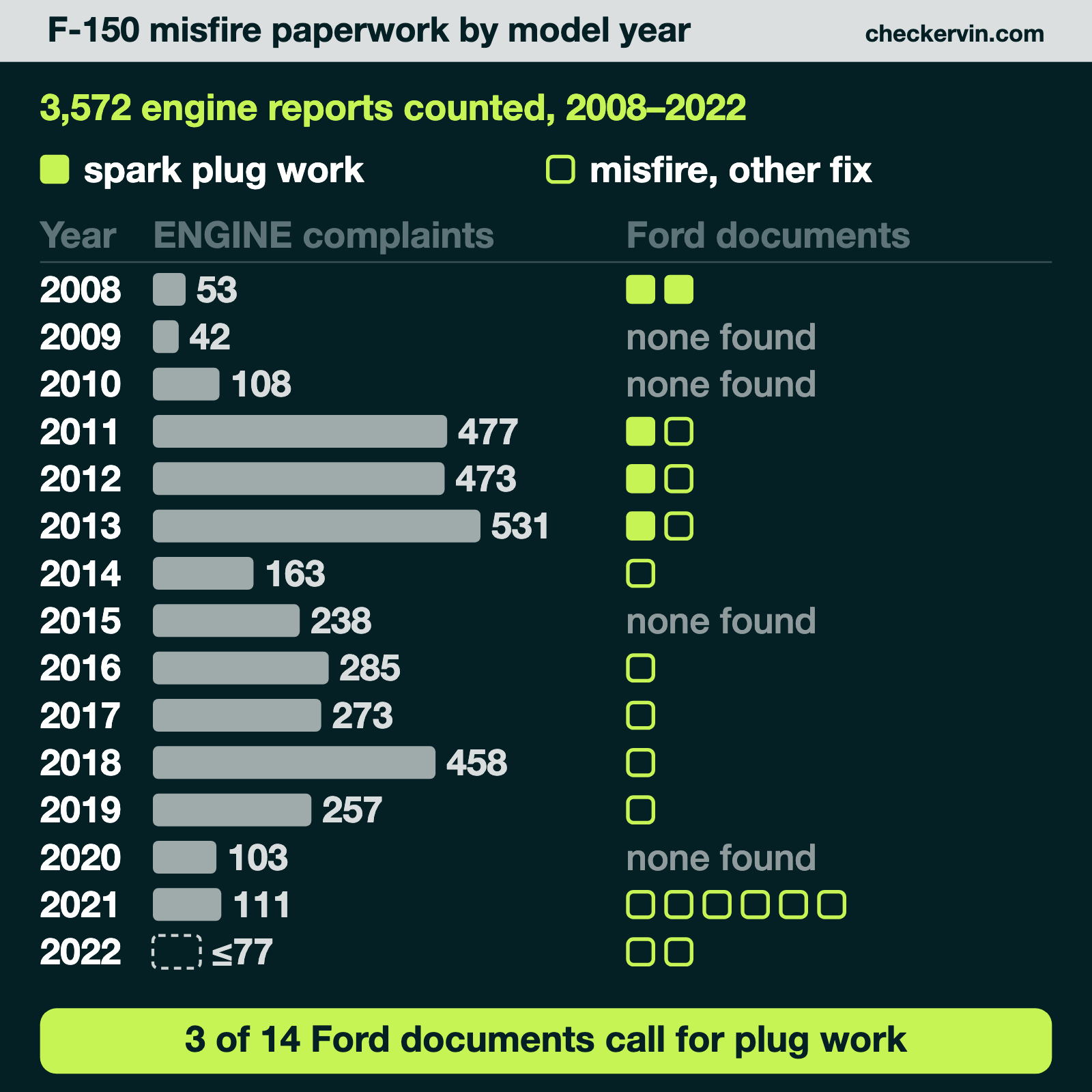
NHTSA files no complaint category for spark plugs or ignition, so our anchor is the ENGINE category, which holds every engine fault owners report. Across the 2008–2022 F-150 it sits among the five most-reported components in 14 of 15 model years, and we count 3,572 engine reports in those years. For 2022, ENGINE falls below that year’s fifth-place component, so the most it can be is 77; the chart draws that as a dashed ceiling, not a bar. Read every one of those counts as an upper bound on engine trouble of all kinds. None of them is a spark plug count.
Next to that record we placed every Ford document we found in NHTSA’s index of manufacturer communications that names misfire codes or spark plug service on these trucks: 14 of them. 3 call for plug work. The other 11 start from misfire symptoms and end at a different part. The documents bunch where the engine complaints do: the 11 model years with at least one hold 86% of the engine reports counted, and the peak year, 2013, with 531, carries 2 of them. 4 years (2009, 2010, 2015, 2020) have none.
2008: the plug that breaks, and how few trucks in this range have it
The expensive F-150 plug story belongs to the 5.4-liter three-valve V8, and most of it happened before our data begins. Ford’s TSB 08-7-6, dated April 1, 2008, covers 2004–2008 F-150s with that engine built before October 9, 2007. Its stated issue is that these engines “may experience difficulty with spark plug removal,” which can leave part of the plug in the cylinder head. Inside our fifteen-year range, that is a slice of the 2008 model year only, the trucks built before the cutoff; the build date is on a sticker on the left cam cover.
The procedure is why the bill on these trucks has no fixed top. The engine must be at room temperature. Each plug is backed out no more than 1/8 to 1/4 turn, then soaked with half to three-quarters of a teaspoon of Motorcraft carburetor cleaner for at least 15 minutes before it is worked back and forth by hand; power tools are prohibited. If a plug breaks anyway, the bulletin lists two Rotunda extraction tools, one of which bonds the broken porcelain with retaining compound that cures for an hour. Ford pays the whole job as “actual time” rather than a fixed number of hours, and that is the honest answer to why one 5.4L quote can be triple another.
The plug itself changed partway through. A later Ford message, SSM 46542, tells technicians installing a remanufactured 2005–2008 5.4L three-valve to fit longer brown coil boots in place of the original black ones, because of “a running change in the spark plug length.” Which plug a 2008 5.4L carries depends on when its engine was built, another reason to check the build date before trusting a quote. Only 53 ENGINE complaints sit against the 2008 truck in our data, so the record does not flag this year; the bulletin does.
Two-valve engines and stripped threads
The older Ford plug failure is the opposite problem: a plug that leaves the head on its own. NHTSA’s summary of Ford bulletin 07-21-2 describes a spark plug thread repair procedure for some 1997–2008 vehicles with the 4.6L, 5.4L or 6.8L two-valve engines, “not covered under new vehicle limited warranty,” and NHTSA indexes it against the 2008 F-150. That puts the edge of this history inside our range, though most of the trucks it describes are older. We did not find a Ford document extending it to 2009 or later F-150s, and we found no recall that names spark plugs on any 2008–2022 F-150.
A thread repair is not a plug job. It means an insert in the cylinder head, and on a truck old enough to need one, the quote should say so in writing before work starts.
2011–2013: the one EcoBoost bulletin that ends in new plugs
The 3.5-liter EcoBoost arrived for 2011, and its first three model years hold 41% of the ENGINE complaints counted across the whole series. That figure covers every engine Ford sold in those years, not the EcoBoost alone. It is also where Ford’s only EcoBoost spark plug bulletin sits. TSB 14-0160 covers 2011–2013 F-150s with the 3.5L built on or before June 15, 2013, showing codes P0300 through P0306. The technician pulls the plug from the misfiring cylinder and looks for carbon tracking on the insulator; if it is there, the instruction is to “replace all six spark plugs and spark plug coil boots.”
The plug it calls for, CYFS-12-YT3, is the same part the 2014 owner’s manual lists for the 3.5L, so the fix is a fresh set of the factory plug plus new boots, not an upgraded design. The bulletin pays it as actual time under the standard warranty, which has long since expired on these trucks. If a shop finds tracking on one plug, the bulletin’s logic says to replace all six and the boots, and that is a fair line on a quote.
Misfires Ford fixed somewhere else
Here is where the money gets wasted. In the same 2011–2014 trucks, Ford traced a stumble and misfire on hard acceleration after highway driving in humid weather to condensation in the charge air cooler. TSB 13-8-1 (2011–2012) and TSB 14-0017 (2013–2014) fix it with an air deflector, a PCM reflash and, if code P0430 is set, a catalytic converter, booked at 0.5 to 1.0 hours. An earlier Ford field message about the same symptom, from January 2012, was blunter: if the misfire could not be duplicated and only catalyst codes P0420 or P0430 were stored, “do not replace any ignition system components.”
| Ford document (years) | Misfire codes traced to |
|---|---|
| TSB 13-8-1, 14-0017 (2011–2014 3.5L) | Water in the charge air cooler; deflector, PCM update |
| TSB 18-2237 / 19-2384 (2016–2017 2.7L) | Oil use past the valve guides; cylinder heads replaced |
| TSB 18-2270 (2018 2.7L) | Leaking direct injectors; six injectors, 4.4 hours |
| TSB 19-2286 (2019 Limited 3.5L HO) | A muffler assembled wrong inside |
| TSB 21-2085, 21-2131, 21-2158 (2021) | PCM software on the 2.7L, PowerBoost and 5.0L |
| TSB 22-2017 (2021 PowerBoost) | Restricted right air cleaner outlet pipe |
| TSB 25-2569 (2021–2022) | Engine harness rubbing a heater-hose clamp |
The 2021 truck alone carries 6 of these documents in our count, more than any other year, even though ENGINE ranks only fifth among its complaint categories, with 111reports. Ford’s SSM 50412 for 2021–2022 EcoBoost trucks spells out the cheapest test in the whole list: swap the suspect ignition coil to a known-good cylinder and replace it only if the misfire follows it. A misfire that stays put is not the coil, and on a truck with low miles it is rarely the plug.
The codes, read before anyone quotes plugs
- P0300: random or multiple-cylinder misfire — on 2011–2013 3.5L trucks, the entry point for the carbon-tracking check
- P0301–P0308: a misfire in one numbered cylinder — swap that cylinder's coil before buying parts
- P0316: misfire in the first 1,000 revolutions after start — named in the 2.7L head and injector bulletins
- P0430 or P0420 with misfire history: a catalyst code Ford tied to charge air cooler condensation on 2011–2014 EcoBoost trucks
Every one of those codes says a cylinder did not fire. None of them says why, and Ford’s own documents for this truck name at least six different causes. Keep the scan printout, and ask which document the shop is working from. If the light was recently cleared, the freeze-frame data that bulletins like 13-8-1 depend on may be gone; our guide to telling whether a check-engine light was cleared explains what the truck still remembers.
Driving on a misfire, or a plug that blew out
Ford’s 2018 manual gives two plain instructions that apply. Do not run the engine with a spark plug lead disconnected. And if the service engine light flashes, an engine misfire may be occurring, exhaust temperatures can damage the catalytic converter, and the driver should drive moderately and have the truck serviced right away. A plug that has backed out of a two-valve head belongs in the same category: that cylinder is dead, and Ford’s fix for a plug that has left the head is the thread repair described above, not a new plug.
Before you authorize a plug job
- Confirm the engine and build date by VIN — gap, plug part and the 2008 bulletin cutoff all depend on them
- Ask whether the quote is maintenance at the interval or a misfire repair, and if it is a repair, which code started it
- On a 5.4L three-valve, ask whether the price covers extraction if a plug breaks, or only removal
- On 2011–2013 3.5L trucks, ask to see the carbon-tracked plug before paying for six plugs and boots
- On 2021–2022 EcoBoost trucks, ask whether the coil-swap test was done before a coil is billed
If you are buying the truck, not tuning it
Plug history is maintenance a seller can document and a buyer can price. Past 100,000 miles, ask for the invoice; on a truck that towed for a living, ask at 60,000. On a 2008 5.4L built before October 9, 2007, an untouched original set is a negotiating point, because the job that removes it is billed by the hour. The F-150 years-to-avoid breakdown lays out the rest of the complaint record by year, and the Ford recall lookup by VIN shows which campaigns are still open on that exact truck. None of the F-150 recalls we checked names spark plugs or coils, so a clean recall result says nothing either way about the ignition system.
Where this information comes from
- Ford TSB 08-7-6 — spark plug removal, 4.6L/5.4L/6.8L 3VFord's own copy: 2004–2008 F-150 5.4L built before October 9, 2007; room-temperature removal, PM-3 soak, hand tools, actual time.
- Ford TSB 14-0160 (NHTSA copy) — 3.5L ignition misfire2011–2013 F-150 built on or before June 15, 2013: carbon-tracked plugs, replace all six plugs and coil boots.
- Ford TSB 13-8-1 (NHTSA copy) — humid-weather misfire, 2011–2012Misfire traced to charge air cooler condensation; deflector and PCM reflash at 0.5 to 1.0 hours.
- Ford TSB 14-0017 (NHTSA copy) — humid-weather misfire, 2013–2014The same condition on later trucks built on or before December 16, 2013.
- Ford TSB 18-2270 (NHTSA copy) — 2018 2.7L misfire codesMisfire codes traced to leaking direct injectors; 4.4 labor hours.
- Ford SSM 50412 (NHTSA copy) — 2021–2022 3.5L misfireSwap the coil to a known-good cylinder; replace it only if the misfire follows.
- Ford — 2018 F-150 Owner's Manual100,000-mile plug interval, 60,000 for towing or extensive idling; plug part numbers and gaps by engine.
- Ford — 2014 F-150 Owner's ManualThe same 100,000-mile line for the 3.5L EcoBoost, 3.7L and 5.0L; 60,000 only for extensive idling.
- NHTSA — recalls by VINThe official lookup; our year-by-year query found no 2008–2022 F-150 recall naming spark plugs or coils.
- RepairPal — F-150 spark plug replacement estimateThe $314–$433 figure quoted above, read from its search listing in November 2026.
- YourMechanic — F-150 spark plug estimatesThe $169 average and the 2016 2.7L row quoted above, read from its search listing in November 2026.
Keep reading
Frequently asked questions
How much does it cost to replace spark plugs on a Ford F-150?
RepairPal lists $314 to $433 for the F-150, of which $229 to $335 is labor and $86 to $98 is parts. YourMechanic's F-150 average is $169 ($29 parts, $140 labor), and its row for a 2016 F-150 with the 2.7L turbo V6 is $335.19, against a shop or dealer range of $370.49 to $470.54. Both were read from the pages' search listings in November 2026. A V8 takes eight plugs and a V6 six, and a 2008 5.4L three-valve truck can run far past any of these figures if a plug breaks in the head.
How often should you change spark plugs on a Ford F-150?
Ford's own owner's manuals for the 2014, 2018 and 2020 F-150 all list 100,000 miles under normal use. The 2014 manual cuts that to 60,000 miles for extensive idling or low-speed driving; the 2018 and 2020 manuals add towing a trailer to the 60,000-mile list. None of the three gives the EcoBoost a shorter normal interval than the V8. We could not obtain Ford's 2010 owner's guide from a Ford server, so for a 2010 truck check the scheduled maintenance pages in the glovebox copy.
What code comes up if spark plugs are bad?
Misfire codes: P0300 for a random or multiple-cylinder misfire, P0301 through P0308 for a specific cylinder, and on many Ford trucks P0316 for a misfire in the first 1,000 revolutions after start-up. Those codes say a cylinder did not fire, not why. Ford's own F-150 bulletins pin the same codes on wet charge air coolers, leaking injectors, worn cylinder heads, software, a muffler and a chafed wiring harness, and its 2021-2022 EcoBoost guidance says to swap the coil to another cylinder before replacing anything.
Can I drive with a blown out spark plug?
Not far. A plug that has backed out or blown out of the head leaves that cylinder dead, and the repair Ford documents for it is to the cylinder-head threads, not just a new plug. Ford's manual says not to run the engine with a spark plug lead disconnected, and that a flashing check-engine light means a misfire may be occurring that can overheat the catalytic converter, so drive moderately and get the truck serviced right away. On two-valve 4.6L and 5.4L engines, Ford has a thread-repair procedure for this failure, and it is not covered under the new-vehicle warranty.
Why do spark plugs break on the Ford 5.4 three-valve?
The 5.4L three-valve used a long plug whose lower shell can stay behind in the cylinder head when the plug is turned out. Ford's TSB 08-7-6 covers 2004-2008 F-150s with that engine built before October 9, 2007, and tells technicians to work with the engine at room temperature, crack each plug only 1/8 to 1/4 turn, soak it with Motorcraft PM-3 cleaner for at least 15 minutes and use hand tools only. It lists Rotunda extraction tools for plugs that break anyway, and it pays the work as actual time rather than a fixed hour figure.
Know the engine before you buy the plugs
A free CheckerVIN report shows the factory build, engine, specifications and open recalls for any VIN, so you know which plug, gap and Ford bulletin apply.
Run a free VIN check