The short answer
- What does it cost?
- RepairPal lists $834 to $970 on its Explorer page and $778 to $932 for a 2017, before tax.
- Is it really the alternator?
- Often not. Ford's alternator bulletins for the Explorer fix a 2.3L belt and a 2021 calibration, and its dead-battery bulletins blame modules that stay awake.
- Which years?
- Electrical complaints peak on the 2020 redesign, and 2020–2022 hold 34% of the electrical complaints we counted.
$834–$970
RepairPal Explorer alternator range
Installed, before tax; read Nov. 22, 2026
No. 3
Electrical's rank on the 2020 Explorer
Its peak year, 2008–2022
0
Explorer recalls coded to the alternator
NHTSA query, 2008–2022 model years
0.3 hr
Ford's allowance for CSP 21B17
A PCM reflash, no alternator replaced
The estimate, and whose it is
CheckerVIN decodes VINs and lists open recalls; we do not repair cars, so every price here belongs to someone else and carries the date we read it. RepairPal’s Ford Explorer page lists alternator replacement at $834 to $970. Its 2017 Explorer page, the model year people search for most often, lists $778 to $932. RepairPal refuses direct requests from our research tools, so both ranges come from the page text served in two separate searches on November 22, 2026, with the same wording each time. Neither showed a split between parts and labor.
Other estimators publish lower averages, but we could not open their pages to confirm the figures or what they include, so we leave them out. A range like RepairPal’s assumes the alternator is the failed part. On the Explorer, Ford’s own service paperwork gives you several reasons to confirm that first.
Where the Explorer's electrical complaints sit
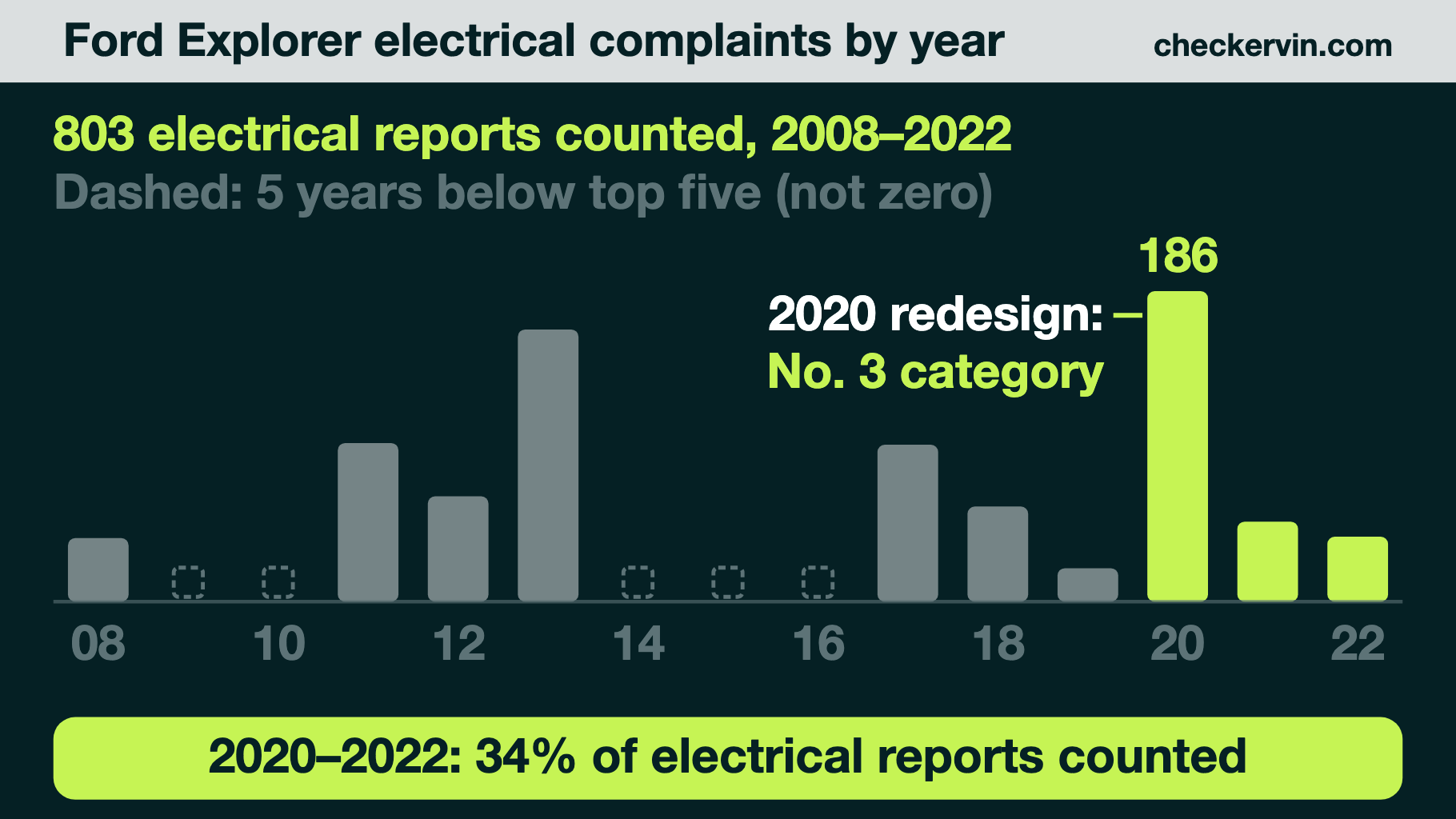
Our corpus holds 15,262 federal complaints against the 2008–2022Explorer. NHTSA files them by system, and there is no alternator system. ELECTRICAL SYSTEM is the closest, and it also holds the 12-volt battery, wiring, fuses, lighting, screens and control modules, so it works as a ceiling on charging trouble, never as a count of failed alternators. We keep each year’s top five categories. Electrical makes the list in 10 of 15 years and falls below fifth place on the 2009, 2010, 2014, 2015 and 2016 models, which means uncounted rather than zero.
That adds up to 803 electrical complaints counted. The category is No. 1 only on the 2008 Explorer, with 38 reports. On the 2011–2013 models it ranks between No. 4 and No. 5, behind steering and body complaints, with the 2013 the tallest at 163. In the later fifth-generation years it returns on the 2017, 2018 and 2019 models. The tallest bar of all is the 2020 redesign at 186, where electrical ranks No. 3 and makes up 15% of that year’s complaints. The 2020–2022 models together hold 34% of everything we counted.
The only two Ford documents that name the alternator
We pulled every manufacturer communication NHTSA holds for the Explorer from 2008 to 2022and searched them for alternator, generator, charging, battery and drain. The search returned dozens of battery and charging items, so it sees that vocabulary. Exactly two mention the Explorer’s alternator, both on the 2.3-liter EcoBoost four, and neither tells a dealer to replace it.
Special Service Message 48001, from May 2019, says some 2016–2019 Explorers with the 2.3L “may exhibit a squeal noise from the accessory drive belt, illuminated charging system indicator, and/or damaged alternator pulley.” Ford’s answer was a revised belt, part DA8Z-8620-G, and the causal part for the claim is the belt. If a 2.3L Explorer squeals and lights the charging warning, the belt is the documented first suspect, and a chewed pulley is a symptom of it.
Customer Satisfaction Program 21B17, from February 2021, covers 2021 Explorers with the 2.3L built at Chicago on November 30, 2020. Ford writes that “the installed high-output alternator and powertrain control module (PCM) calibration were not aligned,” which could make the idle speed rise and fall. The fix is a download of the correct PCM configuration, 0.3 hours, no parts. The program ran through February 28, 2022. A recall lookup on the VIN still shows whether a specific SUV received it.
2008: an ignition switch that moved the seat
The only year electrical tops the Explorer’s list has nothing to do with charging. Reading the 2008 electrical complaints, the same report repeats: on SUVs with a memory driver seat, often Eddie Bauer models, a bump in the road jiggles the key, the car decides the key has been pulled, the easy-exit feature slides the seat back and the dome lights come on, all while driving. Owners describe pushing the key back in to make it stop. A few of the remaining reports are stalls with a dashboard full of warnings.
We found no Ford bulletin for this in NHTSA’s copies, so it stays an owner-reported pattern. It matters here for one reason. A fourth-generation Explorer with flickering lights and odd electrical behavior is not automatically a charging case, and the handful of 2008 owners who did get an alternator describe mixed results, including one whose warning lights came back three months after an alternator and battery were replaced.
2011–2015: a charging warning that came with the steering
On the 2011–2013 Explorer, electrical complaints (321counted) are often steering complaints wearing a second code. Owners describe a “Service Power Steering” or “Power Steering Assist Fault” message, a wheel that suddenly goes heavy and, in a noticeable number of reports, a “Check Charging System” warning at the same moment. Several owners write that a battery and an alternator were replaced and the steering fault came back anyway; others had both tested good.
Ford recalled part of that population. Recall 14V-286 covers 2011–2013 Explorers built from May 17, 2010 through February 28, 2012, whose electric power steering gear may have an intermittent connection that drops the motor position sensor signal and shuts off steering assist. If your Explorer shows a steering fault and a charging warning together, run the VIN for that recall before anyone prices an alternator.
The 2013reports add a second, separate theme: door ajar warnings with the doors shut, interior lights left on and doors that will not lock. Ford’s TSB 18-2013 covers 2013–2014 Explorers built on or before August 15, 2013, and its later program 19N09 extended coverage on the driver’s door latch, with a 0.8-hour labor allowance for the Explorer. That window closed in 2020. Our Edge alternator post walks through how a stuck latch switch drains a healthy battery.
Dead by morning: the drains Ford documented
A battery that is flat after a night parked points away from the alternator, which only works with the engine running. Ford has written up several Explorer drains:
| Document | What Ford describes |
|---|---|
| CSP 18B25 (Sept. 2018) | 2018 Base and XLT 200A Explorers built May 8 to Aug. 5, 2018: the instrument cluster keeps drawing current, about 250 milliamps per SSM 47488; reprogram, 0.3 hr |
| SSM 49128 (Aug. 2020) | 2020 Explorers with SYNC built on or before Aug. 30, 2019: discharged battery or no crank from APIM, BCM or TCU software; reprogram |
| SSM 47899 (Mar. 2019) | 2016–2018 Explorers: crank/no start from the battery junction box relay module, now sold on its own |
| SSM 48123 (Aug. 2019) | 2012–2019 Fords incl. Explorer: corroded battery cable clamps can be replaced without the whole cable |
| TSB 13-6-18 (2013, summary only) | 2011 Explorer: remote function actuator keeps the vehicle network awake, dead battery |
The 18B25 program explains part of the 2018 bar, where electrical ranks No. 4. It ran through September 30, 2019, so an unrepaired 2018 Explorer today needs a dealer reflash under whatever coverage it still has, not a new alternator. Ask for a parasitic draw test whenever the complaint is a dead battery after sitting, and mention the bulletin numbers that match your build date.
2020–2022: the redesign peak is not a charging wave
The rear-drive Explorer launched for 2020, and its first year carries the tallest electrical bar we hold. Electrical ranks no lower than No. 4 and as high as No. 3 across 2020–2022. Reading the 2020 complaints, the common threads are a backup camera that shows a blue or black screen, touchscreens that freeze, all-wheel drive fault messages, liftgates that open on their own, water leaking into the cargo area and occasional stalls with every warning lit. Owners were still filing them in 2025 and 2026.
Ford’s documents for that year match. Besides SSM 49128’s software drain, SSM 49204 says some 2020 Explorers “may exhibit various electrical concerns” from an open fuse array on the high-current battery junction box, and recall 19V-687 covers 10,655 2020 Explorers with 2.3L or 3.3L engines whose wiring harness could rub on the A/C compressor pulley and reach the unfused battery positive wire. Two 2022 owners describe an alternator pulley rubbing through a harness; that is their description, not a Ford finding, and worth a look if the battery positive cable shows wear.
A handful of 2020–2022 owners report alternators replaced, a few with the fault returning. The pattern across the generation is electronics and wiring, and it is why a scan for stored codes in every module is worth more than a quick charging test on these SUVs.
The 2020–2022 Hybrid charges its 12-volt battery differently
The 2020–2022Explorer was also sold as a 3.3-liter hybrid, and our data pools it with the gasoline models. Ford’s 2021 Explorer Owner’s Manual lists a fuse for a “DC/DC converter (hybrid electric vehicle).” On Ford’s hybrids that converter supplies the 12-volt side from the high-voltage pack; Ford’s SSM 52201 ties a discharged 12-volt battery on Escape, Corsair and Maverick hybrids to it. A Ford bulletin for the 2022 Explorer, TSB 23-2187, shows the hybrid still has an accessory drive belt.
What we could not find is a Ford document saying whether that belt also turns a conventional alternator on the Explorer Hybrid. Parts-seller pages say the converter replaces it; a forum post says otherwise. We leave it open. If a hybrid shows a charging or low 12-volt warning, ask the shop to check the converter and the 12-volt battery before quoting an alternator, and to show you where the charging output comes from on that VIN.
A new battery needs eight hours before it reads right
The current Explorer has a battery management system, and it can make a fresh battery look like a failed one. Ford’s 2021 Explorer Owner’s Manual says that after battery replacement, or sometimes after charging with an external charger, the system “requires eight hours of vehicle sleep time to relearn the battery state of charge,” with the SUV locked and the ignition off. Until then it may switch off heated seats, audio and other loads. The same manual calls those messages notices, not signs of an electrical fault.
The manual also warns against grounding an accessory directly at the battery negative post, which “can cause inaccurate measurements of the battery condition.” Ford’s 21B17 procedure tells technicians the same thing about charger clamps, to keep the battery saver mode from activating. A remote starter or dash camera wired to that post can make the Explorer misjudge a healthy battery and send its owner shopping for charging parts.
Which engine, which job
The engine sets the alternator part number, the belt routing and the labor. EPA’s fuel economy listings give this lineup:
| Model years | Engines listed by EPA |
|---|---|
| 2008–2010 | 4.0-liter V6, 4.6-liter V8 |
| 2011 | 3.5-liter V6 |
| 2012–2015 | 3.5 V6, 2.0 turbo four; turbo 3.5 V6 from 2013 |
| 2016–2019 | 3.5 V6, turbo 3.5 V6, 2.3 turbo four |
| 2020–2022 | 2.3 turbo four, 3.0 turbo V6, 3.3 V6 hybrid |
Ford’s labor times and alternator removal steps are not public, so we will not rank which engine is the hard job. Ask the shop how many hours it is quoting and from which labor guide. A Ford VIN decode confirms the engine, and the engine size lookup does the same for any make, so the parts counter orders the right unit. One owner of a 2016 3.5L EcoBoost blames a failed alternator on coolant from a leaking water pump; our Explorer water pump post covers that engine family.
Before you authorize an alternator
- Ask for a battery load test and the charging voltage with the engine running, in writing
- On a 2.3L Explorer with a squeal and a charging light, ask about the drive belt in SSM 48001 first
- If the battery dies only after sitting, ask for a parasitic draw test and mention 18B25 (2018) or SSM 49128 (2020)
- With a steering fault and a charging warning together on a 2011–2013, check recall 14V-286 first
- On a 2020–2022 Explorer with a new battery, allow the eight-hour relearn Ford describes before judging it
- Get a quote that names the part as new, remanufactured or aftermarket and states the core charge
A Ford recall lookup by VIN shows any open campaign, and the guide to bulletins versus recalls explains why a service message pays for nothing on its own while a recall repair is free. If the battery needs replacing, the battery size lookup by VIN gives the group size.
If you are buying an Explorer rather than repairing one, the Ford Explorer years-to-avoid page lays out the full complaint record by year, and the Ford warranty check by VIN estimates whether factory coverage remains on a newer one. A free CheckerVIN report returns the build, engine, specifications and open safety recalls. It does not include accident, title, odometer or repair history, so it cannot tell you whether an alternator was ever replaced.
Where this information comes from
- Ford SSM 48001 (NHTSA copy): 2.3L accessory drive belt noise and charging indicator2016–2019 Explorer 2.3L; damaged alternator pulley; revised belt DA8Z-8620-G.
- Ford Customer Satisfaction Program 21B17 (NHTSA copy), February 20212021 Explorer 2.3L high-output alternator and PCM calibration mismatch; 0.3-hour reflash.
- Ford Customer Satisfaction Program 18B25 (NHTSA copy): key-off load battery drain2018 Explorer instrument cluster continuous draw; built May 8 to Aug. 5, 2018.
- Ford SSM 49128 (NHTSA copy): 2020 Explorer discharged battery/no crankAPIM, BCM or TCU software on SUVs built on or before Aug. 30, 2019.
- Ford SSM 49204 (NHTSA copy): battery junction box fuse arraysVarious 2020 Explorer electrical concerns from an open 3- or 4-post fuse array.
- Ford Customer Satisfaction Program 19N09 (NHTSA copy): left front door latch2013–2014 Explorer latch coverage, 0.8-hour Explorer labor allowance; window closed.
- Ford TSB 23-2187 (NHTSA copy): 2022 Explorer 3.3L hybrid coolant hoseHose contacting the accessory drive belt tensioner pulley on the hybrid.
- NHTSA: recalls by VINOur 2008–2022 Explorer query found no alternator recall; 19V-687 and 14V-286 cited above.
- NHTSA: vehicle complaintsThe federal complaint database our electrical counts are computed from.
- EPA and DOE: fueleconomy.gov vehicle listingsEngine lineup for each Explorer model year in the table above.
- Ford 2021 Explorer Owner's Manual (third-party copy)Eight-hour battery management relearn; negative-post grounding warning; hybrid DC/DC converter fuse.
- RepairPal: Ford Explorer repair and maintenance costsAlternator range as served in search results, November 22, 2026; direct requests refused.
Keep reading
Frequently asked questions
How much does it cost to replace an alternator on a Ford Explorer?
RepairPal's Ford Explorer page lists alternator replacement at $834 to $970, and its 2017 Explorer page lists $778 to $932, as both read in search results on November 22, 2026. Neither figure includes tax, and the engine, the shop's labor rate and the choice between a new and a remanufactured unit all move the final bill. Ask for a written quote that splits part and labor.
Where is the alternator located on a 2016 Ford Explorer?
It is driven by the engine's accessory drive belt, and Ford's SSM 48001 for the 2016–2019 2.3L EcoBoost names the alternator pulley on that belt. The 2016 Explorer was sold with a 2.3L turbo four, a 3.5L V6 and a 3.5L EcoBoost V6, and the exact position and access differ by engine. Ford's removal procedures are not public, so ask the shop which engine it is quoting and how many labor hours.
How common is it to replace an alternator on an Explorer?
Less common than the electrical complaint totals suggest. NHTSA has no alternator category, and when we read the Explorer complaints that name the alternator, many say it was tested good or replaced without curing the fault. In Ford's own bulletins for the 2008–2022 Explorer, the only alternator items we found are a 2.3L drive belt and a 2021 software calibration; no recall covers the alternator.
Is an alternator an expensive thing to replace?
It is a mid-sized repair: RepairPal's Explorer range sits in the high hundreds of dollars before tax, and the part is a large share of that. The expensive mistake is replacing a good alternator. A battery load test, a charging-voltage check with the engine running and a parasitic draw test cost far less, and they catch the drains and belt problems Ford has documented on the Explorer.
Is there a recall on the Ford Explorer alternator?
No. Our query of NHTSA's recall database for every Explorer model year from 2008 to 2022 found no campaign coded to the alternator. The closest is recall 19V-687, which covers 10,655 2020 Explorers with 2.3L or 3.3L engines whose wiring harness could rub on the A/C compressor pulley and short the battery positive wire. Dealers add a tie strap. Ford also ran a no-parts calibration program, 21B17, for some 2021 2.3L models.
Check the VIN before you price the alternator
A free CheckerVIN report shows the factory build, engine, specifications and open recalls for any VIN, so you order the right part and catch any open campaign first.
Run a free VIN check