The short answer
- What does it cost?
- RepairPal estimates $778–$1,578 for a 2021 F-150 in Houston, mostly parts; AutoNation Mobile Service lists a $622 average for an F-150.
- Is it the alternator?
- Often not on 2021–2022 trucks. Ford documents false Check Charging System messages, a scan-tool gap in its charging test, and several key-off battery drains.
- Which years show electrical trouble?
- Electrical complaints rank first or second in 2009, 2010, 2021 and 2022. The category covers far more than the alternator, so it marks where to look, not what failed.
$778–$1,578
RepairPal, 2021 F-150, Houston
Retrieved Nov. 2026, before tax
$622
AutoNation Mobile Service average
F-150 alternator replacement
1,842
Electrical reports counted
2008–2022, a minimum
0.3 hr
Ford's time to fix its charging-test gap
TSB 23-2154, 2021–2022 trucks
The estimates, and whose they are
The F-150 alternator figure that turns up most is RepairPal’s. For a 2021 F-150 in Houston, Texas, its estimator shows $778 to $1,578, splitting the bill into $239 to $350 for labor and $540 to $1,228 for parts, before taxes, fees and related repairs. We read that page’s text in November 2026. It covers one model year in one city, and we could not read a national RepairPal F-150 alternator page, so treat it as a single data point, not the price of every F-150.
AutoNation Mobile Service, which sends mechanics to the driveway, lists an average of $622 for an F-150 alternator replacement. Its listing does not show which model year or engine it assumes or how the figure splits. The gap between the two is mostly the part: RepairPal’s parts range alone runs past $1,200 at the top, which fits a new Ford unit on a late truck, while a remanufactured alternator on an older V8 costs a fraction of that.
Labor is the smaller and steadier share. We found no Ford document that prints alternator hours for each F-150 engine, so we print none. Ask the shop which labor guide it is quoting, how many hours, and whether the quote quietly includes a battery, a belt and a diagnosis fee you did not ask for. We sell VIN checks, not repairs, and publish no price of our own.
Where electrical ranks in 19,621 F-150 complaints
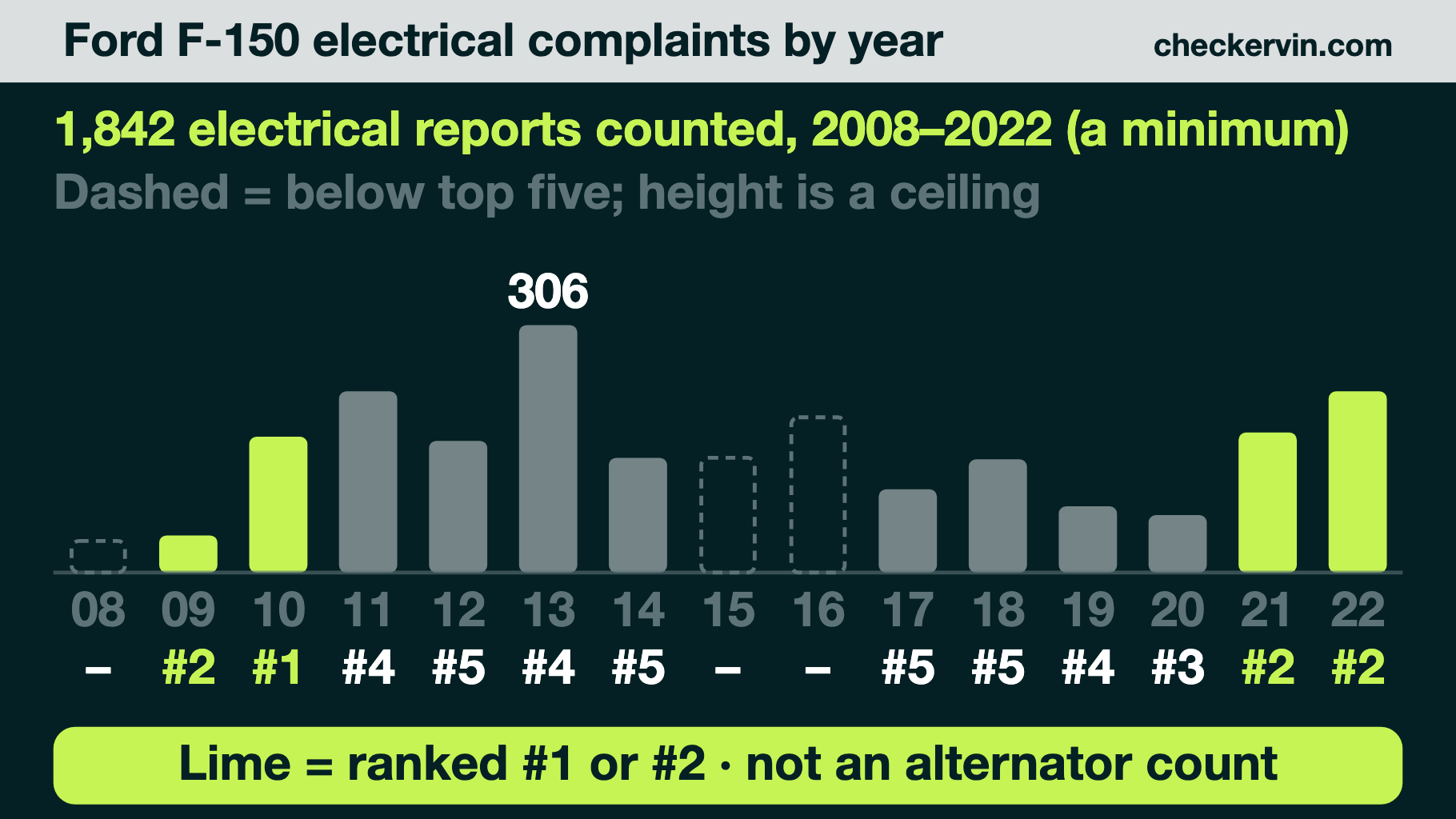
Our corpus of federal NHTSA complaints holds 19,621 reports against the 2008–2022 F-150. ELECTRICAL SYSTEM makes the top five components in 12 of those 15 model years, which adds up to 1,842 counted electrical reports. That category is wide: the 12-volt battery and cables, fuses and relays, wiring, lighting, audio, displays and body modules all land there. The alternator is one slice, and an owner whose truck stalled may file it under ENGINE instead. So the count tells you where electrical trouble clusters, never how many alternators failed.
Ranked against everything else owners reported, the pattern sits at the two ends. Electrical ranks first among components on the 2010 truck, the only year it leads, and second on the 2009. It climbs back to second on both the 2021 and 2022 trucks, where 397 electrical reports make up about 18% of those two years’ complaints. The tallest single bar is the 2013 truck at 306, but that year ranks it only fourth, because everything else was reported in bulk too. Across the 2015–2020 aluminum-body trucks, electrical never ranks higher than third.
For 2008, 2015 and 2016, ELECTRICAL is not among the five most-reported components. The chart draws those years as a dashed outline at the height of the fifth-place count, which is the most electrical could have been, a ceiling of at most 192 in the highest of them. It is not a count, and it is not zero.
2009–2010: the top rank came from defrosters and fuses
The 2010truck is where electrical leads, so it is the obvious place to look for a charging problem. Reading the electrical narratives behind that count on NHTSA’s complaint search, we did not find one. The dominant story is the rear window defroster: owners describe turning it on in cold weather and hearing a bang as the rear glass shattered, or seeing smoke at the grid. After that come melted fuses, lighting failures and stalls. The alternator appears in only a few reports, and in one of them the owner says the battery and alternator both tested good.
The 2009 narratives point the same way. Several describe a truck that cranks but will not run, traced to a melted fuel-pump fuse in the under-hood box, often called fuse 27, and a relocation kit to fix it. Others describe lighting faults and a seat heater that burned. None of the recalls NHTSA lists for the 2009 or 2010 F-150 is electrical: one covers an interior door handle spring and one a brake-lamp switch.
Those trucks ran the 4.6L and 5.4L V8s, according to the EPA’s fuel economy listings, and their alternators are conventional belt-driven units. If a 2009–2010 F-150 has a dead battery and a stall, the alternator is a fair suspect. The complaint record just does not single it out as the reason those years rank so high.
2021–2022: a charging warning that is sometimes false
The newest trucks in our data are where electrical climbs back to second, and here Ford’s own service messages speak directly to the charging system. The most useful one for anyone holding an alternator quote is Special Service Message 52738, from July 2024. It covers some 2021–2024 Bronco and non-Lightning F-150 trucks that show a Check Charging System message while the charging system is fully operational and no charging codes are stored. Ford’s cause is an aftermarket programmer used to change the body control module’s configuration.
Ford returned to the subject in SSM 55031 in July 2026, covering 2021–2026 Ford and Lincoln vehicles. Its summary describes the same false message, often alongside an auto start-stop system that misbehaves, and names the likely reason: someone used a programmer to switch start-stop off or make other unsupported changes. For F-150 and Bronco, dealers run a Ford diagnostic application that checks whether the module setup was changed and offers to restore it. Separately, Ford released an over-the-air body module update in June 2024 described as disabling false “Charging System Service Soon” and “12V Battery State of Charge Low” warnings; NHTSA indexes it to the 2021 F-150.
Not every warning on these trucks is false. SSM 50737 covers some 2021–2022 F-150s with the 2.7L EcoBoost showing Check Charging System with network codes U012D, U042E, U0284, U0285 or U0645. Ford traces it to a communication wire, circuit VE181, shorted to ground near the left engine mount bracket, and the fix is repairing and re-routing that wire. A new alternator would not cure it.
A gap in Ford's own charging test
Diagnosing a modern Ford charging system depends on reading what the engine computer is asking the alternator to do. Ford calls that value generator voltage desired, shown on its scan tool as GENVDSD. In July 2021 Ford issued TSB 21-2205 for some 2021 F-150s with the 5.0L whose scan tool list was missing that value when technicians ran the workshop manual’s charging tests. The bulletin was superseded twice to widen the list, ending at TSB 23-2154 in May 2023.
That final version covers 2021–2022 F-150s with the 2.7L EcoBoost, 3.3L, 3.5L EcoBoost or 5.0L, along with some Transit and Bronco models. The repair is reprogramming the powertrain module, at 0.3 hours of labor under Ford’s warranty terms where they apply. A January 2024 over-the-air update for 2021 F-150s lists the same fix, plus better detection of a low battery to prevent stalls.
The practical point: on a 2021–2022 truck that has not had the update, a shop following Ford’s own charging test may be missing one of its key readings. A diagnosis made without it deserves a second look before an alternator gets ordered, and a dealer can check the module software level quickly.
PowerBoost: a hybrid that charges its 12-volt battery differently
The 3.5L PowerBoost hybrid arrived for 2021, and it changes the alternator question entirely. Cars.com, reporting on its long-term 2021 PowerBoost, describes a DC-to-DC converter that turns voltage from the hybrid battery pack into accessory power and keeps the 12-volt battery charged, and notes two 12-volt batteries, a main one under the hood and an auxiliary one under the rear seat. We did not find a Ford document that says “no alternator” in those words, so that description stays attributed to Cars.com.
Ford’s documents are consistent with it. The charging-test bulletin above names every 2021–2022 F-150 gas engine it applies to, and the PowerBoost is not among them. The PowerBoost has its own bulletin instead, TSB 24-2442, for 2021–2024 trucks showing “12V Battery State of Charge Low” or “Charging System Service Soon”, or a FordPass notice that remote features are disabled to preserve the battery. Ford’s cause is an erroneous state-of-charge calculation by the battery monitoring system, and the repair is a battery test, a body module update and a monitor reset. Its successor, TSB 25-2142, adds climate-control and transfer-case module software as causes and lists a no-crank among the symptoms.
A 2022 PowerBoost owner told NHTSA of paying about $1,500 for what the shop called a new alternator-generator unit, without fixing an intermittent hybrid fault. The name is the trap. On this truck, an alternator price from any estimator does not describe the repair, and a quote that uses the word deserves a question about which component, exactly, is being replaced. The F-150 VIN decoder shows whether a truck was built with the hybrid.
The battery monitor, and why a new battery needs a reset
Later F-150s carry a battery monitoring system that estimates how charged the battery is, and Ford’s documents show the truck posting warnings and shutting off features based on that estimate. When the reading is wrong, the symptoms look like a charging fault. That is what TSB 24-2442 describes on the hybrid, and its procedure ends with a step that matters for every owner: after a battery is replaced, the monitor is reset with Ford’s scan tool. The bulletin’s labor allowances are short, 0.4 hours when the battery passes its test and 0.6 hours when it fails and is replaced.
A battery swapped without that reset can leave the truck working from stale information about the battery it is charging. If a new battery went in shortly before the charging warning started, ask whether the reset was done before anyone blames the alternator.
The monitor’s connection also figures in recall 19V805, which covers certain 2019–2020 F-150s. NHTSA’s summary says the fastener holding the power distribution cable and the battery monitoring system eyelets to the positive terminal may loosen, affecting displays and other systems. The fix is free. Our Ford recall lookup by VINshows whether it is still open on a given truck. We queried NHTSA’s recall database for every F-150 model year from 2008 through 2022, and the campaign counts matched our corpus year for year; none of those campaigns replaces an alternator.
Dead by morning: the drains Ford has documented
A battery that is flat every morning sends many owners to the alternator first. On the F-150, Ford has published several messages where the battery is drained with the truck off, which no alternator can cause or cure:
| Ford document | Key-off drain it describes |
|---|---|
| SSM 47544 / 47755 (2018 F-150) | Parking-brake switch short wakes the ABS module; pull fuse F70 to test |
| TSB 21-2097 / 22-2032 (2021 F-150) | Zone lighting left enabled in SYNC 4 or FordPass drains the battery |
| SSM 54534 (2021–2025 F-150) | Trailer module software; clicking from the module with the truck off |
| SSM 51894 (2021 F-150) | Low battery at start-up sets a steering assist fault; module not replaced |
The last row is a symptom, not a drain, but it belongs here because it sends trucks to shops for the wrong part. Ford says a 2021 F-150 with a weak battery can start with no steering assist and a fault message, and that the steering module does not need replacing; it is reflashed once battery voltage is back above 12 volts. A low battery creates several warnings that look like failures elsewhere.
A parasitic draw test, measuring current with the truck asleep and pulling fuses one at a time, separates these cases from a failing alternator. It is a routine shop procedure and usually far cheaper than an alternator.
When it really is the alternator
The owner narratives that do describe a genuine alternator failure read alike across generations. A battery or charging light comes on while driving, then power steering, stability control and gauges drop out one by one, and the truck stalls. A 2011 owner describes three alternators in a row on the same truck. A 2021owner describes a “check electrical system” warning followed within minutes by a complete loss of power and an electronic parking brake that locked. Others on 2021 trucks describe failures at roughly 60,000 to 71,000 miles, and one says replacement alternators were hard to get.
One 2011 owner, in a report that reached NHTSA twice, describes the alternator sitting low at the left front of the engine, about ten inches off the ground in the owner’s words, where a chunk of road ice struck it. That is an owner’s description, not a Ford specification, but it is a reminder that an alternator on a work truck can fail from outside damage as well as wear.
The way to confirm it is the same on any F-150 with a belt-driven alternator: battery test first, then a charging test that reads what the engine computer asks for and what the alternator delivers. The engine computer commands the alternator’s target voltage, which is what the GENVDSD value reports, so a single voltmeter reading at idle is not a verdict either way. On 2021–2022 trucks, make sure the GENVDSD reading is actually available, per the bulletin above.
Before you authorize the alternator
- Load-test the battery and inspect both cable ends and the battery monitor connection
- On a 2021–2022 truck, ask whether the PCM has the update in TSB 23-2154
- Say whether start-stop was disabled with a programmer; Ford ties that to false warnings
- On a 2.7L 2021–2022, ask the shop to check circuit VE181 per SSM 50737
- If the battery is dead every morning, ask for a parasitic draw test first
- On a PowerBoost, ask which component is being replaced; the 12-volt side is not a belt alternator
- After any new battery, confirm the battery monitor was reset
None of those steps costs much, and each rules out a documented reason a good alternator gets replaced. If the shop has a failed charging test with the right readings, the truck is not a hybrid, and the battery is healthy, then it is the alternator and the published estimates above are a fair yardstick.
If you are buying the truck, not repairing it
An alternator is not a reason to pass on an F-150; at the estimates above it is a negotiating point. The more useful checks tell you which charging system the truck has and whether anything has been tampered with. Confirm the engine through engine size by VIN, since a PowerBoost, a 2.7L and a 5.0L each send you down a different path. Ask whether start-stop works; if it has been switched off by a programmer, Ford’s documents say that can produce false charging warnings later. The battery size lookup by VIN tells you which battery the truck should carry.
The F-150 years-to-avoid breakdown covers the rest of the complaint record by model year; power train complaints outnumber electrical ones in 13 of the 15 years. The F-150 starter cost post covers the no-crank side of the same electrical record, including the two recalls at the battery end of the starter circuit.
Where this information comes from
- Ford TSB 23-2154 (NHTSA copy) — GENVDSD missing during charging diagnostics2021–2022 F-150 2.7L, 3.3L, 3.5L EcoBoost and 5.0L; reprogram the PCM, 0.3 hr. PowerBoost not listed.
- Ford TSB 24-2442 (NHTSA copy) — PowerBoost 12V state-of-charge and charging messagesBattery monitor miscalculation; battery test, body module update and monitor reset.
- Ford SSM 50737 (NHTSA copy) — 2021–2022 2.7L Check Charging SystemCommunication circuit VE181 shorted near the left engine mount bracket.
- NHTSA — Ford communications indexed to the 2021 F-150Where SSM 52738, SSM 55031, the over-the-air updates and the drain messages above were found and summarized.
- NHTSA recalls — 2020 Ford F-150Includes 19V805, the battery terminal fastener and battery monitor eyelets; no F-150 recall from 2008 to 2022 covers the alternator.
- EPA fueleconomy.gov — F-150 engine listings4.6L and 5.4L V8 for 2010; for 2021, the 2.7L, 3.3L, 3.5L, 5.0L, diesel and 3.5L hybrid.
- RepairPal — 2021 Ford F-150 alternator replacement cost, Houston, TXThe $778–$1,578 range and its labor and parts split, retrieved November 2026.
- Cars.com — 2021 F-150 hybrid long-term test, failed 12-volt batteryDescribes the DC-to-DC converter and the two 12-volt batteries on the PowerBoost.
Keep reading
Frequently asked questions
How much does it cost to replace the alternator on a Ford F-150?
RepairPal's estimator puts a 2021 Ford F-150 alternator replacement in Houston, Texas at $778 to $1,578, with labor $239 to $350 and parts $540 to $1,228, before taxes and fees, as retrieved in November 2026. That is one model year in one city. AutoNation Mobile Service lists an average of $622 for an F-150 alternator replacement. The part is most of the bill, so a remanufactured unit and an independent shop usually land lower than a dealer installing a new Ford part.
How do I know if my F-150 alternator is bad?
A failing alternator usually shows a charging warning while driving, dimming lights, and then systems dropping out one by one as the battery runs down, ending in a stall. On 2021 and newer trucks, a Check Charging System message alone is not proof: Ford service messages describe that warning appearing while the charging system works normally, after aftermarket body-module programming or from a shorted wire on 2.7L trucks. Ask for a charging test with live generator readings and a battery test before buying an alternator.
How long do alternators last on an F-150?
Ford publishes no replacement interval, because the alternator is replaced when it fails, not on a schedule. The federal complaint record has no alternator-specific count to measure lifespan with. Among 2021 F-150 owners who wrote to NHTSA about a failed alternator, some describe failures at roughly 60,000 to 71,000 miles, but those are individual reports, not an average.
Does the F-150 PowerBoost hybrid have an alternator?
Not a conventional belt-driven one, according to Cars.com's long-term test of a 2021 PowerBoost, which describes a DC-to-DC converter that turns hybrid-battery voltage into 12-volt power and keeps the 12-volt batteries charged. Ford's own charging-system bulletin for 2021-2022 F-150 engines lists the 2.7L, 3.3L, 3.5L EcoBoost and 5.0L but not the PowerBoost, and Ford's PowerBoost bulletin TSB 24-2442 traces its low-charge warnings to the battery monitoring software. Alternator prices do not apply to that truck.
How much should I pay to get my alternator replaced?
Use the published estimates as a yardstick, not a quote: RepairPal's 2021 F-150 range for Houston is $778 to $1,578, and AutoNation Mobile Service lists a $622 average. Before paying anything, make sure the diagnosis is the alternator and not the battery, a cable, a software fault or a parasitic drain, since Ford documents several of those on F-150s. Ask which part the shop is installing, new or remanufactured, and how many labor hours it is charging.
Confirm the engine and open recalls before you buy an alternator
A free CheckerVIN report shows the factory build, engine, specifications and open recalls for any VIN, so you know whether the truck is a hybrid and whether a free recall repair comes first.
Run a free VIN check