The short answer
- What does it cost?
- KBB's local ranges run from $4,910-$5,719 (2022, ZIP 95060) to $7,402-$7,962 (2016, ZIP 13323), parts and labor included. These are KBB's figures, not ours.
- Which years carry the problem?
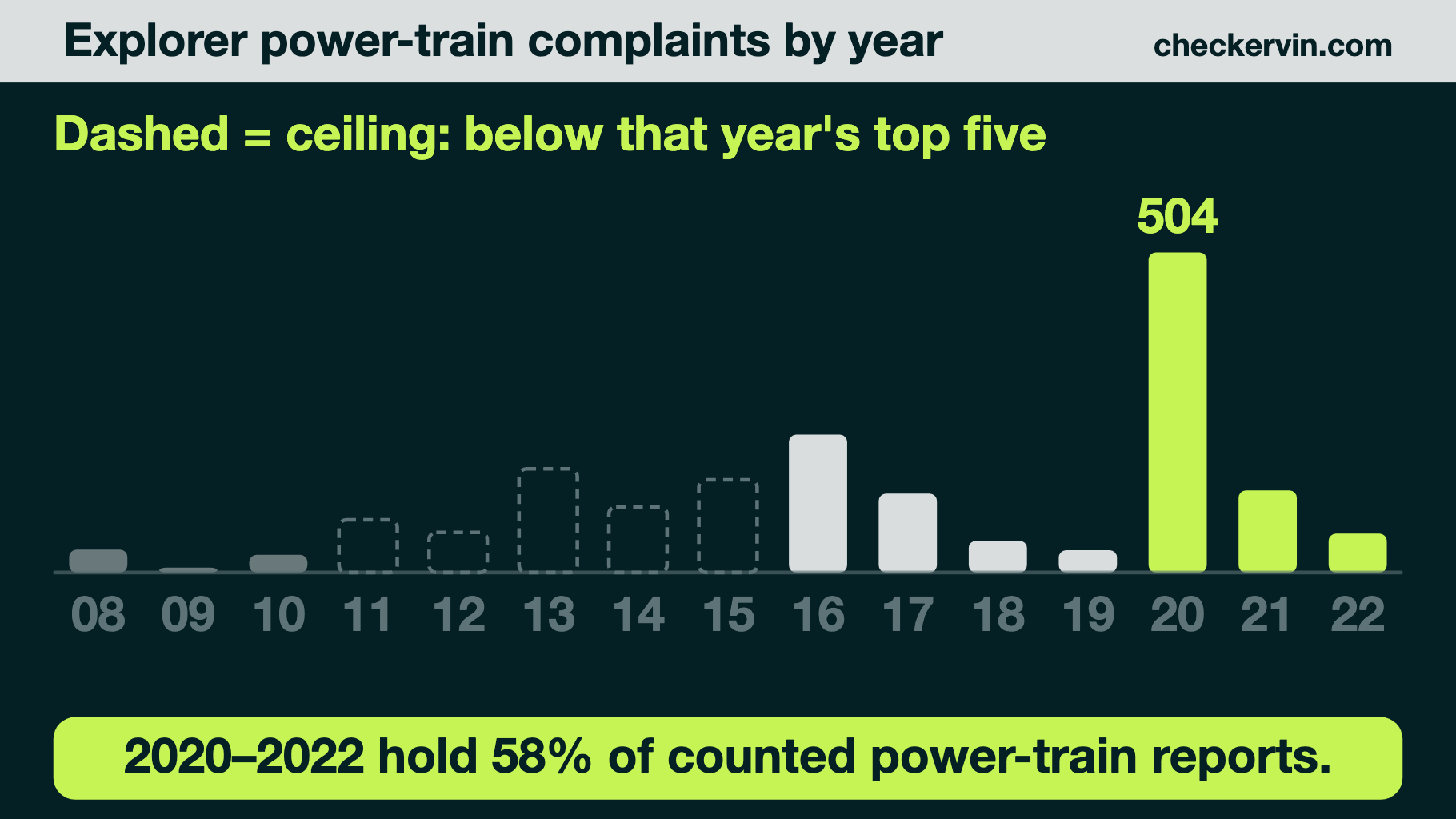
- 2020-2022 rank POWER TRAIN first every year and hold 58% of the counted reports. 2016-2019 also rank it in their top five.
- Will Ford pay?
- On some 2020-2022 Explorers, yes: recall 26V402's remedy began November 20, 2026, and the 24N01 axle-bolt program runs 6 years/150,000 miles.
Four KBB ranges, four ZIP codes
Kelley Blue Book prices an Explorer transmission repair or replacement by model year and ZIP code. The ranges we could read on November 22, 2026, all parts and labor included:
| Explorer and KBB's ZIP | KBB fair repair range |
|---|---|
| 2016, ZIP 13323 (Clinton, NY) | $7,402-$7,962 |
| 2019, ZIP 93955 (Seaside, CA) | $5,184-$6,752 |
| 2021, ZIP 43085 (Columbus, OH) | $5,967-$6,419 |
| 2022, ZIP 95060 (Santa Cruz, CA) | $4,910-$5,719 |
KBB loads these prices in the browser, so a direct fetch of its page came back with a placeholder ZIP and no range. The figures above are the text search engines serve for each named page. They come from different ZIP codes, so the gap between the 2016 and the 2022 numbers says as much about local labor rates as about the gearbox. No 2020 range came up at all, which matters, because 2020 is the model year with the most transmission trouble on record.
We sell VIN checks, not repairs, so we publish no price of our own. What we can add is something a price estimate leaves out: on the Explorer, whether you pay that number depends on which generation you own, which engine it has, and whether Ford has already accepted the fault in a recall or program.
What the complaint record shows
Our corpus of federal NHTSA complaints holds 15,262 owner reports against the 2008–2022 Explorer. POWER TRAIN appears among a model year’s five most-reported categories in 10 of those 15 years, and the counts in those years add up to 1,187. That total is a minimum, because a year where POWER TRAIN falls below fifth place contributes nothing to it.
The pattern after the 2011 redesign is easy to read. From 2011 to 2015 POWER TRAIN never makes the top five, and the chart draws those years as dashed outlines at each year’s fifth-place count (between 63 in 2012 and 163 in 2013). The true figure for those years is somewhere below the line, not zero. Steering, structure and unclassified complaints took the top spots in those years. Then POWER TRAIN returns in all four of 2016 through 2019, ranking between third and fifth, with 217 reports in 2016 alone. Those four years hold 426 counted reports, or 35.9% of the total.
The rear-drive Explorer that arrived for 2020 is where the record peaks. POWER TRAIN ranks first in every one of its three model years on file. In 2020 it accounts for 504 complaints, 40.5% of everything owners filed against that model year and 2.4 times the next category. The three rear-drive years hold 58% of the counted power-train reports while making up 12.9% of all Explorer complaints. These are unverified owner reports, not a failure rate, and POWER TRAIN covers axles, driveshafts and AWD hardware as well as the transmission. They are still a good guide to which years to check first.
2016-2019: the torque converter Ford reprogrammed
The 2016–2019 bump lines up with a program Ford filed with NHTSA. Customer Satisfaction Program 20B27 covers 2016–2019 Explorers with the 2.3-liter EcoBoost and the 6F35 six-speed, built at Chicago from September 29, 2014 to March 3, 2019. Ford’s dealer bulletin says the torque converter can overheat under some driving conditions and that the result can be noise, vibration, rough idle and poor performance which, in Ford’s words, will “ultimately” need internal transmission repairs. The fix was a powertrain control module reprogram.
A companion program, 20N07, promised a one-time free torque converter replacement if symptoms appeared within 12 months of that reprogram and the converter was out of powertrain warranty. When Ford reopened 20B27 in September 2022, its owner letter set the reprogram deadline at August 31, 2023, with no mileage limit, and gave owners who had already paid for a converter until January 31, 2023 to submit receipts. Both deadlines have passed. On a 2016–2019 Explorer the program now matters mainly as a diagnostic clue: a 2.3L with shudder at steady speed or a rough idle in gear may need a converter, not a whole transmission.
The 2016 complaint narratives fit that reading. Reading through the POWER TRAIN reports for that year, torque-converter shudder, lunging at a stop and rough idle in Drive come up again and again, next to slipping and harsh shifts. A separate Ford service message covers some 2015–2016 6F50 and 6F55 units built between November 2, 2015 and February 1, 2016, which could lose reverse, third and fifth gear because of a direct-clutch snap ring. Ford repairs that inside the transmission with a parts kit, not a new unit.
2020-2022: more than one fault in one category
The 2020 spike holds several different faults. Harsh or delayed shifts are the most common complaint in the narratives, and Ford has a bulletin for the best-known one: TSB 20-2337 covers a harsh 7-to-6 downshift on 2020 Explorers with the 10R60 built on or before May 19, 2020. A TSB is a repair procedure, not free coverage. Owners in the record describe paying for that repair once the powertrain warranty ran out.
The same category also holds complaints about the rear axle bolt, AWD warnings and transfer-case behavior, and the park system. Some owners report metal shavings found during a recall visit, which turns a free bolt repair into a paid transmission job. That mix is why a complaint count is only an upper bound for transmission failures, and why the first question on a 2020–2022 Explorer is which part actually failed.
Work Ford pays for on a 2020-2022 Explorer
Here are the campaigns on NHTSA’s recall database and in Ford’s program bulletins that touch the transmission, or that produce symptoms an owner would blame on it. Each covers only certain VINs.
| Campaign | What it covers, per NHTSA or Ford |
|---|---|
| Recall 26V402 (Ford 26S48) | 2020-2021 Explorer: park pawl may engage while moving. Software plus replacement of damaged transmission parts; letters mailed Nov. 20, 2026 |
| Recall 23V069 (Ford 23S05) | 2020-2022 Explorer, 2.3L with 10R60: control-module reset can damage the park system; dealers inspect and repair |
| Recall 23V070 (Ford 23S06) | Certain 2022 Explorers: loose internal bolt can stop park engaging; dealers inspect and replace the transmission if needed |
| Recalls 22V255, 23V199, 23V675, 25V166 | 2020-2022 Explorer rear axle bolt: bushing, bolt, cover and software fixes, including redoing earlier repairs |
| Program 24N01 | 2020-2022 Explorer: one-time free axle-bolt repair, 6 years/150,000 miles from warranty start |
| Program 20B34 | Early 2020 Explorer transmission cooler crack; ended Sept. 30, 2021 |
The newest item matters most. Recall 26V402 now has a remedy: owner letters went out November 20, 2026, and the remedy includes replacing damaged transmission parts as well as the software update. If a 2020 or 2021 Explorer has a damaged park system and the recall is open on its VIN, do not pay out of pocket before a dealer has looked at it under the recall.
Three faults that get called a transmission
Not every “transmission” diagnosis on an Explorer is one. Three driveline faults show up again and again in the record under the same category:
- The 2020-2022 rear axle bolt: a driveline part. Ford's bulletin says a fracture can disconnect the driveshaft or half shafts, so the vehicle will not move or hold park even though the gearbox is fine
- The power transfer unit on 2011-2019 AWD Explorers: a separate gearbox that sends power to the rear axle. Ford's service message on leaking PTU seals says the worn bushing can now be repaired without replacing the PTU
- The 2020 AWD driveshaft: recall 20V693 replaces driveshafts on certain 2020 AWD Explorers that can crack along a weld seam
Each of these produces clunks, vibration or loss of drive, and each costs far less than a transmission. Some are free. A written diagnosis that names the failed part is what separates them.
Five gearboxes across three generations
“Explorer transmission” covers several different units, and a replacement quote has to match the one in your vehicle:
| Explorer | Transmission, and where that comes from |
|---|---|
| 2008-2010, 4.0L V6 | 5R55S five-speed (parts listings and owner forums; secondary) |
| 2008-2010, 4.6L V8 | Ford 6R six-speed (named in recall 07V453) |
| 2011-2019, 3.5L V6 and EcoBoost | 6F50 / 6F55 six-speed (Ford service messages) |
| 2016-2019, 2.3L EcoBoost | 6F35 six-speed (Ford program 20B27) |
| 2020-2022 | 10R60 on the 2.3L (recall 23V069); 10R80 on some others; 10R80 MHT on hybrids |
The 2020–2022 split matters most for parts. A hybrid’s 10R80 MHT includes a hybrid drive unit that the gas versions do not have, and Ford’s bulletins treat the 10R60 and 10R80 as separate repair procedures. The engine code in the VIN tells a supplier which unit to quote. We could not confirm from a primary source whether the 2009–2010 V8 used the 6R60 or the 6R80, so check the transmission tag on those.
Rebuild, remanufactured or used
Ford’s own bulletins answer half of the rebuild-or-replace question. Several Explorer fixes happen inside the case: a direct-clutch kit on some 6F50/6F55 units, a clutch-cylinder repair under TSB 24-2254 on the non-hybrid 10R80, a valve-body separator plate for the park circuit, and a torque converter on the 2.3L. Ford even publishes guidance on seal kits for internal 10R80 repairs. A shop that goes straight to a complete unit may be right, especially if the fluid shows metal, but it should say why.
- Internal repair or rebuild: lowest cost when one part failed, and the shop's warranty is the one you rely on
- Remanufactured unit: a full replacement with a supplier warranty, usually with a refundable core charge
- Used unit from a salvage yard: cheapest to buy and the least known, with the donor's mileage whatever the seller says
- New Ford unit at a dealer: the top of KBB's range, and the route a recall or program uses when it pays
For a 10-speed in particular, ask whether the price includes control-module programming after the swap. Ford’s service procedures for these units include software steps, and a shop without the tools cannot finish the job.
Where Ford's warranty clock stands in late 2026
Ford’s powertrain warranty runs 5 years or 60,000 miles from the warranty start date, whichever comes first, and it covers the transmission’s internal parts. A 2022 Explorer first sold in mid-2022 is covered into mid-2027 if it is under 60,000 miles. Most 2020 Explorers have aged out, and 2021s are aging out now.
The 24N01 axle-bolt program runs longer: 6 years or 150,000 miles from the same start date. Ford’s bulletin gave vehicles already past that limit until July 31, 2025, so a late-2019 sale is probably finished. A 2021 or 2022 sold new is likely still covered, and a 2020 first sold during 2020 may have months left. The in-service date is the number to find, and a Ford dealer can read it from the VIN.
Before you authorize the repair
- Decode the VIN to confirm model year, engine and which transmission family the vehicle has
- Pull the open recalls on that VIN, especially 26V402, 23V069 and the axle-bolt campaigns on a 2020-2022
- Ask a Ford dealer for the in-service date and any open program such as 24N01
- Get the diagnosis in writing: axle bolt, PTU, converter, valve body, or the complete transmission
- Compare quotes for the same work, with programming, fluid and core charge listed
If you are buying the Explorer, not repairing it
The same record works as a shopping guide. A Ford VIN decodeconfirms the model year and engine, which tells you whether a 2016–2019 is a 2.3L in the converter program’s range or a V6. A transmission lookup by VIN narrows down the gearbox, and checking Ford coverage by VIN shows whether any powertrain warranty is left. On a 2020–2022, ask the seller for paperwork on each axle-bolt recall and on 26V402; a missing repair is free to get done, but you want to know before you negotiate.
Compare model years on the Explorer’s full complaint record by year rather than judging the vehicle on power train alone. The same 10-speed family appears in Ford’s pickups, and our F-150 transmission cost post shows how a different set of Ford recalls turned many “transmission” jobs into a sensor or software repair.
Where this information comes from
- NHTSA — Ford Explorer complaints, recalls and bulletinsThe federal record this page's complaint figures are computed from, browsable by model year.
- NHTSA recalls API — 2020 Ford ExplorerSource of 26V402, 23V069, 23V199, 23V675, 25V166 and 20V693 summaries and remedies; every Explorer year 2008-2022 was queried.
- NHTSA-hosted Ford bulletin — Customer Satisfaction Program 20B27Read in full: 2016-2019 Explorer 2.3L with 6F35, Chicago build dates, torque converter overheating, PCM reprogram.
- NHTSA-hosted Ford owner letter — 20B27 reopened and 20N07Read in full: reprogram through August 31, 2023; one-time converter replacement within 12 months; receipts by January 31, 2023.
- NHTSA-hosted Ford bulletin — Customer Satisfaction Program 24N01Read in full: 2020-2022 Explorer rear axle bolt, 6 years/150,000 miles, July 31, 2025 grace date, build dates.
- Kelley Blue Book — 2016 Explorer transmission repair and replacementThe $7,402-$7,962 range for ZIP 13323, read from search-served page text on November 22, 2026; the 2019, 2021 and 2022 pages were read the same way.
- Ford — What parts are covered by the Powertrain WarrantyFord's 5-year/60,000-mile powertrain term and its list of covered transmission parts.
Keep reading
Frequently asked questions
How much does it cost to replace a transmission on a 2020 Ford Explorer?
Kelley Blue Book had no 2020 Explorer range we could read on November 22, 2026. Its neighbors bracket it: $5,184 to $6,752 for a 2019 in ZIP 93955 (Seaside, California) and $5,967 to $6,419 for a 2021 in ZIP 43085 (Columbus, Ohio), parts and labor included. Those are KBB's local figures, not ours. Before paying anything on a 2020, have a Ford dealer run the VIN: recall 26V402, whose remedy began November 20, 2026, covers park-system damage on 2020-2021 Explorers, and the 24N01 axle-bolt program may still apply.
Is it cheaper to rebuild a transmission or replace it?
A rebuild or an internal repair is usually the smaller bill when the fault is confined to one part, and Ford's own bulletins repair Explorer gearboxes that way: a direct-clutch repair on some 2015-2016 6F50/6F55 units, a clutch-cylinder repair on the 10R80, and a torque converter swap on the 2016-2019 2.3L. A complete replacement makes more sense when the case is contaminated with metal or the shop will not warranty a rebuild. Ask for the diagnosis in writing before comparing prices.
How long do Ford Explorer transmissions last?
There is no published lifespan figure we could verify, and NHTSA complaints are owner reports, not a failure rate. What can be measured is coverage: Ford's powertrain warranty runs 5 years or 60,000 miles, whichever comes first. Maintenance and towing load matter more for any one vehicle than an average would, so judge a specific Explorer by its service records and a test drive.
What year Explorer has transmission problems?
In the federal complaint record, 2020 stands out: POWER TRAIN is 504 of that model year's 1,245 complaints (40.5%), and 2020 through 2022 all rank it first. The 2016-2019 Explorers also put it in their top five, the same years Ford's torque-converter program for the 2.3L EcoBoost covers. POWER TRAIN includes axles, driveshafts and AWD parts as well as the gearbox, so read these as an upper bound.
Is there a recall on the Ford Explorer transmission?
Yes, on the 2020-2022 generation. Recall 26V402 covers a park pawl that can engage while 2020-2021 Explorers are moving; 23V069 covers park-system damage after a control-module reset on 2020-2022 Explorers with the 2.3L and 10R60; 23V070 covers a loose internal bolt on a small number of 2022 units. Several more recalls cover the rear axle bolt, which is a driveline part, not the transmission. Check the exact VIN, because each campaign covers only certain vehicles.
Confirm the generation before you price the transmission
A free CheckerVIN report shows the factory build, engine, specifications and open recalls for any VIN, so you know which Explorer and which transmission you are pricing.
Run a free VIN check