The short answer
- What does it cost?
- RepairPal's national estimate is $770 to $1,062, labor $239 to $350 and parts $531 to $711, before tax and fees.
- Is it really the alternator?
- Often not. On 2011–2013 Edges Ford ties a stuck door ajar warning to the latch switch, which keeps lights on and drains the battery.
- Which years?
- Electrical is the No. 1 complaint category on the 2011–2013 Edge, and those years hold 85% of the electrical complaints we counted.
$770–$1,062
RepairPal national estimate
Installed, before tax; read Nov. 22, 2026
85%
Electrical complaints counted on 2011–2013
Of every electrical complaint counted, 2008–2022
1.2 hr
Ford's labor allowance for the Edge door latch
Customer Satisfaction Program 19N09
87
Vehicles in the only alternator recall
18V-548, built May 29, 2018
The estimate, and whose it is
CheckerVIN decodes VINs and lists open recalls. We do not fix cars, so any price on this page is someone else’s, with the date we read it. RepairPal’s national estimate for a Ford Edge alternator replacement is between $770 and $1,062, which it splits into $239 to $350 of labor and $531 to $711 of parts. RepairPal refuses direct requests from our research tools, so we took those figures from the page text that two separate searches served on November 22, 2026, both with the same wording. The estimate leaves out tax, fees and related repairs.
Other estimators publish lower averages, but we could not open their pages to confirm the numbers, so we leave them out. The part is most of RepairPal’s figure. That makes the order of operations matter: a remanufactured unit, a new Motorcraft part and an aftermarket alternator are priced very differently, and none of them fixes a battery that is being drained by something else. On the Edge, Ford’s own paperwork says that something else is often a door latch.
Where the Edge's electrical complaints actually sit
Our corpus holds 13,042 federal NHTSA complaints against the 2008–2022Edge. NHTSA has no alternator category. The closest one, ELECTRICAL SYSTEM, also covers the 12-volt battery, wiring, lighting, switches and control modules, so it is a ceiling on charging trouble and never a count of failed alternators. We keep each year’s top five categories, and electrical makes that list in 11 of 15 years. It falls below fifth place on the 2015–2018 cars, which means uncounted, not zero.
The counted total is 2,352 electrical complaints, and the shape is lopsided. On the 2011–2013 Edge, electrical is the single largest complaint category every year, with the 2013 model the peak at 853. Those three years alone account for 85% of everything we counted, and 37% of all complaints filed against them. The 2008 Edge is the next tallest bar at 158, or 14% of that year. Electrical falls to No. 3 on the 2014 car, and every other year combined adds 192 more.
A jump that size invites a closer look. To find its cause we read the complaints themselves, then Ford’s bulletins for those model years.
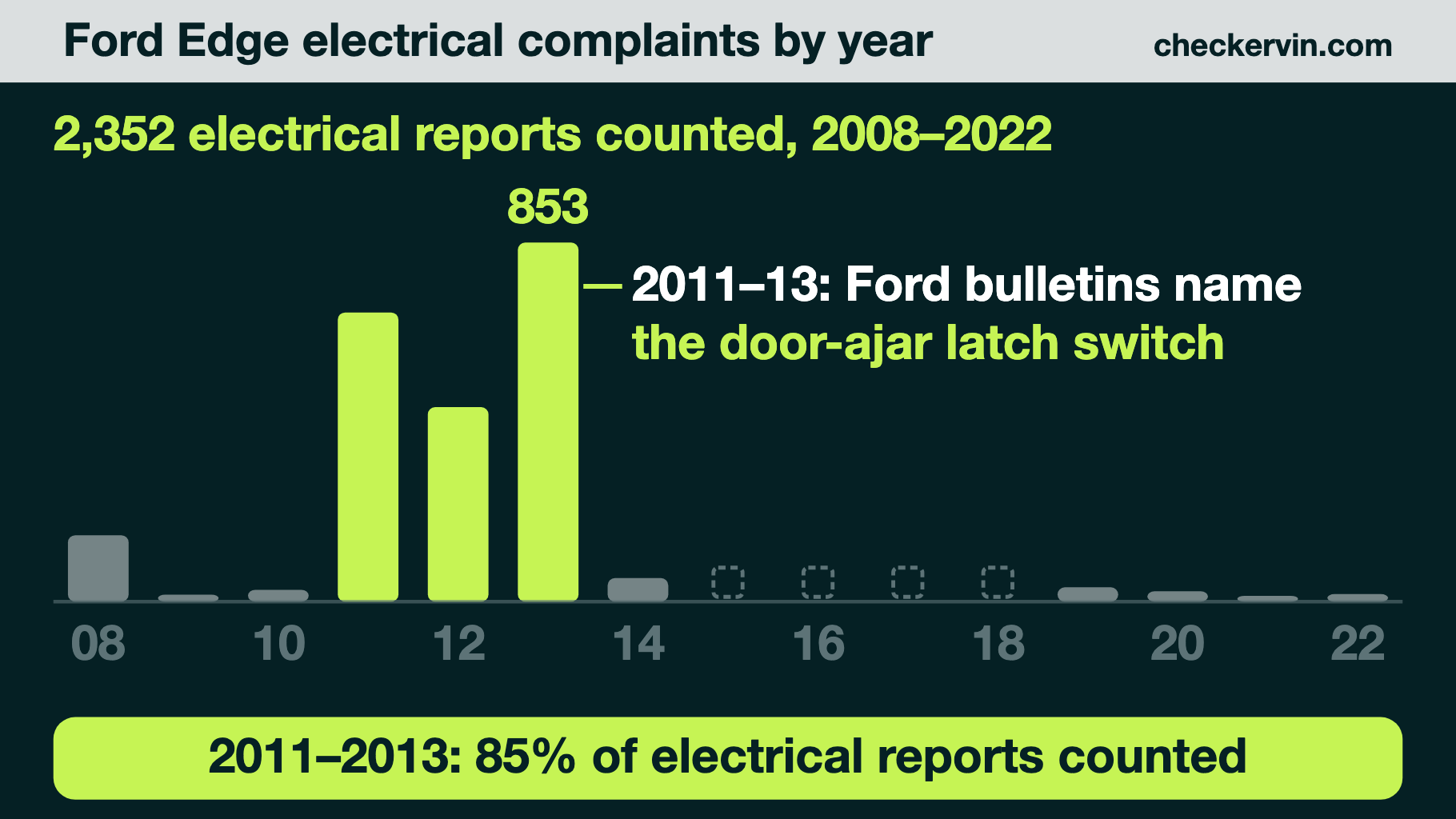
2011–2013: a switch in the driver's door, not a charging part
The answer is in the driver’s door. In the electrical complaints filed against the 2011–2013 Edge, the same story repeats: a door ajar warning that stays on with the door shut, dome lights that will not go out, doors that refuse to lock, a chime on the highway, and a battery found flat in the morning. Most of those reports were filed in 2014 through 2017, as the cars aged.
Ford published the cause. Technical Service Bulletin 18-2013, dated January 17, 2018 and replacing an earlier 15-0013, covers 2011–2013 Edge and MKX models built on or before July 15, 2013: they “may exhibit a door ajar lamp illuminated with all doors closed,” and the bulletin says this may be due to the door ajar sensor within the door latch. The fix is a revised latch. Its warranty status reads “Information Only,” so the bulletin itself paid for nothing.
In December 2019 Ford went further with Customer Satisfaction Program 19N09 for 2011–2014 Edges built at Oakville through July 31, 2013. It extended coverage on the driver’s door latch to seven years or 84,000 miles, and explains that the door ajar switch may not operate properly, so that “the dome light and/or door ajar message may remain illuminated and the doors may not lock.” Ford allowed dealers 1.2 hours to replace the Edge latch, part BT4Z-78264A27-B.
Here is why this belongs in an alternator article. A car that thinks its door is open keeps the interior lights on. Left overnight, that empties a good battery, and a dead battery in the morning is exactly what sends owners shopping for an alternator. If your 2011–2014 Edge shows a door ajar warning, even intermittently, fix that before you price a charging part.
What Edge owners describe about the alternator itself
A category count cannot separate a latch from an alternator, so we read every 2008–2022Edge complaint that mentions the alternator, whatever NHTSA coded it as. There are few of them next to the door complaints, and the typical one says the alternator was tested and passed. A 2011 owner describes a “BATTERY SAVER” message on the dash after the battery, starter and alternator had all been checked by different shops. Another 2011 owner lists a dead battery, lights that come on in the night and a door ajar warning that never clears, with the alternator and starter tested good.
The handful of owners who did get an alternator describe mixed results. A 2015 owner had a battery light on a new car and a dealer replaced the alternator. Several 2018 owners report alternators replaced together with batteries and sensors while the original complaint continued. One 2013 owner blames the voltage regulator in the alternator, which is that owner’s diagnosis, not a Ford finding.
Battery saver messages are not alternator codes
From 2011 the Edge carries a battery management system. Ford’s 2011 Edge Owner’s Guide says the system “monitors battery conditions and takes actions to extend battery life,” such as shutting the audio off with the engine stopped. The guide adds that its messages “do not necessarily indicate that an electrical problem exists.” It also warns that accessories wired with their ground directly at the negative battery post “can cause inaccurate measurements of the battery condition.” An aftermarket remote starter or dash camera grounded there can make the car misread a healthy battery.
Ford has also documented drains that start in the modules. An NHTSA summary of a 2013 Ford bulletin says the remote function actuator on some 2011 Edges kept the vehicle network awake through excessive draw from an accessory interface module, ending in a dead battery. We saw only NHTSA’s summary, not the bulletin itself. The pattern is the same as the door latch: the battery goes flat while the car is parked, which no alternator can cause or cure.
The one Edge recall that names the alternator
Our query of NHTSA’s recall database for every Edge model year from 2008 to 2022 found exactly one campaign coded to the alternator, and the alternator was not the defect. Recall 18V-548, filed August 20, 2018, covers 87 vehicles: 2018 Edge and MKX plus 2019 Flex and MKT, all built on May 29, 2018. For about an hour and a half that day a cut network cable at the plant forced a manual torque process for the nuts that hold the power cables to the alternator and starter, and two warranty claims showed it had not worked.
Ford’s report says a loose or cross-threaded nut can arc and start a fire, and the warning signs are messages on the instrument cluster or an engine that will not start. Dealers inspect the nuts and studs and torque them; there are no replacement parts. Ford said it knew of no fire, accident or injury. For context, electrical complaints on the 2018Edge do not reach that year’s top five. If you own a 2018 Edge, a recall lookup on the VIN settles whether yours was one of the 87 in seconds.
2019–2022: liftgate drains and a false charging message
Electrical complaints return to the top five on every Edge from 2019 to 2022, but never above No. 4 and never more than 14% of a year’s complaints. Ford’s bulletins for those years again describe batteries drained by something other than charging. TSB 19-2104 covers 2019 Edges with a power liftgate built on or before November 14, 2018: a discharged battery, interior lamps cycling on and off and a Liftgate Ajar message with everything shut, caused by the rear gate trunk module staying awake. The fix is a reprogram booked at 0.3 hours under the new vehicle warranty.
The newest document is the most direct. Ford’s Special Service Message 55031, issued July 23, 2026 and filed by NHTSA under the 2021 and 2022 Edge, describes a “Check Charging System” message “while the charging system is operating properly” with no charging trouble codes stored. Ford’s explanation is aftermarket programming of the body control module, often done to switch off auto start/stop. Ford says reverting the configuration is “not warrantable.” If you bought a used 2021 or 2022 Edge and the message appeared, ask whether anyone has plugged a programmer into it before anyone sells you an alternator.
Which engine, which alternator
The Edge has used several engines, and the alternator, its mounting and the labor to reach it change with each. EPA’s fuel economy listings give this lineup:
| Model years | Engines listed by EPA |
|---|---|
| 2008–2010 | 3.5-liter V6 |
| 2011 | 3.5-liter and 3.7-liter V6 |
| 2012–2014 | 3.5 and 3.7 V6, plus a 2.0-liter turbo four |
| 2015–2018 | 2.0 turbo four, 2.7 turbo V6, 3.5 V6 |
| 2019–2022 | 2.0 turbo four, 2.7 turbo V6 |
We could not obtain Ford’s labor times or removal procedures for the alternator on any of these engines, so we will not tell you which one is the hard job. A parts site claims the Edge is harder than most to work on, but we found no Ford document to back that up either way. Ask the shop how many hours it is quoting and from which labor guide. A Ford VIN decode confirms the engine, and the engine size lookup does the same for any make, so the parts counter gets the right unit the first time.
Before you authorize an alternator
- Watch the dash for a door ajar or liftgate ajar warning with everything shut; on a 2011–2014 Edge, suspect the driver's door latch
- Ask for a battery load test and the charging voltage with the engine running, in writing
- Ask whether a parasitic draw test was done if the battery only dies after the car sits overnight
- On a 2021 or newer Edge with Check Charging System, ask whether the body control module was reprogrammed
- Run the VIN for open recalls, including 18V-548 on a 2018 Edge
- Get a quote that names the part as new, remanufactured or aftermarket and states the core charge
The first two items cost little and are the most likely to change the bill. A battery that tests weak after a night of dome lights is a victim, not a cause. A Ford recall lookup by VIN shows any open campaign, and the guide to bulletins versus recalls explains why TSB 18-2013 paid for nothing while a recall repair is free. If the battery itself needs replacing, the battery size lookup by VINgives the group size, and Ford’s guide asks for a battery that matches the car’s electrical requirements.
If you are buying the Edge, not repairing it
On a 2011–2014 Edge, open and shut the driver’s door a few times during the test drive and watch the cluster and the dome light. A warning that lingers means a latch replacement is coming, now at the owner’s expense. Ask the seller whether the battery has been replaced recently and why. The Ford Edge years-to-avoid page lays out the full complaint record by year, and the Ford warranty check by VIN estimates whether factory coverage remains on a newer car.
The 2011–2013 cars sit just before the gearbox changes covered in our Edge transmission fluid post. A free CheckerVIN report returns the factory build, engine, specifications and open safety recalls for any VIN. It does not include accident, title, odometer or repair history, so it cannot tell you whether a latch or an alternator was ever replaced.
Where this information comes from
- Ford TSB 18-2013 (NHTSA copy): door ajar lamp remains illuminated with doors closed2011–2013 Edge/MKX; may be due to the door ajar sensor within the door latch; information only.
- Ford Customer Satisfaction Program 19N09 (NHTSA copy), December 20192011–2014 Edge driver door latch coverage to 7 years/84,000 miles; 1.2-hour labor allowance.
- Ford Part 573 Safety Recall Report 18V-548 (NHTSA copy)87 vehicles built May 29, 2018; alternator and starter cable nuts inspected and torqued.
- Ford TSB 19-2104 (NHTSA copy): power liftgate, discharged battery2019 Edge rear gate trunk module kept awake; reprogram, 0.3 hr.
- Ford SSM 55031 (NHTSA copy): Check Charging System message from aftermarket BCM programmingMessage can appear while the charging system is operating properly; 2021–2026 Ford/Lincoln.
- NHTSA: recalls by VINOur year-by-year Edge query found 18V-548 as the only alternator-coded recall.
- NHTSA: vehicle complaintsThe federal complaint database our electrical counts are computed from.
- EPA and DOE: fueleconomy.gov vehicle listingsEngine lineup for each Edge model year in the table above.
- Ford 2011 Edge Owner's Guide, battery management system (third-party copy)BMS messages do not necessarily mean an electrical fault; do not ground accessories at the negative post.
- RepairPal: Ford Edge alternator replacement cost estimateNational estimate as served in search results, November 22, 2026; direct requests refused.
Keep reading
Frequently asked questions
How much does it cost to replace an alternator in a Ford Edge?
RepairPal's national estimate for a Ford Edge alternator replacement is $770 to $1,062, with labor at $239 to $350 and parts at $531 to $711, as its page read on November 22, 2026. That excludes tax and fees. Your price depends on the engine, the shop and whether the unit is new or remanufactured, so ask for a written quote that separates part and labor.
Is it expensive to replace an alternator?
On an Edge it runs from several hundred dollars to about a thousand before tax, judging by RepairPal's estimate, and the part is most of it. That is why the diagnosis matters more than the shop rate. Several Edge owners who reported a dead battery to NHTSA say their alternators tested fine; on 2011–2013 cars Ford's own bulletins point at the driver's door latch switch, which can leave the dome lights on overnight.
Why does my 2011–2013 Ford Edge battery keep dying?
Check the door ajar warning first. Ford's TSB 18-2013 says 2011–2013 Edges may show a door ajar lamp with all doors closed because of the sensor inside the door latch, and its later Customer Satisfaction Program 19N09 notes the dome light may stay on and the doors may not lock. Lights left on all night will flatten a healthy battery without any alternator fault.
Is there a recall on the Ford Edge alternator?
One, and it is tiny. Recall 18V-548 covered 87 vehicles, 2018 Edge and MKX plus 2019 Flex and MKT, built on May 29, 2018, when a cut network cable at the plant forced a manual check of the alternator and starter cable nuts. Dealers inspect and torque the nuts; no alternator is replaced. Our query of every Edge model year from 2008 to 2022 found no other alternator recall.
Is it worth fixing an alternator on a car?
If the alternator has actually failed, yes: the car will not stay running without it, and the repair costs far less than most Edges are worth. The question is whether it has failed. Ask for the battery test, the charging voltage with the engine running and any stored codes before you approve the part, and on a 2021 or newer Edge ask whether the body control module was reprogrammed, which Ford says can trigger a false Check Charging System message.
Check the VIN before you price the alternator
A free CheckerVIN report shows the factory build, engine, specifications and open recalls for any VIN, so you order the right part and catch any open campaign first.
Run a free VIN check