The short answer
- Is the size hard to find?
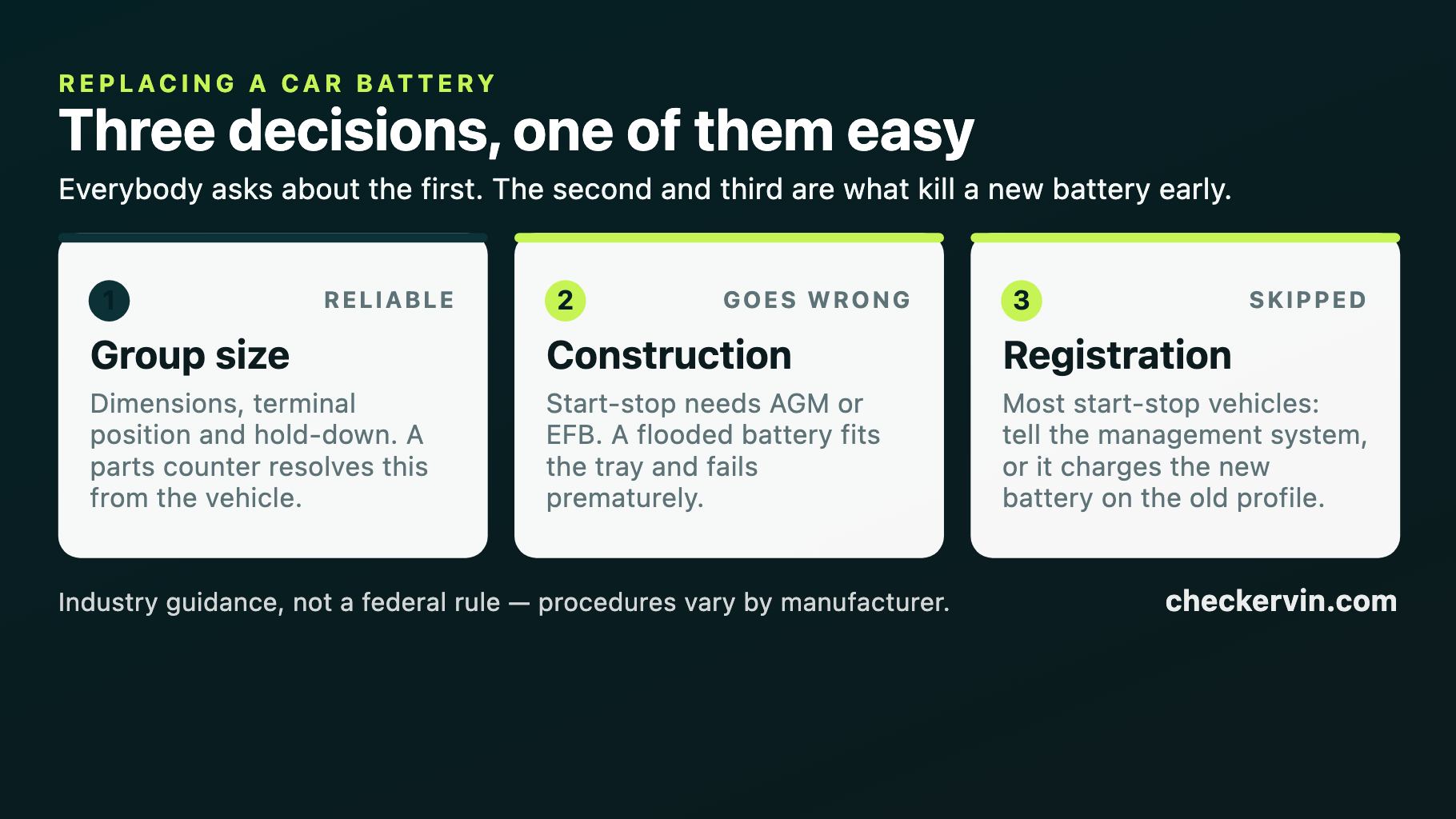
- No. Group size follows from year, make, model and engine, and a parts counter resolves it routinely.
- So what goes wrong?
- Construction. A start-stop car needs AGM or EFB; a standard flooded battery fits and then fails early.
- What gets skipped?
- Registration. On most start-stop vehicles the new battery must be declared to the management system.
Reliable
Group size from the vehicle
Year, make, model, engine
AGM or EFB
What start-stop requires
Flooded fails prematurely
Register it
The step that gets skipped
Most start-stop vehicles
Minimum
What the CCA figure is
Not a target to beat
Fitment is the easy part
It is worth saying this clearly, because it is the opposite of what most pages on this subject imply.
Battery group size is one of the few vehicle specifications that resolves cleanly from the basic facts about a car. Year, make, model and engine determine the tray, the hold-down, the terminal positions and the clearance under the hood. Parts counters and retail lookups handle this all day and are generally right.
So unlike our oil specification guide, where the honest answer is that no lookup can give you the spec, here the lookup genuinely works. Which means the useful thing this page can do is not repeat the easy part — it is to cover the two decisions after it.
What group size actually means
The group number is a physical description rather than a performance one, which is why it settles fitment and nothing else.
| What the group defines | Why it matters |
|---|---|
| Length, width and height | The battery has to sit in the tray and clear whatever is above it. An over-tall battery can contact a hood liner or a brace. |
| Terminal position and polarity | Which end the positive post is on. Get this wrong and the cables will not reach, or will reach only under strain. |
| Terminal type | Top post, side post, or a threaded stud arrangement. Adapters exist and are a poor substitute for the correct terminal. |
| Hold-down provision | How the battery is clamped. A battery that fits the tray but not the clamp will move, and vibration is a leading cause of early failure. |
What the group number does not describe is what the battery is made of or how it behaves under repeated deep cycling. Two batteries in the same group can be entirely different products, and that distinction is the next section.
Flooded, EFB and AGM
Three constructions are in common use, and they are not interchangeable in the direction most people assume.
| Construction | Where it belongs |
|---|---|
| Conventional flooded | The traditional lead-acid battery with liquid electrolyte. Appropriate for vehicles without start-stop and without heavy electrical cycling. |
| EFB — enhanced flooded battery | A reinforced flooded design built to tolerate more cycling than a conventional battery. Fitted to many entry-level start-stop systems. |
| AGM — absorbent glass mat | Electrolyte held in a glass mat rather than free liquid. Tolerates deep and frequent cycling best, and is what more demanding start-stop and high-electrical-load vehicles are designed around. |
The important point is that these are engineering choices made for the vehicle, not tiers of quality you can shop up and down freely. A car specified for AGM was designed around what AGM does.
Why start-stop changes the answer
If the engine shuts off at traffic lights, the battery in that car is doing a fundamentally different job from the one in a car without the feature.
A conventional vehicle starts once per trip and then the alternator carries the load. A start-stop vehicle restarts repeatedly within a single journey, and between restarts the battery alone runs the electrical system — climate control, lights, infotainment, the whole load. That is a deep, repeated cycle, over and over, every day.
Industry guidance on this is consistent and blunt: a standard flooded battery fitted to a start-stop vehicle fails prematurely, in some cases within months. It will fit the tray perfectly. It is simply not built for the duty cycle.
The step nobody mentions
This is the genuinely under-known part, and it is the reason a correctly chosen battery can still disappoint.
Most start-stop vehicles run a battery management system that tracks the battery’s age and condition and adjusts charging accordingly. As a battery ages, the system adapts — charging it differently than it did when new.
Fit a new battery without telling that system, and it carries on applying the old battery’s profile. Industry guidance is direct about the consequence: the management system retains the old battery’s data, including its age and condition, and without a reset the wrong charging parameters get applied. A new battery charged as though it were four years old and tired does not last as it should.
Registration — sometimes called a BMS reset or battery adaptation — is the procedure that tells the system a new battery is installed and resets the profile. It is done with a scan tool, it takes minutes, and it is exactly the kind of step a hurried replacement skips.
Which swaps are allowed
The direction of a substitution matters, and the general guidance runs one way.
- AGM should be replaced by AGM — industry guidance specifies an identical housing and a similar performance class
- EFB may be replaced by EFB, or in some circumstances by AGM, again matching housing and class
- Going downward — AGM replaced by EFB or flooded — is the swap to avoid, because the vehicle was designed around the construction it left with
- A conventional vehicle with no start-stop does not need AGM, and fitting one is a spending decision rather than a correctness one
- Where your manufacturer publishes its own guidance, that governs — the detail varies by make
The last point deserves weight. What follows here is general industry guidance, not a regulation, and manufacturers differ on the specifics of both substitution and registration.
CCA is a minimum, not a target
Cold cranking amps is the specification people try to optimize, and it rewards less attention than it gets.
The figure describes how much current the battery can deliver at low temperature for a short period — its ability to turn a cold engine. The manufacturer specifies a minimum appropriate to the engine and the climate the vehicle was designed for.
Meeting or modestly exceeding that figure is sensible, particularly in a cold climate. Treating it as a score to maximize is not, because a higher CCA rating does not compensate for the wrong construction and will not help a battery survive a duty cycle it was not built for. Construction first, then group, then an adequate CCA.
What the VIN is actually doing
It is worth being precise about the VIN’s role, because it is real but indirect.
The federal decoder returns the build record — make, model, model year, body class, displacement, cylinders, fuel type. It has no parts catalog in it and never has. What it gives you is an unambiguous identification of the engine and trim your car was actually built with, which is the input every battery lookup needs and the thing people most often get wrong when working from the badge on the tailgate.
That matters here for one specific reason: whether a vehicle has start-stop can vary by trim and by engine within the same model year. Establishing which one you have is the difference between the right construction and a battery that fits and dies. Our engine size guide and trim level guide cover reading those fields.
Where the authoritative answer is
Four sources, and they answer different parts of the question.
- 1The battery currently in the carThe fastest answer to all three questions at once. The label carries the group size, usually the construction, and the CCA — assuming the last person fitted the right one.
- 2The owner's manualThe authority on the required construction and on whether registration is needed. It outranks the label if they disagree.
- 3A parts counter, given the VINReliable for group size and generally for construction. Ask specifically whether the vehicle requires AGM or EFB rather than accepting the default offered.
- 4Your manufacturer's own published guidanceThe last word on substitution and registration, both of which vary by make more than general advice suggests.
Symptoms of getting it wrong
The failures here are slow and easy to misattribute, which is why they are worth naming.
- Start-stop stops working, or works only occasionally — often the first sign the system does not trust the battery
- A new battery that struggles within a year, particularly in a start-stop vehicle
- Warning messages about the charging or electrical system after a battery change
- Repeated flat batteries on a car that is driven regularly
- A battery that tests fine but behaves poorly, which can point at charging strategy rather than the battery
Start-stop quietly ceasing to function is the one most often ignored. Drivers frequently treat it as a welcome relief rather than a symptom, and it can be the system reporting that the battery is not up to the job.
Buying used: what the battery tells you
There is a small but genuine inspection point here, and it costs nothing to look.
Open the hood and read the battery label. On a car with start-stop, a conventional flooded battery is a finding: either it will fail soon, or it already is failing, and either way it suggests maintenance done to a price rather than to the specification. A battery whose construction does not match what the vehicle requires is a small window onto how the rest of the car has been treated.
Many batteries also carry a date code, which tells you roughly how old the fitted one is. None of this changes a purchase on its own, but it is one more line in the same picture our used car red flags and pre-purchase inspection guides build.
The check sequence
Decode the VIN free to establish the exact engine and trim, and whether the vehicle has start-stop. Read the manual for the required construction and whether registration is needed. Match the group size at a parts counter. Buy to the construction first and the CCA second. Have it registered if the vehicle calls for it. And while you have the number in front of you, check open recalls through NHTSA at no cost.
Where this information comes from
- VARTA — EFB and AGM differencesManufacturer guidance that AGM should be replaced by AGM in an identical housing and similar performance class, and EFB by EFB or in some circumstances AGM
- Banner — registering start-stop batteriesWhy a replacement battery is registered to the vehicle's management system, and what the procedure is for
- Midtronics — battery issues in auto start-stop vehiclesWhy start-stop duty cycles demand AGM or EFB construction and how a conventional battery fails in that service
- NHTSA recall lookupOpen safety recalls by VIN, free — worth running while you have the number to hand
Keep reading
Frequently asked questions
Can I find my battery size from the VIN?
Effectively yes, and this is one of the few specifications where a lookup is genuinely reliable. Group size follows from year, make, model and engine, and the VIN establishes all four. Parts counters do this routinely and get it right. The part that goes wrong is not which battery fits — it is which type the vehicle requires, and what has to happen after it is fitted.
Can I put a normal battery in a start-stop car?
It will physically fit and it will fail early. Start-stop systems cycle the battery far harder than a conventional car does, and they are designed around AGM or EFB construction. Industry guidance is consistent that a standard flooded battery in a start-stop vehicle fails prematurely, in some cases within months.
What is battery registration and do I need it?
On most start-stop vehicles the battery management system tracks the battery's age and condition and adjusts charging accordingly. Registration tells it a new battery has been fitted so it resets that profile. Skip it and the system keeps applying the old, degraded battery's charging strategy to a new one, which shortens the new battery's life.
Can I upgrade from EFB to AGM?
Industry guidance is that an AGM must be replaced with another AGM of identical housing and similar performance class, while an EFB may be replaced with an EFB or, in some circumstances, an AGM. Going the other way — AGM down to EFB or flooded — is the swap to avoid. Check your manufacturer's own guidance, because the detail varies by make.
Does CheckerVIN return a battery group size?
No. Our free lookup returns the factory build, specifications and open safety recalls from the federal decoder, which has no parts fields. Decode the VIN here to confirm the exact engine and trim, then take that to a parts counter or your manual.
Start with the VIN
Decode any VIN free for the factory build, specifications and open safety recalls. No account, no card.
Run a free VIN check