The short answer
- What does it cost?
- KBB serves $729–$823 for a 2017 Escape (ZIP 43085). RepairPal lists $889–$1,279 for a 2015 and $1,713–$2,287 for a 2017 in Seattle.
- What is the catch?
- On 2017–2019 1.5L EcoBoosts, Ford documents coolant entering the cylinders. The fix is a short block, not a pump.
- Is there a recall?
- None names the pump. Ford's 1.5L repair ran as programs 19B37 and 21N12; check the VIN with a dealer first.
1,121
Escape cooling complaints counted
2008–2022, top-five data
83%
Of them in 2017–2019
The 1.5L program years
19.7 hrs
Ford labor, 1.5L short block
FWD Escape, TSB 19-2375
$729–$823
KBB, 2017 Escape pump
ZIP 43085, parts and labor
The numbers, and whose numbers they are
We sell no repairs and publish no price of our own, so every dollar figure here belongs to the site that published it, retrieved in October 2026. Kelley Blue Book’s 2017 Escape page, as served for ZIP 43085 near Columbus, Ohio, shows a fair repair range of $729 to $823: $291 to $329 in parts and $438 to $494 in labor. Its 2016 Escape page for ZIP 29506 in South Carolina shows $770 to $870, and its 2022 page for Brooksville, Florida shows $650 to $1,087.
RepairPal reads higher. Its 2015 Escape estimator lists $889 to $1,279 and its 2016 page $863 to $1,279, both marked as last updated June 13, 2023. Its 2017 Escape page for Seattle lists $1,713 to $2,287 before taxes and fees, which shows how much a high-cost market moves the number. We could not open RepairPal’s pages directly from our tools, so these are the figures its pages show in search results. KBB’s pages fetched without a ZIP code show only a generic $375 to $787 line that appears across Ford models, and we do not treat that as an Escape estimate.
All of these price the same thing: unbolting a pump and fitting a new one. None of them knows which engine your Escape has, and none prices what a 1.5L EcoBoost needs when its coolant is disappearing into the combustion chambers. That job is measured in Ford’s own labor tables at close to twenty hours.
What turns the pump, as far as Ford’s catalog shows
A water pump that carries its own pulley is spun by a belt on the outside of the engine, and that is the cheap case. We could not open Ford’s parts catalog pages directly (the dealer site that hosts them refused our region), so the part numbers below are from its pages as served in search results, retrieved October 26, 2026.
For the 2011 Escape, the catalog lists water pump pulley 5M6Z-8509-AE, with a fitment list that includes the 2.5L Duratec. For the 2022 Escape it lists pulleys HJ5Z-8509-A, the current replacement for that older number, and GN1Z-8509-A, with fitment that includes the 2.5L full hybrid and plug-in hybrid. For the 2014–2015 Fusion it lists pulley DS7Z-8509-A on the 1.5L EcoBoost, and Ford’s bulletin 19-2375 specifies the same short block, DS7Z-6009-G, for the Fusion and the 2017–2019 Escape 1.5L. Our Focus water pump post read a catalog pulley for the 2.0L EcoBoost as well.
So on the engines we could trace, the Escape does not have the buried, chain-driven pump that makes the Explorer’s 3.5L V6 job so expensive. Three engines we could not confirm: the 2008–2012 3.0L V6, the 2013–2016 1.6L EcoBoost and the 2020–2022 1.5L three-cylinder. For those, ask the shop to show you the pump on the parts diagram for your VIN before you accept a quote.
Which engine you have, by model year
The federal fuel economy records at fueleconomy.gov list each engine Ford certified for the Escape. That list decides which pump, which bulletins and which recalls apply:
| Model years | Engines EPA lists for the Escape |
|---|---|
| 2008 | 2.3L four; 3.0L V6; 2.3L hybrid |
| 2009–2012 | 2.5L four; 3.0L V6; 2.5L hybrid |
| 2013–2016 | 1.6L turbo four; 2.0L turbo four; 2.5L four (FWD only) |
| 2017–2019 | 1.5L turbo four; 2.0L turbo four; 2.5L four |
| 2020–2022 | 1.5L turbo three; 2.0L turbo four; 2.5L hybrid; 2.5L plug-in hybrid (FWD) |
The 2017–2019 row is the one that matters most for a coolant complaint. Three engines share those years, and only one of them, the 1.5L EcoBoost, is covered by Ford’s coolant intrusion programs. An engine lookup by VINsettles which one a particular Escape carries, and it is worth doing before a shop writes “water pump” on the work order.
What 22,813 complaints say about Escape cooling
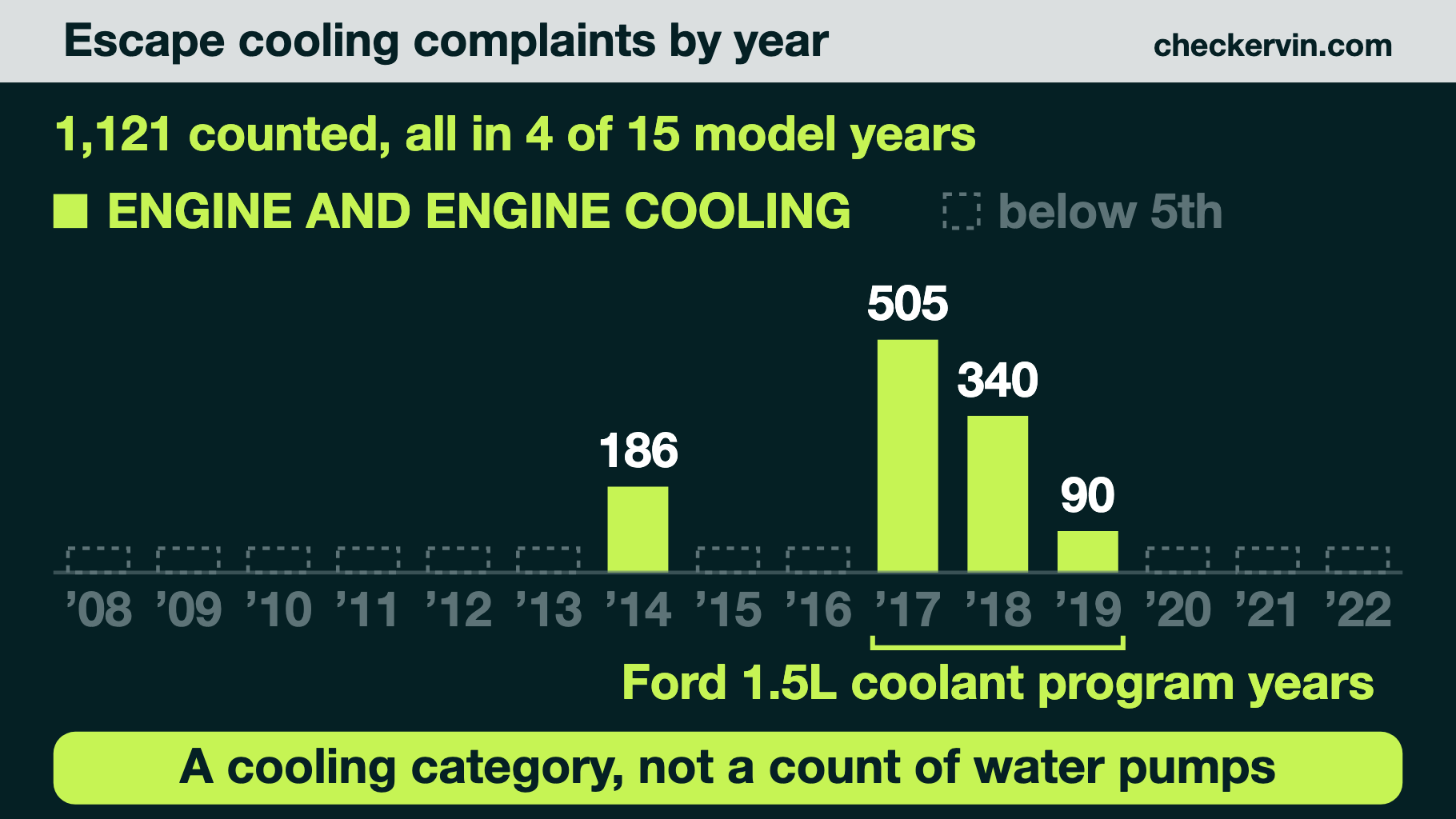
Our corpus of federal NHTSA complaints holds 22,813 reports against the 2008–2022Escape. The category that comes closest to a water pump, ENGINE AND ENGINE COOLING, reaches a year’s top five only in 2014, 2017, 2018, 2019, for 1,121 reports counted, and 935 of them, or 83%, sit in 2017–2019.
Share tells the same story more sharply. Counting ENGINE and ENGINE AND ENGINE COOLING together, the two engine categories hold about 19% of all complaints for the 2009–2012 Escape, 37% for 2013–2016 and 13% for 2020–2022. For 2017–2019 they hold 78%, the highest of the four stretches.
What the record does not prove
NHTSA has no water pump category. ENGINE AND ENGINE COOLING mixes pumps with radiators, hoses, thermostats, fans and, on these cars, coolant that leaves through the tailpipe. Complaints are unverified owner reports, not a measured failure rate, and our data keeps only each year’s five largest categories, so every total here is a minimum. The 2014 bar, at 186 reports, is the only first-generation EcoBoost year where cooling made the top five; in the other years it sat below fifth, which is not zero.
The complaint records do not say which engine a car had, and 2017–2019 Escapes were also sold with the 2.0L EcoBoost and the 2.5L. So the chart cannot tell you how many of these complaints were 1.5L coolant intrusion. It shows that the cooling record bunches into the same years Ford chose for its program. We also checked our file against NHTSA’s live counts: for 2017–2019 the live totals run a little above ours, so those years are, if anything, undercounted here.
The 1.5L EcoBoost: coolant in the cylinders, not at the pump
Ford’s technical service bulletin 19-2375, dated December 10, 2019, describes 2017–2019 Escapes with the 1.5L EcoBoost, built on or before April 8, 2019, that show low coolant, white exhaust smoke or a rough-running engine, with misfire and overheat codes such as P0300 through P0304 and P0217. Ford’s stated cause is coolant intrusion into the cylinder. Its repair is a new short block and head gasket, with a labor allowance of 19.7 hours on a front-drive Escape and 21.2 hours on all-wheel drive, where the power transfer unit has to come out with the engine.
The test it prescribes is the useful part for an owner. A technician pressurizes the warm cooling system to 20 psi and leaves it for five hours. If it loses more than 4 psi, the spark plugs come out and the cylinders are inspected for coolant. A pump that weeps from its seal leaves a wet trail on the outside of the engine; this failure leaves none. The bulletin’s parts list even includes a new coolant pump gasket and bolts, because the old pump is moved over to the new block.
Ford then turned the fix into two customer satisfaction programs, both read in full from the copies filed with NHTSA. Program 19B37 reprogrammed the engine computer to run what Ford calls the “external coolant pump” for a period after shutdown, which tells you this engine has a pump that can run with the engine off, in addition to its main pump. Program 21N12, dated June 9, 2022, provides “a no-cost, one-time repair (if needed) to the 1.5L short block” for 7 years of service or 84,000 miles from the warranty start date, and the dealer had to complete 19B37 first. Coverage transfers to later owners.
The 2.0L EcoBoost: the same symptom, no program
The 2.0L EcoBoost sold alongside the 1.5L has its own bulletin. Ford’s TSB 19-2346 covers 2017–2019 Escapes with the 2.0L built on or before May 16, 2019, showing the same low coolant, white smoke and misfire pattern, and its remedy is a complete long block engine assembly: 13.6 hours of labor on a two-wheel-drive Escape and 15.3 on four-wheel drive. We found no customer satisfaction program for the 2.0L in the Escape’s filed communications. Coverage follows the normal warranty, which Ford puts at 5 years or 60,000 miles for the powertrain.
A second, cheaper cause turns up on the newer cars. Ford service message 48345 describes some 2019–2020 Escapes with the 2.0L whose EGR cooler leaks coolant into the intake, with white smoke, an overheat warning and sometimes an external leak. It is another way to lose coolant that a pump will not fix, and one a shop should rule out before quoting the long block.
The 2013–2016 1.6L: four recalls about coolant
The first EcoBoost Escape carried the 1.6L, and its cooling problems were handled as safety recalls rather than programs, so they cost an owner nothing. For the 2013 model year, NHTSA lists 12V431, in which a cylinder head cup plug could come loose and dump coolant; 12V551, for coolant leaks that could overheat the engine, fixed with an inspection and new overheat software; and 13V583, for localized overheating that could crack the cylinder head and leak oil.
For the 2014 Escape with the 1.6L, recall 17V209 says that driving with too little coolant can overheat and crack the head, and the remedy was a coolant level sensor. That recall’s logic is the best advice for any Escape owner with a weeping pump: the danger is running low without noticing. Our Escape timing chain post covers how these engine generations differ in what drives the camshafts.
Is there a recall on the Escape water pump?
No. We queried NHTSA’s recall database for every Escape model year from 2008 through 2022, and no campaign names the water pump. The recall counts per year match the ones in our own corpus, which is a check on the query itself. Two block heater campaigns are worth knowing because a cracked block heater leaks coolant from the side of the block and is easy to mistake for a pump: 26V011 covers 2013–2019 Escapes with the 2.0L, and 25V685 includes 2020–2022 Escapes. Both replace the heater at no charge.
Check the Ford recalls on that VIN before paying for any coolant diagnosis. Our TSB versus recall page explains the difference that matters here: a recall is free regardless of age, while a bulletin like 19-2375 is only free while a warranty or program covers the car.
Owners have also sued. According to the law firm Lieff Cabraser, three proposed class actions filed in December 2020 over coolant leaking into the cylinders of 1.5L and 2.0L EcoBoost engines, including 2013–2019 Escapes, were consolidated before U.S. District Judge Troy L. Nunley in California. We found no settlement in reporting through mid-2025 and could not confirm the case’s current status, so it should not figure in a repair decision today.
Before you authorize the repair
- Confirm the engine by VIN: 1.5L, 1.6L, 2.0L, 2.5L or hybrid each lead somewhere different
- Ask where the leak was seen — on the pump, or only as a falling reservoir
- On a 2017–2019 1.5L or 2.0L with no external leak, ask for the 5-hour pressure test and a cylinder check
- Have a Ford dealer check the VIN for 19B37 and 21N12 before paying a short block bill
- Rule out open block heater recalls 26V011 and 25V685
- Get the thermostat, belt and coolant listed as separate lines
Refill with the coolant the engine was built for; the coolant type lookup by VINshows the factory specification. If the gauge climbs, stop and let the engine cool. On every EcoBoost generation above, Ford’s own recall language links low coolant to cracked heads.
If you are buying the Escape, not repairing it
A belt-driven pump on a 2.5L or 2.0L Escape is a routine repair and should not move an offer much. A 2017–2019 1.5L that uses coolant is a different conversation: ask the seller for records of the 19B37 reprogramming or a 21N12 short block, look for white smoke on a cold start, and check whether the reservoir level holds over a few days. The same advice applies to the transmission side covered in our Escape transmission cost post, where free fixes also sit behind a VIN check.
A Ford VIN decode confirms the engine and model year, and the full record by year is on our Ford Escape problems page.
Where this information comes from
- Ford Customer Satisfaction Program 21N12 (NHTSA-hosted)The 7-year or 84,000-mile no-cost short block repair for 2017–2019 Escape 1.5L coolant intrusion, and its November 30, 2022 deadlines.
- Ford Customer Satisfaction Program 19B37, Supplement #4 (NHTSA-hosted)The engine computer reprogramming that runs the external coolant pump after shutdown; a prerequisite for 21N12.
- Ford TSB 19-2375, 1.5L EcoBoost low coolant and white smoke (NHTSA-hosted)The pressure test, the short block repair and the 19.7- and 21.2-hour labor allowances quoted above.
- Ford TSB 19-2346, 2.0L EcoBoost coolant in cylinders (NHTSA-hosted)The long block remedy and labor times for 2017–2019 Escapes with the 2.0L.
- NHTSA — Escape complaints, recalls and manufacturer communicationsThe federal complaint record behind every figure here, and the recall list showing no water pump campaign for 2008–2022.
- EPA and DOE — fueleconomy.gov vehicle recordsThe per-year Escape engine listings behind the engine table.
- Kelley Blue Book — 2017 Escape water pump replacementThe $729–$823 range for ZIP 43085 quoted above, retrieved October 2026.
- Lieff Cabraser — EcoBoost engine lawsuits consolidatedThe source for the consolidated 1.5L and 2.0L coolant intrusion class actions, as reported in May 2021.
Keep reading
Frequently asked questions
How much does it cost to replace the water pump on a Ford Escape?
Published estimates for a straightforward pump job run from about $650 to $1,300, with big-city quotes higher. Kelley Blue Book's 2017 Escape page, as served for ZIP 43085 near Columbus, Ohio, shows $729 to $823, of which $291 to $329 is parts and $438 to $494 labor. RepairPal lists $889 to $1,279 for a 2015 Escape and $1,713 to $2,287 for a 2017 in Seattle. Those are their figures, retrieved October 2026, and none of them prices an engine with coolant in the cylinders.
Why is my 2017–2019 Ford Escape losing coolant with no leak?
On the 1.5L EcoBoost, Ford's own bulletins describe coolant getting into the cylinder bores, with low coolant, white exhaust smoke, a rough-running engine and misfire codes. Ford's fix in technical service bulletin 19-2375 is a new short block and head gasket, not a water pump. Its program 21N12 covered that repair at no cost for 7 years or 84,000 miles from the warranty start date, so a dealer should check the VIN before you pay anyone.
Is there a recall on the Ford Escape water pump?
No. We queried NHTSA's recall database for every Escape model year from 2008 through 2022 and no campaign names the water pump. Several recalls involve coolant: three 2013 campaigns and one 2014 campaign on the 1.6L EcoBoost, and block heater recalls 26V011 (2013–2019 Escape with the 2.0L) and 25V685 (2020–2022 Escape among others). The 1.5L coolant intrusion repair was a Ford customer satisfaction program, not a safety recall.
Is the Ford Escape water pump driven by the timing belt or chain?
On the engines we could check, no. Ford's parts catalog, as served in search results, lists a separate water pump pulley for the 2011 Escape's 2.5L, the 2022 Escape's 2.5L hybrid and plug-in hybrid, the Fusion's 1.5L EcoBoost, whose short block Ford's bulletin shares with the 2017–2019 Escape, and the 2.0L EcoBoost. A pulley means a belt outside the engine turns the pump. We could not confirm the 3.0L V6, the 1.6L or the 2020–2022 three-cylinder from the catalog, so check those by VIN.
Which Ford Escape years have the most cooling complaints?
In our corpus of NHTSA complaints, the ENGINE AND ENGINE COOLING category reaches the Escape's top five only in 2014, 2017, 2018, 2019. Those years account for 1,121 reports, and 2017 is the largest at 505. Because we store only each year's five biggest categories, every other year is below its fifth category rather than zero, and none of these figures counts water pumps specifically.
Confirm the engine before you price the pump
A free CheckerVIN report shows the factory build, engine, specifications and open recalls for any VIN, so you know whether a coolant problem points to a pump, a recall or a Ford program.
Run a free VIN check