The short answer
- What does it cost?
- RepairPal lists $1,135–$1,544 for the chain job, $1,213–$1,695 for the belt job — different parts, different estimators, both theirs.
- Chain or belt?
- Depends on the engine: 2.5L, 3.0L V6 and 2.0L EcoBoost run a chain. The 1.6L (2013-2014) and 1.5L (2017-2018) EcoBoost run a wet belt.
- Which years carry the risk?
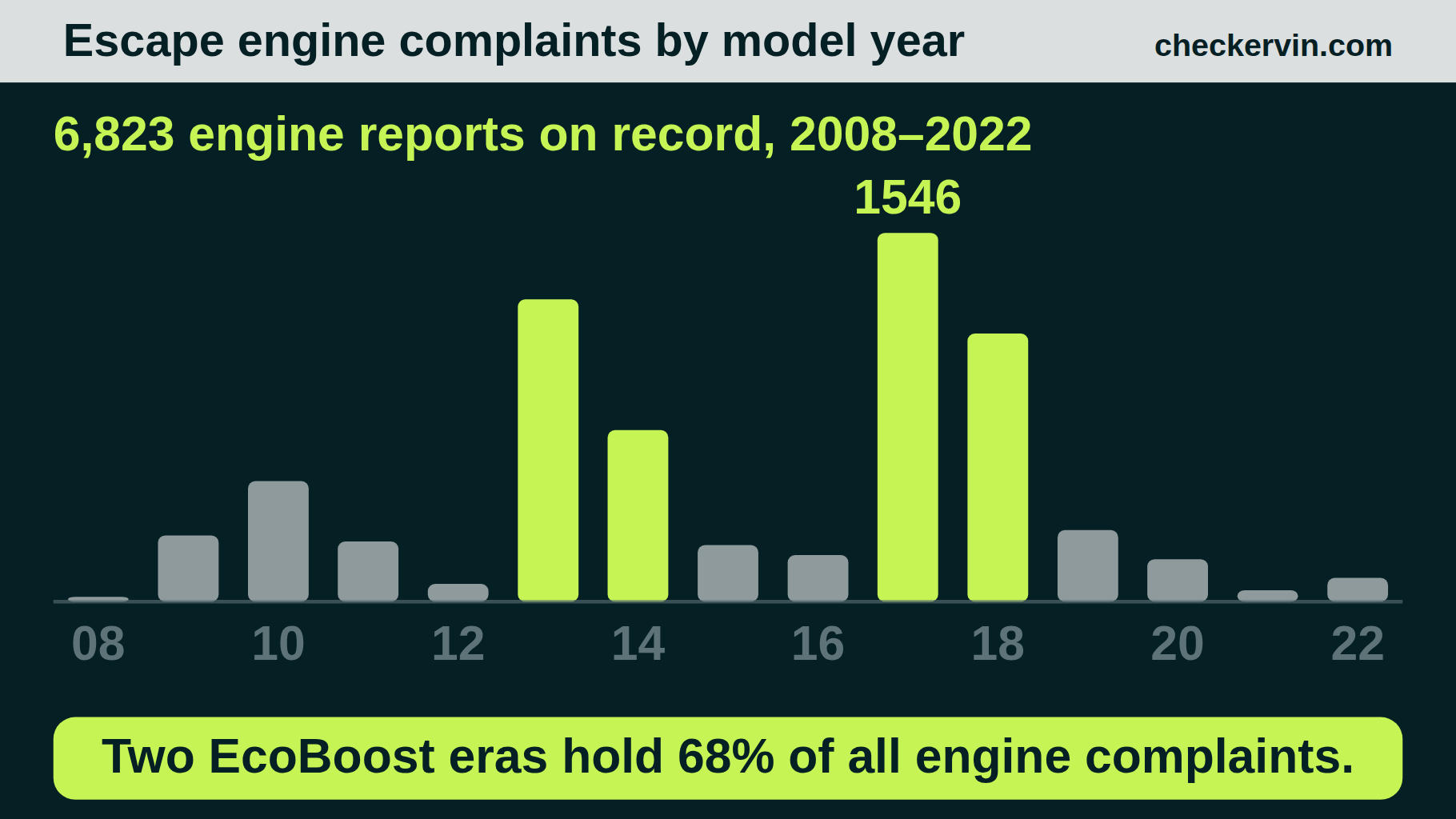
- 2013, 2014, 2017, 2018 hold 68% of the Escape's engine complaints on record, peaking at 1546 reports in 2017.
The numbers, and whose numbers they are
Two RepairPal figures matter here, and they are not the same job. Its Ford Escape timing chain tensioner estimator lists $1,135 to $1,544, parts and labor combined — the number a chain-engine Escape owner should expect. Its separate Escape timing belt estimator lists $1,213 to $1,695, running as low as $884 in some markets — the number that actually applies to the two EcoBoost generations built around a belt instead of a chain. Kelley Blue Book’s page for this query shows $409 to $919, retrieved September 2026 and quoted with attribution, because we sell VIN checks, not repairs, and publish no price of our own.
A shop quote will land somewhere in one of those ranges depending on scope — tensioner-only versus a full chain-and-guide job on the chain engines, or a full belt-kit-plus-water-pump job on the belt engines, which mechanics consistently describe as the more labor-intensive of the two. The rest of this page is about confirming which job a specific Escape actually needs before either number means anything.
Chain, or belt? It depends on the engine
Every Ford Escape sold with the 2.5-liter four, the 3.0-liter V6, or the 2.0-liter EcoBoost times its valves with a metal chain — a part built to last the engine’s life and, on a healthy engine, never scheduled for replacement at all. The 1.6-liter EcoBoost offered in 2013 and 2014, and the 1.5-liter EcoBoost that replaced it starting in 2017, are different: both use an oil-lubricated “wet” timing belt that runs inside the engine, submerged in the same oil that lubricates everything else. Independent engine-reference write-ups describe the wet belt as prone to degrading and shedding material into that oil well before a dry serpentine belt would ever need attention — and because it is an interference engine, a belt that lets go does not leave a stranded car, it leaves a wrecked one.
None of the three engines were exclusive to their model years — the 2.5L and the belt-driven EcoBoost were sold side by side on the same trim lineup in both 2013-2014 and 2017-2018. That means the keyword this page targets does not describe one repair; it describes two, and the only way to know which applies to a specific car is to confirm the engine, not just the model year.
What 22,813 complaints say about four model years
Our corpus of federal NHTSA complaints holds 22,813 reports against the 2008–2022 Escape, 6,823 of them filed against the engine. The distribution is the finding: 2013, 2014, 2017, 2018— four of fifteen model years — account for 68% of every engine complaint in the nameplate’s year-by-year record, peaking at 1546 reports against the 2017 car alone.
Complaints are unverified owner reports, not a measured failure rate — the honest caveat this site attaches to every figure like it — but a concentration this steep, landing on the exact model years each EcoBoost generation was sold, is not noise. It is the shape of two known engine transitions, six years apart.
Two engine generations, not one
The 2013 model year introduced the 1.6-liter EcoBoost as a mid-range option, and its complaint and recall record moves together: 2013 and 2014 are the Escape’s two highest single- year engine-complaint totals in the corpus outside the 2017-2018 stretch, and they are also the only two years where our own recalls count spikes to 18 and 16campaigns — against a baseline that never exceeds 9 in any other model year through 2019. Public reporting from that period describes a series of recalls tied to 1.6L EcoBoost engine-compartment fires, driven by cracked cylinder heads and a fuel line prone to splitting near hot components.
The 2017-2018 stretch is a different engine and a different pattern. Ford replaced the 1.6L with the 1.5L EcoBoost for the Escape’s mid-cycle refresh, and engine complaints climb back up — 1,546 reports in 2017 alone, the single highest year in the entire corpus — without a comparable recall spike in our data. That asymmetry is worth sitting with: it is not evidence the 2017-2018 engine is fine, only evidence that whatever is driving those complaints has not (yet, in this record) produced the kind of federal recall the earlier fire risk did.
What the recall record covers, and what it doesn't
Recalls address unreasonable safety risk, not ordinary wear, and that distinction explains the pattern above: a fire risk gets a recall letter; a belt or chain that eventually needs replacing on a schedule does not. Nothing in the record we hold, or in the public reporting on the 2013-2014 recalls, specifically names the timing belt as the recalled component — the documented issues are cylinder-head cracking and a fuel line, not the belt itself — so this page does not claim the wet belt is a recalled part. It claims only what the numbers show: complaints and recalls both spike on the same two model years, for engines that also happen to run a belt instead of a chain.
| Program | What it actually pays for |
|---|---|
| Recall | Safety defect — free fix at any dealer, no time limit on the remedy |
| Special coverage | Ford extends warranty on a known problem — mileage and year limits apply |
| Technical service bulletin | Repair instructions to dealers — pays nothing by itself |
| Goodwill / policy adjustment | Dealer discretion, usually only on cars still close to warranty |
What a VIN check does settle is whether the specific car in front of you has open recall campaigns of any kind — both the 2013-2014 and 2017-2018 Escapes carry several — and that lookup is free at CheckerVIN or straight from NHTSA.
What failure sounds like before it costs anything
- A rattle at cold start that fades as oil pressure builds — the shared early symptom on both engines
- On the belt engines specifically: oil that darkens or thickens sooner than its change interval, a sign the belt is shedding material
- Check-engine light with camshaft/crankshaft correlation codes on a scan
- Rough idle or hard starting — a later-stage sign that timing has already drifted on either design
The order matters because the early symptom is cheap and the late ones are not. Both the chain and belt engines here are interference designs, meaning timing that slips far enough puts pistons into valves — which turns a four-figure repair into an engine replacement. A rattle, or oil that looks wrong, caught at the first inspection is the cheapest moment either problem will ever offer.
Where the money goes
On the chain engines, a tensioner-only fix is the smaller job — the part is inexpensive and reachable on some Escape engines without pulling the full timing cover, which is why RepairPal’s tensioner estimate sits close to its full chain-and-gear-set range rather than far below it. On the belt engines, mechanics consistently recommend replacing the full kit — belt, tensioner, idlers — and the water pump together in one job, since the belt’s location inside the engine means most of the labor cost is disassembly, not the parts themselves.
Two practical consequences follow. First, on either engine, once the front cover is open, marginal parts cost little extra to add, which is why an honest shop quotes them alongside and a bargain quote does not. Second, ask specifically which job is being quoted — chain or belt — and confirm it matches the engine actually under the hood rather than assuming from the model year.
Before you authorize the repair
- Confirm the engine by VIN before accepting either quote — chain and belt Escapes were sold in the same model years
- Scan the codes and keep the printout — correlation codes are the shared early signature
- On a belt-engine car, ask whether the quote includes the water pump — most shops bundle it and a bargain quote may not
- Pull the VIN's open recalls before paying for anything a campaign might cover
- On a 2013–2014 or 2017–2018 car, ask if the shop has direct experience with that specific EcoBoost engine
If you are buying the Escape, not repairing it
The same record reads as a shopping map. A car from either engine-transition era — 2013-2014 or 2017-2018 — should show either the relevant service work already done or a clean cold-start test before a fair price treats the engine as a non-issue. A Ford VIN decode confirms the exact engine and build year before you price a repair specific to one of them, and checking what factory coverage remains by VIN settles whether any of this is still someone else’s problem to fix.
On any candidate car, five minutes of diligence beats an hour of negotiation: cold-start it yourself and listen before the engine warms up, run the recall lookup, and check the timing system a specific VIN actually carries rather than assuming from the model year. The years outside these two stretches carry a fraction of the engine complaints in the record, and the price gap between a high-complaint year and a quiet one is usually smaller than one repair.
Where this information comes from
- NHTSA — Escape complaint databaseThe federal complaint record this page's figures are computed from, browsable by model year.
- RepairPal — Escape timing chain tensioner estimateThe $1,135–$1,544 chain-engine figure quoted above, attributed to its estimator as retrieved September 2026.
- RepairPal — Escape timing belt estimateThe $1,213–$1,695 figure for the wet-belt EcoBoost engines — a different job than the chain estimate above.
- NHTSA — recalls by VINThe official lookup that settles whether a specific Escape has open campaigns, including the 2013-2014 fire recalls.
Keep reading
Frequently asked questions
How much does it cost to replace a timing chain in a Ford Escape?
RepairPal's Escape-specific estimator lists $1,135 to $1,544 for a timing chain tensioner replacement, parts and labor combined — both figures theirs, quoted with attribution. That number only applies to the Escape's chain-driven engines: the 2.5L four, the 3.0L V6, and the 2.0L EcoBoost. If the car has a 1.5L or 1.6L EcoBoost, the correct job is a timing belt, and RepairPal's separate belt estimator lists $1,213 to $1,695 for that instead.
Does the Ford Escape have a timing belt or a timing chain?
Both, depending on the engine. The 2.5L four-cylinder, the 3.0L V6, and the 2.0L EcoBoost all use a timing chain. The 1.6L EcoBoost (2013-2014) and the 1.5L EcoBoost that replaced it (2017 onward) use an oil-lubricated 'wet' timing belt instead — a different part, a different job, and on some estimator sites a different price entirely. Confirm which engine a specific VIN carries before pricing either repair.
Which Ford Escape model years have the most engine complaints?
The federal complaint record concentrates into two separate stretches: 2013, 2014, 2017, 2018 — four of the fifteen model years in our corpus — together hold 68% of every engine complaint filed against the Escape, peaking at 1546 reports against the 2017 car alone. The two stretches sit six years apart and correspond to two different EcoBoost engine generations, not one continuous problem.
Is there a recall for the Ford Escape's engine?
Our corpus's own recall count shows a sharp spike in 2013 and 2014 — 18 campaigns in the worse of the two years, against a baseline that never exceeds 9 campaigns in any other model year through 2019. Public reporting on that period describes recalls addressing 1.6L EcoBoost engine-fire risk from cracked cylinder heads and leaking fuel lines. The 2017-2018 stretch, despite carrying comparably high engine complaints, shows no matching recall spike in the record — check the specific VIN's open recalls either way rather than assuming either era is or isn't covered.
What does a failing timing chain or belt sound like on a Ford Escape?
A rattle at cold start that fades as oil pressure builds is the symptom owners report most, on both the chain and belt engines. On the wet-belt EcoBoost engines specifically, watch for oil that looks unusually dark or gritty sooner than its change interval — a sign the degrading belt is shedding material into the oil, which is a wet-belt-specific failure mode a chain engine cannot have. Left alone on either engine, timing drift progresses to correlation codes, then rough running, then — on these interference engines — valve damage if the belt or chain lets go outright.
Confirm the engine before you price the repair
A free CheckerVIN report shows the factory build, specifications and open recalls for any VIN — including which engine it shipped with, chain or belt.
Run a free VIN check