The short answer
- What does it cost?
- KBB showed $5,060–$6,740 for a 2014 and $7,088–$7,624 for a 2017 (single ZIP codes, October 2026). A reseller lists a reman 2017–2019 six-speed at $3,199 before labor.
- What should I check first?
- The shifter-cable bushing recalls (18V471, 22V413, 22V254). A failed bushing can leave the car stuck in the wrong gear, and the dealer fix is free.
- Which years carry the complaints?
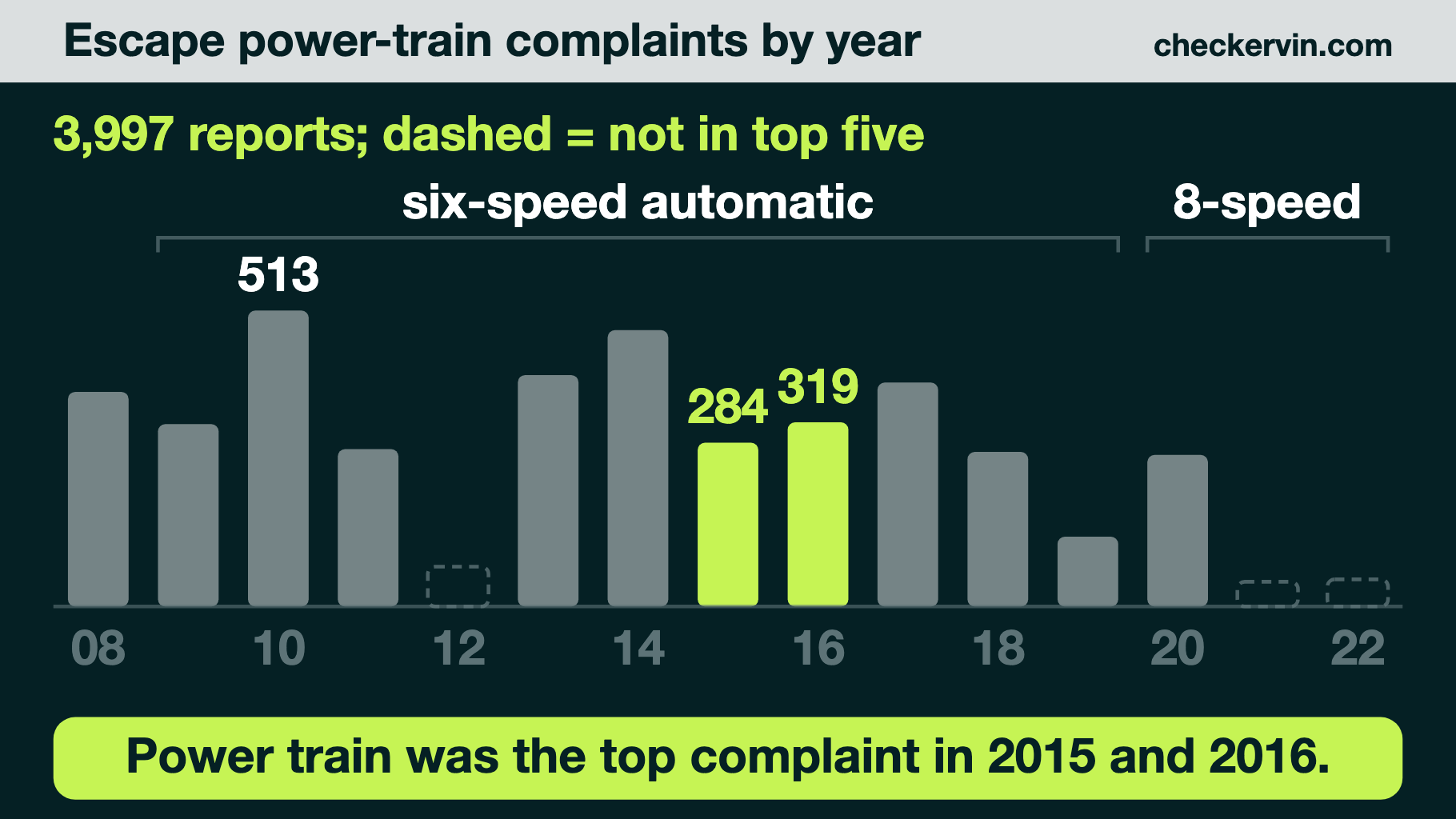
- Nearly every year, with no single spike: 3,997 power-train reports across 12 model years, with power train the top complaint of all in 2015 and 2016.
The numbers, and whose numbers they are
Kelley Blue Book publishes a separate transmission repair-and-replacement page for each Escape model year, and each one prices the job for a ZIP code. Checked on October 25, 2026, the 2014 page showed $5,060 to $6,740 for ZIP 66101 (Kansas City, Kansas). The 2017 page showed $7,088 to $7,624 for ZIP 43085 (Columbus, Ohio), split into dealer parts of $4,969 to $5,329 and labor of $2,119 to $2,295. The 2022 page, same Ohio ZIP, showed $8,015 to $8,623. These are KBB’s figures, read from its pages as indexed by search; a direct fetch of the 2017 page from our tools returned a placeholder ZIP and no range, because KBB fills the price in after it knows where you are.
On the parts side, one remanufacturer, Powertrain Products, lists a rebuilt six-speed for the 2017–2019 Escape 2.0L AWD at $3,199, marked down from $3,699, before anyone installs it. The gap between that and KBB’s dealer parts line is the gap between a reman unit and a new Ford assembly, and it is the biggest lever you have on the final bill. We sell VIN checks, not repairs, and quote these only with attribution.
Which transmission is in the car
The Escape in our record used at least three different automatics, and the replacement part has to match. The 2008 car still carried the CD4E four-speed, which NHTSA’s own recall 15V606 names for 2001–2008 Escapes. For 2009, Ford’s launch release described a new 6F35 six-speed replacing the four-speed, paired with a new 2.5L four and an upgraded 3.0L V6. The redesigned 2013 car kept a six-speed automatic: NHTSA’s 2018 recall names the “six-speed automatic transmissions” in 2013–2014 Escapes, and a 2022 recall extends the same shifter-bushing fix across 2013–2019.
The 2020 redesign split the line. Ford’s reveal release gave the EcoBoost models a new eight-speed automatic and the hybrids a continuously variable transmission. Ford’s own 2023 dealer notice for program 22B38 lists 2022 Escapes among the vehicles built with the 8F35. So a “2020 Escape transmission” can mean two completely different parts. A transmission lookup by VIN or a Ford VIN decode settles which one a specific car has before anyone orders anything.
What 3,997 power-train complaints say
Our corpus of federal NHTSA complaints holds 22,813 reports against the 2008–2022 Escape. Power train appears among the top five components in 12 of those 15 model years, for 3,997 reports in all. The highest single year is 2010, at 513; the lowest year that still made the top five is 2019, at 121. In 2012, 2021, 2022, power train fell below fifth place, which means fewer reports than that year’s fifth component, not zero.
The shape is the finding. The engine complaints we charted for the timing-chain post pile into two short EcoBoost eras; the 2017 car alone drew 1,546 engine reports, about 4 times its 388 power-train reports. Power train never does that. It runs as a steady background year after year, and in 2015 and 2016, the two years between the engine spikes, it was the most-reported component of all, at 27% to 30% of each year’s complaints. These are unverified owner reports, not failure rates, and NHTSA’s power-train category also covers axles, driveshafts and AWD hardware. Read it as where owners felt trouble, not as a transmission failure count.
Complaints by transmission era
Grouping the same counts by the transmission each car shipped with shows where the reports actually sit. Treat the 2020–2022 line as a floor, since two of those three years fall outside the top five.
| Model years and transmission | Power-train reports on record |
|---|---|
| 2008 — CD4E four-speed | 372 |
| 2009–2012 — 6F35 six-speed, older body | 1,102 (2012 below top five) |
| 2013–2019 — six-speed, redesigned body | 2,260 |
| 2020–2022 — 8F35 eight-speed or hybrid CVT | 263 (2021–2022 below top five) |
The six-speed years hold 84% of the total, but they also cover eleven of the fifteen model years and the bulk of Escapes on the road, so that share says more about fleet size than about the gearbox. The useful comparison is year to year inside the six-speed run, and there the 2015 and 2016 cars stand out: modest raw counts, but more of each year’s complaints than any other component.
The recall that mimics a dead transmission
Before anyone prices a gearbox, rule out the shifter cable. Three NHTSA campaigns cover one small part on the six-speed Escapes: the bushing that clips the shifter cable to the transmission. Campaign 18V471, filed in July 2018, covered 2013–2014 Escapes and said the bushing could degrade and detach, letting a driver move the lever to Park and remove the key while the transmission was not in Park. Campaign 22V254 covered 2015 Escapes with the 2.0L. Campaign 22V413, filed in June 2022, widened the fix to 2013–2019 Escapes and warned that a damaged bushing could stop the car shifting into the intended gear or let it roll after Park was selected.
Read the symptoms again: wrong gear, won’t engage, selector says one thing and the car does another. A driver who has never heard of the bushing can easily read that as a failing transmission. The 2022 remedy, per NHTSA, is a replacement bushing under the hood plus a protective cap over the cable joint, free at a Ford dealer. If the car you are pricing is a 2013–2019, the Ford recall lookup is the first step, not the last.
Two older campaigns belong to the same family. Recall 10V222 covered 2010 Escapes built in a four-week window in early 2010 whose park rod guide retention pin may not have been installed. Recall 15V606 is the stranger one: it covered 2001–2008 Escapes that had already received a remanufactured CD4E built between June 11 and July 15, 2015, because the shift lever bolt on those rebuilt units might not be tight. A replacement transmission can carry its own recall, which is worth remembering in the options section below.
The 2020–2022 cars: recalls on new hardware
Our corpus counts 23 recall campaigns against the 2020 Escape, more than any single year through 2019 (the highest of those is 18). Several touch the drivetrain, and each is a reason to check a VIN before paying for a transmission. Campaign 20V550 covered 2020 Escapes whose start/stop accumulator endcap bolts could be missing or loose; NHTSA’s summary says the resulting fluid leak could progress to loss of transmission function, and dealers replace the accumulator. Campaign 21V011 covered 2020 Escapes whose rear drive unit might have too little lubricant and seize, a driveline fault rather than a gearbox one.
Hybrids have their own entry. Campaign 24V330 covered 2020–2022 Escapes whose hybrid powertrain control module software could shift the car into neutral without warning; 25V133 followed for 2022 cars that had been repaired incorrectly under the first campaign. Both remedies are a software update. A hybrid Escape that suddenly loses drive may need a reflash, not a transmission.
And on a few cars Ford did swap the whole unit. Program 22B38, sent to dealers in January 2023, told them to replace the 8F35 on 2022 Escapes built at Louisville between August 29 and September 22, 2022, because a clutch snap ring had not been fully seated. Ford put the total population across six vehicle lines at 29. It is a narrow program, but it shows the free replacement path exists when the defect is Ford’s.
Who pays: recall, program or bulletin
| What it is | What it means for your bill |
|---|---|
| Safety recall (e.g. 22V413) | Free repair at any Ford dealer, regardless of mileage or owner |
| Customer satisfaction program (e.g. 22B38) | Free fix within Ford's stated dates and vehicle list |
| Warranty extension (e.g. 20N07) | Covers named parts on named vehicles; we found none for the Escape transmission |
| Technical service bulletin | Repair instructions for dealers; pays nothing on its own |
The extension row matters because owners ask about it most. The one 6F35 warranty extension we found, program 20N07, is referenced in Ford’s 2020 dealer notice for program 20B27 and names 2015–2019 Lincoln MKC and 2016–2019 Explorer models with the 2.3L engine. The Escape is not on that list. We searched for an Escape equivalent and did not find one; that is a statement about our search, so check the specific VIN with a dealer or through a Ford warranty check rather than taking our absence as final.
Bulletins can still save money indirectly. A reproduction of Ford bulletin 11-11-23, posted on a document-sharing site rather than by Ford, covers 2009–2010 Escapes with the 6F35 that shift harshly from first to second or second to third on the first drives of the day. Its fix is a fluid-level check at operating temperature and a PCM reprogram, not a new transmission.
New, remanufactured, used or rebuilt
Four routes lead to a working Escape again, and they trade price against certainty. A new Ford assembly is the dealer default and the top of KBB’s range. A remanufactured unit, rebuilt to factory specifications by Ford or an independent like the reseller quoted above, usually lands well below that and comes with its own warranty; read the terms, since one listing we checked gave two different mileage limits on the same page. A local rebuild of your own unit can cost less again if the case and torque converter are sound. A used unit from a salvage yard costs least and carries the most unknowns, starting with how many miles and which calibration it left the donor car with.
Two details apply to all four. First, the part must match the car, not just the model year: a 2017 Escape could be a 1.5L, a 2.0L or a 2.5L, front-drive or AWD, and listings are split that way. Second, the transmission is run by the powertrain control module, so expect a software update or adaptive relearn after installation. Ask whether programming is inside the quote or billed afterward.
Before you authorize the replacement
- Run the VIN for open recalls; on 2013–2019 cars look for the shifter-bushing campaigns first
- Ask the shop to inspect the shifter cable and bushing before diagnosing the gearbox
- Get the trouble codes in writing, with the scan tool's freeze-frame data
- On a 2020–2022, ask whether 20V550, 21V011 or the hybrid software campaigns are open
- Confirm engine, drive type and transmission by VIN so the replacement unit matches
- Ask which unit is quoted (new, reman, used or rebuilt), its warranty, and whether programming is included
If you are buying the Escape, not repairing it
On a used Escape, the transmission check takes ten minutes. Shift slowly through every gear while stationary and watch whether the indicator matches what the car does. Park on a slight slope, select Park, release the brake and confirm it holds. Then drive it from cold. A harsh first shift that smooths out as the car warms matches the symptom in the 2009–2010 six-speed bulletin, whose fix was software; slipping, flaring or a refusal to engage under load is a different and more expensive story.
Pair that with a recall check and the model page for the nameplate. Our Ford Escape problems by year page sets every model year’s complaint record side by side, so you can see where power train sits against steering, engine and electrical for the exact year you are looking at. If a seller says the transmission was replaced, ask for the invoice: it should name the unit type, the warranty and the shop, and a reman CD4E fitted in mid-2015 may itself carry the 15V606 recall.
Where this information comes from
- NHTSA — recalls for the 2014 Ford EscapePrimary record for 18V471 and 22V413, the shifter-cable bushing campaigns; retrieved October 25, 2026.
- NHTSA — recalls for the 2020 Ford EscapePrimary record for 20V550 (accumulator), 21V011 (rear drive unit) and 24V330 (hybrid software).
- Ford program 22B38 (NHTSA-hosted)Ford's dealer notice replacing the 8F35 on 29 vehicles, including 2022 Escapes built in late summer 2022.
- Ford program 20B27 / 20N07 (NHTSA-hosted)The 6F35 warranty extension we found, which names MKC and Explorer models, not the Escape.
- Kelley Blue Book — 2017 Escape transmission replacementSource of the $7,088–$7,624 range for ZIP 43085; KBB's 2014 and 2022 pages follow the same URL pattern.
- Powertrain Products — reman 6F35 for 2017–2019 EscapeSource of the $3,199 remanufactured-unit price quoted above, retrieved October 25, 2026.
Keep reading
Frequently asked questions
How much does it cost to replace a transmission in a 2017 Ford Escape?
Kelley Blue Book's 2017 Escape page showed a fair repair range of $7,088 to $7,624 for ZIP 43085 when we checked on October 25, 2026, with dealer parts at $4,969 to $5,329 and labor at $2,119 to $2,295. Those are KBB's numbers, tied to one ZIP code. A remanufactured six-speed for the 2017-2019 Escape 2.0L AWD was listed by one reseller at $3,199 before installation. We sell VIN checks, not repairs, and publish no price of our own.
Which Ford Escape years have the most transmission complaints?
There is no single bad stretch. Power-train complaints appear in 12 of the 15 model years in our NHTSA corpus, 3,997 reports in all, peaking at 513 for the 2010 car. What stands out is 2015 and 2016: in those two years power train was the most-reported component of all, at 27% to 30% of each year's complaints. Power train in NHTSA's coding includes driveline and AWD parts, not only the gearbox.
Is there a recall on the Ford Escape transmission?
Several, and most involve the shifter, not the gearbox internals. NHTSA campaign 18V471 covered the 2013-2014 Escape's six-speed shifter cable bushing; 22V413 widened the same bushing fix to 2013-2019 Escapes; 22V254 covered 2015 Escapes with the 2.0L. A degraded bushing can leave the car in the wrong gear or let it roll after the driver selects Park. On 2020 cars, 20V550 replaced a start/stop accumulator whose loose bolts could leak transmission fluid. The fix in each case is free at a Ford dealer.
Does Ford have an extended warranty on the Escape transmission?
We found none for the Escape. The one 6F35 transmission warranty extension we located, Ford program 20N07, names 2015-2019 Lincoln MKC and 2016-2019 Explorer models with the 2.3L engine. Ford did replace the 8F35 transmission free on a small batch of 2022 Escapes built in late summer 2022 under program 22B38, for an improperly seated snap ring. Run the VIN through Ford or NHTSA to see what applies to one car.
Is it cheaper to rebuild or replace a Ford Escape transmission?
Usually a rebuild or a remanufactured unit costs less than a new Ford assembly, and a used unit from a salvage yard costs least and carries the most risk. Whatever goes in, the powertrain control module typically needs its software updated afterward. A Ford bulletin for harsh shifts on the 2009-2010 six-speed, as reproduced online, called for a PCM reprogram and noted that the shift strategy adapts over time. Ask any shop whether programming is in the quote.
Check the recalls before you price the gearbox
A free CheckerVIN report shows the factory build, specifications and open recalls for any VIN, including the shifter-bushing campaigns that can mimic a failed transmission.
Run a free VIN check