The short answer
- What does it cost?
- KBB serves $719–$811 for a 2014 Focus (ZIP 43085) and $633–$958 for a 2016 near Norfolk, VA. RepairPal lists $493–$606 for a 2011.
- Why is it cheaper than some Fords?
- Every gasoline Focus pump has its own belt pulley in Ford's catalog. It is not buried behind the timing chain.
- Is there a recall?
- None names the pump. Block heater recalls 26V011 and 26V012 cover coolant leaks on many 2013–2018 cars, free.
2,202
Focus engine complaints counted
2008–2018, top-five data
38%
Engine + cooling share, 2017–18
Against 15% engine-only, 2012–14
0
NHTSA recalls naming the pump
All years 2008–2018
$719–$811
KBB, 2014 Focus
ZIP 43085, parts and labor
The numbers, and whose numbers they are
We sell no repairs and publish no price of our own, so every dollar figure on this page belongs to the site that published it, retrieved in October 2026. Kelley Blue Book is the most detailed. Its 2014 Focus page, as served for ZIP 43085 near Columbus, Ohio, shows a fair repair range of $719 to $811, made up of $288 to $324 in parts and $431 to $487 in labor. Its 2016 Focus page, served for a ZIP near Norfolk, Virginia, shows $633 to $958. Its 2014 Focus ST page, for ZIP 84058 in Orem, Utah, shows $630 to $864, and its 2011 Focus page near Troy, Michigan shows $681 to $779.
RepairPal reads lower on the older car: its 2011 Focus cost table lists $493 to $606 for the pump. We could not open RepairPal’s own Focus water pump estimator page from our tools, so we quote no national RepairPal figure. KBB’s pages also carry a generic $375 to $787 line in their FAQ, but the same line appears on other Ford models, so we treat it as boilerplate rather than a Focus estimate.
The striking thing is how narrow the spread is. Across an older 2.0L, a direct-injection 2.0L and a turbocharged ST, the estimates cluster within a few hundred dollars of each other. That is the opposite of what shoppers see on some other Fords, and the reason is mechanical.
What turns the pump, according to Ford’s own catalog
Ford’s genuine-parts catalog, as published through a Ford dealer’s parts site, lists a separate “Pulley - Water Pump” for every gasoline Focus engine from 2008 to 2018. Part 1S7Z-8509-A fits the 2.0L Duratec and the 2.0L direct-injection engine; 5M6Z-8509-AE fits the 2.0L EcoBoost in the ST and the 2.3L EcoBoost in the RS; CM5Z-8509-A fits the 1.0L three-cylinder. A pump that carries its own pulley is spun by a belt running on the outside of the engine.
The same catalog makes the contrast easy to check. For a 2015 Explorer it lists a water pump for the 3.5L V6 but no pulley for that engine, because that pump sits inside the engine and the timing chain drives it. Our post on the Explorer water pump covers what that costs. A Focus owner does not face that job on any gasoline engine. The work is not trivial: YouCanic’s Focus repair guide has the engine mount unbolted and the engine raised slightly for clearance before the belt, pulley and pump come off. But the engine stays assembled, and that is the difference between a few hours and a few days.
The parts themselves are inexpensive. The dealer site lists the pump assembly for the 2.0L direct-injection engine at $55.90 and the 1.0L EcoBoost pump at $61.95, as of October 25, 2026. That is why most of KBB’s figure is labor, and why a quote far above the ranges above deserves a question about what else is included. Many shops replace the thermostat, the drive belt and the coolant at the same time, which is reasonable, but those should appear as separate lines.
Which engine you have, by model year
The federal fuel economy records at fueleconomy.gov list every engine Ford certified for each Focus model year. They decide which pump, which pulley and which recalls apply:
| Model years | Engines EPA lists for the Focus |
|---|---|
| 2008–2011 | 2.0L four-cylinder |
| 2012 | 2.0L four-cylinder, direct injection; Focus Electric |
| 2013–2014 | 2.0L direct injection; 2.0L turbo (the ST); Focus Electric |
| 2015 | 2.0L direct injection; 2.0L turbo; 1.0L turbo three-cylinder; Focus Electric |
| 2016–2018 | 2.0L direct injection; 1.0L turbo; 2.0L turbo ST; 2.3L turbo RS (AWD); Focus Electric |
Two details matter for pricing. EPA’s U.S. records first list the 1.0L three-cylinder for 2015, not 2014, so a seller describing a 2014 American Focus as an EcoBoost three-cylinder is probably wrong. And the 1.0L carries a second pump: Ford’s catalog lists a Motorcraft “Engine Auxiliary Water Pump” for it alongside the main one. A diagnosis on that engine should say which pump failed. An engine lookup by VIN confirms which engine is under the hood before any of this matters.
What 13,432 complaints say about the Focus engine
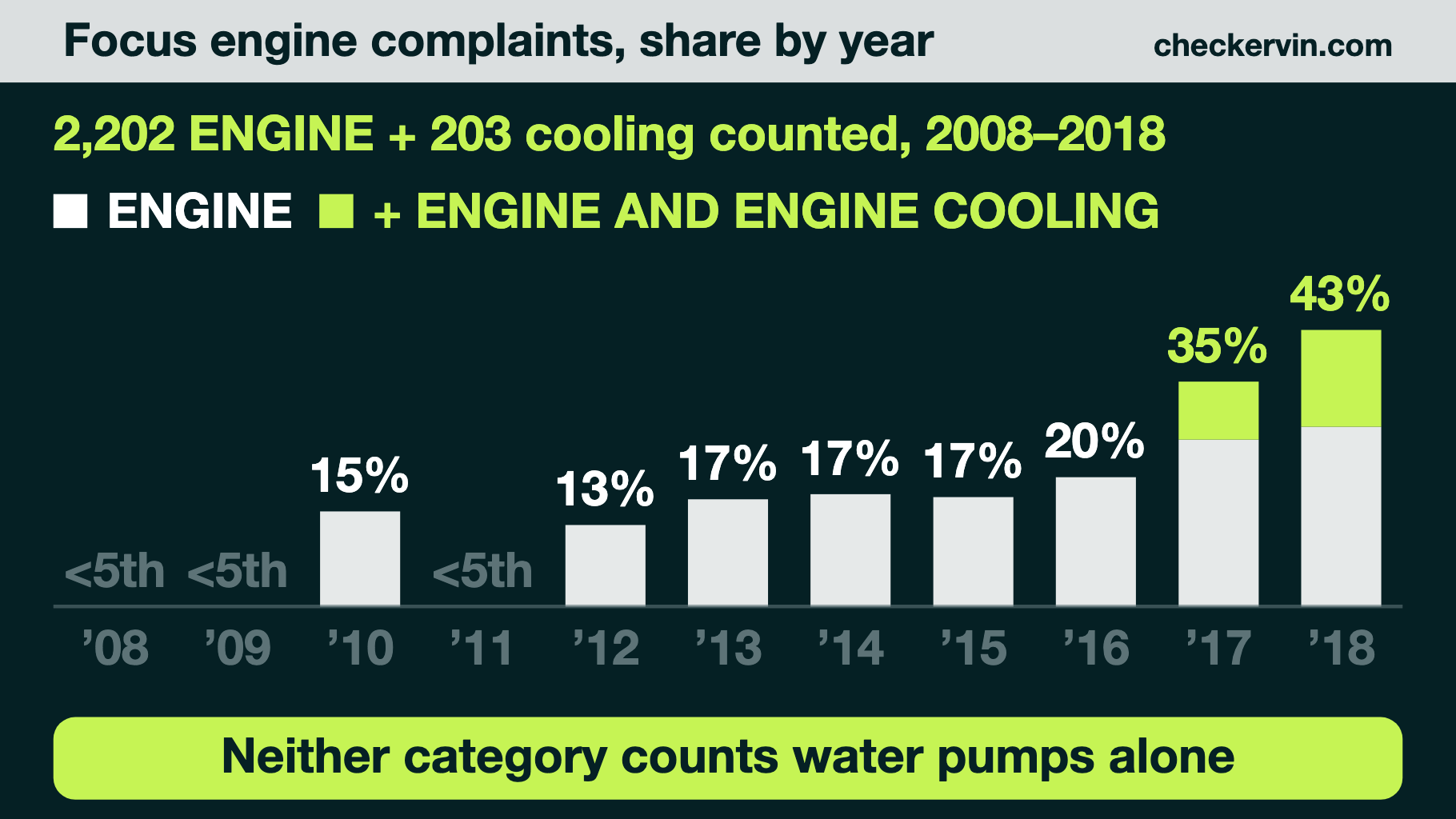
Our corpus of federal NHTSA complaints holds 13,432 reports against the 2008–2018 Focus, and 2,202 of them are counted in the ENGINE category. The direct-injection years, 2012–2018, hold 2,160 of those, or 98%. The single largest year is 2012, at 476engine reports, but raw counts on the Focus mostly track how many complaints of every kind a year drew, and 2012–2014 drew a lot of them for transmission reasons covered in our Focus transmission cost post.
The more telling number is share. Engine reports make up about 15% of all complaints for the 2012–2014 cars and about 27% for 2017–2018. In those last two years a second category, ENGINE AND ENGINE COOLING, also reaches the top five, adding 203 reports. Together the two engine categories hold 38% of the 2017–2018 record, and in 2018 alone they reach 351 reports against 315 for POWER TRAIN. On a car known for its gearbox, the final model year’s owners filed more complaints in the two engine categories than in the power-train one.
What the record does not prove
Neither category is a water pump category. ENGINE holds every kind of engine complaint, from stalling to oil consumption, and ENGINE AND ENGINE COOLING mixes radiators, hoses, thermostats and fans with pumps. NHTSA has no water-pump bucket at all, so no number on this page is a count of pump failures, and complaints are unverified owner reports rather than a measured failure rate.
Our data also stores only the five largest categories per model year, so every total here is a minimum. ENGINE AND ENGINE COOLING appears only in 2017 and 2018; in other years it sat below that year’s fifth category, which is not the same as zero, and we do not know whether the late appearance reflects real failures or a change in how complaints were coded. ENGINE itself is outside the top five for 2008, 2009, 2011. When we compared our file against NHTSA’s live per-year complaint totals, most years differed by about one percent, with our figure slightly lower; 2013 runs the other way, our count a few percent higher. None of that changes the shape of the chart. The Ford Focus years-to-avoid page lays out the rest of the record year by year.
Coolant loss that is not the pump
Because the pump is cheap to replace, it is tempting to start there whenever the reservoir runs low. Ford’s own service messages to dealers argue for a test first. Special Service Message 47587, filed with NHTSA in 2018, covers 2015–2018 Focus cars with the 1.0L EcoBoost that consume coolant, blow white smoke or run rough. It sends technicians to a pressure test and, if no coolant is leaking externally, to the integrated exhaust manifold to look for cracks.
SSM 47462 does the same for the 2.0L EcoBoost in the ST and several other Fords: pressure-test, check the coolant for combustion gases, and if coolant is being lost internally, inspect the head gasket area and the block and head surfaces between the cylinders for erosion and pitting. Both messages describe repairs far larger than a pump. A new pump on either engine will not stop that coolant from disappearing.
Is there a recall on the Focus water pump?
No. We queried NHTSA’s recall database for every Focus model year from 2008 through 2018, and no campaign mentions the water pump. To be sure the search could see the term, we ran it where a hit was known to exist and got one. We also searched every Ford bulletin and service message NHTSA lists for these model years: none names the Focus water pump or its coolant reservoir.
Two recalls do involve coolant, and both landed in 2026. Campaign 26V011 covers 2013–2018 Focus cars with the 2.0L engine whose engine block heater “may crack and develop a coolant leak,” which can short-circuit when the heater is plugged in. Campaign 26V012 covers certain 2016–2018 Focus cars with the same failure. Ford tells owners not to plug in the block heater until the car is fixed, and the dealer replaces it or fits a blanking plug at no charge. A block heater is threaded into the engine block, and a coolant leak from it can be mistaken for a pump leak, so check the Ford recalls on that VIN first.
One other 2016–2018 Focus recall is worth knowing about because it involves a belt inside the engine. Campaign 23V905 covers an oil pump drive belt or tensioner that may fail and cost the engine its oil pressure. It has nothing to do with the cooling system, but a shop replacing the water pump on an affected car should confirm that recall is done. Our TSB versus recall page explains why a service message like SSM 47587 pays for nothing on its own while a recall is free.
The Focus Electric has no engine pump, and a different leak
The 2012–2018 Focus Electric has no engine and no belt-driven water pump. Ford’s catalog lists a separate pump assembly against its electric motor instead. The coolant problem Ford documented on this car is elsewhere: bulletins 20-2004 and 20-2140 describe a “Stop Safely Now” message caused by an internal coolant leak in the high-voltage battery, or by corrosion on its connector, after which the car may not restart.
The listed fix is replacing the high-voltage battery or treating the connector, a job in a different price class from any pump. If you are pricing coolant work on a Focus Electric, none of the gasoline figures above apply.
Can you keep driving it?
- Temperature gauge rising, or a high engine temperature warning
- Coolant reservoir dropping between top-ups
- Wet coolant or dried crust around the water pump and its pulley
- A whine, rumble or wobble from the pump pulley or drive belt
- Steam, or a sweet smell after a drive
A weeping pump with a stable gauge buys you a short window to book the repair, as long as you watch the level daily. A rising gauge ends that window. A cylinder head that overheats can warp, and that turns a pump job into a head job. If the gauge climbs, pull over and let the engine cool rather than pushing on to the shop.
Before you authorize the repair
- Confirm the engine by VIN — 2.0L, 1.0L, ST or RS each use a different pump
- Rule out open block heater recalls 26V011 and 26V012 before paying for a diagnosis
- Ask whether the leak was seen at the pump, or whether only the level is dropping
- On a 1.0L or 2.0L EcoBoost with no external leak, ask for a pressure and combustion-gas test
- Get the thermostat, belt and coolant listed as separate lines
- Refill with the coolant the car was built for
The last point is cheap insurance against a second problem: the coolant type lookup by VIN shows what the factory specified, so a top-up or refill matches it. Keep the invoice. On a car this age a documented pump and thermostat replacement is a selling point.
If you are buying the Focus, not repairing it
For a shopper, the water pump is one of the smaller risks on this car. A belt-driven pump on a 2008–2018 gasoline Focus is a routine repair priced in the hundreds, and it should not move the offer much. What deserves more attention is unexplained coolant loss on a 1.0L or ST, given the service messages above, and on the 2016–2018 cars, whether the block heater and oil pump belt recalls were done.
A Ford VIN decode confirms the engine and model year, and the recall check on the same VIN shows whether any of the three campaigns above are still open. Ask the seller when the coolant was last changed and look under the car after the test drive. A dry engine and a full reservoir tell you more than any estimate on this page.
Where this information comes from
- NHTSA — Focus complaints, recalls and manufacturer communicationsThe federal complaint record behind every figure here, and the recall list showing no water pump campaign for 2008–2018.
- Ford Special Service Message 47587 (NHTSA-hosted)Coolant consumption on the 2015–2018 Focus 1.0L EcoBoost; directs technicians to the integrated exhaust manifold when no external leak is found.
- Ford Special Service Message 47462 (NHTSA-hosted)Coolant consumption on 2.0L EcoBoost engines, including the Focus ST; head gasket and block erosion checks.
- NHTSA — recall lookup by VINWhere to confirm block heater recalls 26V011 and 26V012 and oil pump belt recall 23V905 on a specific car.
- EPA and DOE — fueleconomy.gov vehicle recordsThe per-year Focus engine listings behind the engine table, including the 1.0L's first U.S. year of 2015.
- Ford genuine parts catalog — 2016 Focus water pump pulley (dealer site)The water pump pulleys listed for each gasoline Focus engine, retrieved October 25, 2026.
- Kelley Blue Book — 2014 Focus water pump replacementThe $719–$811 range for ZIP 43085 quoted above, retrieved October 2026.
Keep reading
Frequently asked questions
How much does it cost to replace the water pump on a Ford Focus?
Most published estimates sit between about $490 and $960. Kelley Blue Book's 2014 Focus page, as served for ZIP 43085 near Columbus, Ohio, shows $719 to $811, with $288 to $324 in parts and $431 to $487 in labor. Its 2016 Focus page near Norfolk, Virginia shows $633 to $958, and RepairPal's 2011 Focus cost table lists $493 to $606. Those are their figures, retrieved October 2026. Prices vary by ZIP code and shop.
Is the Ford Focus water pump driven by the timing chain?
Not on any gasoline Focus from 2008 to 2018, according to Ford's parts catalog. It lists a separate water pump pulley for the 2.0L Duratec, the 2012–2018 direct-injection 2.0L, the 1.0L EcoBoost, and the ST and RS EcoBoost engines. A pump with its own pulley is turned by a belt on the outside of the engine. That is why the Focus job costs a fraction of the Ford Explorer 3.5L V6 job, whose pump the timing chain drives from inside the engine.
Is there a recall on the Ford Focus water pump?
No. We queried NHTSA's recall database for every Focus model year from 2008 through 2018 and no campaign names the water pump. Two 2026 recalls do involve coolant: 26V011 covers 2013–2018 Focus cars with the 2.0L engine whose block heater may crack and leak coolant, and 26V012 covers certain 2016–2018 Focus cars with the same block heater problem. Both are free at a Ford dealer, so rule them out before paying for a pump.
What are the signs of a bad water pump on a Ford Focus?
A coolant puddle or dried coolant crust around the pump and its pulley, a coolant level that keeps falling, a temperature gauge that climbs, and a whine or grinding from the belt area are the usual signs. Coolant loss with no visible leak points elsewhere. Ford's own service messages tell technicians to check a cracked exhaust manifold on the 1.0L EcoBoost and the head gasket area on the 2.0L EcoBoost when coolant disappears without an external leak.
Is it worth replacing the water pump on an older Focus?
Usually, yes. On a belt-driven Focus pump the parts are inexpensive and the labor is a few hours, so the repair is small next to the car's value even at high mileage. The exception is an engine that already overheated badly. Ask the shop to pressure-test the cooling system and check for combustion gases in the coolant first, because a warped head or a failed head gasket changes the math entirely.
Confirm the engine before you price the pump
A free CheckerVIN report shows the factory build, engine, specifications and open recalls for any VIN, so you know which Focus water pump and which recalls apply.
Run a free VIN check