The short answer
- What does it cost?
- A reman 1.5L long block lists at $4,299 from one seller; Ford pays dealers 13.6–21.2 labor hours depending on engine and drive.
- Does Ford ever pay?
- Yes for some cars: 2020–2022 2.5L hybrids under program 23N06, and late-sold 2019 1.5L cars under 21N12. Check the VIN first.
- Which years carry the risk?
- 2013–2014 and 2017–2019. ENGINE is the top complaint area in 6 of 15 Escape model years, and 5 of those 6 fall in those five.
$4,299
Reman 1.5L long block
Fraser Engine Co. list price
19.7 hrs
Ford labor, 1.5L short block
FWD Escape, program 21N12
10 yr / 150k
Hybrid engine program
2020–2022 2.5L, program 23N06
14 of 15
Years ENGINE is top five
NHTSA complaints, 2008–2022
The price routes, and whose numbers they are
We sell VIN checks, not engines or repairs, so every dollar figure here belongs to the business that published it, retrieved November 22, 2026. Fraser Engine Co., a remanufacturer, lists a “zero-mile remanufactured 1.5L EcoBoost long block” at $4,299 with a 3-year, unlimited-mile parts and labor warranty. Its page lists fitment for both the 2017–2019 four-cylinder and the 2020-and-later three-cylinder and tells buyers to confirm by VIN, and its core-deposit terms contradict each other, so read the fine print before ordering. EP Transmissions, a drivetrain seller, puts 2017 Escape engines at $700 to $1,500 used and $2,200 to $4,000 remanufactured, and says those prices are for the part alone, before installation.
The forum and social posts that fill this search, with dealer quotes from about five thousand dollars to eleven, could not be opened and read from our tools, so we do not repeat their figures. The widest bands on the results page also lump every Escape engine together. The two numbers that do not depend on anyone’s survey are the hours Ford pays its own dealers, below, and whether Ford is still on the hook for your engine at all.
Ford's labor clock for three Escape engines
When Ford pays a dealer for an engine job under a program or warranty, it publishes the time allowed. Those hours are the cleanest check on the labor half of a quote, because independent labor guides are built from the same teardown. Each figure below is from a Ford document read in full on NHTSA’s servers:
| Engine and Ford document | Job and labor allowance |
|---|---|
| 2017–2019 1.5L EcoBoost, FWD — program 21N12 | Replace short block and head gasket, with inspection — 19.7 hours |
| 2017–2019 1.5L EcoBoost, AWD — program 21N12 | Same job, power transfer unit in the way — 21.2 hours |
| 2017–2019 2.0L EcoBoost — TSB 19-2346 | Diagnose and replace long block — 13.6 hours 4x2, 15.3 hours 4x4 |
| 2020–2022 2.5L hybrid / plug-in — program 23N06 | Replace long block, transfer parts, new head temperature sensor — up to 18.3 hours |
The 1.5L figure is the surprise: a short block job takes longer than a complete long block swap on the 2.0L. A short block is the bottom half only, so the technician has to strip the cylinder head, timing drive and accessories off the old engine and rebuild them onto the new block. A long block arrives with the head already on. Ford also allows 0.6 hours to recheck front toe after the 1.5L job. Take the row for your car, multiply by the shop’s posted hourly rate, add the engine and fluids, and you have a fair test of any quote before you sign it.
How much of 23,216 complaints is the engine
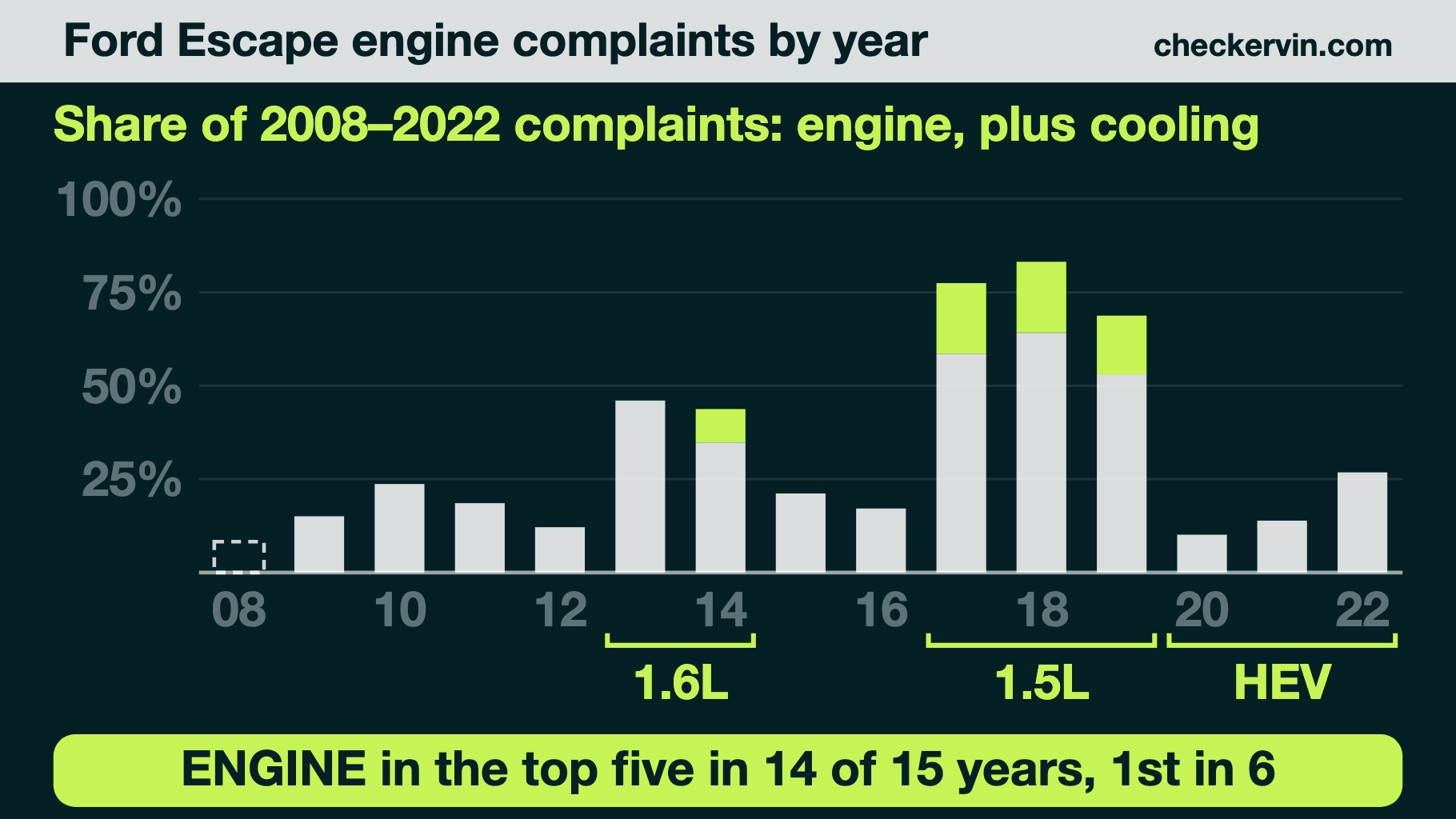
Our corpus of federal NHTSA complaints holds 23,216 reports against the 2008–2022Escape. ENGINE is among each year’s five most-reported components in 14 of 15 model years and ranks first in 6: 2013, 2014, 2017, 2018, 2019, 2022. Counting ENGINE plus NHTSA’s separate ENGINE AND ENGINE COOLING category wherever each reaches a year’s top five gives at least 8,085 engine reports, 35% of the whole record.
The share is what moves. Across 2008–2012, the engine categories hold 13% of complaints. In 2013–2014 it is 45%. In 2017–2019 it reaches 78%, peaking at 83% for the 2018Escape, and in 2020–2022 it drops back to 13%. Those tall years are the years Ford answered with engine recalls or engine programs.
Read it with its limits. ENGINE covers every engine fault on every engine sold that year, from a sensor to a seized crank, so it is context and an upper bound, never a count of replaced engines. Complaints are unverified owner reports. And our data keeps only each year’s top five components, so every share here is a counted minimum. For 2008, ENGINE sits below fifth place; the chart draws that year as a dashed outline at the fifth-place level, an upper bound rather than a zero.
Which engine is in the car decides the bill
The Escape has carried more engine families in fifteen years than most nameplates carry in thirty, and a price for one says nothing about another. EPA’s fuel economy records list these:
| Model years | Engines offered |
|---|---|
| 2008 | 2.3L four, 3.0L V6, 2.3L hybrid |
| 2009–2012 | 2.5L four, 3.0L V6, 2.5L hybrid |
| 2013–2016 | 1.6L EcoBoost, 2.0L EcoBoost, 2.5L four |
| 2017–2019 | 1.5L EcoBoost, 2.0L EcoBoost, 2.5L four |
| 2020–2022 | 1.5L EcoBoost three-cylinder, 2.0L EcoBoost (AWD), 2.5L hybrid, 2.5L plug-in hybrid |
Two years can share a showroom and nothing under the hood. A 2019 Escape with the 2.5L and a 2019 with the 2.0L EcoBoost fall under different Ford documents, and only the 1.5L in between falls under the short block program. The engine lookup by VIN settles which one a specific car left the factory with, and that answer comes before any price.
Who pays, model year by model year
This is the table to read before calling a shop. It reflects the Ford documents and NHTSA recall records as they stood on November 22, 2026.
| Escape | Who pays for a failed engine |
|---|---|
| 2008–2012, all engines | Owner. We found no Ford engine program for these years |
| 2013–2016 1.6L | Owner for the engine; four fire-risk recalls are free if still open |
| 2013–2019 2.0L | Owner; TSB 19-2346 pays nothing outside normal warranty |
| 2017–2019 1.5L | Ford under 21N12 only within 7 years / 84,000 miles of warranty start |
| 2020–2022 2.5L hybrid / plug-in | Ford under 23N06 within 10 years / 150,000 miles, with conditions |
| 2021 Escape Hybrid, 155 cars | Ford under recall 22V109 — crankshaft inspection, engine if needed |
| 2020–2022 1.5L three-cylinder | Owner; its recalls fix leaks, not engines |
A recall is free at any Ford dealer with no age limit. A customer satisfaction program is free only inside the dates and mileage Ford wrote down. A bulletin is a repair instruction and pays nothing on its own. Our TSB versus recall guide explains the difference, and the Ford warranty check by VIN shows whether factory powertrain coverage of 5 years or 60,000 miles is still running on a newer car.
2017–2019 1.5L EcoBoost: the 21N12 window is closing
Ford’s Customer Satisfaction Program 21N12, dated June 9, 2022, provides “a no-cost, one-time repair (if needed) to the 1.5L short block, due to coolant intrusion to the cylinder bores” for 7 years of service or 84,000 miles from the warranty start date, whichever comes first. It covers 2017–2019 Escapes built at Louisville from September 17, 2015 through April 8, 2019, and it moves with the car to later owners. The dealer has to find one of the listed misfire or overheat codes and confirm coolant in a cylinder before the program pays. Our Escape water pump post walks through the pressure test and how this differs from a leaking pump.
The calendar is what matters for cost now. The grace period for cars already past 7 years or 84,000 miles ended November 30, 2022, and so did Ford’s refund offer for owner-paid short block or head gasket work. Seven years from a warranty start in 2017 or 2018 has already passed. As of late November 2026, only a car whose warranty started after late November 2019, typically a 2019 sold off a dealer lot late, and still under 84,000 miles, can be inside the window. Everyone else is quoting a customer-paid short block at the 19.7- or 21.2-hour labor figure above.
2020–2022 hybrid and plug-in: an engine program still open
This is the part of the Escape story most engine quotes miss. Safety recall 23V380, Ford number 23S27, covers 2020–2023 Escapes with the 2.5L hybrid or plug-in hybrid engine because, in NHTSA’s summary, an engine failure can release oil and fuel vapor near hot parts and start a fire. On the 2020–2022 cars the remedy is new engine software that watches for a failing connecting rod bearing, and a new long block if it finds one. The recall replaced an earlier campaign, 22V484, and a later one, 25V345, re-does cars repaired incorrectly under it.
Ford then backed the software with Customer Satisfaction Program 23N06, dated June 25, 2024. If the light comes on with codes P1061 or P032F after the recall work, and diagnosis leads to engine replacement, the dealer replaces the long block free of parts and labor. The first letter set the limit at 10 years or 100,000 miles; Supplement #1, dated September 3, 2024, tells owners 10 years or 150,000 miles from the warranty start date. Coverage transfers to later owners. The grace period for cars already past those limits ended September 30, 2025, and the program excludes cars whose powertrain warranty was canceled.
A 2020 Escape Hybrid first sold in 2020 is inside that window until 2030 if it is under 150,000 miles. Separately, recall 22V109 covers 155 2021 Escape Hybrids whose crankshaft may have been made incorrectly; dealers inspect and replace the engine as needed. Our corpus shows the hybrid-era recall load directly: the 2020, 2021 and 2022 Escape carry 24, 21, 21 recall campaigns. Run the Ford recall lookup before paying for any hybrid engine diagnosis.
2013–2014 1.6L EcoBoost: recalls about fire, not free engines
The first EcoBoost Escape is where the complaint record first turns. ENGINE leads the 2013 model year with 1,269 reports and the 2014 with 727, and the fire column jumps with it: 91 fire reports for 2013 and 104 for 2014, when no other Escape year in our data tops 20. Those years also carry 18 and 16 recall campaigns.
NHTSA lists four 1.6L campaigns with an engine-fire consequence: 12V431 (Ford 12S39), a cylinder head freeze plug that could pop out and dump coolant; 12V551 (12S41), coolant leaks and overheat software; 13V583 (13S12), localized head overheating that could crack the head and leak oil, fixed by changing shielding, cooling and controls; and 17V209 (17S09), which added a coolant level sensor to 2014 cars because driving low on coolant could crack the head. Each one is free if it was never done. None of them buys a replacement engine, so a 1.6L with a cracked head today is an owner-paid job at whatever the parts route above costs.
2020–2022 1.5L three-cylinder: leaks fixed, engines not
The redesigned Escape’s base engine has its own recall trail, and none of it is an engine program. Campaign 22V191 replaces a cracked oil separator housing on 2020–2022 Escapes with the 1.5L. Campaigns 22V859, 24V187, 25V165 and 25V467 address fuel injectors that may crack and leak fuel in the engine bay, adding leak-detection software and a drain tube. All are fire-risk fixes, free at the dealer, and worth confirming on the VIN because a leaking injector can look like an engine problem. We found no Ford program extending engine coverage on this engine and no recall for a cylinder-deactivation fault, so beyond 5 years or 60,000 miles a failed three-cylinder is the owner’s bill.
Short block, long block, used engine or another car
Once Ford is out of the picture, the choice is between four routes, and the cheapest part is not always the cheapest outcome.
| Route | What it trades |
|---|---|
| Short block | New bottom end, your old head reused; most labor, as Ford's 1.5L hours show |
| Remanufactured long block | Highest part price, less labor, and usually a multi-year warranty |
| Used engine | Lowest part price; unknown history and short or no warranty |
| Sell or replace the car | No repair bill; you take the car's value as-is |
A used engine from the same coolant-intrusion years can carry the same fault, so on a 2017–2019 1.5L ask the seller for the donor car’s build date and mileage. The worth-it question is plainer: if the installed quote approaches what the car would be worth running, a new engine only pays off when the body, transmission and suspension are sound and you will keep the car for years. The car value by VIN guide explains how to price the running car. Insurance is not a backstop here; our post on whether gap insurance covers a blown engine explains why it does not.
Before you authorize an engine replacement
- Confirm the engine and build date by VIN; every Ford document above has a build-date range
- Find the warranty start date and mileage, and do the 7-year and 10-year math yourself
- Run the VIN for open recalls, especially 23V380 on a 2020–2022 hybrid
- Get the codes in writing; P1061 and P032F point to the hybrid program
- Ask whether the quote is a short block, long block or used engine, and whose warranty comes with it
- Compare quoted labor hours with Ford's figure for the same job
The second item is where money is saved. Dealers check program eligibility in Ford’s system, but an independent shop may not, and a car that qualifies for 23N06 or 21N12 should never be repaired at the owner’s expense. If a dealer says no, ask which limit the car missed.
If you are buying the Escape, not repairing it
The same documents work as a shopping filter. On a 2017–2019 1.5L, ask for paperwork showing 19B37 was done and whether the short block was ever replaced; a replaced block with receipts can be the safer car. On a 2020–2022 hybrid, confirm recall 23V380 was completed, since the program protection depends on it. A Ford VIN decode confirms the engine and build year, and the Ford Escape problems by year page covers the rest of the complaint record, including steering and power train. For the gearbox side of the same decision, see the Escape transmission cost post.
Where this information comes from
- Ford Customer Satisfaction Program 21N12 (NHTSA copy)1.5L short block terms: 7 years / 84,000 miles, 19B37 prerequisite, 19.7 and 21.2 labor hours.
- Ford Customer Satisfaction Program 19B37, Supplement #4 (NHTSA copy)The 1.5L reflash and its November 30, 2022 end date.
- Ford Customer Satisfaction Program 23N06 (NHTSA copy)2020–2022 Escape 2.5L hybrid long block program, triggering codes and the 18.3-hour allowance.
- Ford Customer Satisfaction Program 23N06, Supplement #1 (NHTSA copy)Owner letter stating 10 years or 150,000 miles and the September 30, 2025 grace date.
- Ford TSB 19-2346 (NHTSA copy) — 2.0L EcoBoost long block13.6 and 15.3 labor hours for the Escape; normal warranty only.
- NHTSA — recalls by VINSource of 23V380, 22V109, 12V431, 12V551, 13V583, 17V209 and the 1.5L injector campaigns.
- EPA fueleconomy.govThe engines offered in each Escape model year.
- Fraser Engine Co. — remanufactured 1.5L EcoBoostThe $4,299 long block price and its warranty, retrieved November 2026.
- EP Transmissions — 2017 Escape engine pricesUsed and remanufactured part-only ranges, retrieved November 2026.
Keep reading
Frequently asked questions
How much does it cost to replace the engine in a Ford Escape?
Parts set the floor. Fraser Engine Co. lists a remanufactured 1.5L EcoBoost long block at $4,299 with a 3-year, unlimited-mile parts and labor warranty, and EP Transmissions puts 2017 Escape engines at $700 to $1,500 used and $2,200 to $4,000 remanufactured, part only (both retrieved November 2026). Labor is the other half: Ford pays its own dealers 19.7 hours for a front-drive 1.5L short block, 21.2 on all-wheel drive, 13.6 to 15.3 hours for a 2.0L long block and up to 18.3 hours for a 2.5L hybrid long block. Multiply the matching figure by your shop's hourly rate and add the engine price to test any quote.
How long will a Ford Escape engine last?
No public dataset tracks Escape engines to failure by mileage, and complaint counts cannot measure lifespan. The most concrete signal is how long Ford itself agreed to stand behind engines it knew had a problem: 7 years or 84,000 miles for the 2017-2019 1.5L under program 21N12, and 10 years or 150,000 miles for the 2020-2022 2.5L hybrid under program 23N06. Ordinary powertrain coverage is 5 years or 60,000 miles. Past those points, maintenance history and coolant level matter more than the badge.
Which Ford Escape engine should I stay away from?
The federal record points at two. The 2013-2014 Escape, when the 1.6L EcoBoost was new, drew four NHTSA engine-fire-risk recalls and 195 fire reports in those two model years; no other Escape year in our data tops 20. The 2017-2019 1.5L EcoBoost is the subject of Ford's coolant-intrusion short block program, and those three years file 78% of their complaints under the engine categories. Neither means every car fails; it means those cars deserve a VIN check and paperwork before purchase.
Will Ford pay for my Escape's engine?
It depends on the engine and the date. A 2020-2022 Escape Hybrid or Plug-In Hybrid with the 2.5L can get a free long block under program 23N06 within 10 years or 150,000 miles of its warranty start, if the dealer finds codes P1061 or P032F after recall 23S27. A 2017-2019 1.5L can get a free short block under 21N12 within 7 years or 84,000 miles, which by late 2026 only fits cars first sold after late November 2019. The 2.0L EcoBoost has a Ford bulletin but no extended program we could find.
Is it worth replacing an Escape engine or buying another car?
Compare the full quote, engine plus labor, with what the car would be worth running. If the repair costs more than that value, or close to it, replacement only makes sense when the rest of the car is sound and you plan to keep it for years. A remanufactured engine with a multi-year warranty changes that math more than a used one does. Gap insurance will not help: it pays the loan gap after a covered total loss, not a mechanical failure.
Check the VIN before you price the engine
A free CheckerVIN report shows the factory build, engine, specifications and open recalls for any VIN, so you know which Ford program, if any, applies before anyone quotes a replacement.
Run a free VIN check