The short answer
- Does gap insurance cover it?
- No. Gap pays a loan-balance gap after a total loss from a covered peril — not a mechanical engine failure. Attributed to Capital One, Bankrate, Uswitch and WalletHub.
- Why does this question come up so much?
- Because ENGINE is the largest complaint category in our entire corpus (19.8% of 432,995 complaints) — and it is not spread evenly.
- What actually covers it?
- A mechanical breakdown insurance policy or vehicle service contract — a different product from gap, bought separately.
The direct answer, and whose answer it is
Gap insurance does not cover a blown engine, and every major source that writes about this agrees. Capital One’s own explainer says gap protects against depreciation, not mechanical failure. Uswitch states plainly that guaranteed asset protection does not cover engine repair or replacement costs. Bankrate and WalletHub describe the same boundary from different angles: gap activates on a total loss, and a blown engine on its own is not one.
There is one indirect case worth naming: if an engine is damaged in a crash or a comprehensive-covered event (fire, flood, theft recovery) severely enough that the car is declared a total loss, gap can cover the remaining loan balance — but it still is not paying to fix the engine, and a repairable engine failure on its own triggers none of this.
What gap insurance actually covers
Gap insurance exists for one narrow purpose: closing the difference between what you still owe a lender and what the car is actually worth, at the moment it is totaled. New cars depreciate faster than most loans amortize in the first year or two, so a totaled car can leave an owner owing thousands more than an insurer’s actual-cash-value payout covers. Gap is the product that fills that specific hole — nothing about whether the engine, transmission or any other mechanical system still works.
That is also why the question in this post’s title gets asked so much: people searching it almost always already have a blown or failing engine and are looking for any policy that might pay for it. Gap is the wrong product for that search, and the rest of this page explains what the record says about why the search happens, and which product is the right one.
Why this question gets asked so often
Our corpus holds 432,995 federal complaints across 60 nameplates and 838model-year records. Of every component category NHTSA tracks, ENGINE is the single largest — 85,870 complaints, 19.8% of the entire corpus, ahead of ELECTRICAL SYSTEM (15.1%) and every other category. A blown or failing engine is, by this measure, the most-reported kind of problem in the file, which is a reasonable part of why a financial question about it gets searched as often as it does.
A corpus-wide share only tells half the story, though. The more useful question for a shopper is not “how common is this overall” but “is it common on my car” — and that answer varies enormously by nameplate, covered next.
Where the concentration actually lands
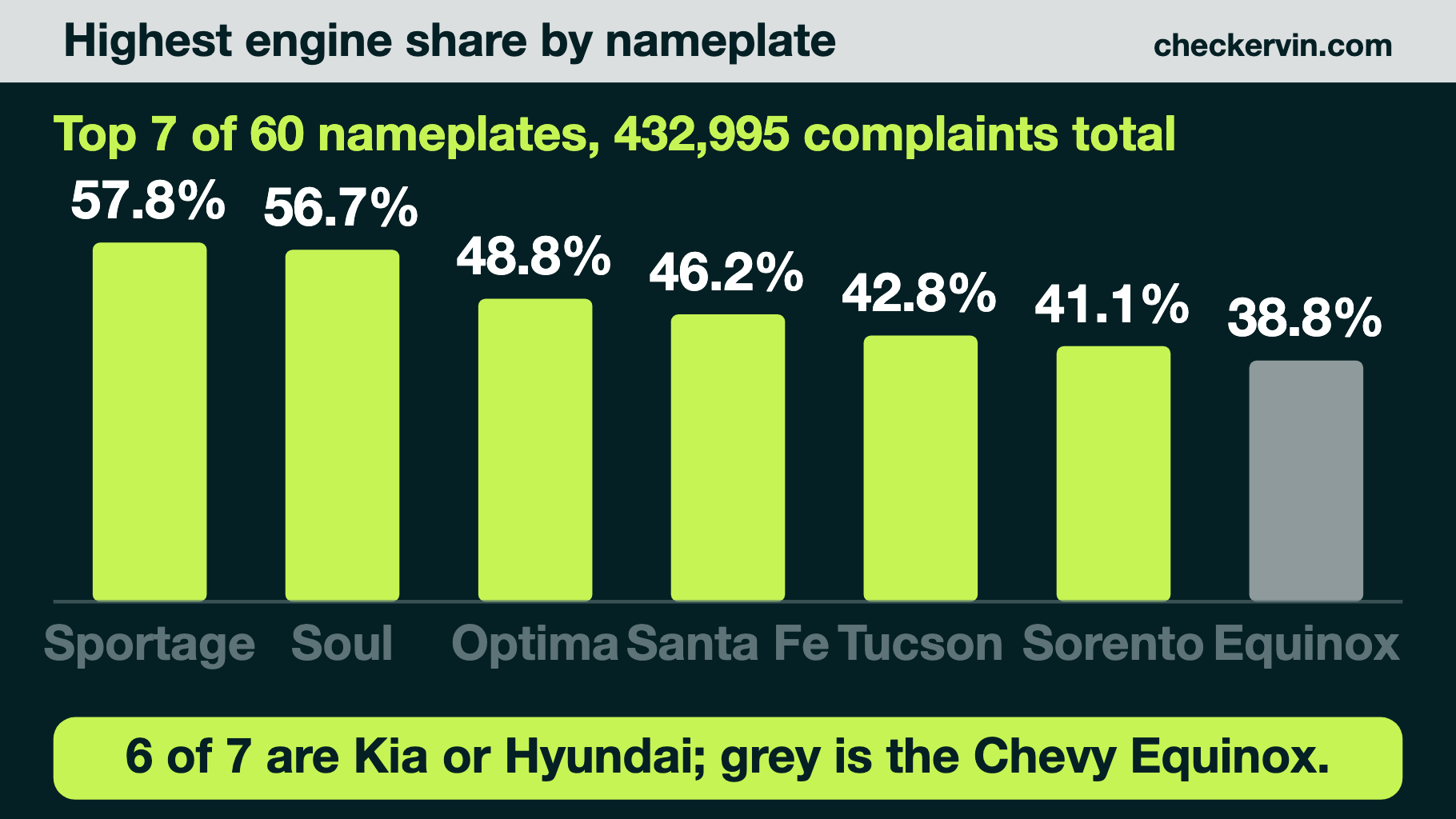
Ranked by each nameplate’s own ENGINE share of its own total complaints — not raw count, so a low-volume nameplate cannot hide behind a popular one’s numbers — 6 of the top 7 nameplates in our entire 60-model corpus are Kia or Hyundai vehicles. This is computed fresh from the corpus, not looked up from a single source:
| Nameplate | Engine share of its own complaints |
|---|---|
| Kia Sportage | 57.8% (1,421 of 2,459) |
| Kia Soul | 56.7% (3,127 of 5,519) |
| Kia Optima | 48.8% (3,295 of 6,756) |
| Hyundai Santa Fe | 46.2% (2,987 of 6,460) |
| Hyundai Tucson | 42.8% (2,339 of 5,463) |
| Kia Sorento | 41.1% (3,521 of 8,565) |
| Chevrolet Equinox | 38.8% (2,594 of 6,686) |
No other brand pair comes close to filling a ranking like this. That is not a coincidence of how NHTSA categorizes complaints — it is a specific, named, well-documented engine problem, covered next.
The recalls and settlements behind the concentration
Hyundai and Kia’s Theta II, and later Nu and Gamma, GDI and MPI engines have been the subject of a multi-year series of recalls, technical service bulletins and warranty-extension programs, running from the mid-2010s into the 2020s. In November 2020, per carpro.com’s reporting on NHTSA’s own announcement, NHTSA reached consent orders with Hyundai Motor America and Kia Motors America totaling $210 million in combined civil penalties, tied to recalls covering more than 1.6 million Theta II-equipped vehicles that the agency said were untimely, with information inaccurately reported during the process.
Separate class-action settlements followed, reported at different times with different scopes and dollar totals across secondary sources that do not fully reconcile with each other — stated here as a range of reporting rather than one number we can stand behind. What matters more for an owner than any settlement total is the warranty-extension program terms themselves, and each manufacturer ran more than one program with different mileage caps and different triggering conditions. Our own by-VIN breakdowns of the Hyundai and Kia programs, each sourced from the manufacturers’ own bulletins, walk through exactly which one applies to which engine — deliberately not repeated here, since those pages already own that detail and keep it current.
What actually helps, free first
- Check the VIN for open safety recalls — free, and the first thing to rule out
- If you own a Kia or Hyundai from this era, read the program-specific breakdown — the model year alone does not tell you which engine or program applies
- Confirm whether a knock-sensor-detection-system software update has been installed — several of these programs only activate after it has been
- Keep the repair order if a dealer ever diagnoses an engine-related code, even if no immediate recall applies — it documents the history a warranty claim may need later
- Do not assume gap insurance is a backstop for any of this — it only pays after a total loss, never a mechanical repair
The coverage that does apply to a blown engine
If an engine is not covered by an open recall or warranty-extension program, the products built to pay for mechanical failure are a manufacturer or third-party vehicle service contract (what most dealers sell as an “extended warranty,” though the phrase is legally imprecise) or a standalone mechanical breakdown insurance policy. Both are purchased separately from gap insurance and underwritten differently — read the contract itself, since coverage, exclusions and the pre-sale disclosure rules vary by product and by state.
Before you buy any policy
- Confirm in writing whether a policy covers mechanical breakdown at all — gap and standard auto insurance generally do not
- Ask what triggers a claim: a covered peril and total loss (gap), or a mechanical failure regardless of cause (a service contract or MBI)
- Check the VIN for open recalls before paying for coverage a recall might make unnecessary
- Get the exclusions list before the payment, not after — pre-existing conditions and wear items are the most commonly disputed
- If the car is a Kia or Hyundai from the affected era, rule out an active warranty-extension program first
If you own a Kia or Hyundai already
The concentration this corpus shows is real, but it is not a reason to assume the worst about a specific car. It is a reason to do the two free checks before paying for anything: pull the VIN’s open recalls, and read the program-specific breakdown for your brand to see which engine and which mileage cap applies. Both take a few minutes and cost nothing, which is more than can be said for discovering the answer after a shop quotes the repair.
Where this information comes from
- NHTSA — datasets and APIsThe federal complaint data this page's corpus-wide and per-nameplate figures are computed from.
- NHTSA — recall lookup by VINThe free federal check for open safety recalls, including Hyundai/Kia knock-sensor campaigns.
- Capital One — does GAP insurance cover engine failureThe core answer this page opens with: gap protects against depreciation, not mechanical failure.
- CarPro — the $210M NHTSA consent orderReporting on NHTSA's November 2020 consent orders with Hyundai and Kia over untimely Theta II recalls.
Keep reading
Frequently asked questions
Does gap insurance cover a blown engine?
No. Gap insurance pays the difference between what you owe on a loan and the car's actual cash value after a total loss — and only when that total loss follows a covered peril like a collision or a comprehensive claim (theft, fire, flood). A blown engine from wear, defect or lack of maintenance is not a covered peril, so gap does not pay toward repairing or replacing it, per Capital One, Bankrate, Uswitch and WalletHub.
What does gap insurance actually cover, then?
The loan-value gap on a financed or leased car that gets totaled. If you owe more than the car is worth when it is declared a total loss, gap covers that difference so you are not still paying off a car you no longer have. It has nothing to do with whether the car runs.
Why do Kia and Hyundai come up so often with engine problems?
Because the federal complaint record backs it up. Across 432,995 complaints against the 60 nameplates in our corpus, ENGINE is the single largest category at 19.8% — and ranked by each nameplate's own engine share, 6 of the top 7 are Kia or Hyundai models. That traces to a well-documented, years-long series of Theta II, Nu and Gamma GDI/MPI engine recalls and warranty-extension programs, not a coincidence.
What should I do if I own an affected Kia or Hyundai?
Start with the free routes: check the VIN for open recalls, then read our dedicated breakdowns of the Hyundai and Kia engine warranty-extension programs — each manufacturer ran more than one, with different mileage caps and different qualifying conditions, and the model year alone does not tell you which applies to your engine.
If gap insurance does not cover a blown engine, what does?
A mechanical breakdown insurance policy or a vehicle service contract (often sold as an 'extended warranty,' though it legally is not one) is the product built for this. Read what it actually promises before buying — our breakdown of vehicle service contracts covers the federal disclosure rules that apply.
Check the VIN before you price any coverage
A free CheckerVIN report shows the factory build, specifications and open recalls for any VIN — the first thing to rule out before any insurance or warranty decision.
Run a free VIN check