The short answer
- Can the VIN answer it directly?
- No. The federal decoder has no oil field. It identifies the engine, and the specification attaches to the engine.
- Is the grade the whole answer?
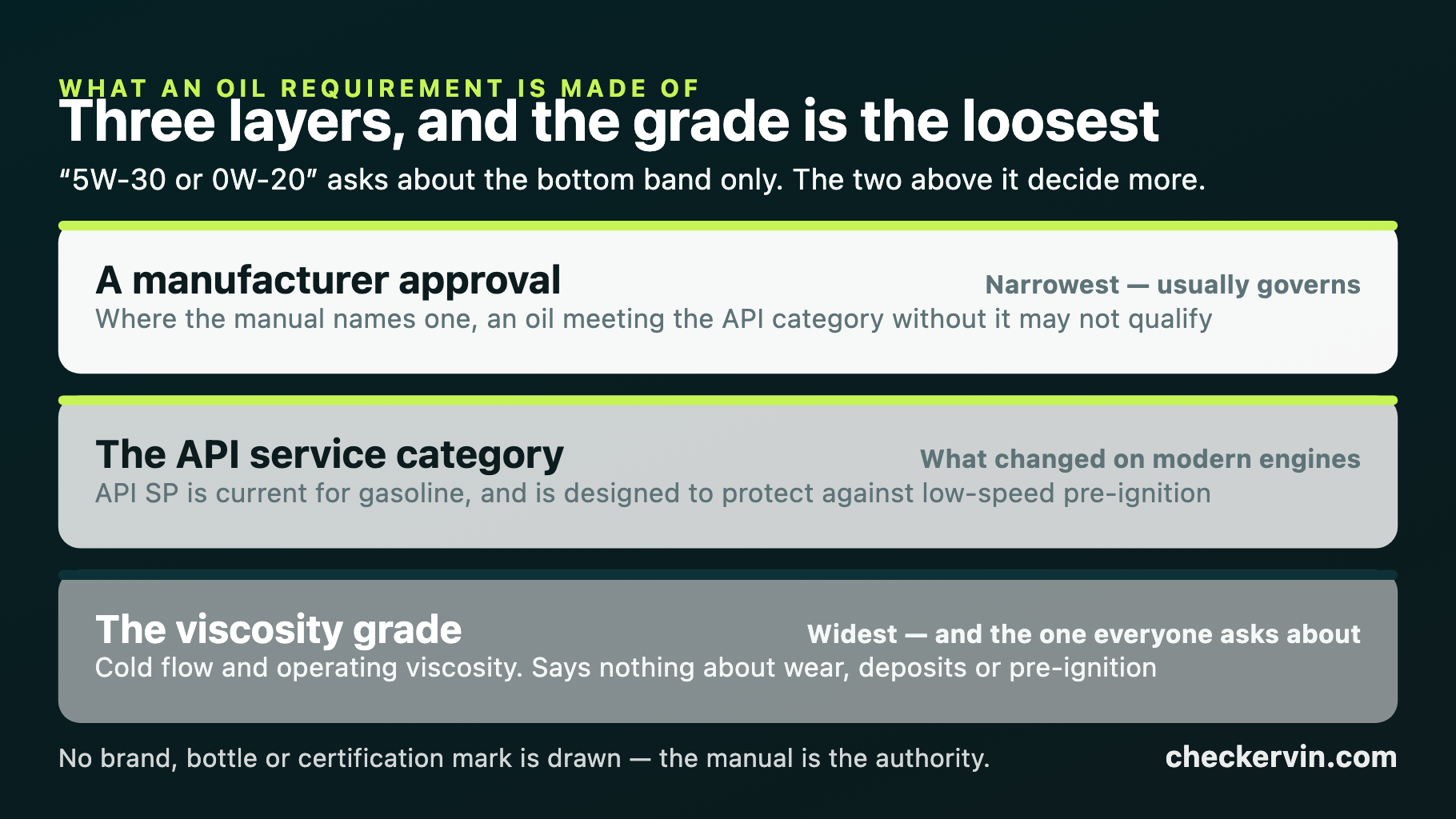
- No. Viscosity is one of three layers — grade, API service category, and any manufacturer approval.
- Where is the authority?
- The owner's manual, backed by the filler cap. A dealer parts desk can look it up from the VIN if the manual is gone.
No field
Oil, in the federal decoder
It returns the engine instead
Three
Layers in a requirement
Grade, category, approval
API SP
Current gasoline category
Developed partly to address LSPI
The manual
Where the authority sits
Not any VIN lookup
No decoder returns an oil type
Start with what the tool actually holds, because it makes every other section follow.
The federal vehicle decoder returns what the manufacturer reported about how the vehicle was built: make, model, model year, body class, engine displacement, cylinder count, fuel type, plant, and a long list of equipment fields. It is a build record. It contains no service information at all — no oil specification, no capacity, no interval, no filter part number.
That is not a gap somebody forgot to fill. Oil specification is an engineering requirement the manufacturer publishes in its own documentation and updates over the life of a model. It was never a field in a registration-and-build dataset, and a lookup that presents one as if it were is inferring rather than reporting.
Why the VIN still matters
The reason to start with the number rather than the badge on the tailgate is that one model in one year is frequently several different engines.
A single nameplate can be sold in the same model year with a naturally aspirated four, a turbocharged four and a six, and those engines do not necessarily share an oil specification — a turbocharged direct-injection engine can carry requirements the naturally aspirated version in the same showroom does not. Getting that wrong is the common failure, and it is not caused by the oil aisle. It is caused by identifying the car as a model rather than as an engine.
So the sequence is: decode the VIN to establish the engine, then take the engine to the manufacturer’s own specification. The VIN is doing real work in that sequence. It is just not the last step.
Viscosity is not the specification
This is the correction the whole page exists for, and it is worth stating plainly before the detail.
Almost everybody asks this question as “5W-30 or 0W-20?” — a question about viscosity grade. But grade is one requirement among up to three, and on a modern engine it is frequently not the one that decides whether the oil is appropriate.
Two bottles both marked 5W-30 can be licensed against different performance standards, meet different manufacturer approvals, and behave very differently in a highly boosted engine. The grade tells you how the oil flows at two temperatures. It tells you almost nothing about what the oil is formulated to survive.
What the two numbers mean
Since the grade is the part everybody already looks at, it is worth being accurate about what it describes.
| The part of the grade | What it describes |
|---|---|
| The number before the W | Cold-temperature behavior — how readily the oil flows when the engine is started cold. A lower number means it stays fluid at a lower temperature. The W is for winter. |
| The number after the W | Viscosity at engine operating temperature. This is the figure people think of as the oil's thickness in normal running. |
| What neither number tells you | Anything about detergency, wear protection, deposit control or resistance to pre-ignition. Those come from the performance standards the oil was licensed against, not from the grade. |
Using a grade the manufacturer did not specify has real consequences on engines with tight clearances and variable-timing systems that rely on oil pressure. But matching the grade and ignoring the rest is the more common mistake, and on a modern engine it is the more consequential one.
The donut, and the service category
Turn the bottle round and there is a circular symbol — the API service symbol, universally called the donut. It carries three things: the service category, the viscosity grade, and whether the oil is resource conserving.
The service category is the letter code, and for gasoline engines the current one is API SP. Categories are developed and licensed by the American Petroleum Institute, and older ones become obsolete as engine technology moves. An oil licensed against a category from a previous generation is not defective — it is formulated for engines of that generation.
Alongside API’s categories sit the ILSAC specifications, of which GF-6 is the relevant modern one, split into GF-6A and GF-6B. Where a bottle carries a current category and the grade your manufacturer specifies, you have satisfied two of the three layers.
Why the category matters more than it used to
There is a specific engineering reason the service category stopped being a technicality, and it is the single most useful thing on this page for anyone running a modern engine.
Turbocharged gasoline direct-injection engines — now ordinary rather than exotic — can suffer low-speed pre-ignition. LSPI is a combustion event that begins before the ignition spark, and it is typically followed by excessive in-cylinder pressure and heavy knock. It is capable of causing severe engine damage and failure, and it happens at low engine speed under load, which is ordinary driving.
Engine oil formulation influences whether LSPI occurs. That is why the Sequence IX test was developed specifically to evaluate an oil’s ability to protect against LSPI events, for the ILSAC GF-6 category — and why API states that API SP oils are designed to provide protection against it.
The third layer: maker approvals
Above the industry categories sits a narrower layer, and on some vehicles it is the one that actually governs.
A number of manufacturers publish their own oil specifications and approve individual products against them. Where your manual names one of these, it is not a suggestion alongside the API category — it is generally the binding requirement, and an oil that meets the API category without carrying the maker’s approval may not satisfy it.
Manufacturers do this because their own engines have characteristics an industry-wide standard is not written around: particular aftertreatment hardware, extended intervals, specific timing-chain or turbocharger demands. The approval is the manufacturer saying this specific product was tested against our specific requirement.
- If the manual names a maker specification, treat that as the requirement
- Check the back label for that specification by name, not just the API donut
- A shop's house-brand bulk oil may meet the category and not the approval — it is fair to ask
- On a vehicle still in warranty, using an oil outside the specification is a conversation you do not want to have later
Where the real answer is
Three sources, in order of authority, and none of them is a VIN lookup.
- 1The owner's manualThe authority. It gives the grade, any specification or approval, and the capacity. Most manufacturers publish manuals free on their own websites if yours is missing.
- 2The oil filler capUsually carries the viscosity grade molded into it. Good for a quick confirmation, but it rarely carries the service category or an approval, so it is not the whole answer.
- 3An under-hood or door-jamb label, on some vehiclesLess common, but where present it is manufacturer-applied and reliable.
- 4A dealer parts department, given the VINThis is the VIN doing its real job — they identify the exact engine from the number and read the specification from the manufacturer's own system.
- 5Then buy to that specification, not to a general recommendationRead the back label for the category and any named approval, rather than trusting shelf placement.
Why two lookups disagree
If you have tried two online tools and got different answers, the reasons are mundane and worth knowing.
| Cause | What is happening |
|---|---|
| They resolved a different engine | The most common. A model with several engine options in one year, and the tool matched on model rather than on the engine character in the VIN. |
| One is quoting a current recommendation, one a historic one | Manufacturers do update specifications over a model's life, and sometimes for older engines. Two answers can both have been right at different times. |
| One is giving a grade only | A tool returning '5W-30' with no category or approval has answered a third of the question. |
| One is a retailer's catalog | Which is built to sell a product that fits, and may be listing what it stocks rather than what the maker specifies. |
Synthetic, blend, conventional
A separate axis from everything above, and it causes less trouble than people expect.
If your manual requires a full synthetic, that is a requirement rather than an upgrade path, and many modern engines with extended intervals do require one. If it does not, a conventional oil meeting the specified grade and category is compliant, and the decision becomes a value judgment about intervals and operating conditions rather than a correctness question.
What matters is that the base-oil type does not override the three layers. A full synthetic in the wrong grade, or licensed against an obsolete category, is still the wrong oil for a modern engine.
The other half of the question
People usually arrive at oil type and change interval together, so it is worth saying where the interval comes from.
Modern vehicles frequently calculate it rather than fixing it — an oil life monitor tracks operating conditions and reports remaining life, and the manual will say whether to follow the monitor or a fixed schedule. Manuals also commonly distinguish normal from severe service, and a great many drivers are in the severe category without realizing it: short trips, extensive idling, towing, dusty conditions, sustained extreme temperatures.
The relevance to this page is that the interval assumes you used the specified oil. An extended interval calculated for a full synthetic meeting a maker approval is not a promise about whatever is in the oil pan.
Buying used, with no service history
This is where the subject touches the rest of the site, and it is a genuine consideration rather than a tacked-on paragraph.
On a used car with no records you do not know what was put in it, at what interval, or whether the specification was respected. On an older naturally aspirated engine that is a modest concern. On a turbocharged direct-injection engine with an unknown oil history it is worth more attention, for exactly the reasons in the LSPI section above.
You cannot check it from a VIN, and no history report carries it either — our maintenance report guide covers why service data is thin and where it does exist. What you can do is ask for records, look for an oil-change sticker, and have an inspection include an assessment of engine condition. Our pre-purchase inspection guide covers what that examination reaches.
The check sequence
Decode the VIN free to establish exactly which engine you have. Confirm it against the engine fieldand, if you are buying, against the metal. Take that engine to the owner’s manual, or to a dealer parts desk with the VIN. Buy to the grade, the service category and any named manufacturer approval. Then check open recalls through NHTSA at no cost while you have the number in front of you.
Where this information comes from
- API — new engine oil standardsAPI's own statement that API SP oils are designed to protect against low-speed pre-ignition, and the relationship to ILSAC GF-6A and GF-6B
- SAE — the Sequence IX low-speed pre-ignition testThe standardized test developed for ILSAC GF-6 to evaluate an oil's effect on the occurrence of LSPI
- API 1509 — Engine Oil Licensing and Certification SystemThe system behind the service symbol on the bottle, and how categories are licensed
- NHTSA recall lookupOpen safety recalls by VIN, free — worth checking while you have the number to hand
Keep reading
Frequently asked questions
Can a VIN tell me what oil my car takes?
Not directly. The federal decoder returns engine displacement, cylinder count and fuel type, and has no field for oil at all. What the VIN does is identify which engine your car was built with, and the oil specification attaches to the engine — so the VIN is the right starting point for a question it cannot answer by itself.
Is 5W-30 or 0W-20 better for my car?
Neither, in the abstract — use what the manufacturer specifies for your engine. Viscosity grade is only part of the requirement, and the part people over-weight. A 5W-30 that meets an obsolete service category can be a worse choice for a modern turbocharged engine than a current-category oil in the grade the maker calls for.
What does API SP mean on the bottle?
It is the API service category, shown in the donut symbol on the container, and it describes the performance standard the oil was licensed against. API SP is the current category for gasoline engines and was developed in part to address low-speed pre-ignition in turbocharged direct-injection engines — which is why the category, not just the grade, matters on a modern car.
Where do I actually find the right oil for my car?
The owner's manual is the authority, and the oil filler cap usually carries the viscosity grade molded into it. Some vehicles also have an under-hood label. If the manual is missing, a dealer parts department can look up the specification from the VIN — which is the VIN doing its real job of identifying the engine.
Does CheckerVIN return an oil type?
No. Our free lookup returns the factory build, specifications and open safety recalls, drawn from the federal decoder — which carries no oil field. Decode the VIN here to confirm which engine you have, then take that to the manual or a dealer parts desk.
Start with the VIN
Decode any VIN free for the factory build, specifications and open safety recalls. No account, no card.
Run a free VIN check