The short answer
- What does it cost?
- RepairPal lists $743–$1,088 nationally. GM books the 1.4L pump job at 1.6 hours of labor out of warranty.
- Is it really the pump?
- Not always. GM's bulletins send technicians to the pump, thermostat housing, heater core and surge tank. Test before buying parts.
- Is there a recall?
- No. GM's special coverage for 2011–2014 1.4L pumps ran 10 years or 150,000 miles, which has now passed for nearly every car.
76%
Of Cruze engine complaints
2011–2014 model years
1,253
Engine complaints on record
2011–2019
1.6 hr
GM labor time, pump job
Out of warranty, 1.4L
$743+
RepairPal, national
Low end of its range
The numbers, and whose numbers they are
We do not repair cars or sell parts, so every dollar figure on this page belongs to whoever published it. RepairPal’s estimator gives the most detailed reading. Its national figure for a Chevrolet Cruze water pump replacement is $743 to $1,088, made up of $361 to $529 in labor and $383 to $558 in parts, and the page says it was last updated September 3, 2026. Its separate page for a 2016 Cruze Limited runs higher, $845 to $1,290, with $439 to $644 of labor. Neither figure includes tax or your local labor rate.
Kelley Blue Book was less useful when we checked in October 2026. Its 2013 Cruze, 2016 Cruze Limited and 2018 Cruze pages all showed no local pricing data without a ZIP code, and fell back on a general FAQ answer that a water pump runs $375 to $787 including parts and labor, a figure not specific to the Cruze. Treat that as a floor for a simple job, not a Cruze quote.
What none of these numbers tells you is whether the car needs a pump. On a Cruze that question deserves more attention than the price, because a pump replaced on a car that was leaking somewhere else costs the full amount and leaves the leak where it was.
What GM's own labor time says about the job
General Motors published its own figure for this repair. Special Coverage bulletin 14371B, dated January 2015 and covering 2011–2014 Cruze models with the 1.4-liter turbo engine, lists the labor time a dealer could claim for a pump replacement on a car outside its normal warranty: 1.6 hours, which includes inspecting the pump and refilling the cooling system. Cruze models with hydraulic power steering get another 0.1 hour. An inspection that finds nothing wrong is booked at 0.3 hour.
That is a short job by water pump standards. GM’s bulletin photos show the pump mounted at the front of the engine behind its own pulley, reachable without opening the engine, which is why GM can book it at under two hours. Labor rates vary widely, so we will not turn 1.6 hours into a dollar figure for you, but you can: ask the shop how many hours its quote assumes. If the answer is far above GM’s time and nothing else is being replaced, ask why.
| GM labor operation (bulletin 14371B) | Time |
|---|---|
| Water pump inspection, no repair needed | 0.3 hr |
| Pump replacement, out of warranty (includes inspection and refill) | 1.6 hr |
| Add for hydraulic power steering (Cruze only) | 0.1 hr |
The same bulletin’s parts kit is a guide to what a complete job includes: the pump, its gasket, and the thermostat housing seal, plus replacement bolts for the engine front cover, transaxle and engine mount bracket, and a gallon of Dex-Cool. A quote for “pump only” that skips the seals is a quote for a job GM would not do that way.
Why the leak is often not the pump
GM wrote four separate bulletins about coolant loss on the early 1.4-liter Cruze, and read together they make one point: the water pump area is where coolant shows up, which is not always where it comes from.
| GM bulletin | What it says about the leak |
|---|---|
| PI0762C, March 2013 (2011–2012, 1.4L LUJ) | Coolant may weep from the pump mounting bolts. Do not tighten or seal the bolts; replace the pump and gasket. |
| PIE0275, December 2013 (2013, 1.4L LUV) | Low coolant or odor may come from the gasket between the pump housing and the engine front cover. Engineering was still finding the root cause. |
| PI0740B, March 2014 (2011–2012, 1.4L LUJ) | Coolant smell in the cabin may be vapor from the reservoir overflow. Dye and pressure test, then check the pump seal and bolts, thermostat housing, heater core and surge tank. |
| 14371B, January 2015 (2011–2014, 1.4L) | Pump may leak from its weep reservoir or shaft seal. Replace only if obviously leaking or heavily crusted. |
The third row is the one most owners never hear about. A sweet coolant smell inside the car sounds like a failing pump, yet GM’s first explanation was vapor venting from the coolant reservoir and slipping through gaps in the hood seal. That bulletin’s fix was hood seals and a drain tube, plus a hunt for real leaks with dye and a pressure tester. Its list of places to look puts the thermostat housing, the heater core and the surge tank alongside the pump.
The fourth row matters just as much. GM’s coverage bulletin includes photos of pumps a technician should leave alone, with “only slight coolant staining” around the cover plate, and says a pump in that condition is working as designed. A little crust is not a diagnosis. The owner complaints filed with NHTSA show what happens when the order gets reversed: owners describing pumps replaced more than once, then thermostat housings, radiators and sensors, on cars that kept losing coolant.
What 3,707 complaints say about the Cruze
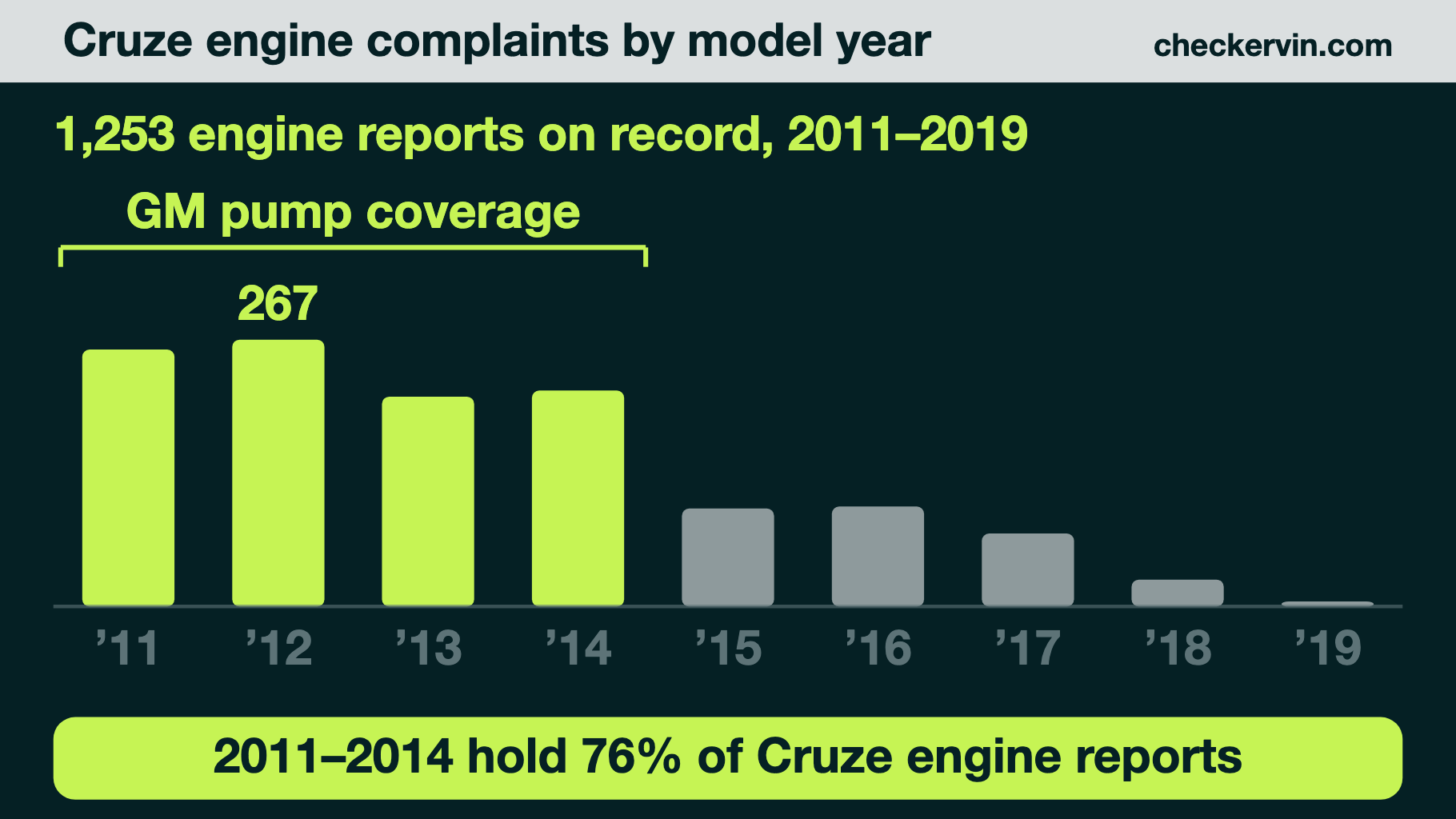
Our corpus of federal NHTSA complaints holds 3,707 reports against the 2011–2019 Cruze, and 1,253 of them, about 34%, fall in the ENGINE component category. ENGINE is the single most-reported component in every model year from 2011–2018 and ranks #2 in 2019. The worst year is 2012, with 267 engine reports.
The 2011–2014model years, the ones GM’s pump coverage names, hold 950 of those engine reports, or 76%. Engine complaints then fall off sharply: 98 for 2015, 100 for 2016, and 105 across all three second-generation years from 2017 on.
What the record does not prove
NHTSA has no water pump category. ENGINE holds every kind of engine complaint, from every engine Chevrolet sold that year, so those counts include oil leaks, turbo problems, misfires and everything else alongside coolant loss. They are an upper bound on cooling trouble, never a count of pump failures, and complaints are unverified owner reports rather than a measured failure rate.
The early years also dominate the Cruze’s record in general. 2011–2014 carry 78% of all Cruze complaints in our data, close to their 76% share of engine complaints. Measured against each period’s own complaints, engine reports run about 33% for 2011–2014 and about 37% for the later years. So the record does not show the early cars as unusually engine-heavy for their size. What it shows is that most of the engine trouble ever reported on a Cruze happened on the cars GM’s bulletins describe, which are also the oldest and cheapest Cruzes on used lots now. The Chevrolet Cruze years-to-avoid page breaks the rest of that record down by year.
Reading the complaint narratives themselves supports the same split. The 2012 and 2014 files contain many accounts of coolant loss, overheating and repeated cooling repairs. A search of the 2017 and 2018 files for the same terms turned up almost nothing about the cooling system; the few matches were clutch fluid reservoir complaints.
GM's special coverage, and why it probably no longer helps
In October 2014 GM wrote to owners of 2011–2014 Cruze models with the 1.4-liter engine, and 2012–2014 Sonics, that the water pump “may leak from the weep reservoir or from the water pump shaft seal.” Under Special Coverage 14371, a Chevrolet dealer would replace a leaking pump free for 10 years or 150,000 miles from the date the car was first placed in service, regardless of who owned it. GM also offered to reimburse owners who had already paid, with a US deadline of October 31, 2015.
The coverage runs from the in-service date, and the youngest cars it names are 2014 models. For a Cruze sold new in 2013 or 2014, the ten years ran out in 2023 or 2024; one that sat on a lot into 2015 ran out in 2025. As of October 2026, very few cars remain inside it. A dealer can check a specific VIN in GM’s warranty system, and it costs nothing to ask, but do not price a repair on the assumption that GM will pay.
Is there a recall on the Cruze water pump?
No. We queried NHTSA’s recall database for every Cruze model year from 2011 through 2019, and no campaign mentions the water pump or a coolant leak. To make sure the search could find one, we ran the same check against a car with a known water pump recall, a 2012 BMW 328i, and it came back positive. The Cruze has special coverage and service bulletins on the pump, not a recall.
Two recalls sit close to the subject. Campaign 12V288 covers 2011–2012 Cruzes in which spilled or dripping oil, such as after an oil change, could collect in the engine shield near hot surfaces and ignite. Campaign 14V417 covers certain 2013–2014 Cruzes with an engine block heater cord whose insulation can crack in cold weather. Neither is a coolant leak, but both are free fixes that a shop already working under the hood should confirm are done. The Chevrolet recall check shows whether a specific car has either open, and our TSB versus recall page explains why the bulletins above pay nothing on their own.
Which Cruze you have changes the job
Every bulletin on this page names the first-generation car with the 1.4-liter turbo. The federal fuel economy records list these engines for the Cruze by model year:
| Model years | Engines EPA lists |
|---|---|
| 2011–2013 | 1.4L turbo, 1.8L |
| 2014–2015 | 1.4L turbo, 1.8L, 2.0L diesel |
| 2016 Cruze Limited | 1.4L turbo, 1.8L (first-generation body) |
| 2016 Cruze | 1.4L turbo (second-generation body) |
| 2017–2019 | 1.4L turbo, 1.6L diesel |
The 2017-and-later 1.4-liter is a different engine from the early one, and we found no GM bulletin about its water pump in the bulletins NHTSA hosts, though that search is not exhaustive. Our 2016 row also cannot be split between the old-body Limited and the new car, so read that bar as a blend. The practical step is the same for every year: confirm the engine before comparing quotes. An engine lookup by VIN settles it, and a Chevrolet VIN decode adds the trim and build details.
Can you keep driving it?
- “Engine Hot, AC Off” message, or the temperature gauge climbing
- Reduced engine power together with a Service Engine light
- Coolant reservoir dropping again within days of a top-up
- Sweet coolant smell inside the cabin
- Orange coolant crust building at the front of the engine
The first two are reasons to pull over. GM’s own bulletin lists exactly that sequence as what an uncorrected pump leak leads to: lost coolant, reduced cooling, then the hot-engine message and reduced power. The rest are reasons to book a diagnosis soon and carry a jug of the correct coolant meanwhile. A slow external weep can be watched for a short while; a level that drops with no visible leak cannot, because that coolant is going somewhere you cannot see.
Test before you pay for a pump
The diagnosis that separates these causes is cheap compared with the parts. GM’s own procedure in bulletin PI0740B starts with tracer dye in the coolant, one full warm-up and cool-down, and a pressure test of the cooling system, then a look at each of the four leak points it names. Ask the shop to do the same and to tell you where the dye showed up.
- Dye and pressure test, with the leak point named on the invoice
- Pump inspected against GM's 'slight staining' versus 'excessive deposits' standard
- Thermostat housing and surge tank checked, not assumed
- Oil and exhaust checked for coolant if the level drops with no visible leak
That last check is the one that changes the bill. If a pressure test holds outside but the reservoir keeps emptying, coolant may be getting into the engine itself, and a new pump will not fix that. Find out before the pump goes in, not after. When the cooling system is refilled, use the coolant the engine was built for. GM’s kit lists Dex-Cool, and a coolant type lookup by VIN confirms it for a specific car.
Before you authorize the repair, or buy the car
- Confirm the engine and model year by VIN; the GM bulletins cover the early 1.4L only
- Ask a Chevrolet dealer whether Special Coverage 14371 still applies to that VIN
- Ask how many labor hours the quote assumes and compare it with GM's 1.6
- Ask whether the thermostat housing seal and new bolts are included
- Keep the invoice with the leak point named; it is useful when you sell
For a shopper looking at a 2011–2014 Cruze, the cooling system is worth asking about directly. A receipt naming the leak source and the parts replaced is better evidence than a clean engine bay, which can mean the car was washed rather than fixed. A warranty check by VIN shows whether any factory coverage remains on a newer one.
Where this information comes from
- GM Service Bulletin 14371B — Special Coverage, Engine Coolant Leak from the Water Pump (NHTSA)January 2015. The 2011–2014 Cruze 1.4L coverage terms, the leak description, the parts kit and the 1.6-hour labor time.
- GM PI0762C — Coolant Leak at Water Pump (NHTSA)March 2013. Leaks at the pump mounting bolts on the 2011–2012 1.4L; replace the thermostat housing seal with the pump.
- GM PIE0275 — Low Coolant Level, Coolant Leak, Engine Overheating (NHTSA)December 2013. Points to the gasket between pump housing and engine front cover on the 2013 1.4L.
- GM PI0740B — Engine Coolant Odor inside Passenger Compartment (NHTSA)March 2014. Reservoir vapor as a cause of coolant smell, and the four leak points to check with dye and pressure.
- NHTSA — recalls by vehicle and VINOur 2011–2019 query found no Cruze campaign naming the water pump; 12V288 and 14V417 are the nearby ones.
- EPA and DOE — fueleconomy.gov vehicle recordsThe per-year Cruze engine listings behind the generation table.
- RepairPal — Chevrolet Cruze water pump estimateThe national and 2016 Cruze Limited figures quoted above, retrieved October 2026.
Keep reading
Frequently asked questions
How much does it cost to replace a water pump on a Chevy Cruze?
RepairPal's national estimate for a Cruze water pump is $743 to $1,088, with $361 to $529 of labor and $383 to $558 of parts, last updated September 3, 2026. Its 2016 Cruze Limited page lists $845 to $1,290. Kelley Blue Book's general figure for a water pump is $375 to $787. GM's own bulletin books the out-of-warranty pump job on a 2011–2014 1.4L Cruze at 1.6 hours of labor, including inspection and refilling the coolant, so a quote far above that deserves a question.
Is there a recall or warranty extension on the Cruze water pump?
There is no safety recall. GM issued Special Coverage 14371 for 2011–2014 Cruze models with the 1.4L engine, covering water pump coolant leaks for 10 years or 150,000 miles from the date the car was first put in service. Ten years have now passed for nearly every car it covered, so in practice it rarely pays today. A Chevrolet dealer can confirm by VIN whether a specific car is still inside the window.
Why does my Cruze keep losing coolant after a new water pump?
Because the pump is one of several places the 1.4L leaks. GM's own bulletin on coolant odor tells technicians to check the water pump seal and bolts, the thermostat housing, the heater core and the coolant surge tank. A dye and pressure test finds the actual source. If no external leak shows up and the level keeps dropping, have the oil and the exhaust checked for coolant before buying another part.
Can I drive my Cruze with a leaking water pump?
Only short distances, and only while the coolant level and temperature gauge stay normal. GM's bulletin says a leaking pump eventually leads to overheating, and warns of an 'Engine Hot, AC Off' message and reduced engine power. If you see that message or the gauge climbs, stop. Topping up and watching the level buys time for a diagnosis, not for months of driving.
Should the thermostat be replaced with the water pump on a Cruze?
On the 2011–2014 1.4L, GM's own parts lists treat them as connected. The pump bulletin's parts list includes a thermostat with its seal, and the special-coverage kit includes the thermostat housing seal. The thermostat housing is also a leak point in its own right. Ask the shop whether the quote includes the thermostat and its seal, and whether the housing itself was checked.
Confirm the engine before you price the pump
A free CheckerVIN report shows the factory build, engine, specifications and open recalls for any VIN, so you know which Cruze bulletins apply before you pay for parts.
Run a free VIN check