The short answer
- Which is best?
- Wrong question. Rank by dataset: free decode for build and recalls, federal title record for brands and odometer.
- Is there an official list?
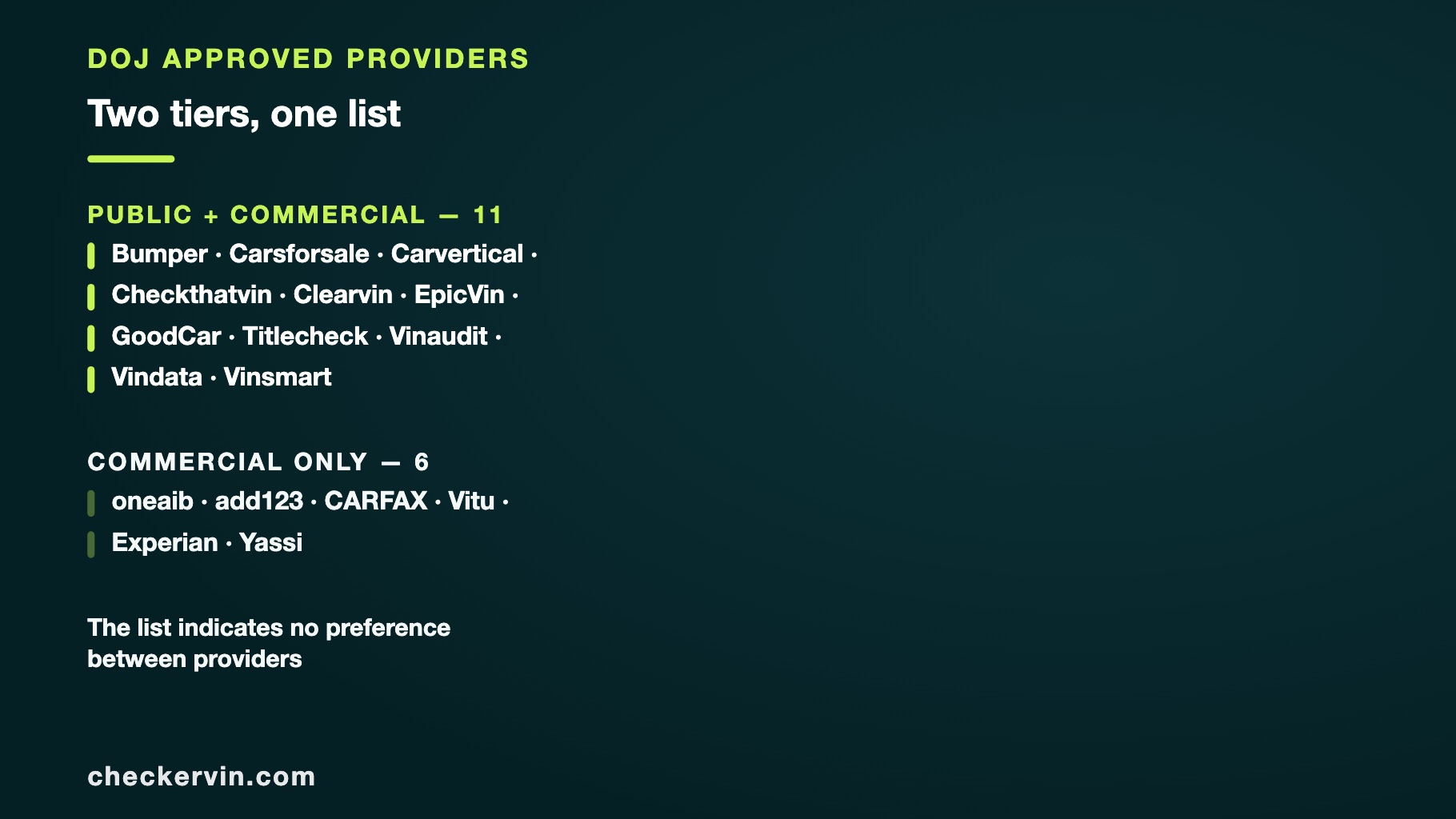
- Yes. The DOJ publishes it — 11 businesses approved to sell the federal title record to the public.
- What does it cost?
- The free layer is genuinely free. The federal title record is a few dollars. Premium reports are for specific questions.
11
Approved to sell to the public
Department of Justice list
6
Approved for commercial only
Not consumer-facing for this data
Free
Cost of the build and recall layer
No paid report improves on it
Best is the wrong question, and the market knows it
Ask which VIN check is best and you get a list, usually ordered by who pays the most for the placement. The question fails for a more basic reason than that: these services are not competing versions of one product. They sell access to different datasets, and two of those datasets are ones no company owns.
Once you see the market as layers rather than brands, the choice becomes mechanical. You are not picking a winner. You are deciding how far down the stack your question lives, and buying only that far.
Four layers, and what each one actually holds
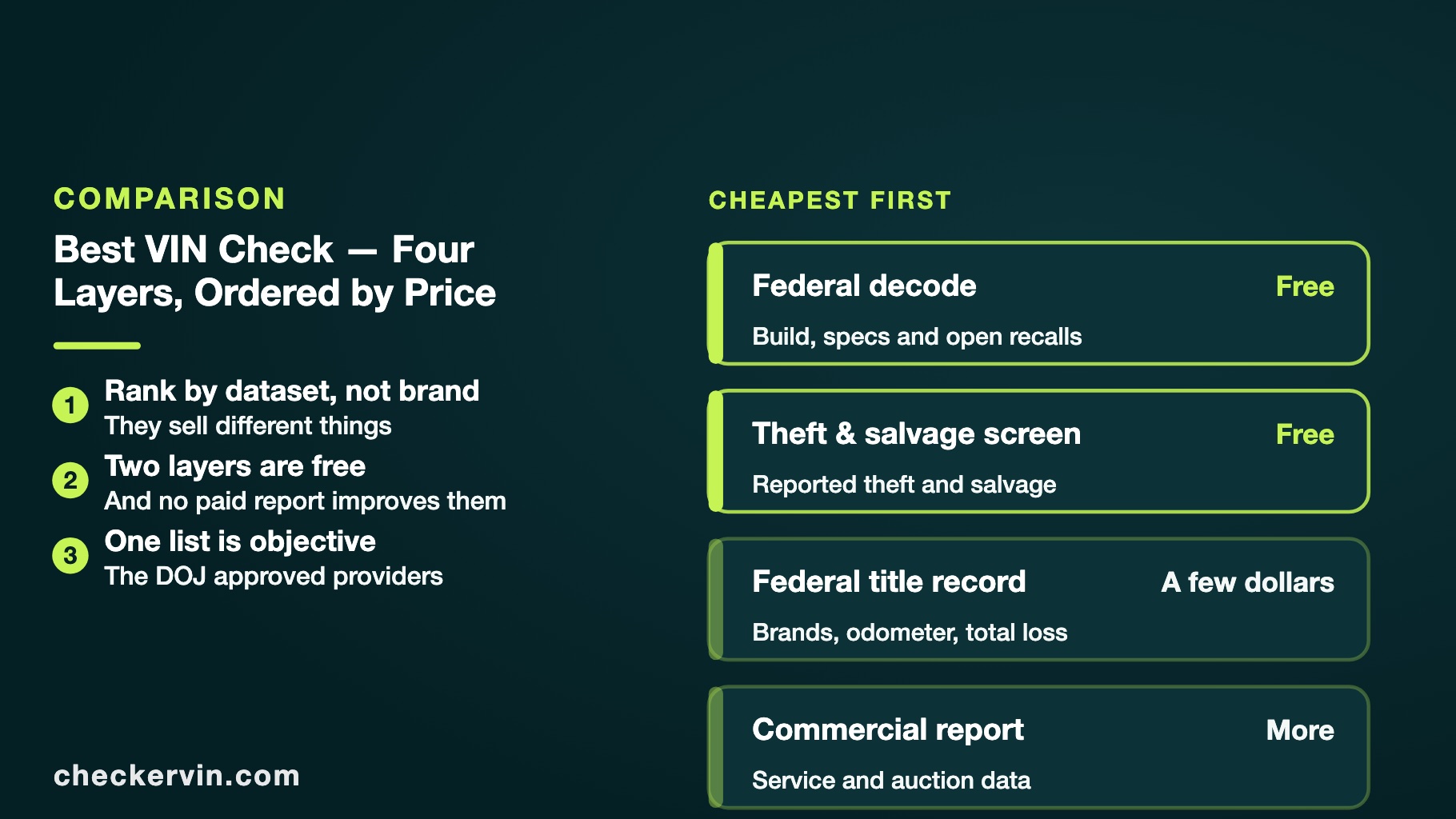
Every VIN check on the market is selling one or more of these. The order is by price, ascending, and the top two are free.
| Layer | Cost and contents |
|---|---|
| The federal decoder | Free — Build, specifications and open safety recalls |
| The federal theft and salvage screen | Free — Theft and salvage records reported to it |
| The federal title record, through an approved provider | A few dollars — Titles, brands, odometer readings and total-loss records reported by states, insurers and salvage yards |
| A commercial history report | More — The above where the seller has it, plus that company's own service, auction and dealer data |
The two free layers are not a trial version of the paid ones. A federal decode is the manufacturer’s own filing and a recall result is the agency’s own campaign data; no paid report has a better version of either. Where paid reports earn their money is the third and fourth rows.
Check any VIN free
Decoded from official manufacturer and NHTSA records
The one objective list, and who is on it
The federal title record — the third layer — is not sold directly to the public. It is sold through businesses the Department of Justice has approved, and the department publishes the list. That makes it the only ranking in this market that is not an opinion.
Approved to provide the record to all interested parties, consumers included:
- Bumper.com
- Carsforsale.com
- Carvertical.com
- Checkthatvin.com
- Clearvin.com
- EpicVin.com
- GoodCar.com
- Titlecheck.us
- Vinaudit.com
- Vindata.com
- Vinsmart.com
Several of those also operate additional sites that sell reports containing the same federal data, which the department lists alongside the parent. If you are comparing two services and both appear here, the federal title data in their reports is the same data. What differs is presentation, packaging and price.
The second tier, which most comparisons never mention
The list is published in two parts, and the second part is the one that changes how you read the market. These businesses are approved for commercial customers only:
- oneaib.com
- add123.com
- CARFAX.com
- Vitu.com
- Experian.com
- Yassi.com
Commercial here means dealerships, lenders, insurers and similar — not a private buyer checking a car. So if your question is specifically about the federal title record, these are not the route to it, whatever else they may be excellent at.
What that means for the biggest name in the category
One entry in the commercial tier deserves stating carefully, because it is the single most useful sourced fact on this page and it is easy to misuse.
Read that precisely. It does not mean the reports are inferior, and it is not a scandal. Carfax holds a very large amount of data that no government system has — service records, reported accidents, dealer and auction entries — and a great many buyers are happy with what they get. What the line establishes is narrower: the NMVTIS federal title record specifically is not the dataset a consumer is buying there.
That matters when the question you are trying to answer is a title question. If you need to know whether a state branded this car salvage, or what the odometer read when the title last changed hands, that record has a defined source and a published list of who may sell it to you. Our page on the NMVTIS report covers what is in it and what it costs.
Note also that AutoCheck does not appear on the list under its own name. We are reporting what the department publishes rather than reconstructing corporate relationships from it.
Several of these names are the same company
Here is a detail the department publishes and almost no comparison mentions. Alongside each approved provider it lists the additional websites that provider owns which also sell reports containing the same federal data.
| Approved provider | Also sells the same federal data as |
|---|---|
| Bumper.com | BeenVerified.com |
| Carsforsale.com | VehicleHistoryReport.com |
| EpicVin.com | VinGurus.com and Vininspect.com |
| GoodCar.com | InfoTracer, Recordsfinder.com and StateRecords.org |
| Vinaudit.com | VinCheck.Info |
So a “comparison” between two sites in the same row is not a comparison of datasets at all. It is a comparison of two storefronts over one approval, and any difference you find between them is in the interface, the packaging or the price rather than in what the federal record says about the car.
Checking a service yourself, before you pay
Everything above is reproducible, and it takes less time than reading a review. The list is a government page, it is public, and it is the same page whichever service you are considering.
- 1Open the department's provider pageLinked in the sources below. It is the authoritative version and it changes as approvals change, which a copy on a review site does not.
- 2Look for the service in the public tierIf it is there, the federal title data in its report is genuine. If it is only in the commercial tier, that dataset is not what you would be buying as a private individual.
- 3Check whether it shares a parent with something else you are consideringThe additional-sites lines are on the same page, and they collapse a lot of apparent choice.
- 4If it is not on the list at all, ask what it is sellingThat is not automatically a problem — plenty of useful tools hold their own data or repackage the free federal layers. It does mean you should know which of those you are paying for.
Choosing by question rather than by brand
Put the layers and the list together and the decision falls out of the question you actually have.
| What you want to know | What to use |
|---|---|
| What did the factory build? | The free federal decode |
| Are there open safety recalls? | The free federal decode — and the repair is free too |
| Has a state branded this car? | The federal title record, from any approved provider |
| What did the odometer read at each transfer? | The federal title record |
| Has it been reported stolen or sent to a salvage yard? | The free federal theft and salvage screen, then the title record |
| Where has it been serviced, and by whom? | A commercial report — no government system holds this |
Four of those six are answered free or for a few dollars. The last row is the one that justifies a premium report, and it is worth knowing that is what you are paying for.
Where our individual reviews fit
We have looked at these services one at a time, and those pages go into what each holds, how it presents it and where it disappoints. They are the detail behind this page’s structure rather than a substitute for it.
- Approved providers we have reviewed individually: Bumper, CarVertical, EpicVin, GoodCar and VinAudit
- Services we have reviewed that are not on the approved list — which is a fact about the dataset, not a verdict on the company
- The two market leaders, reviewed on what their own data actually covers
Start with Carfax alternatives if you want the ladder rather than the individual reviews, and what a vehicle history report costs for the pricing argument this page deliberately leaves alone.
The order that wastes the least money
The same sequence works for every used car, and it front-loads everything free.
- 1Decode the VIN and read the recallsFree, immediate, and an open campaign is unfinished work somebody else has already paid for. Do it before you travel to see the car.
- 2Run the free theft and salvage screenAlso free, and it catches the two worst outcomes early.
- 3Buy the federal title record from any approved providerA few dollars, and the same underlying data whichever name on the list you pick.
- 4Only then consider a commercial reportWorth it when service or auction history is the specific question. Not worth it as a first move.
- 5Spend the rest on an inspectionEvery record in this stack describes the past. A mechanic describes the car.
For the last step, the pre-purchase inspection covers what one costs and what it covers.
Where this information comes from
- U.S. Department of Justice — Approved NMVTIS Data ProvidersThe two-tier list reproduced above, including the commercial-only entries
- NHTSA vPIC — VIN decoding APIThe free build-and-specifications layer
- NHTSA recalls by VINFree to check, and the remedy is free as well
- NICB VINCheckThe free theft and salvage screen
Frequently asked questions
What is the best VIN check?
It depends entirely on the question, and the honest ranking is by dataset rather than by brand. For build and open recalls the federal decoder is free and complete. For title brands and odometer records the federal title record is the authoritative source, sold for a few dollars by approved providers. For service and auction detail you are into commercial reports, which hold data no government system has.
Which VIN check services are officially approved?
The Department of Justice publishes the list, and it is the only objective ranking anybody in this market has. 11 businesses are approved to sell the federal title record to the public. A separate, shorter group is approved for commercial customers only. Being on the list does not make a service good; it means the federal title data in its report is the real thing.
Is Carfax an approved NMVTIS provider?
It appears in the commercial-only tier of the Department of Justice list, with a note in the government's own words that "CARFAX offers NMVTIS data to commercial customers in California only". That does not make its reports worse — it holds a large amount of data no government system has. It means the federal title record specifically is not what a consumer is buying there, which is a different point and worth understanding before you choose.
Is a free VIN check good enough?
For some questions it is the complete answer. A free federal decode gives you the factory build and every open safety recall, and no paid report improves on either. What free cannot give you is the history — title brands, odometer records, total-loss declarations — because those come from a records system that charges a few dollars to query.
What is the cheapest reliable VIN check?
Run the free federal decode and recall check first, then buy the federal title record from an approved provider. That combination costs a few dollars and covers the questions that decide most purchases. Commercial reports are worth their premium when the car's service or auction history is the specific thing you need.
Do all VIN check sites have the same data?
No, and the approved-provider list is the fastest way to see the difference. Providers on the list sell the same underlying federal title record, so they differ in presentation and price rather than in that dataset. Anything not on the list is selling something else, which may be valuable or may be a repackaged free decode.
Which VIN check should I use before buying a used car?
Both of the cheap ones, in order. The free decode rules out a category of problems and finds open recalls that are free to fix. The federal title record then answers whether the car has been branded, totaled or had its odometer questioned. Only then does a premium report earn its price, and only for specific questions.
Keep reading
Start with the layer that costs nothing
Factory build, specifications and open safety recalls, decoded from the VIN. No account, no card.
Run a free VIN check