The short answer
- How do you read a Mercedes-Benz VIN?
- Characters one to three identify country and manufacturer — a W prefix marks German assembly, while US-built Mercedes SUVs carry a United States identifier. Four to eight are the descriptor covering model, body and engine. Nine is the check digit, ten the model year, eleven the plant, and twelve to seventeen the production sequence.
- How do I find my Mercedes' generation?
- Decode the VIN for the model and model year, then map that to the W-code. A C-Class of one generation is a W204 and the next is a W205; parts, service procedures and known faults all follow the W-code rather than the model name.
- How do I see every factory option?
- Request the data card from a Mercedes dealer using the VIN. It lists the complete option code set the vehicle was built with, which no public decode reproduces.
W
Prefix marks German build
US-built SUVs differ
W205
Generation codes, not VIN
How the marque is organized
Data card
Every factory option
From a dealer, by VIN
Free
Mercedes data via NHTSA vPIC
Public, no account
What a Mercedes VIN tells you
A decode establishes the vehicle as built — the baseline you assess everything else against. On a Mercedes that baseline matters unusually much, because option content varied enormously between otherwise identical cars and drives both value and running cost.
- Model year, model and body class as filed with NHTSA
- Engine displacement, cylinder count and fuel type
- Drivetrain configuration, including all-wheel drive
- Restraint system fitted at the factory
- Country of manufacture and the assembly plant
- Open safety recalls against that exact vehicle
Mercedes WMI codes
| Starts with | What it identifies |
|---|---|
| WDB | Mercedes-Benz built in Germany — used across many older model lines |
| WDC | Mercedes-Benz built in Germany — commonly multipurpose and SUV classes |
| WDD | Mercedes-Benz built in Germany — widely used on later passenger cars |
| 4JG | Mercedes-Benz built in the United States — the Alabama SUV plant |
Yes, some Mercedes models are built in America
This surprises owners regularly. Mercedes has run an assembly plant in Alabama for decades, and several SUV models sold worldwide are built there rather than in Germany. Those vehicles carry a United States world manufacturer identifier.
It is not a lesser product and it is not a gray import — it is where Mercedes chose to build those models. If a seller insists a US-coded Mercedes SUV must be “wrong,” they are mistaken about the marque rather than telling you something about the car.
The first three characters settle the vehicle class
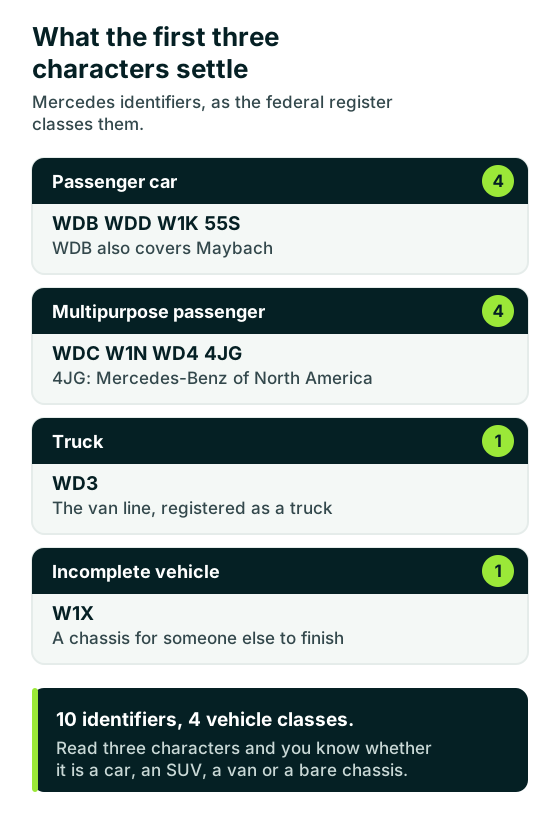
Mercedes does not use one manufacturer identifier. It uses several, and they are not interchangeable — each is registered against a vehicle class, so the opening characters tell you what kind of vehicle you are looking at before any other position is read. We queried the federal decoder for each one rather than repeating a list from elsewhere.
| Identifier | What the federal register returns for it |
|---|---|
| WDB | Passenger car — and the make field reads MERCEDES-BENZ, MAYBACH, so one identifier covers both marques |
| WDD, W1K, 55S | Passenger car |
| WDC, W1N, WD4, 4JG | Multipurpose passenger vehicle — the SUV and crossover stream |
| WD3 | Truck |
| W1X | Incomplete vehicle — a chassis delivered for someone else to finish |
That last pair is the useful part when a listing is vague. A van-shaped Mercedes whose VIN begins WD3 is registered as a truck, and one beginning W1X was never a finished vehicle at the factory gate at all. Neither fact depends on the seller’s description, and both are readable from three characters.
One identifier, two marques
The WDB entry is worth pausing on, because it breaks an assumption people bring to badge identification. Its make field does not read Mercedes-Benz alone. It reads Mercedes-Benz and Maybach together.
A single manufacturer identifier covering two marques means the opening characters cannot separate them, and the distinction has to come from later positions and from the build record. For a buyer this matters mainly in one direction: a decode returning a Mercedes-Benz identifier is not evidence that a car badged as something more exclusive has been misrepresented, because the register genuinely groups them.
The identifier registered to a different company
One entry in that table is registered to a different legal entity from the rest, and it is the one on a large share of the Mercedes SUVs sold in America.
The German identifiers are held by Mercedes-Benz AG or Mercedes-Benz Cars. The identifier beginning 4JG is registered to Mercedes-Benz of North America, Inc., and it is classed as a multipurpose passenger vehicle. A separate registration for the North American operation is exactly what you would expect for vehicles assembled there, and it gives a reader something concrete: the identifier, not the badge, is what reflects which arm of the company put the vehicle together.
Pair that with the plant character and you can place a car without asking anyone. Our guide to build location works through which position carries the plant and why the country in the first character is not the same question as the plant in the eleventh.
When the factory never finished the vehicle
The W1X identifier is classed as an incomplete vehicle, and it entered the federal register in November 2019. That classification describes a real commercial process rather than a defect, and it changes what a decode can tell you.
An incomplete vehicle leaves the manufacturer as a chassis and powertrain for a second company to build onto — a box, a camper conversion, a service body. The original manufacturer describes what it supplied; whoever completed the vehicle is responsible for the rest, and that later work is not in the factory record your decode is reading.
- The decode describes the chassis as delivered, not the body somebody added
- Weight ratings can be set by the final-stage manufacturer rather than the original one
- A second certification label is normally present alongside the original
- Service history may sit with two different companies
- Recalls can come from either the chassis maker or the body builder
For a used buyer looking at a converted van, that is the difference between reading a record and reading half of one. The chassis half is decodable; the conversion half has to come from the label the final-stage manufacturer applied and from whatever paperwork the converter left behind.
Checking any of this yourself, in one request
Nothing above needs to be taken on trust. The federal decoder exposes a lookup for the manufacturer identifier on its own, so you can confirm what any three-character prefix is registered as without a paid tool and without a full VIN.
Give it the first three characters of the VIN and it returns the make, the manufacturer entity that registered it, the parent company, the vehicle class and the date the registration became public. That last field is quietly useful: an identifier that only entered the register recently cannot belong to an older vehicle, which is a small but real consistency check against a VIN that has been altered.
- Take the first three characters of the VIN in front of you
- Query the federal identifier lookup with them
- Read the vehicle class and compare it to the vehicle you are looking at
- Read the registering entity, which tells you which arm of the company built it
- Check the registration date against the model year the seller claims
A car whose identifier is registered as a passenger vehicle, sitting in front of you as a van, is not a decoding curiosity. It is a mismatch worth resolving before money moves, and it costs one request to find.
W-codes: how Mercedes is actually organized
Mercedes generations are identified by chassis codes — W for saloons and many core models, R for roadsters, S for estates, C for coupes, among others, followed by a three-digit series number.
These codes are not in the VIN. They matter anyway, because every parts catalog, specialist workshop, forum thread and buying guide is organized around them. Two C-Class cars a year apart can be different W-codes and share very little.
| Identifier | What it does |
|---|---|
| VIN | Identifies one vehicle. Used for title, registration, insurance and recalls. |
| W-code / chassis code | Identifies a generation shared by many vehicles. Used for parts, service procedures and known-fault research. Not on the title. |
| Data card | The complete factory option list for one VIN. Retrieved from a dealer. |
The data card: the document that settles everything
Mercedes maintains a build record for every vehicle it produces, listing the complete set of option codes fitted at the factory. Owners call it the data card, and it is far more detailed than any public VIN decode.
- 1Take the VIN from the vehicleWindshield plate or driver's door jamb. Photograph rather than transcribe.
- 2Ask a Mercedes dealer's parts or service departmentThey can retrieve the build record from Mercedes' systems. This is the reliable route and it is usually free.
- 3Read the option codes against the carWalk the vehicle with the list open. Equipment claimed but not coded was added later.
- 4Keep a copy permanentlyIt supports the asking price when you sell, and it answers parts questions for as long as you own the car.
Engine codes on a Mercedes
Mercedes identifies engines by their own family designations — M-prefixed codes for gasoline engines and OM-prefixed codes for diesels, followed by a series number. Like W-codes, they are the language specialists and parts suppliers use.
The eighth VIN character identifies the engine as built. Confirm it against the stamping on the engine itself if the car has an uncertain history, and treat any discrepancy as something to resolve before purchase rather than after.
Sprinter vans are a different case
The Sprinter is a commercial vehicle, and commercial vehicles carry their own manufacturer identifiers and their own considerations. Many are also upfitted — turned into campers, service vehicles or shuttles by a second company after leaving the factory.
Where a Sprinter has been converted, the VIN still describes the chassis, while the conversion is outside its scope entirely. That is the same chassis-versus-coach split that governs motorhome identification, and it applies here for the same reason.
Gray imports and euro-spec cars
Mercedes sells different specifications in different markets, and a car built for Europe is not identical to the US version — lighting, emissions equipment, instrument calibration and available options all differ.
A euro-spec Mercedes in the United States is usually there under the twenty-five-year import rule or as a previously federalized vehicle. Both are legitimate, but they affect parts sourcing, emissions testing and insurance. If the decode returns a specification that does not match a US-market car, ask how the vehicle got here and what documentation came with it.
Checking Mercedes recalls by VIN
Recalls are scoped to VIN ranges rather than models, so a model-name search shows campaigns that may not apply. NHTSA's free lookup answers it at VIN level.
The manufacturer must perform the remedy at no charge to the owner regardless of how many owners the vehicle has had, so an open recall on a used Mercedes is a dealer appointment rather than a repair bill.
Buying a used Mercedes: the VIN checklist
- 1Decode, then establish the W-codeModel year gives you the generation, and the generation is what you research for known faults and parts prices.
- 2Request the data cardBefore you agree a price. It confirms which options are genuinely factory-fitted.
- 3Run the free recall checkInstant, free, and the remedy costs nothing.
- 4Check the country of build against the seller's storyA US-built SUV is normal. A euro-spec car needs an import history you can see.
- 5Budget for the generation, not the badgeParts and labor vary enormously between W-codes. Research the actual generation before committing.
- 6Pay a marque specialist for the inspectionA Mercedes specialist knows the failure points of a specific W-code in a way a general shop does not.
What the VIN implies about running costs
The decode is telling you more about your future spending than it first appears. Engine choice, drivetrain complexity, air suspension, and the generation itself all follow from what the VIN describes, and all of them drive maintenance cost.
- Air suspension is superb when working and expensive when it is not — establish whether the car has it
- All-wheel drive adds components and adds service cost
- Larger engines carry more ancillary systems, each with its own failure modes
- Some generations have well-documented weak points that a specialist can price for you
- Deferred maintenance on a luxury car compounds faster than on an economy car
- A comprehensive service file is worth more on a Mercedes than on almost any other used purchase
Where this information comes from
- NHTSA vPIC — manufacturer identifier lookupThe federal register queried directly. Returns the make, registering entity, parent company, vehicle class and public registration date for any three-character identifier — the source of every classification on this page
- NHTSA vPIC — public VIN decoderThe federal database manufacturers file their VIN structure with
- NHTSA recall lookupFree open-recall check by VIN, repaired at no cost by the manufacturer
- EPA fuel economy dataOfficial economy figures by engine and drivetrain configuration
Keep reading
Frequently asked questions
How do I decode a Mercedes-Benz VIN for free?
Enter the 17-character VIN into a decoder. Mercedes files its VIN structure with NHTSA's public vPIC database, so a free decode returns make, model, model year, body class, engine, drivetrain and manufacturing plant with no charge and no account.
What does WDD mean on a Mercedes VIN?
It identifies a Mercedes-Benz built in Germany. W is the country code for Germany and the following characters identify Daimler and the vehicle class. Mercedes uses several German identifiers including WDB, WDC and WDD across different eras and vehicle types.
Is the W-code in my Mercedes VIN?
No. Codes such as W205, W212 or R107 are Mercedes' internal chassis designations for a model generation. They are not printed in the VIN, but a decode gives you the model and model year, which maps directly to the right W-code.
Are any Mercedes models built in America?
Yes. Mercedes has operated an assembly plant in Alabama for decades, building SUV models for worldwide sale. Those vehicles carry a United States world manufacturer identifier rather than a German one, which surprises owners who assume all Mercedes are imported.
What is a Mercedes data card?
The factory build record for a specific VIN, listing every option code the vehicle was built with. A Mercedes dealer can retrieve it, and it is the definitive answer to what equipment the car left the factory with — far more detail than a VIN decode returns.
Decode your Mercedes in seconds
Enter any Mercedes-Benz VIN for the factory build, specifications, assembly plant and open safety recalls. Free, no account.
Run a free VIN check