The short answer
- How do you read a BMW VIN?
- Characters one to three identify the manufacturer and country — and on BMW they also separate the standard range, the M division and the electric models. Four to eight cover model, body and engine. Nine is the check digit, ten the model year, eleven the plant, and twelve to seventeen the production sequence.
- What is the single most useful thing a BMW VIN tells you?
- Whether the car is a genuine M division vehicle. BMW assigns M cars their own manufacturer identifier, so the distinction appears at the start of the VIN rather than only in the equipment.
- What do I still need beyond the decode?
- The chassis code, which follows from the model year and determines what you research; and the original option list from a dealer, which determines much of what the car is worth.
Own code
M division VINs differ
From standard cars
E→G
Chassis code generations
Not printed in the VIN
Carolina
Where X models are built
Not all BMWs are imported
Free
BMW data via NHTSA vPIC
Public, no account
What a BMW VIN tells you
- Model year, model and body class as filed with NHTSA
- Engine displacement, cylinder count and fuel type
- Drivetrain — rear-wheel drive or all-wheel drive
- Restraint system fitted at the factory
- Country of manufacture and the assembly plant
- Whether the vehicle is an M division car
- Open safety recalls against that exact vehicle
BMW WMI codes
| Starts with | What it identifies |
|---|---|
| WBA | BMW passenger car built in Germany — the standard range |
| WBS | BMW M division vehicle — the genuine M cars |
| WBY | BMW electric models |
| 5UX | BMW built in the United States — the South Carolina plant, X models |
Spotting a real M car: the check most buyers skip
This is the most valuable thing on the page. BMW sells two things that are easy to confuse and very different in price: genuine M division cars, engineered by BMW M with their own engines, chassis and brakes; and standard cars fitted with the M Sport appearance and equipment package.
M Sport cars are perfectly good cars. They are not M cars, and they are not worth M car money. Because the package includes badges, bumpers, wheels and interior trim, a casual look does not separate them — and some sellers describe an M Sport car in language that blurs the line.
| What you are looking at | How to tell |
|---|---|
| Genuine M division car | Carries BMW's M division manufacturer identifier at the start of the VIN. Different engine, chassis, brakes and drivetrain from the standard model. |
| M Sport package car | Carries the standard passenger car identifier. The M content is appearance, trim, wheels and suspension tuning — not the M division powertrain. |
| Badged car | A standard car with M badges added by an owner. No M content at all, and no VIN trace of any. |
E, F and G codes: how BMW is actually organized
BMW identifies generations by chassis code, and the entire specialist, parts and enthusiast ecosystem runs on them. Codes beginning E cover the older generations, F the middle era, and G the more recent ones.
A 3 Series from one generation and the next share a name and very little else — different engines, different known faults, different parts. Researching by model name averages across all of them and tells you nothing useful.
- 1Decode the VIN for the model and model yearThat is the input. The chassis code follows from it.
- 2Map the year to the generation codeMarque references and owner communities publish these mappings for every model line.
- 3Research that generation specificallyKnown faults, service intervals and parts prices are generation-specific, not model-specific.
- 4Find a specialist who knows that generationAn independent BMW specialist familiar with the specific chassis will be better informed and cheaper than a general workshop.
Some BMWs are built in America
BMW operates a large assembly plant in South Carolina, and it builds the X-model SUVs — for the United States and for export worldwide. Those vehicles carry a United States manufacturer identifier.
This is not a lesser BMW and it is not a gray import. It is where BMW chose to build those models. A seller who insists a US-coded X model must be wrong is mistaken about the marque rather than telling you something about the car.
Option codes and the build record
BMW sells heavily optioned cars, and the original specification is a substantial part of what a used one is worth. A dealer can retrieve the build record from the VIN, listing the option codes the car was delivered with.
- Seat type and upholstery, which carry real value differences
- Wheel specification, and whether the wheels fitted are the originals
- Suspension options, including adaptive systems
- Driver assistance and technology packages
- Transmission choice, which on some models drives value more than anything else
- Individual or special-order paint and trim
Engine codes
BMW identifies engines by its own family designations, and the code is what a parts department and a specialist will ask for. The eighth VIN character identifies the engine as built; the family code is what you research.
Get the engine code and research that engine rather than the model. BMW uses engines across multiple model lines, so the documented experience with a specific engine is broader and more useful than anything organized by model name.
What the first character decides, and it is not the factory
The WMI table above splits BMW production between Germany and South Carolina, and most guides leave it there as a piece of trivia about where the car was screwed together. It is more than that. That first character determines which legal entity built your car, and therefore which body of federal law that entity had to satisfy before the vehicle could be sold to you at all.
A W prefix identifies a vehicle built by a German manufacturer. Under 49 CFR Part 551, subpart D, that makes it a foreign manufacturer, and foreign manufacturers carry an obligation domestic ones do not.
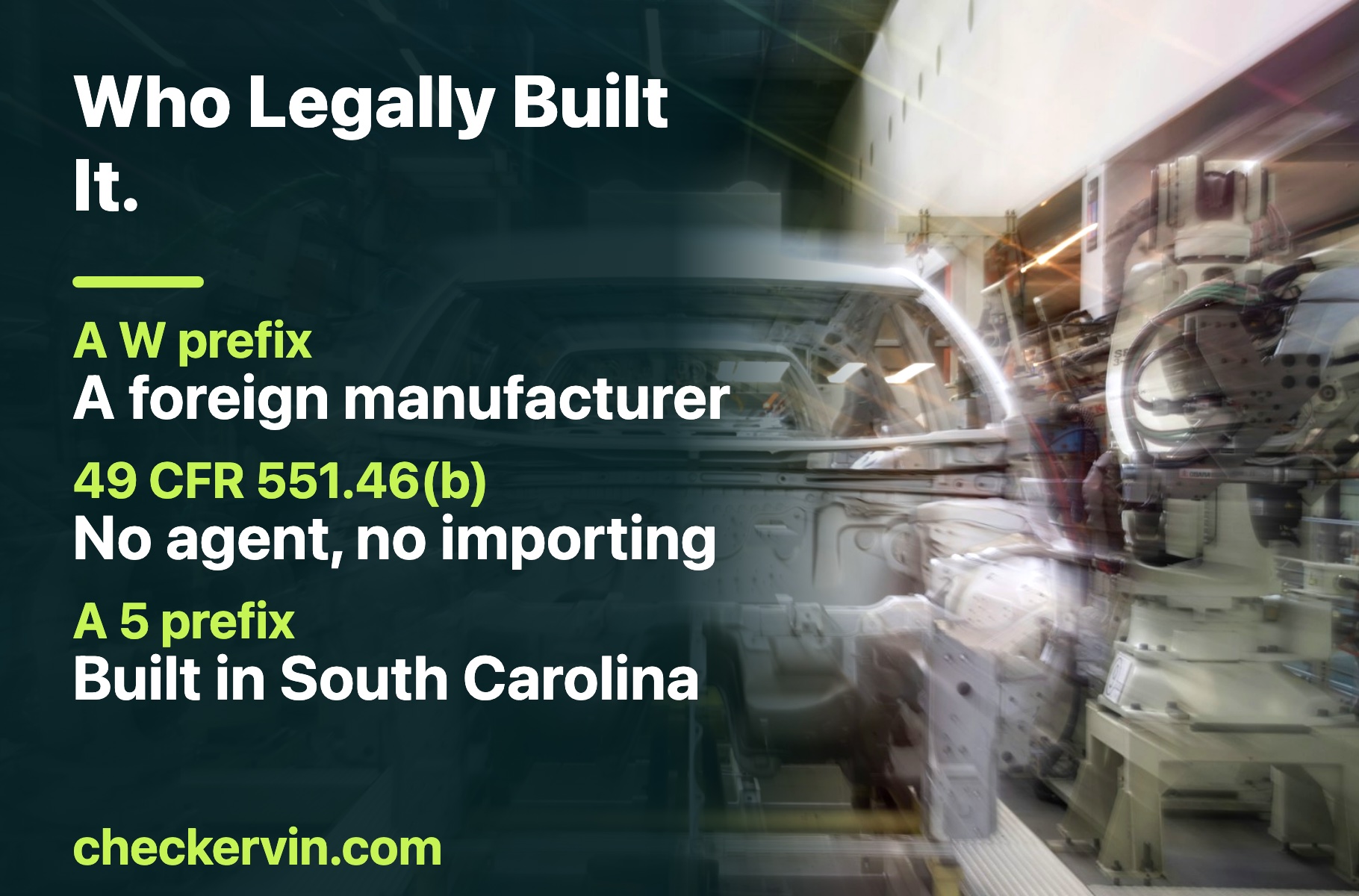
Section 551.45 sets out the purpose plainly: it establishes how foreign manufacturers, assemblers and importers designate an agent in the United States on whom service of administrative or judicial notices or process may be made. Section 551.46 then makes it a precondition rather than a formality. Every foreign manufacturer must comply before offering a vehicle or item of equipment for importation, and until it appoints an agent under the subpart, it may not import into the United States at all.
The rule keeps that grip after the fact. Under 551.52, a designation stays in effect until the manufacturer replaces or withdraws it — and a manufacturer that withdraws its agent without appointing a new one may not continue importing. The right to sell cars here is tied to having a reachable name on file, continuously.
| 49 CFR 551, subpart D | What it requires |
|---|---|
| 551.46(a) | Compliance before offering any vehicle or equipment for importation |
| 551.46(b) | No agent, no importing — the designation is a precondition, not paperwork |
| 551.47 | The agent must be an individual, domestic firm or domestic corporation that is a permanent resident of the United States |
| 551.50 | Any number of foreign manufacturers may separately designate the same person |
| 551.51 | An agent may not assign performance of its functions to anyone else |
| 551.52(b) | Withdraw the agent without replacing it and importing must stop |
A car carrying a 5 prefix was built in the United States, by a domestic manufacturing entity, and this subpart does not reach it. Same badge on the hood, same dealer, different answer to the question of who the manufacturer legally is.
And the register you are already searching
There is a neat closing of the loop here, because the database this page keeps telling you to decode a VIN against is the same one manufacturers have to file their own identity into.
49 CFR 566.5 requires each manufacturer of a motor vehicle to furnish NHTSA with its full individual, partnership or corporate name; its residence address and state of incorporation where applicable; and a description of each type of vehicle it makes, including the approximate ranges of gross vehicle weight ratings for each type. The regulation names vPIC as the place to submit it.
The descriptions can be general — “passenger cars” is explicitly acceptable — but not always. For multipurpose passenger vehicles, trucks and trailers, the description has to be specific enough to indicate intended use, with the rule giving examples like a tank trailer, a motor home or a cargo van. And an incomplete vehicle manufacturer must say so, describing the stage of completion and, where known, the intended use.
Under 566.6 a manufacturer must submit that information not later than 30 days after it begins manufacture. So the free decoder returning your BMW's specifications is not a convenience someone built on top of the industry; it is the public face of a register the manufacturer was required to enter. That is worth knowing when a paid site implies its decode is proprietary.
Service on the agent is service on the manufacturer
The reason any of this matters to a private buyer sits in three short sections at the end of the subpart, and they are worth reading in full because they are unusually blunt.
Section 551.66 states the legal effect: service on an agent of administrative or judicial notices or process is deemed to be service on the manufacturer. Not a courtesy copy, not a step on the way to reaching Munich. Serving the agent is serving the company that built the car.
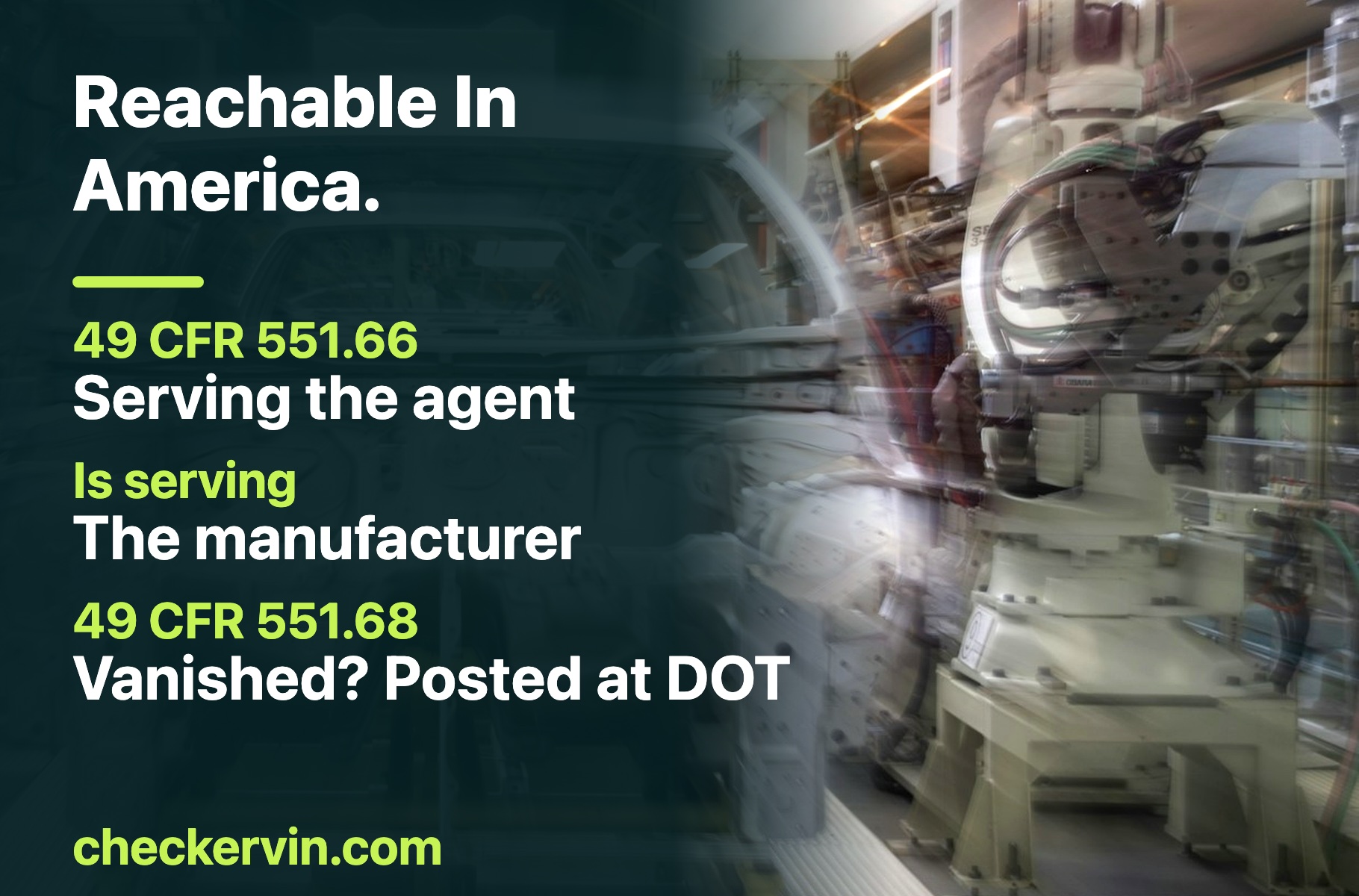
Section 551.67 says how it is done: an agent may be served at the agent's office or usual place of residence, by registered or certified mail addressed to the agent with return receipt requested, or by any other manner authorized by law.
And 551.68 covers the case everybody assumes is a dead end. If the agent cannot be served — because the agent cannot be located, has ceased to exist, or does not receive correctly addressed mail — service may be made by posting the notice or process in the Office of the Secretary of Transportation. The federal government has written itself a backstop so that a foreign manufacturer cannot become unreachable by letting its American contact evaporate.
It also explains something buyers notice and misread. The entity named on your paperwork is often a US subsidiary rather than the German parent, and people take that as a corporate shell game. It is closer to the opposite: federal law requires a permanent United States resident to stand in for the manufacturer precisely so that the manufacturer is reachable here rather than only abroad.
Checking BMW recalls by VIN
Recalls attach to VIN ranges rather than models. NHTSA's free lookup answers it at VIN level, and the manufacturer must perform the remedy at no cost to the owner however many times the car has changed hands.
We keep a dedicated page on this: BMW recall check walks through the water pump fire campaign, and the seven-month gap before owners were told.
Buying a used BMW: the VIN checklist
- 1Decode and check the manufacturer identifier firstEstablish whether it is an M division car before any conversation about price.
- 2Establish the chassis code from the model yearThen research that generation's specific weak points and service costs.
- 3Get the original option list from a dealerBefore agreeing a price. It is a major input into value.
- 4Get the engine code and research that engineNot the model. Engines carry across model lines.
- 5Ask about deferred maintenance specificallyCooling system, gaskets and suspension bushings are the usual candidates on an older BMW, and they compound when skipped.
- 6Run the free recall checkInstant, free, and the remedy costs nothing.
- 7Use an independent BMW specialist for the inspectionCheaper than a dealer and generally better informed about the specific chassis.
What the specification implies about running costs
The VIN describes a specification, and the specification forecasts your spending. This is a car where deferred maintenance compounds faster than on a mainstream vehicle.
- Adaptive suspension is excellent when working and expensive when it is not
- All-wheel drive adds components and adds service cost
- Larger wheels mean expensive tires and more pothole damage risk
- Turbocharged engines reward strict oil service and punish neglect
- M division cars carry M division running costs — brakes, tires and fluids all cost more
- A complete service file is worth more here than on a mainstream used car
Where this information comes from
- 49 CFR 566.5 — manufacturer identificationWhat every manufacturer must file with NHTSA, and the 30-day deadline in 566.6
- 49 CFR 551 subpart D — designation of agent for service of processWhy a foreign manufacturer cannot import until it names a US agent, and what serving that agent means
- NHTSA vPIC — public VIN decoderThe federal database manufacturers file their VIN structure with
- NHTSA recall lookupFree open-recall check by VIN, repaired at no cost by the manufacturer
- EPA fuel economy dataOfficial economy figures by engine and drivetrain configuration
Keep reading
Frequently asked questions
How do I decode a BMW VIN for free?
Enter the 17-character VIN into a decoder. BMW files its VIN structure with NHTSA's public vPIC database, so a free decode returns model, model year, body class, engine, drivetrain and plant with no charge and no account.
How can I tell if a BMW is a real M car from the VIN?
BMW uses a distinct manufacturer identifier for its M division vehicles, separate from the code used on standard cars. That makes the VIN one of the few places where a genuine M car and an M Sport package car differ at the identity level rather than the equipment level.
Is the chassis code in a BMW VIN?
No. Codes like E46, F30 and G20 are BMW's internal designations for a model generation. They are not printed in the VIN, but a decode gives the model and model year, which maps directly to the correct chassis code.
Are any BMWs built in the United States?
Yes. BMW operates a large plant in South Carolina that builds its X-model SUVs for worldwide sale. Those vehicles carry a United States manufacturer identifier rather than a German one, which surprises owners who assume every BMW is imported.
How do I get a BMW's original option list?
A BMW dealer can retrieve the build record from the VIN, listing the option codes the car was delivered with. On a used BMW this matters, because options were expensive when new and a well-optioned car is worth meaningfully more.
Decode your BMW in seconds
Enter any BMW VIN for the factory build, engine, plant and open safety recalls. Free, no account.
Run a free VIN check