The short answer
- Do I need the title number?
- No. All 5 of the state tools read here will run on a VIN, and 2 of them accepts nothing else.
- Will it show me crashes or brands?
- No. It reports on the document in one state's file — issue date, lien, paper or electronic — not on the vehicle's history.
- Why has mine not arrived?
- Most often because no paper was ever due. In an electronic titling state the record is the title unless you ask for print.
5 of 5
State tools that will answer on a bare VIN alone
Read off the live forms, not off the help pages
10 days
To release a Texas lien once the payoff is tendered
Tex. Fin. Code 348.408(b)(2), with 3x damages behind it
25 days
For a dealer to pay off the car you traded in
Tex. Fin. Code 348.408(c)
45 days
New York's own threshold before you should chase it
NYS DMV, Check a Title or Lien Status

Two questions wearing one phrase
“Title status check” is asked by two people with almost nothing in common. The first has bought a car, or paid off a loan, and is waiting for a document that has not turned up. They want to know where it is. The second is standing in a stranger’s driveway looking at a car they are thinking of buying, and they want to know whether the title is clean.
The state tools that dominate this search were built for the first person. They read one state’s administrative file and report on the paperwork: when a certificate was issued, whether a lien sits on it, sometimes where it was posted. That is a complete answer to “where is mine” and close to no answer at all to “what has this car been through.”
The confusion is not the searcher’s fault. Nothing in the phrase distinguishes the two, and the tools do not turn the second person away — they take the VIN, return something, and let the reader work out that it was not what they wanted. This page is for the first person. If you are the second, skip to the section written for you.
What a status check actually is
A certificate of title is a document a state issues, and every state keeps a file behind it. A status check is a narrow public window onto that file. It is not a database of cars; it is a database of documents, and the questions it can answer are the questions you can ask about a document: does one exist, when was it made, who is named on it as a secured party, was it printed or is it held as data, and where did it go.
That framing explains almost every disappointment people report with these tools. Asking one whether a car was in a flood is like asking a courthouse clerk whether a deed describes a nice house. The clerk has the deed. The question is about something else entirely.
It also explains why the tools are so uneven. Each one is a window a particular agency chose to cut into its own system, at a particular time, for a particular reason. There is no standard, no shared vocabulary, and no obligation on any state to offer one at all.
What each state asks you for
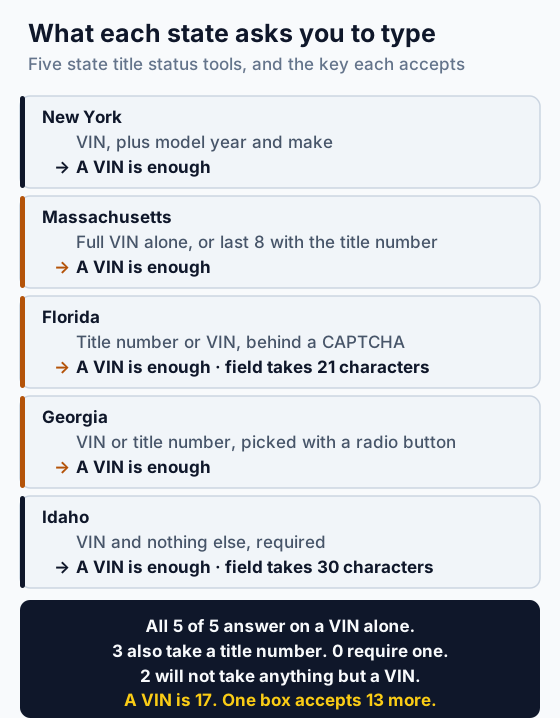
The first thing worth knowing is what gets you through the door, because that is the part people assume is restrictive. The table below was built by reading the live forms rather than the help pages that describe them — the field names, the maximum lengths and the validation rules the pages actually enforce.
| State | What the form accepts |
|---|---|
| New York | A VIN, hull number or manufactured-home serial, plus the model year and make — NYS DMV, Check a Title or Lien Status |
| Massachusetts | The last 8 of the VIN with the title number, or the full VIN on its own — Mass.gov RMV, Check the status of your vehicle's title |
| Florida | A title number of up to 10 numeric characters, or a VIN, behind a CAPTCHA — FLHSMV, Motor Vehicle Check |
| Georgia | A VIN or a title number, chosen with a radio button before you type — Georgia DRIVES e-Services, Title Status Lookup |
| Idaho | A VIN and nothing else, required, behind a CAPTCHA — Idaho Transportation Department, Check Title Status |
The door is open. The answer is the narrow part.
It is natural to assume that a government lookup keyed to a car you may not own would be gated somehow — a login, an ownership check, a reason for asking. None of the 5 tools read here does any of that. All 5 of them will take a VIN from a stranger and return an answer.
What limits them is not who may ask but what they are willing to say. New York states the boundary in a single line: the service does not display any personal information about the vehicle owner or registrant. Georgia goes further and describes its own tool as providing limited information, pointing anyone who needs more toward a separate trade channel. The restriction has been moved off the door and onto the response.
This is a sensible design and a confusing one. It means you can always get an answer, which feels like success, and it means the answer is scoped to administration rather than history, which is why so many people come away thinking the tool is broken. It is not broken. It is answering the question it was built for.
The title number you probably do not have
3 of these 5tools offer a title number as an input. It is worth being clear about what that is, because it is the field that makes people give up. A title number is the state’s own reference for the certificate, printed on the document and often on the registration alongside it. If you are waiting for a title you have never held, you do not have one.
The important detail is that it is an alternative, not a requirement. Massachusetts asks for the last eight digits of the VIN together with the title number, then says directly that if you do not have the title number you will need the full VIN instead. Florida and Georgia both present the two as a choice. Not one of the 5 states makes the title number mandatory.
So if a form has stopped you at a title number field, look again for the VIN path. It is almost always there, sometimes behind a radio button you have to select before the right box appears, as in Georgia.
What the VIN field length gives away
A small thing, but it tells you what these systems are. A modern VIN is exactly 17 characters, fixed by federal standard. Florida’s VIN box accepts up to 21 characters and Idaho’s accepts up to 30 — 13 more than the standard allows for.
Neither field is validating a VIN. Both are accepting a record key, because state title files contain vehicles from before the 17-character format existed and equipment that never had a conforming VIN at all. That is a useful reassurance if you are holding an older vehicle whose number looks wrong: the form is not going to reject it for being the wrong length.
It is also a reminder that the number on the form is the number in the file, not the number on the car. Where those two disagree, the file wins for the purposes of the lookup, and the disagreement itself is worth investigating. Reading the document properly is a separate exercise from checking its status.
New York: a date, a count and a lienholder
New York asks for a VIN, hull number or manufactured-home serial together with the model year and make. The extra two fields are a light confirmation that you are looking at a real vehicle rather than probing numbers at random, and they are facts anyone standing next to the car has.
What comes back is precise and short: the date the title was issued by the DMV, the number of liens if there are any, and the name and address of the lienholders. Then the boundary — the service does not display any personal information about the vehicle owner or registrant.
Notice how well that fits the waiting applicant and how badly it fits the buyer. A date and a lienholder tell you whether your title exists yet and who is standing between you and it. They tell a prospective buyer nothing about what the car has been through, though the lienholder name is genuinely useful to a buyer for a different reason: it is the clearest early warning that the seller does not own the car outright. That is the ground a lien check covers properly.
Massachusetts: the field that answers the question
Massachusetts returns four things, and one of them is the single most useful field on any of these tools. It gives the date the certificate was issued, the name of the lienholder if there is one, whether the certificate is an electronic title — and to whom the certificate of title was, or will be, mailed.
Read that last one again. It is the literal answer to “where is my title,” given by name, including for a title that has not shipped yet. Almost nothing else in this area is that direct. The RMV charges no fee for it.
The electronic-title flag matters just as much. If it comes back saying the title is electronic, the waiting is over in the sense that nobody is going to post you anything. That single field converts an open-ended wait into a decision about whether you want paper and what you have to do to get it.
Georgia: a limited view, admitted in writing
Georgia’s lookup asks you to choose between VIN and title number with a radio button, then returns details of the vehicle, the title status, and a suspension status — the last being a Georgia-specific concern that has more to do with insurance lapses than with the title itself.
The part worth quoting is in the help panel beside the form, addressed to dealers: the application is strictly for public use and provides limited information, and anyone needing more should use their regular electronic titling process. It is unusually candid. The agency is telling you, on the page, that you are looking at a deliberately reduced view of a record that contains more.
Keep that in mind everywhere, not just in Georgia. When a public status tool returns nothing alarming, you have learned that nothing alarming appears in the public view. The two are not the same statement, and no state tool is designed to make the difference obvious.
The usual answer: nothing was ever going to arrive
Most people searching this phrase are waiting. The most common reason a title has not come is not a backlog, a lost envelope or an error. It is that no paper title was ever due.
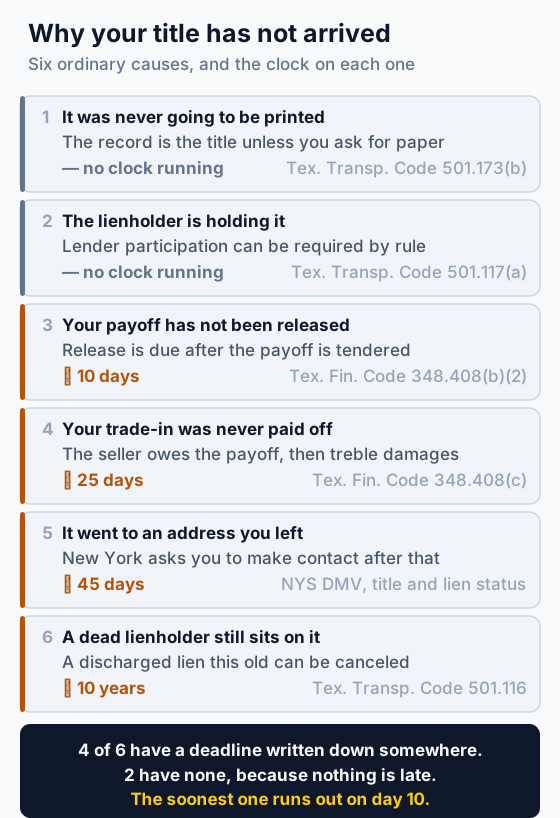
Texas states the principle as cleanly as any state does. Under Tex. Transp. Code 501.173(b) a record of title maintained electronically by the department is the official record of vehicle ownership unless the owner requests that the department issue a printed title. The data is the title. Paper is an option you exercise, and subsection (c) allows a fee to be set for issuing it.
If that is the position in your state, the waiting was always going to be indefinite, because nobody ever undertook to send anything. What you do instead is either request a printed title and pay for it, or accept the electronic record as what it is — the official one. Massachusetts, as above, will tell you which situation you are in as a field in its response.
When the lender is holding it
The second common answer is that the record went to whoever financed the car. This is ordinary and expected: the lienholder’s interest is recorded against the title, and in the electronic systems most states now run, the lienholder holds the record until the debt is satisfied.
Participation is often not voluntary for the lender. Tex. Transp. Code 501.117(a) directs the department to develop an electronic lien system and lets it require lienholders to participate, with a carve-out at subsection (d) for small depository institutions receiving fewer than 100 notifications in a year. Subsection (f) stops the department both from barring lenders from using an intermediary and from forcing them to use one.
For you, the practical consequence is that during a loan the question “where is my title” usually has the answer “with your lender, as data.” That is not a problem to solve. It becomes one only when the loan ends and nothing changes.
The clock that starts when you pay it off
This is where a status check earns its keep. You have made the final payment, and weeks later the state file still shows the lien. The question is whether anyone is actually obliged to act, and how quickly.
In Texas, they are. Tex. Fin. Code 348.408(a) binds the holder of a retail installment contract to the payoff figure it gave you and requires it to honor that figure for a reasonable time. Under 348.408(b), where you tender an amount derived from that figure, the holder must accept it as payment in full and release its lien within a reasonable time not later than the 10th day after the date the amount is tendered.
Section 348.409 gives that teeth. A holder violating 348.408 is liable to the buyer for an amount computed by adding 3 times the difference, among other elements. That is why the tender date is the date to write down: it starts a statutory clock, and the status check is how you observe whether the clock was obeyed.
Separately, Tex. Transp. Code 501.115(a) requires a satisfied lienholder to execute and deliver a discharge to the owner in the manner the department prescribes, and lets the owner submit that discharge with the title for a new one. Other states set their own windows and some set none at all, so treat the 10-day figure as a benchmark for what a reasonable statute looks like rather than as a rule that follows you across a state line.
The trade-in nobody paid off
A particular and nastier version of the same problem. You traded a car in, you drove away in a new one, and months later you discover that the loan on the old car was never settled — because the payoff was the dealer’s job and the dealer did not do it. Your credit is exposed to a debt on a car you no longer have.
Texas puts a hard number on this too. Under Tex. Fin. Code 348.408(c) a retail seller must pay in full the outstanding balance on a vehicle traded in not later than the 25th day after the retail installment contract is signed and the buyer takes delivery, and the seller has received both the traded-in vehicle and the documents needed to transfer its title.
Two conditions, both of which have to be met before the clock starts, and the second is the one people forget: the dealer needs the paperwork from you. If you left a signature missing, the 25 days may not have begun. Run the status check on the car you traded in, not just the one you drove home, and do it inside the first month rather than the first year.
The lien nobody is left to release
Occasionally the status check returns a lien belonging to a lender that no longer exists. A bank that was absorbed twice over, a finance arm wound up years ago, a credit union merged out of existence. There is nobody to sign a release, and the ordinary route assumes somebody will.
States that have thought about this provide an administrative escape. Tex. Transp. Code 501.116 lets the department cancel a discharged lien that has been recorded on a title for 10 years or more where the recorded lienholder does not exist or cannot be located for the owner to obtain a release.
The 10-year threshold is the point to notice. This is not a fast remedy and it is not available for a recent lien; it exists to clear genuinely stale records. If you are inside that window with an unreachable lienholder, you are in the harder case, and the status check is the evidence you will be asked for.
Mailed, and never delivered
The last ordinary cause is the dullest and the easiest to fix: the title was printed and posted to an address you no longer use. Moving house between applying and issuing is enough to do it, and so is a small error in the address on the application.
New York publishes the threshold you should be working to. It can take up to 45 days to receive the title certificate from the DMV in the mail, and if more than 45 days have passed and it has not arrived, the DMV asks you to make contact. That is a useful number even outside New York, because it tells you what a state considers the outer edge of normal rather than the average.
This is also where Massachusetts’ mailing field is worth its weight. If the tool names an address or a party you do not recognize, you have converted a vague wait into a specific, fixable problem, and you know which one to raise when you call.
What to do, in order
The order matters, because two of these steps make the others unnecessary and both are free.
- 1Run your own state's status check on the VINDo not hunt for a title number first. Every state tool read here has a VIN path, and in Idaho it is the only path.
- 2Read whether the title is electronic before anything elseIf it is, no paper was ever due. Massachusetts reports this as a field; elsewhere the absence of an issue date alongside a live record is the signal.
- 3Read the lien line nextA lienholder on the record is the answer in most open cases. Note the name and the address exactly as shown.
- 4Date the payoff, not the phone callWhere a statute sets a clock it runs from the tender. Texas gives 10 days from tender under Tex. Fin. Code 348.408(b)(2).
- 5Check the car you traded in as wellA dealer payoff has its own deadline — 25 days in Texas — and nothing tells you it was missed except the record on the old car.
- 6Only then chase the agency, with the record in handNew York asks you to wait 45 days before making contact. Arriving with the status output turns a general complaint into a specific one.
If you do not own the car yet
If you came here as a buyer, the honest answer is that a state title status check is a poor instrument for your purpose and a good one for a narrow part of it. The narrow part is the lien: New York will name the lienholder, Massachusetts will name it, and knowing that the seller does not own the car outright is worth the two minutes it takes.
For everything else the tools are the wrong shape. They read one state’s file, so a brand applied in another state may simply not be there. They report on the document rather than the vehicle, so damage, odometer history and theft records are outside their scope entirely. And as Georgia says on its own page, the public view is a reduced one.
- For brands carried across state lines and the odometer trail, the national record is the right source — that is what an NMVTIS-sourced report reads from.
- For whether the seller can actually convey the car, a lien check is the specific tool and the one worth running first.
- For the physical document in front of you, the security features and what the fields mean, read the certificate itself rather than a status page.
- For what a particular state's tool means and what its brands are called locally, the state pages go into detail this one deliberately does not.
The relevant pages are the NMVTIS report, the lien check, reading a car title, and the state write-ups for New York, Massachusetts, Georgia and Florida.
What we can and cannot do here
We do not have a live connection into any state title file, and neither does anybody selling you one. The state tools described on this page are the state’s own, they are free, and running one yourself gets you a more current answer than any intermediary can. Where we have named a field or a maximum length, it was read off the live form; where we have named a deadline, it was read out of the statute cited beside it.
Two honest gaps. Illinois runs a well-known title and registration status inquiry and it appears prominently for this phrase, but its systems declined every attempt we made to read them directly, so we have deliberately said nothing about what it asks for or returns rather than repeat a description we could not verify. And for Florida and Idaho we read the input forms but could not observe a response, so those two states appear in the input table and nowhere else.
What we can do is decode a VIN and check it against the federal recall and safety records for free, which is a different question from title status and a good one to answer at the same time. If your interest is the car rather than the paperwork, the difference between a title and a registration is the distinction most worth understanding first.
Where this information comes from
- New York State DMV — Check a Title or Lien StatusRequired inputs, what the service displays, the exclusion of owner personal information, and the 45-day mail threshold
- Massachusetts RMV — Check the status of your vehicle's titleDate issued, to whom the certificate was or will be mailed, lienholder, electronic title flag, and the VIN-only path
- Georgia DRIVES e-Services — Title Status LookupVIN or title number selection, suspension status, and the notice that the public application provides limited information
- Florida Highway Safety and Motor Vehicles — Motor Vehicle CheckTitle number and VIN field constraints read off the live form
- Idaho Transportation Department — Check Title StatusVIN as the sole required input, and the field's maximum length
- Tex. Transp. Code ch. 501 — Certificate of Title ActSection 501.173(b) electronic record as official title, 501.117 electronic lien system, 501.115 discharge, 501.116 stale lien cancellation
- Tex. Fin. Code ch. 348 — Motor Vehicle Installment SalesSection 348.408 payoff release and trade-in deadlines, 348.409 damages for a violation
- 49 CFR part 565 — Vehicle Identification Number requirementsThe 17-character VIN standard the state form fields exceed
- US Department of Justice — National Motor Vehicle Title Information SystemThe national record a state status check is not, referenced for the buyer-side contrast
Frequently asked questions
What is a title status check?
It is a state-run lookup that reports the administrative state of a certificate of title in that state's own file — typically the date the title was issued, whether a lien is recorded, who the lienholder is, and in some states whether the title exists as paper or only as an electronic record. All 5 of the state tools read for this page will accept a bare VIN, so anyone can run one. What none of them returns is a history: no accident record, no odometer trail, no brand carried from another state. It answers where a title is, not what a car has been through.
Why has my car title not arrived?
The most common answer is that it was never going to. Under Tex. Transp. Code 501.173(b) the electronic record held by the department is the official record of ownership unless the owner requests a printed title, so in an electronic titling state waiting for paper is waiting for something nobody has agreed to send. After that the usual causes are a lienholder holding the record, a payoff that has not been released, a trade-in the dealer has not settled, or a mailing address you no longer use. New York allows up to 45 days in the mail before it asks you to make contact.
Can I check a title status without the title number?
In every state read here, yes. Idaho takes a VIN and nothing else. New York takes a VIN with the model year and make. Massachusetts asks for the last eight of the VIN alongside the title number but tells you plainly that the full VIN will do if you do not have the number. Florida and Georgia both offer the VIN as an alternative to the title number rather than as a supplement to it. The title number is a convenience for people holding the document, not a gate.
How long does a lienholder have to release a lien after payoff?
Where a statute fixes it, the window is short. Under Tex. Fin. Code 348.408(b)(2), once the buyer tenders an amount derived from the payoff figure the holder gave them, the holder must accept it as payment in full and release the lien within a reasonable time not later than the 10th day after tender. Section 348.409 backs that with damages of 3 times the difference where the holder fails. Other states set their own windows, and some set none, so the Texas number is a benchmark rather than a national rule.
Does a title status check show accidents or salvage brands?
No, and that is the misunderstanding the phrase creates. These tools read one state's administrative file and report on the document, not the vehicle. Georgia states the position in its own help text — the public lookup is for public use and provides limited information, with a separate channel for the trade. For damage history, odometer readings and brands carried in from other states you want the national record instead, which is the national title record an NMVTIS report draws on.